Revitol Eye Cream Review 2026: Can a Cosmetic Cream Really Tackle Dark Circles and Fine Lines?
Revitol Eye Cream Review 2026: Can a Cosmetic Cream Really Tackle Dark Circles and Fine Lines?

⚡ Quick Answer
Revitol Eye Cream is a cosmetic formulation combining retinol, niacinamide, hyaluronic acid, and botanical extracts, marketed for dark circles, puffiness, and fine lines. The individual ingredients have varying degrees of published evidence for general skin improvement, but the product itself has no published clinical trials. It may suit adults looking for a mid-range topical option to support under-eye skin health, provided expectations are realistic and it is not used as a substitute for medical advice.
🛒 Shop the product
Approx. £32 / $40.00 per bottle — affiliate link, see disclosure above.
If you have ever looked in the mirror first thing in the morning and thought, "I look more tired than I feel," you are not alone. The skin around our eyes — known in dermatology as the periorbital region — is thinner, more delicate, and more prone to showing the early signs of ageing, fatigue, and environmental stress than almost anywhere else on the body. Dark circles, puffiness, and fine lines in this area are among the most common cosmetic concerns reported by adults, and the market for products claiming to address them is enormous.
One product that appears in searches is Revitol Eye Cream, available through HealthBuy. It combines several well-known cosmetic active ingredients — including retinol, niacinamide, and hyaluronic acid — in a formula designed for the under-eye area. At roughly £32 per bottle, it sits in the mid-range of cosmetic eye creams rather than the pharmaceutical category.
In this review, we will take an honest look at the ingredients, what the published evidence says (and does not say), how to use an eye cream sensibly, and who this particular formulation might — or might not — be appropriate for. It is worth stating upfront: this is a cosmetic product, not a licensed medicine, and that distinction matters when evaluating the claims. For readers who are specifically interested in what a retinol-based under-eye cream can offer, the information below should help you make a more informed decision.
What Revitol Eye Cream Actually Is
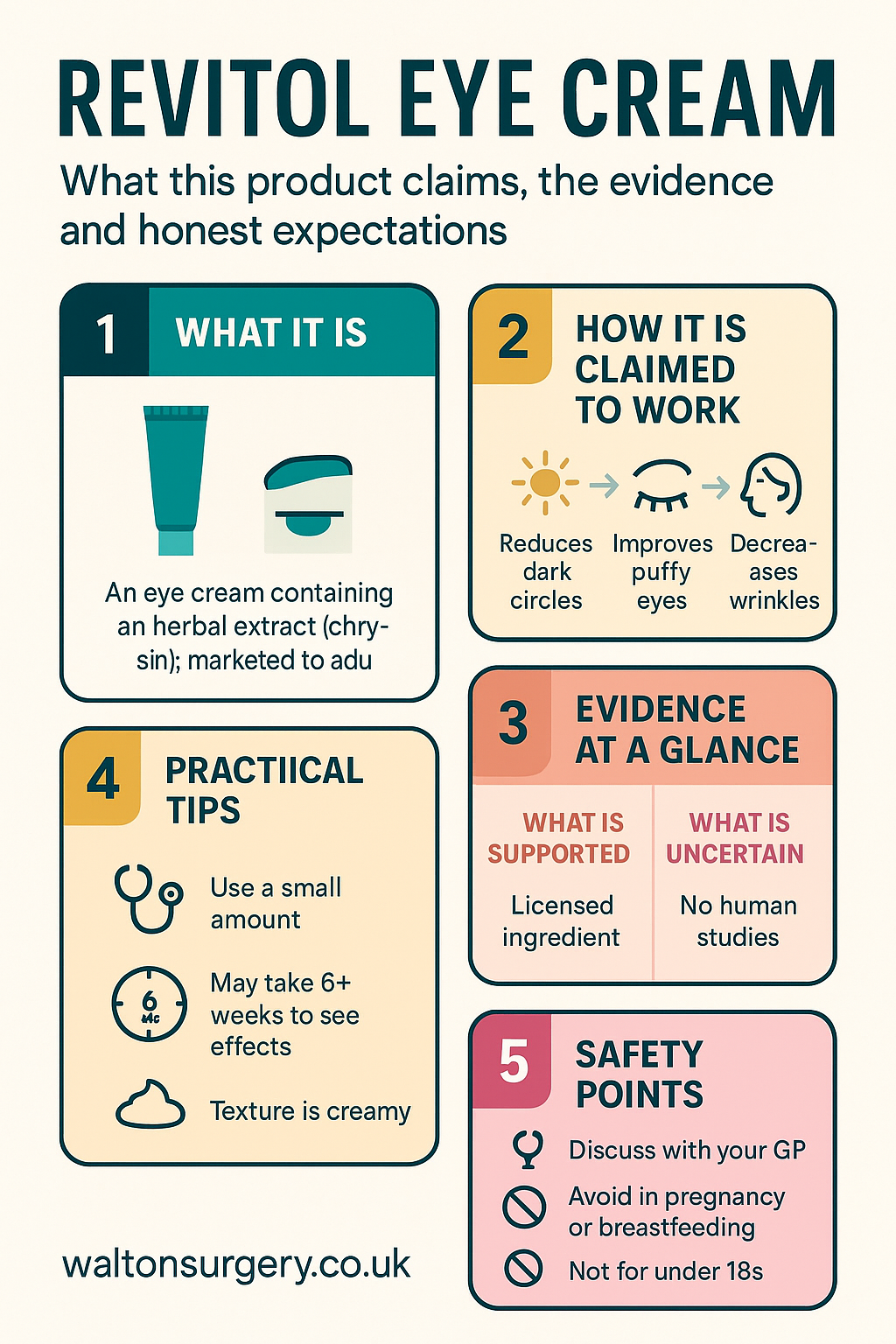
Revitol Eye Cream is a topical cosmetic product designed for application to the skin surrounding the eyes. It is not a medicine, and it is not licensed by the MHRA (Medicines and Healthcare products Regulatory Agency) for the treatment, prevention, or cure of any medical condition. In regulatory terms, it falls into the same category as any other over-the-counter skincare cream — a cosmetic intended to improve the appearance of the skin.
The formulation combines several ingredients that are commonly found in higher-end skincare ranges. These include retinol (a vitamin A derivative), niacinamide (vitamin B3), hyaluronic acid (a moisture-binding molecule), arnica extract (a botanical traditionally associated with reducing bruising and swelling), and bisabolol (a soothing compound derived from chamomile). The idea is to layer multiple evidence-informed actives into a single product rather than relying on any one ingredient in isolation.
The product is sold in cream format and is marketed towards three main under-eye concerns: dark circles, puffiness (also called periorbital oedema), and fine lines or wrinkles. These are legitimate cosmetic concerns, but it is important to understand that their causes are varied and complex — and not all of them will respond to a topical cream in the same way.
How the Key Ingredients Work
Understanding what is in an eye cream — and why each ingredient is there — is more useful than reading marketing claims. Let us walk through the principal actives in Revitol's formulation.
Retinol is perhaps the best-studied topical anti-ageing ingredient in dermatology. It is a precursor to retinoic acid, the biologically active form of vitamin A. Once absorbed into the skin, retinol is converted into retinaldehyde and then into retinoic acid, which binds to specific nuclear receptors and influences gene expression. The practical result is accelerated cell turnover (the shedding of older, duller skin cells and their replacement with fresher ones) and increased production of collagen, the structural protein that gives skin its firmness. Retinol is well supported by clinical evidence for improving the appearance of photoaged skin, including fine lines and uneven pigmentation.
Niacinamide (vitamin B3) works through a different mechanism. It supports the skin's natural barrier by boosting ceramide production, reduces transepidermal water loss, and has a well-documented ability to inhibit the transfer of melanin (pigment) to skin cells. A 2011 study published in the British Journal of Dermatology demonstrated that 5% niacinamide significantly reduced hyperpigmentation and improved skin texture over a 12-week period. For under-eye discolouration related to pigmentation rather than blood vessels or structural hollowing, niacinamide is one of the more promising topical ingredients.
Hyaluronic acid is a glycosaminoglycan — a large sugar molecule that occurs naturally in the skin and connective tissue. Its primary role in skincare is as a humectant: it attracts and holds water, plumping the surface of the skin and temporarily reducing the appearance of fine lines. The effect is real but transient; once the product is washed off or the moisture evaporates, the plumping effect diminishes.
Ingredient spotlight
Why retinol is both promising and demanding
- Retinol has the strongest evidence base of any non-prescription anti-ageing topical.
- It works by accelerating cell turnover and stimulating collagen synthesis.
- However, it can cause irritation, dryness, and peeling — especially on thin under-eye skin.
- The periorbital area may require lower concentrations or less frequent application than the rest of the face.
- Daily broad-spectrum sunscreen is essential when using retinol, as it increases photosensitivity.
Arnica extract and bisabolol are included for their soothing and anti-inflammatory properties. Arnica has a long history in herbal medicine for treating bruises and swelling, though rigorous clinical evidence for topical skincare benefits is limited. Bisabolol, derived from chamomile, is better supported as a skin-calming agent and is widely used in formulations designed for sensitive skin. Together, they may help counteract the potential irritation from retinol.
The Evidence — What Research Actually Supports
This is where an honest review needs to be careful. There is a meaningful difference between evidence for individual ingredients and evidence for a specific finished product. Retinol, niacinamide, and hyaluronic acid each have substantial bodies of published research supporting their use in skincare. However, there are no published, peer-reviewed clinical trials testing the specific formulation of Revitol Eye Cream on human subjects.
This does not automatically mean the product is ineffective. Many cosmetic products on the high street — from Boots own-brand to premium labels — have not undergone their own clinical trials. The cosmetics industry operates under a different regulatory framework than pharmaceuticals. But it does mean that the marketing claims about this particular cream are based on the theoretical benefits of its ingredients rather than on direct product-level evidence.
⚠️ Reality check — evidence hierarchy
It is worth understanding how evidence works in skincare. At the top of the hierarchy, you have randomised controlled trials (RCTs) testing a finished product on a defined population. Below that, you have ingredient-level studies — trials showing that retinol or niacinamide works in general, but not necessarily in the concentration or combination used in a specific product. And below that, you have in-vitro (test-tube) or animal studies. Revitol Eye Cream's claims sit largely in the second tier: ingredient-level plausibility. That is reasonable grounds for cautious optimism, but it is not the same as proof.
We should also note that dark circles, in particular, are a multifactorial concern. They can be caused by increased melanin deposition (pigmented type), visible blood vessels through thin skin (vascular type), structural shadowing from tear-trough hollowing (structural type), or a combination of these. A topical cream is most likely to help with pigmented dark circles. It is unlikely to address vascular or structural causes meaningfully.
How to Use It — Application and Practical Tips
If you decide to try an eye cream containing retinol — whether this product or another — a few practical points are worth bearing in mind.
Less is more. A pea-sized amount split between both ring fingers is sufficient for the under-eye area. The skin here is thin and absorbs actives readily. Applying too much product increases the risk of irritation without improving results.
Pat gently, do not rub. Use your ring finger (it applies the least pressure) to tap the cream along the orbital bone — the bony ridge around the eye. Avoid applying directly to the eyelids or too close to the lash line, as product can migrate into the eye and cause stinging or irritation.
Introduce retinol gradually. If your skin is not accustomed to retinol, start with every other evening for the first two weeks, then build up to nightly use if your skin tolerates it. Some initial mild dryness or flaking is normal and usually settles within a few weeks. If irritation persists or worsens, reduce frequency or discontinue use.
Wear sunscreen daily. Retinol increases the skin's sensitivity to ultraviolet radiation. This is non-negotiable. Even in the UK, where the sun is often modest, UV exposure accumulates over time and can undo the benefits of a retinol product. Apply a broad-spectrum SPF 30 or higher to the face and eye area every morning.
Give it time. Most dermatologists advise assessing a topical skincare product after a minimum of 8 to 12 weeks of consistent use. Instant results are not realistic. The skin's renewal cycle takes roughly 28 days in younger adults and longer with age, so meaningful improvements in texture or pigmentation will take several cycles to become apparent.
Side Effects and Who Should Think Twice
Cosmetic products are generally safe for most adults when used as directed, but the under-eye area deserves particular caution because the skin is exceptionally thin — roughly 0.5 mm compared to 2 mm elsewhere on the face. This makes it more permeable to active ingredients and more susceptible to irritation.
The most likely side effect from a retinol-containing eye cream is irritation — redness, dryness, flaking, or a mild burning sensation. This usually occurs in the first few weeks and can often be managed by reducing application frequency. If the irritation is severe or does not resolve, discontinue use and consult a pharmacist or GP.
Who should avoid or seek advice before using this product:
⚠️ Important safety considerations
Pregnancy and breastfeeding: Retinol (vitamin A derivatives) should be avoided during pregnancy and breastfeeding due to the known teratogenic risk of high-dose vitamin A. While topical retinol at cosmetic concentrations poses a lower theoretical risk than oral retinoids such as isotretinoin, most dermatologists and midwives advise erring on the side of caution. Choose a retinol-free eye cream if you are pregnant, trying to conceive, or breastfeeding.
Active skin conditions: If you have eczema, dermatitis, rosacea, or psoriasis around the eyes, a retinol product may worsen symptoms. Speak to your GP or dermatologist first.
Prescription retinoid users: If you are already using a prescription-strength retinoid (tretinoin, adapalene, tazarotene), adding a retinol eye cream may cause excessive irritation. Consult your prescriber before layering products.
Under-18s: This product is intended for adult use. Adolescents with under-eye concerns should speak to a parent and, ideally, a healthcare professional before starting any active skincare.
Contact lens wearers: Be mindful that product migration into the eye can cause discomfort or affect lenses. Apply carefully and allow the cream to absorb fully before inserting lenses.
As always, if you are taking regular medication or have a chronic skin condition, it is sensible to discuss any new topical product with your pharmacist or GP before incorporating it into your routine.
A Focused Look at This Product
Revitol Eye Cream is sold exclusively through online retailers and is not currently available in high-street chemists such as Boots or Superdrug. The product description provided by HealthBuy describes it as part of their range of "natural and organic beauty products," though independent ingredient analysis would be needed to verify the extent of natural sourcing for each component.
Below is a summary of what we know about the product from the available information:
🔬 Product snapshot — Revitol Eye Cream
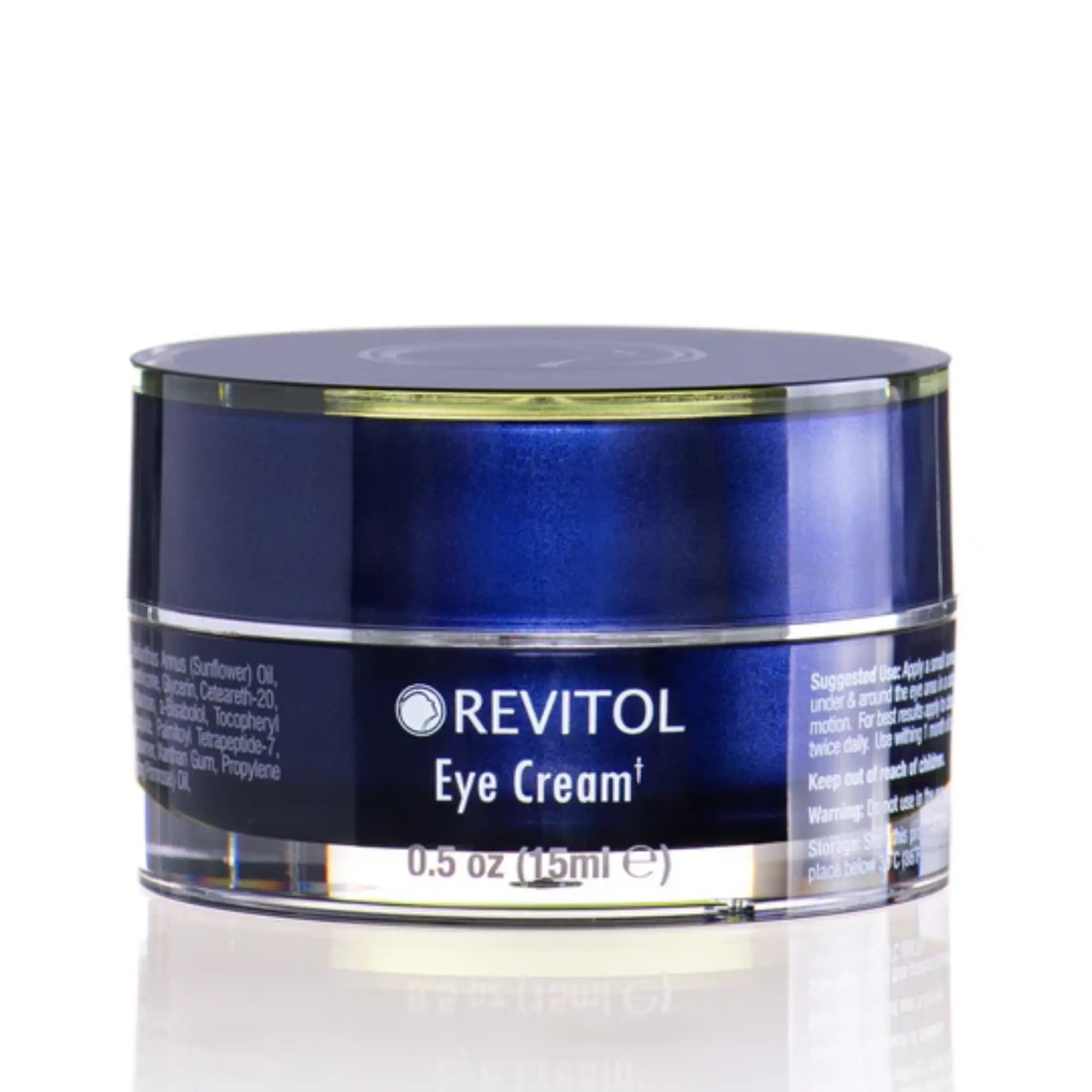
- Active ingredient(s): Retinol (vitamin A), niacinamide (vitamin B3), hyaluronic acid, arnica extract, bisabolol
- Format: Topical cream, applied to the under-eye area
- Marketed claims: Reduction in dark circles, puffiness, and fine lines/wrinkles
- Quality info: Manufactured by Revitol; specific third-party testing certifications and independent lab verification details are not publicly disclosed
- Price: approx. £32 / $40.00 per bottle
Realistic Expectations — What to Actually Expect
Perhaps the most important part of any cosmetic product review is managing expectations. The claims made about eye creams — across the industry, not just this brand — tend to be more optimistic than what the evidence reliably supports.
Here is a balanced summary of what you might and might not reasonably expect from a product like Revitol Eye Cream over a 12-week period of consistent use:
What you may notice
A realistic timeline for under-eye skincare
- Weeks 1–2: Improved hydration and a temporary plumping effect from hyaluronic acid. Skin may feel softer. Some users may experience mild retinol adjustment (dryness, flaking).
- Weeks 3–6: Gradual improvement in skin texture as cell turnover accelerates. Pigmented dark circles may begin to lighten if the discolouration is melanin-related.
- Weeks 8–12: More visible improvement in overall skin tone and smoothness. Fine lines may appear slightly softened. Puffiness may be modestly reduced — but structural and vascular dark circles will likely remain unchanged.
If after 12 weeks you see no meaningful improvement, the underlying cause of your under-eye concerns may not be one that responds to topical cosmetics. At that point, a conversation with a GP or a consultation with a dermatologist would be a sensible next step — there may be other approaches worth exploring, from prescription treatments to, in some cases, aesthetic procedures for structural volume loss.
Frequently Asked Questions
What is Revitol Eye Cream?
Revitol Eye Cream is a cosmetic skincare product marketed for under-eye concerns including dark circles, puffiness, and fine lines. It contains ingredients such as retinol, niacinamide, hyaluronic acid, arnica extract, and bisabolol. It is classified as a cosmetic product, not a medicine, and is not MHRA-licensed for the treatment of any medical condition.
Is Revitol Eye Cream clinically proven to work?
The individual active ingredients — particularly retinol and niacinamide — have a reasonable body of clinical evidence for general skin benefits. However, there are no published clinical trials specifically testing this particular product formulation for under-eye concerns. The claims rest on ingredient-level evidence rather than product-level proof. This is common across the cosmetics industry but is worth understanding.
Can eye cream actually remove dark circles?
Dark circles have many causes including genetics, thin skin revealing blood vessels, pigmentation, and volume loss. Topical eye creams may help with pigmentation-related darkening over time, particularly those containing niacinamide or vitamin C. However, they cannot address structural or genetic causes. A GP or dermatologist can help identify the underlying cause if dark circles are persistent or distressing.
Is Revitol Eye Cream safe to use?
As a cosmetic product, it is generally considered safe for external use by most adults. However, the under-eye skin is thin and sensitive, and retinol can cause irritation, redness, or peeling. It should not be used during pregnancy or breastfeeding, or by people with active eczema or dermatitis around the eyes. Always patch-test a small area before regular use.
How long does it take to see results from an eye cream?
Most dermatologists suggest that topical skincare products need 8 to 12 weeks of consistent use before meaningful changes may be visible. Hydrating ingredients like hyaluronic acid can provide a temporary plumping effect within hours, but changes related to pigmentation and fine lines take considerably longer. Managing expectations is important — dramatic overnight transformation is not realistic with any cosmetic product.
Should I see a GP about my under-eye concerns before buying an eye cream?
If your under-eye concerns have appeared suddenly, are accompanied by swelling or pain, or are significantly affecting your wellbeing, it is worth speaking to your GP first. Persistent dark circles can sometimes be linked to underlying health conditions such as iron-deficiency anaemia, thyroid issues, or allergies. A healthcare professional can help rule these out before you invest in topical products.
✅ The verdict
Revitol Eye Cream brings together several well-established cosmetic ingredients — retinol, niacinamide, and hyaluronic acid — that each have independent evidence supporting their role in improving skin texture, tone, and hydration. The formulation is sensible in principle, and the inclusion of soothing agents like bisabolol may help mitigate the irritation that retinol can cause on delicate under-eye skin. However, it is important to be clear: there are no published clinical trials on this specific product, the exact concentrations of each ingredient are not disclosed, and claims about dramatically reducing dark circles or wrinkles should be taken with appropriate caution.
This product may be a reasonable option for adults who want a mid-range retinol-based eye cream and understand that results — if they come — will be gradual and modest. It is not appropriate for pregnant or breastfeeding women, those with active skin conditions around the eyes, or anyone expecting a medical-grade solution. If you would like to check current pricing here, the product is available through HealthBuy at approximately £32 per bottle.
If you are exploring other areas of health and wellness alongside your skincare routine, you may also find our reviews of NAD+ supplements and BPC-157 supplements informative, as both touch on cellular health and recovery — topics that sit alongside skin ageing in the broader wellness conversation.
🛒 Reader-recommended option
A retinol-based eye cream combining multiple evidence-informed ingredients — suitable for adults who have decided to explore a cosmetic approach to under-eye skin concerns.
Affiliate link — see disclosure at the top of this article. Current price approx. £32 / $40.00 per bottle.
This article is informational and contains affiliate links. It does not replace personalised advice from your GP, pharmacist, or another qualified healthcare professional. Revitol Eye Cream is a cosmetic product and is not licensed by the MHRA as a medicine. It should not be used during pregnancy or breastfeeding due to the retinol content. If you have a diagnosed skin condition around the eyes, are under 18, or are taking prescription skincare medications, please consult a healthcare professional before use. Individual results will vary, and the claims discussed are based on ingredient-level evidence rather than product-specific clinical trials.