Revitol Skin Tag Removal Treatment Review 2026: What the Evidence Actually Says
Revitol Skin Tag Removal Treatment Review 2026: What the Evidence Actually Says

⚡ Quick Answer
Revitol Skin Tag Removal Treatment is a topical cosmetic product containing botanical and homeopathic ingredients — most notably Thuja occidentalis — marketed for at-home skin tag removal. While the individual plant extracts have some traditional use, there is no robust clinical trial evidence that this or any comparable topical product reliably removes skin tags. It may suit adults who have had a benign skin tag confirmed by a clinician and who prefer a non-invasive approach to try first, though professional removal remains the gold-standard option with the strongest evidence.
🛒 Shop the product
Approx. £32 / $40.00 per bottle — affiliate link, see disclosure above.
Skin tags — those small, soft, flesh-coloured flaps of skin that tend to appear on the neck, armpits, eyelids, and under the breasts — are one of the most common benign skin growths in adults. They are harmless in the vast majority of cases, yet many people find them cosmetically bothersome or physically irritating when they catch on clothing or jewellery. The desire to remove them without visiting a clinic has fuelled a thriving market for over-the-counter topical treatments, and Revitol Skin Tag Removal Treatment is one of the more widely advertised products in this space.
Revitol is a brand that sells primarily through online affiliate channels, offering a range of skincare products including acne treatments, stretch-mark creams, and this skin tag removal treatment by Revitol. The sales page claims the formula "effectively targets and eliminates unwanted skin tags" using "natural ingredients" without "harsh chemicals." Those are appealing promises — but as with many cosmetic products sold online, the real question is whether the claims hold up under scrutiny.
In this review, we will examine what the product actually contains, what the scientific evidence says about topical skin tag removal, what the established medical alternatives look like, and where this Thuja-based skin tag remover fits — if at all — in a sensible approach to dealing with these very common growths.
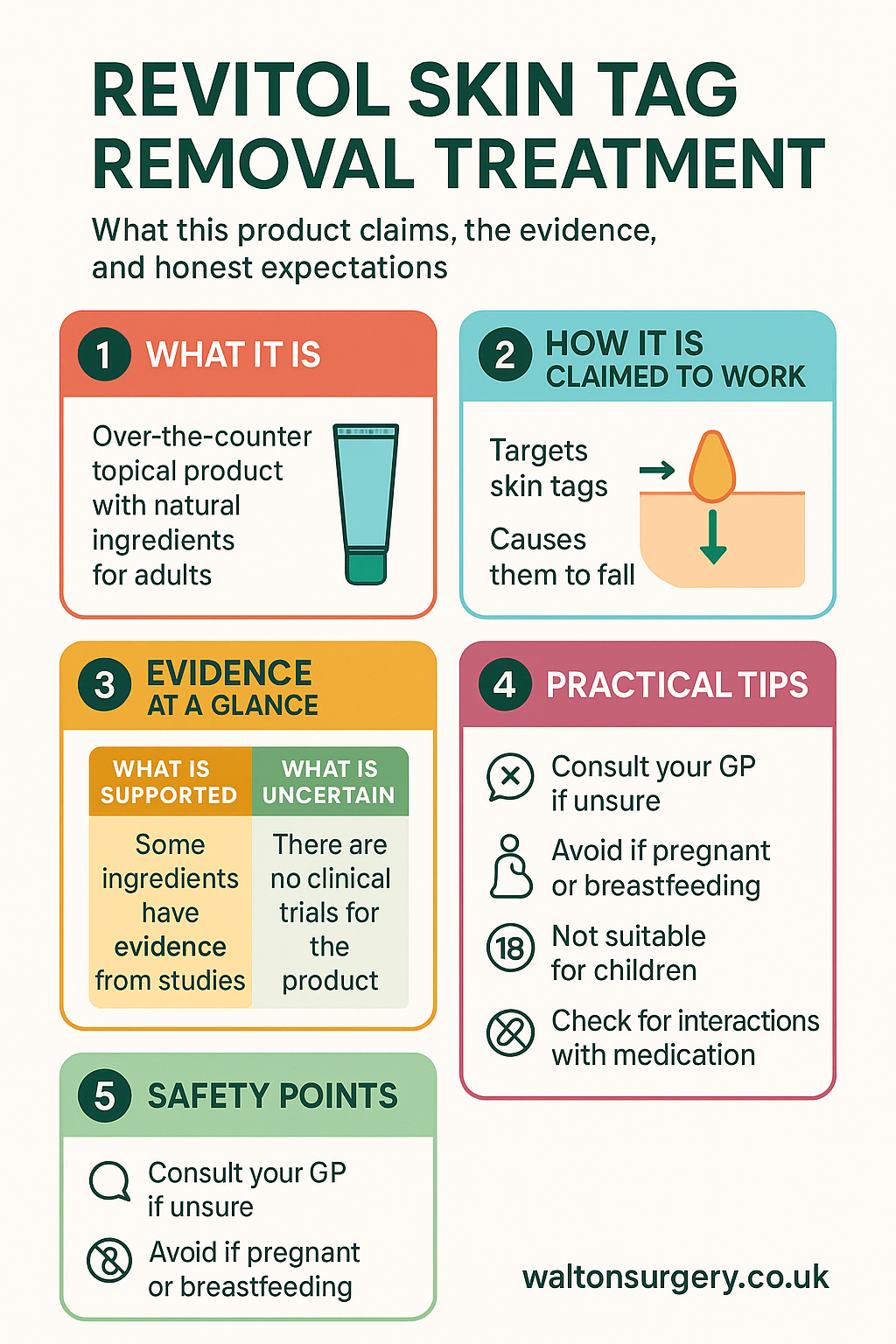
What Are Skin Tags, and Why Do They Appear?
Skin tags — medically known as acrochordons — are small, benign tumours of the skin that typically measure between 1 mm and 5 mm, though they can occasionally grow larger. They consist of loose collagen fibres and blood vessels surrounded by an outer layer of skin (epidermis). They are extremely common: studies suggest that around 50–60% of adults will develop at least one skin tag during their lifetime.
The precise cause is not fully understood, but several risk factors are well established. Skin tags are more common in people who are overweight or obese, have type 2 diabetes or insulin resistance, are pregnant, or have a family history of them. Friction from skin rubbing against skin or clothing is thought to play a role, which is why they tend to appear in skin folds.
Crucially, skin tags are not dangerous. They are not pre-cancerous and do not typically become cancerous. However, it is important to have any new or changing skin growth examined by a GP or dermatologist, because what appears to be a skin tag could sometimes be a different type of lesion — including, rarely, something that warrants further investigation. This is perhaps the single most important point to make before discussing any at-home removal method.
What Is Revitol Skin Tag Removal Treatment?
Revitol Skin Tag Removal Treatment is a topical liquid product marketed for at-home application directly onto skin tags. The brand describes it as "formulated with natural ingredients" that "gently removes skin tags without any harsh chemicals." Based on Revitol's product line and typical formulations in this category, the active components are likely to include Thuja occidentalis (white cedar extract), tea tree oil, and various other botanical carrier oils.
The product is sold as a cosmetic — not as a licensed medicine. This is an important distinction. In the UK, products making medicinal claims (such as "eliminates skin tags") are expected to hold a Marketing Authorisation from the MHRA (Medicines and Healthcare products Regulatory Agency) or be registered under the appropriate exemption scheme. Products sold as cosmetics cannot legally claim to treat, cure, or remove medical conditions. The regulatory status of this particular product is not clearly stated on the sales page, which itself warrants a note of caution.
⚠️ Reality check — regulatory status
Revitol Skin Tag Removal Treatment does not appear to hold an MHRA Marketing Authorisation. It is not listed as a registered medicine in the UK. The product is marketed as a cosmetic, which means it has not undergone the rigorous efficacy and safety review that licensed medicines are required to pass. If a product claims to remove a skin growth but is not regulated as a medicine, the claim has not been independently verified by a regulatory body. This does not automatically mean the product is harmful — but it does mean you should approach the marketing claims with appropriate caution.
The Key Ingredients — and What the Science Says
While the Revitol sales page does not provide a full ingredient list with concentrations, products in this category typically centre on a few key botanical components. Let us look at each one and assess the evidence honestly.
Thuja occidentalis (white cedar or arborvitae) is the ingredient most commonly associated with skin tag removal products. It has a long history of use in homeopathic medicine for various skin growths, including warts and papillomas. However — and this is important — homeopathic evidence is not the same as clinical evidence in the conventional medical sense. There are no high-quality, peer-reviewed randomised controlled trials demonstrating that topical application of Thuja occidentalis reliably removes skin tags. A Cochrane-style review of homeopathic remedies for skin conditions has not found convincing evidence of efficacy for this indication.
Tea tree oil (Melaleuca alternifolia) is a widely studied essential oil with genuine antimicrobial and anti-inflammatory properties. There is some evidence supporting its use in acne, fungal infections, and minor wound care. However, there is no published clinical evidence demonstrating that tea tree oil can dissolve or eliminate skin tags. It may help maintain skin hygiene around the application site, but this is a very different claim from removing a growth.
Other botanical oils commonly found in similar formulations — such as sunflower seed oil, castor oil, and various essential oils — serve primarily as carrier or soothing agents. While they may soften or moisturise the skin, there is no pharmacological mechanism by which they would be expected to cause a skin tag to detach.
🌿 Ingredient evidence summary
What the research does and does not support
- Thuja occidentalis: Traditional homeopathic use for skin growths; no robust RCT evidence for skin tag removal
- Tea tree oil: Genuine antimicrobial properties; no evidence it removes skin tags
- Carrier / botanical oils: May moisturise skin; no mechanism for dissolving skin tags
- The combination: No published clinical trials on this specific formulation
How Do Established Skin Tag Removal Methods Compare?
To put the topical approach into context, it helps to understand what medical professionals actually do when removing skin tags. These methods have well-documented success rates and are performed in controlled clinical environments.
Cryotherapy involves applying liquid nitrogen to freeze the skin tag, which causes the tissue to die and fall off within 7–14 days. It is quick, generally well-tolerated, and has a high success rate. Surgical excision — simply snipping the tag off with sterile scissors or a scalpel — is the most common method in GP surgeries. It is immediate, effective, and usually requires only minimal aftercare. Cauterisation (burning the tag off using electrical current) and ligation (cutting off blood supply with a surgical thread) are other established options.
In England, NHS skin tag removal is generally available when a GP considers it medically necessary — for instance, if the tag is causing pain, bleeding, or significant functional impairment. Cosmetic removal is usually not funded by the NHS, which is why some people turn to private clinics or over-the-counter products. Private removal typically costs between £50 and £150 per session, depending on the number of tags and the method used.
The key takeaway is that professional methods remove skin tags in a single visit with a well-understood success rate. Topical products, by contrast, have no published success rates because they have not been studied in controlled trials.
How to Use It — and What to Realistically Expect
The general approach with topical skin tag products is straightforward: apply the liquid or cream directly to the skin tag, usually two to three times daily, for several weeks. The idea is that the active ingredients will gradually cause the tag to dry out, shrink, and eventually detach. Some users report seeing changes after a couple of weeks; others use the product for a month or more with little visible effect.
It is worth noting that even the manufacturer does not specify a timeframe for results, which is fairly typical for cosmetic products in this category. Compare this with professional removal, which takes minutes and delivers immediate results.
If you do decide to try a topical approach, keep the following in mind:
- Have the growth confirmed as a skin tag by a GP or pharmacist first
- Avoid applying to moles, warts, or any lesion you are uncertain about
- Do not use near the eyes, mucous membranes, or genital area without medical advice
- Stop immediately if you experience significant irritation, redness, or pain
- Be patient — if there is no change after 4–6 weeks, the product is unlikely to work for you
Side Effects and Who Should Think Twice
The individual ingredients in Revitol Skin Tag Removal Treatment are generally considered safe for topical use in most adults. However, "natural" does not automatically mean "risk-free." Tea tree oil, for example, is a known contact allergen in some people and can cause dermatitis, particularly at higher concentrations. Thuja occidentalis can cause skin irritation in sensitive individuals. Any topical product has the potential to cause an allergic reaction.
You should think twice — or consult your GP first — if any of the following apply:
- You have not had the growth assessed by a healthcare professional
- You have sensitive skin, eczema, or a history of contact allergies
- You are pregnant or breastfeeding (insufficient safety data for most botanical skin products)
- The growth is changing in size, shape, or colour
- The growth is bleeding, painful, or inflamed
- The growth is on your face or eyelids (risk of irritation to delicate tissue)
- You are under 18 years of age
⚠️ Important safety note
Never attempt to self-diagnose a skin growth. What looks like a harmless skin tag could be a different type of lesion entirely. The British Association of Dermatologists recommends having any new or unusual skin growth evaluated by a qualified professional before attempting any form of removal. This is not just prudent advice — it could be genuinely important for your health.
A Focused Look at This Product
Revitol as a brand has been around for many years, primarily operating through online affiliate sales channels. They offer a wide range of skincare products. The brand does not publish clinical trial data for its skin tag removal treatment, nor does it appear to hold any independent quality certifications (such as USP, NSF, or third-party testing) that are publicly verifiable. This does not mean the product is unsafe — but it does mean we cannot independently verify its manufacturing standards.
Here is what we can say based on the available information:
🔬 Product snapshot — Revitol Skin Tag Removal Treatment
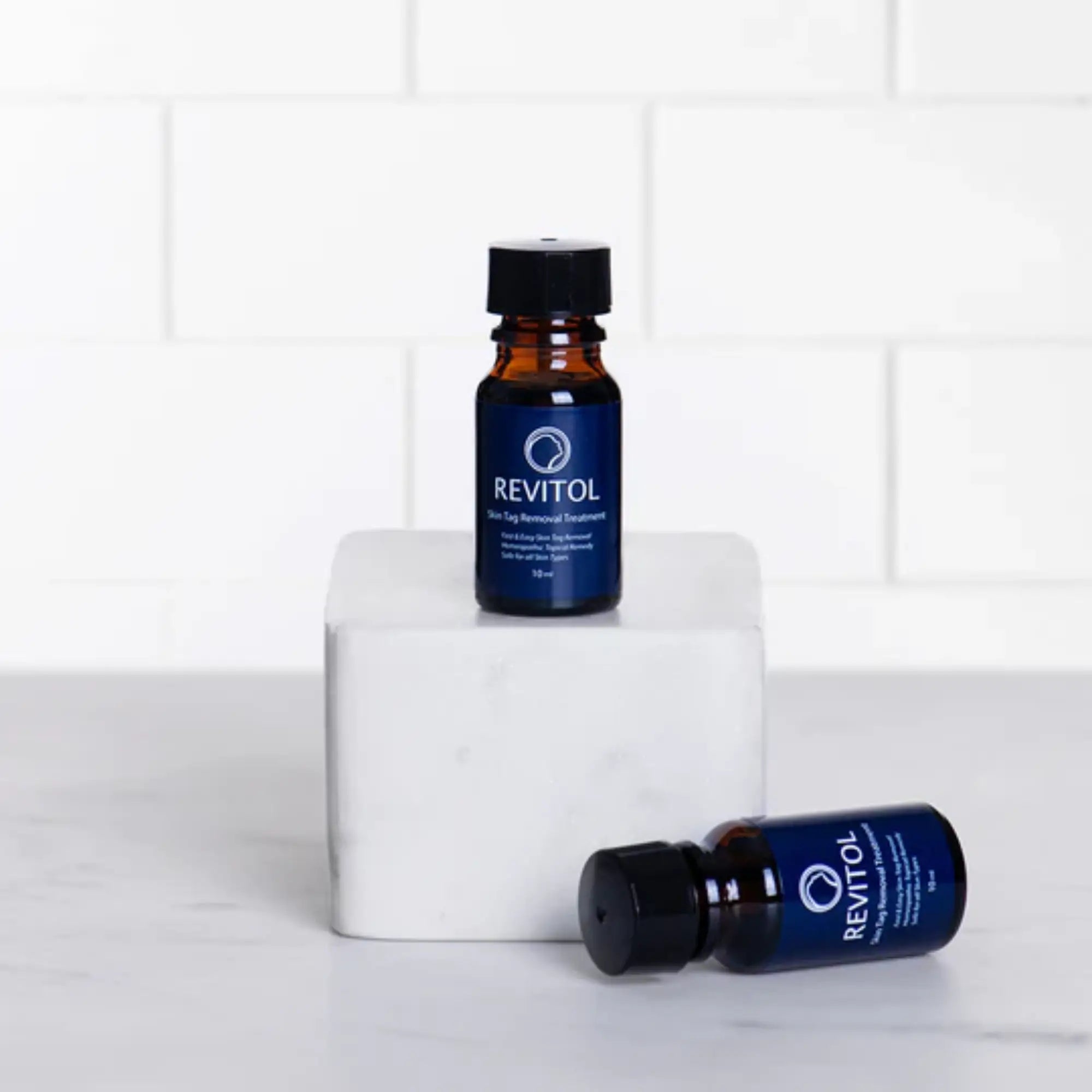
- Active ingredient(s): Thuja occidentalis (white cedar), tea tree oil, and botanical carrier oils (exact concentrations not disclosed)
- Format: Topical liquid applied directly to skin tags
- Marketed claims: "Effectively targets and eliminates unwanted skin tags" using "natural ingredients" without "harsh chemicals"
- Quality info: No publicly verifiable third-party testing, cGMP certification, or MHRA licensing information found
- Price: Approx. £32 / $40.00 per bottle
Realistic Expectations
It would be easy to dismiss this product entirely based on the lack of clinical evidence — and for many readers, that analysis alone will be enough to steer them towards a GP appointment instead. That is a perfectly reasonable conclusion. Professional removal is quick, effective, and in many cases relatively affordable on a private basis.
However, we recognise that some adults will have already decided they want to try a topical approach — perhaps because they have multiple small skin tags, prefer to avoid clinical procedures, or simply want to try the least invasive option first. For those readers, the honest framing is this: a product like Revitol Skin Tag Removal Treatment might have a mild drying or softening effect on very small skin tags over several weeks of consistent use, but there is no scientific basis to expect it to reliably "eliminate" them. If it works for you, that is a bonus; if it does not, it would not be surprising.
The most important thing you can do — regardless of which approach you choose — is to have the growth properly identified first. A five-minute conversation with your GP or a quick check with a pharmacist can confirm that what you are dealing with is genuinely a benign skin tag and not something that warrants closer examination. That single step is worth more than any topical product on the market.
Frequently Asked Questions
What is Revitol Skin Tag Removal Treatment?
Revitol Skin Tag Removal Treatment is a topical cosmetic product designed for at-home application on skin tags. It contains botanical ingredients — most notably Thuja occidentalis — and is applied directly to the skin tag several times daily. It is sold online through affiliate retailers and is not a licensed medicine.
Is there clinical evidence that topical products can remove skin tags?
No. To our knowledge, there are no peer-reviewed randomised controlled trials demonstrating that any topical herbal or homeopathic product reliably removes skin tags. The evidence base for established medical methods — cryotherapy, excision, cauterisation — is far stronger. If you are looking for a proven solution, professional removal is the most evidence-based route.
Is Revitol Skin Tag Removal Treatment safe to use?
The listed ingredients are generally considered low-risk for topical use in healthy adults. However, allergic reactions and contact dermatitis are possible — tea tree oil and Thuja occidentalis can both cause irritation in sensitive individuals. If you have a history of skin allergies, eczema, or sensitive skin, perform a small patch test first or speak to a pharmacist before use.
Should I see a doctor before trying to remove a skin tag at home?
Yes — strongly. Any new or changing skin growth should be examined by a GP or dermatologist before you attempt any form of removal. What looks like a skin tag could occasionally be a different type of lesion, and self-treating without a proper diagnosis could delay an important medical assessment. It is a quick check that could save you considerable worry.
How does Revitol compare to professional skin tag removal?
Professional removal methods (cryotherapy, excision, cauterisation) are performed under clinical conditions, take minutes, and have well-documented success rates. Topical products like Revitol are unregulated for this use, have no published clinical data, and may or may not produce visible results after weeks of application. For a definitive solution, professional removal is clearly the more reliable option.
Is this product MHRA-approved or clinically tested?
Revitol Skin Tag Removal Treatment does not appear to hold an MHRA Marketing Authorisation and is not listed as a registered medicine in the UK. There are no publicly available clinical trial results for this specific product. It is marketed as a cosmetic, which means it has not undergone the regulatory review process required for medicines making therapeutic claims.
✅ The verdict
We have to be straightforward: there is no clinical trial evidence that Revitol Skin Tag Removal Treatment — or any comparable topical product — reliably removes skin tags. The individual ingredients (Thuja occidentalis, tea tree oil) have some traditional and antimicrobial credentials respectively, but neither has been shown in controlled studies to cause skin tags to shrink or detach. The product is not MHRA-licensed, no independent quality certifications are publicly available, and the sales page makes claims that go beyond what the evidence supports. At £32 per bottle, it is not inexpensive relative to a private GP skin tag removal appointment, which may cost only slightly more for a definitive result.
That said, we recognise that some readers will want to try a non-invasive, at-home approach first — and we respect that choice. If you have had your skin tag confirmed by a clinician, understand the evidence limitations, and accept that the product may not work, you can check current pricing here. Just please — see your GP first to confirm the growth is genuinely a skin tag. That step alone is the most valuable thing you can do for your skin health.
For readers interested in other evidence-focused wellness reviews, you may also find our recent look at NAD+ supplements and BPC-157 peptides helpful — both offer honest assessments of products in the broader health and recovery space.
🛒 Reader-recommended option
If you have decided to try a topical approach after consulting your GP, Revitol Skin Tag Removal Treatment is one of the more widely available options in this category.
View Revitol Skin Tag Removal Treatment →
Affiliate link — see disclosure at the top of this article. Current price approx. £32 / $40.00 per bottle.
This article is informational and contains affiliate links. It does not replace personalised advice from your GP, pharmacist, or another qualified healthcare professional. Skin tags should be diagnosed by a qualified clinician before any removal attempt. This product is not an MHRA-licensed medicine. If a skin growth is changing, bleeding, or causing concern, please consult your GP promptly rather than attempting self-treatment. Not recommended for use during pregnancy or breastfeeding without medical guidance, or for anyone under 18.