

Provillus 5% Minoxidil for Men Review 2026: How It Works, the Evidence, and Honest Expectations

⚡ Quick Answer
Minoxidil 5% is one of only two clinically proven over-the-counter treatments for male pattern hair loss (the other is oral finasteride, which is prescription-only in the UK). Around 60–70% of men get a useful response, with results visible from 3–6 months of consistent twice-daily use. Effects stop when you stop. Provillus is a 60ml bottle of the same active ingredient sold under the Regaine brand at UK pharmacies; the product is the active ingredient, not the brand name.
🛒 Shop the product
Approx. £19 / $24 per 60ml bottle — affiliate link, see disclosure above.
If you are a man in your 20s, 30s or 40s noticing thinning at the crown or a slowly retreating hairline, you are in the same situation as roughly half of all UK men by the time they are 50. The good news is that the evidence base for the standard topical treatment — minoxidil 5% — is unusually robust, with more than three decades of randomised trials behind it. The slightly less exciting news is that no topical treatment cures the underlying condition; it just slows it and partially reverses it for as long as you keep using it.
This guide explains, in plain UK English, what minoxidil 5% actually does, how strong the evidence is, what realistic results look like, how to apply it, and what side effects to watch for. We will also take a sober look at the Provillus 5% minoxidil 60ml bottle at the end, because this is the same active ingredient as Regaine and a handful of generics — the product question is really about price and convenience, not whether the science works.
A short note on framing: this is a review of a specific Provillus topical product, but the underlying treatment is the same minoxidil molecule that has been UK-licensed since the 1980s. If a different bottle of 5% minoxidil is easier to find for you, the biology is identical.
What minoxidil actually is
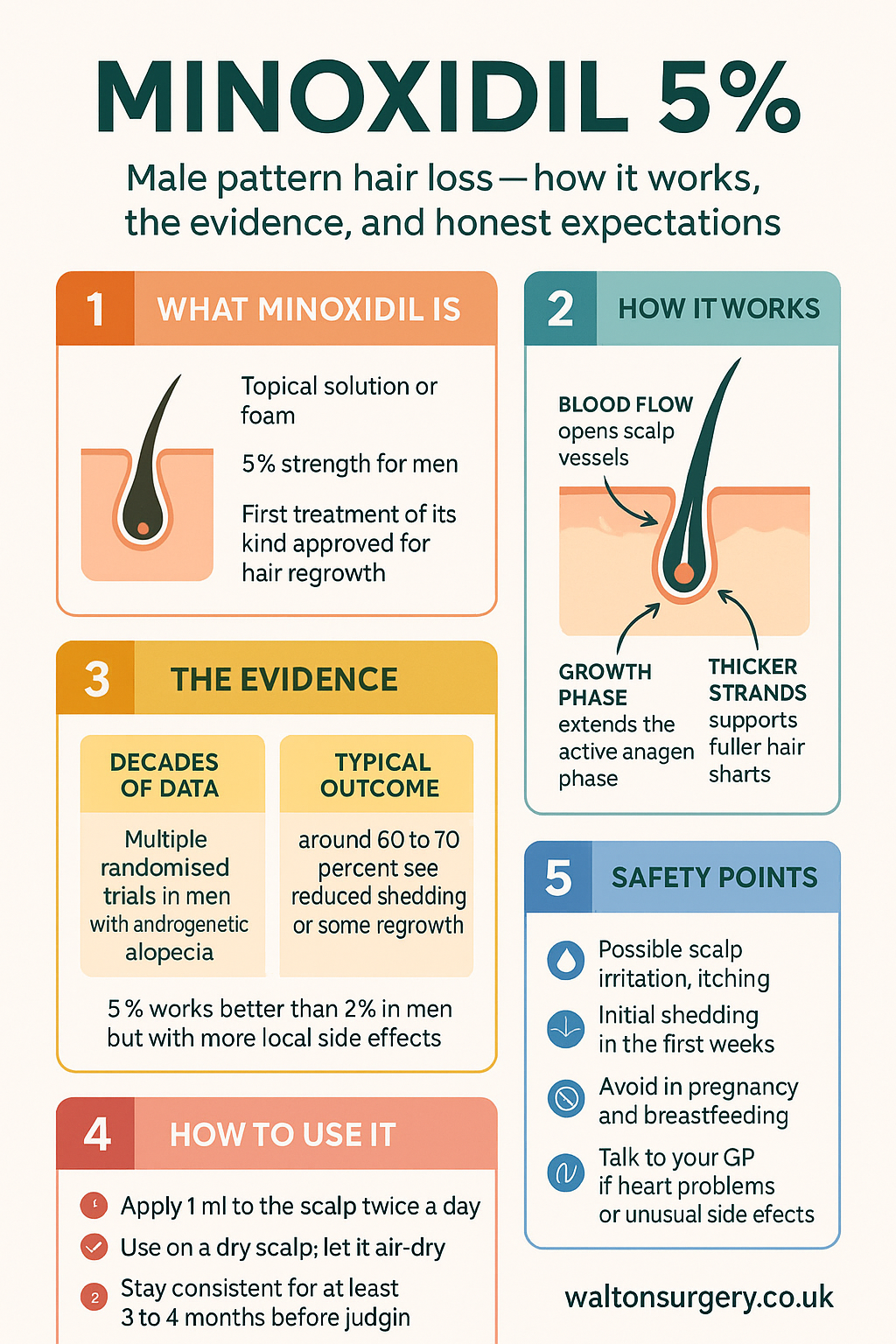
Minoxidil was originally developed in the 1970s as an oral blood-pressure medication. Doctors noticed that patients taking it began growing unusually thick hair on their scalps, arms and faces. The active ingredient was reformulated into a topical solution for the scalp, and by the late 1980s it had been approved by the FDA, and shortly afterwards by the UK MHRA, as the first treatment ever licensed for hair regrowth.
The 2% strength was the original formulation. The 5% solution and foam were added later, and head-to-head studies in men show 5% produces more regrowth than 2%, at the cost of slightly higher rates of local skin irritation. The 5% strength is the standard recommendation for men with androgenetic alopecia.
Practically, minoxidil is sold in the UK as: Regaine 5% (the brand-leader at Boots, Lloyds and supermarket pharmacies); a foam and a solution version; and a growing range of generic and own-brand 5% products with identical active ingredient, typically at a lower price point. None of these are prescription products — they sit on the pharmacy shelf alongside paracetamol and ibuprofen.
How it works — and what it cannot do
Minoxidil works by opening (or “vasodilating”) small blood vessels in the scalp and by extending the growth phase of the hair cycle. Each hair follicle goes through three phases: anagen (active growth), catagen (transition) and telogen (rest). In androgenetic alopecia, the anagen phase progressively shortens, hairs grow thinner each cycle, and eventually a follicle that previously produced a thick terminal hair only manages a fine vellus hair, then nothing at all.
Minoxidil partially reverses that process. Existing thinning hairs spend longer in the active growth phase, so they grow longer and thicker before shedding. Some completely dormant follicles can be re-activated, particularly in areas that have only recently stopped producing visible hair. Two important caveats: minoxidil does not address the underlying hormonal driver of male pattern baldness (DHT — dihydrotestosterone — acting on susceptible follicles), and it cannot rescue follicles that have been completely scarred over or dormant for many years. This is why it works much better on the crown than on a hairline that has been receding for two decades.
💡 What to expect
A realistic 12-month timeline
- → Weeks 1–2: nothing visible
- → Weeks 2–8: initial shedding (normal — telogen hairs pushed out)
- → Months 3–4: first signs of fuller texture, less daily fallout
- → Months 6–9: visible regrowth in responders (mainly crown)
- → Month 12: maximum effect; assessed against pre-treatment photos
- → Stop using it: hair re-thins within 3–6 months
The evidence: what 30+ years of trials actually show
Few non-prescription treatments have the depth of evidence minoxidil has. The major 5% versus 2% trial in 393 men (Olsen et al., 2002) found 5% produced significantly more hair counts at 48 weeks. A 2015 Cochrane-style review of 21 randomised trials concluded minoxidil is effective for stabilising or partially reversing male pattern hair loss. More recent network meta-analyses comparing topical minoxidil, oral finasteride and combinations consistently place 5% minoxidil among the better-tolerated and most evidence-supported options.
In practical terms: roughly 60 to 70 percent of men using 5% minoxidil consistently for at least 4 months will see a measurable benefit, ranging from reduced shedding through to visible regrowth. Around 20 to 30 percent will see little or no effect. A small minority will stop because of side effects. These numbers depend heavily on how far advanced the hair loss is — early to moderate cases respond best.
It is worth noting what the evidence does not support: minoxidil is not a treatment for hair loss in patches (which suggests alopecia areata or another scarring/inflammatory cause), it is not effective for diffuse hair shedding from medical illness or stress (telogen effluvium — that needs the underlying cause addressed), and it should not be used to grow eyebrow, beard or eyelash hair, where the safety profile has not been established.
⚠️ Honest expectations
Minoxidil halts and partially reverses male pattern hair loss — it does not restore your hairline from twenty years ago. Expect “fuller and thicker” rather than “young man’s full head of hair.” If a product page promises dramatic transformation, read it as marketing, not evidence.
How to use minoxidil 5% properly
Most failure cases are about technique and patience, not the drug. The standard application is 1 ml of 5% solution applied to a dry scalp twice a day, every day. The dropper that comes with the bottle measures this for you. Apply directly to the thinning area, gently massage it in with the fingertips, wash hands, and let the scalp air-dry — do not blow-dry, as the heat reduces absorption.
Use it on dry hair, not after a shower while the scalp is wet — the dilution reduces absorption. Avoid applying it before bed without giving it time to dry, since solution that transfers to a partner’s skin (including a baby’s) can have unwanted effects. The foam formulation is more forgiving on application and tends to produce less local irritation, but the active ingredient is the same.
Do not double the dose hoping for faster results — it does not work that way and increases side-effect risk. Do not stop after a month if you see no change — the biology takes time. Do not interpret the initial shedding around weeks 2 to 6 as the treatment “making things worse” — it is a recognised early sign of the treatment working, and it settles within a few weeks.
Side effects and who should think twice
The commonest side effects are local: scalp itching, dryness, mild redness, and dandruff-like flaking. These are typically related to the propylene glycol carrier in the solution rather than minoxidil itself, which is why the foam (propylene-glycol-free) is better tolerated by users prone to irritation.
Less common: unwanted hair growth on the forehead, temples or upper cheeks (usually from solution running off the scalp). Headache, fluid retention, or a faster heartbeat are uncommon and usually mild, but they warrant stopping if persistent. Significant chest pain, palpitations or marked ankle swelling are very rare but require stopping treatment and seeing a GP promptly.
There are clear groups who should not use minoxidil 5% without first speaking to a GP: anyone under 18, anyone with significant cardiovascular disease or uncontrolled heart conditions, anyone with sudden or patchy hair loss (which suggests a different diagnosis and needs evaluation first), and women — the 2% formulation is the licensed strength for female pattern hair loss; the 5% is not licensed for women and is associated with more facial hair growth. Pregnant or breastfeeding women should avoid all minoxidil products.
The Provillus 5% minoxidil 60ml bottle
For readers who have decided to try a 5% minoxidil topical solution, the practical question is which bottle to buy. There are several reasonable options in the UK in 2026: Regaine 5% (the brand-leader, typically £25–£35 per 60ml bottle), generic 5% solutions sold by supermarket pharmacies (£12–£20), and a number of internet-direct options. Provillus 5% Minoxidil 60ml is one of those — sold for around $24 (roughly £19) with a 20% flash discount currently running, which puts it broadly in line with generic pharmacy pricing.
🔬 Product snapshot — Provillus for Men 60ml
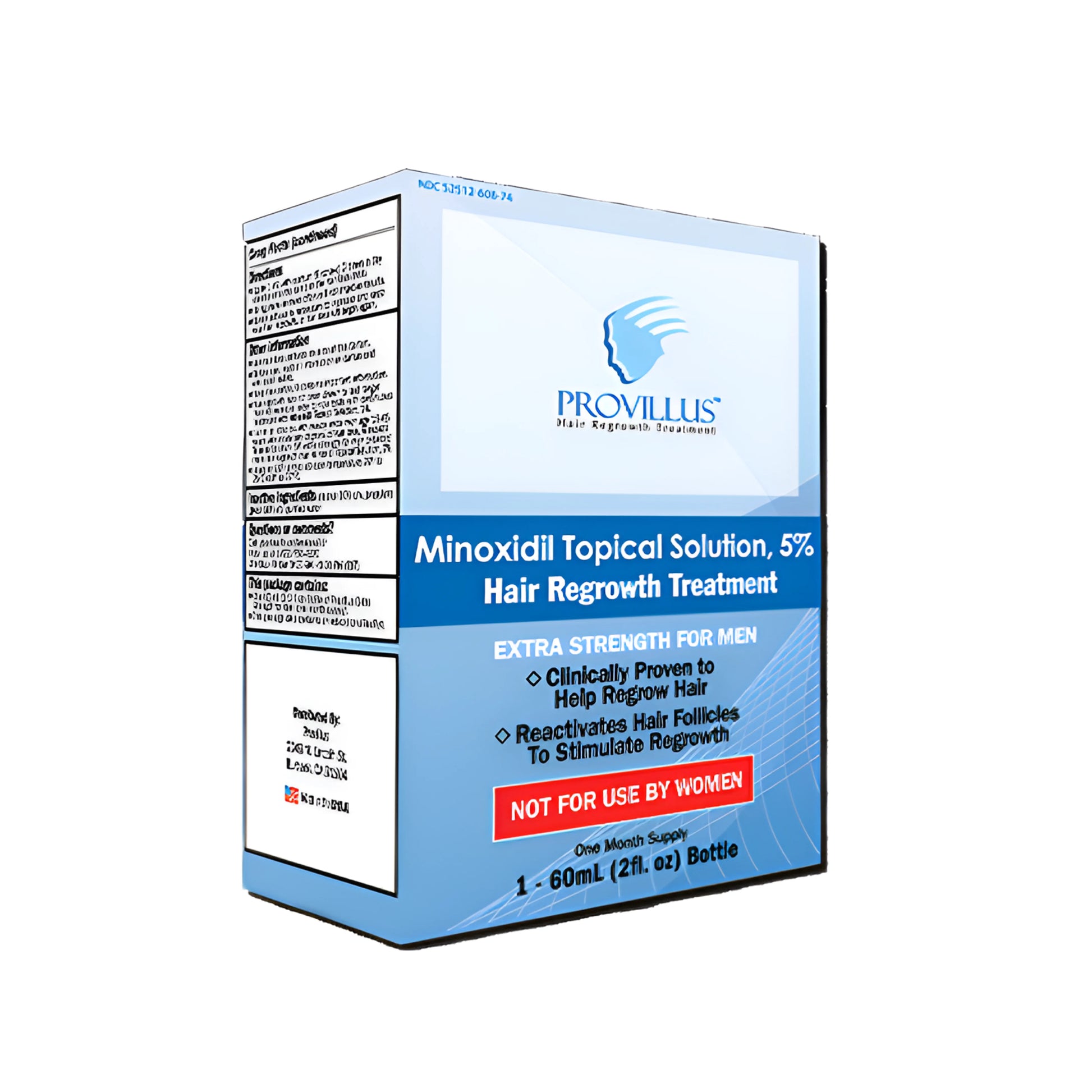
- Active ingredient: Minoxidil 5% (the FDA- and MHRA-recognised active for male pattern hair loss)
- Format: Topical solution, 60ml bottle (roughly one month’s supply at 1 ml twice daily)
- Marketed for: Men with androgenetic alopecia (the 5% strength is not licensed for women)
- Stated claims: reduced shedding, increased thickness, improved confidence — consistent with the general minoxidil evidence base
- Price: $24.00 (≈ £19) per bottle, with a 20% flash sale at the time of writing
- Caveat: the product page is somewhat marketing-heavy and does not include detailed application instructions or formal safety leaflets — read the standard Regaine 5% patient information leaflet for full guidance
What matters when choosing between bottles is not the brand on the label — minoxidil 5% is minoxidil 5%. What matters is: (1) is the concentration correct (5% for men), (2) is the product from a reputable source with clear labelling, (3) is the price reasonable for a month’s supply, and (4) can you commit to the daily routine. On the first three, the Provillus listing checks out at a typical UK-accessible price point. The fourth is the part only you can answer.
A practical tip: whichever bottle you choose, take a smartphone photograph of your scalp under consistent lighting (overhead, towel-dried, parted in the same way) on day one. Repeat at months 3, 6 and 12. Your own daily perception of your hair is hopelessly biased; the photos are not. If after six months of consistent twice-daily use you cannot see any difference in the photos, it is reasonable to stop and accept that you are in the non-responder minority.
Frequently Asked Questions
Does minoxidil 5% actually work for male hair loss?
For most men with early to moderate androgenetic alopecia (male pattern baldness), yes — multiple randomised controlled trials over more than 30 years show that minoxidil 5% applied twice a day reduces hair shedding and produces some visible regrowth in roughly 60 to 70 percent of users. It works best for thinning at the crown and is less reliable for a fully receded hairline. Effects appear gradually over 3 to 6 months, and the treatment must be continued to maintain results.
Is minoxidil legal and available over the counter in the UK?
Yes. Minoxidil is licensed as an over-the-counter treatment in the UK, sold most widely under the brand name Regaine. The 5% solution and foam are available without a prescription from pharmacies and supermarkets for men aged 18 to 65. A 2% formulation is available for women. Generic and own-brand 5% products with identical active ingredients are also widely sold.
How long before I see results?
Most users will not see any visible change for at least 2 months and should not judge the treatment until at least 4 months of consistent twice-daily use. Some men notice initial shedding in weeks 2 to 6, which is a normal sign that hairs in the resting phase are being pushed out to make way for new growth. Maximum effect is typically seen at around 12 months.
What are the side effects of minoxidil 5%?
Common and usually mild: scalp itching, dryness, redness, or dandruff, often related to the propylene glycol in solution-based formulas. Occasionally users get facial hair growth where the product has run off, headache, or fluid retention. Rare but more serious effects include rapid heart rate, chest pain, or significant fluid retention — these require stopping treatment and seeing a GP. The foam formulation tends to cause less irritation than the solution.
Who should not use minoxidil 5%?
Anyone under 18, pregnant or breastfeeding (women), anyone with significant cardiovascular disease or uncontrolled heart conditions, anyone with a known allergy to minoxidil or propylene glycol, and anyone whose hair loss is not androgenetic alopecia (for example, anyone with patchy hair loss suggestive of alopecia areata, scarring alopecia, or a sudden diffuse loss). If you are unsure why you are losing hair, see your GP before starting any treatment.
What happens if I stop using minoxidil?
Hair that grew or thickened on minoxidil generally returns to its untreated state within 3 to 6 months of stopping. Minoxidil is not a one-off cure for male pattern baldness; it works only while you are using it. This is the single most important practical fact to understand before starting — it is a long-term commitment, not a course of treatment.
✅ The verdict
Minoxidil 5% is one of the best-evidenced treatments in the entire wellness space and the standard topical recommendation for men with early to moderate male pattern hair loss. It is not a miracle, and it is not a cure — but for the majority of men who use it consistently, it produces a meaningful reduction in shedding and a visible improvement in thickness within 3 to 6 months. The “active ingredient” question is closed; the “which bottle” question is genuinely about price, packaging and convenience.
If you want to try a 5% minoxidil solution and are looking for a reasonably priced UK-accessible bottle, the Provillus 60ml is one straightforward option at roughly £19 with the current discount. You can check current pricing and stock here. Whichever bottle you choose, take pre-treatment photos, apply 1 ml twice a day, give it 4 to 6 months before judging, and accept that you will need to keep using it to keep the benefit.
For other product reviews and UK health context in 2026, you may also find these useful: NAD+ and healthy ageing, BPC-157 recovery peptide, and creatine for women in menopause.
🛒 Reader-recommended option
If you have decided to try a 5% minoxidil topical, the Provillus 60ml bottle is one of the more reasonably priced UK-accessible options currently shipping with the same FDA- and MHRA-recognised active ingredient as Regaine.
View Provillus Minoxidil 5% 60ml →
Affiliate link — see disclosure at the top of this article. Current price approx. £19 / $24 per 60ml bottle.
This article is informational and contains affiliate links. It does not replace personalised advice from your GP, pharmacist, or another qualified healthcare professional. Minoxidil 5% is an MHRA-licensed over-the-counter treatment in the UK for male pattern hair loss; this article is not intended to diagnose, treat, cure or prevent any other condition. Read the patient information leaflet supplied with any minoxidil product before use, and seek medical advice if you experience persistent side effects.
