

⚡ Quick Answer
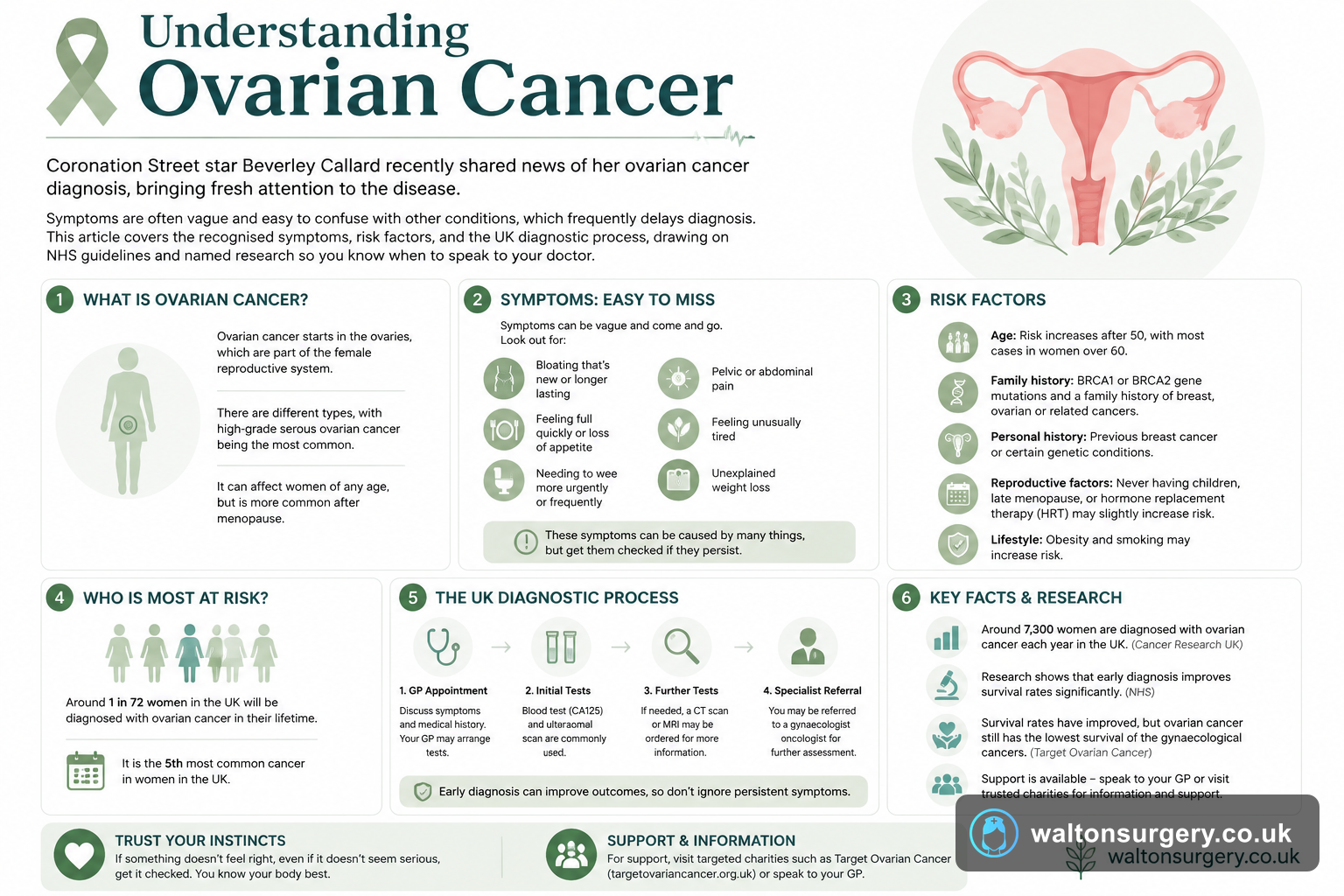
Former Coronation Street star Beverley Callard recently shared an update on her ovarian cancer diagnosis with fans, sparking renewed public interest in the disease. Ovarian cancer symptoms can be subtle and easily mistaken for other conditions, which often leads to late diagnosis. This article explains the known symptoms, risk factors, and the diagnostic pathway in the UK, using NHS guidelines and named research to help you understand when to seek medical advice.
Beverley Callard, famous for playing Liz McDonald on Coronation Street and her stint in the I’m a Celebrity jungle, has been open with fans about a recent cancer diagnosis. Her candour has understandably put ovarian cancer back in the public eye, a disease which affects thousands of women across the UK annually.
Getting to grips with what ovarian cancer actually is, how it shows up, and what action to take if something feels off is a sensible way to stay on top of your health. We’ve looked at NHS guidance and specific research to put together what you really need to know here.
What Is Ovarian Cancer?
It starts in the ovaries, those two small organs flanking the womb responsible for storing eggs and producing hormones. Sometimes, though, it actually begins in the fallopian tubes or the peritoneum — that’s the lining of your abdominal cavity — and doctors often lump these together when they’re diagnosing and treating it.
Epithelial ovarian cancer, the kind that grows from cells covering the ovary’s surface, is the one you hear about most. There are rarer forms like germ cell tumours and sex cord-stromal tumours too. The type you have matters a lot for how the cancer behaves and what treatment works best, which is exactly why those pathology reports after surgery go into such painstaking detail.
According to Cancer Research UK, ovarian cancer ranks as the sixth most common cancer in women in this country. It’s mostly a disease of women who’ve been through the menopause, although you can get it at any age. Catching it early makes a massive difference to outcomes, yet so many cases get picked up late because the symptoms are vague and get confused with less serious, everyday problems.
Why Did Beverley Callard’s Diagnosis Get So Much Attention?
When someone like Beverley Callard talks publicly about a health issue, people naturally sit up and listen. Her update back in July 2026, directed at fans who were understandably worried, really highlighted that jolt of shock and confusion so many feel after such news. By sharing her story, she’s helping to make talking about ovarian cancer feel more normal, and that encourages other people to pay attention to what their own body is telling them.
A famous name going through this often sends people searching for answers online, and honestly, that’s a good thing if it means symptoms get spotted earlier. The NHS and charities such as Target Ovarian Cancer have pushed hard for better awareness for years, precisely because ovarian cancer signs are so often brushed off as IBS, period troubles, or a urinary tract infection. Her candour joins a growing list of celebrity health stories — such as jessie j cancer free breast cancer mastectomy update 2026 — that help normalise open conversations about serious illness.
If reading about Beverley’s experience has made you want to find out more, that awareness in itself is valuable. Simply knowing what to look out for makes you far more likely to actually get yourself to the GP without putting it off for months.
What Are the Main Symptoms of Ovarian Cancer?
The NHS points to three core symptoms commonly tied to ovarian cancer. You should see your GP if any of these are happening regularly — and by regularly, we mean more than twelve times in a single month:
- Persistent bloating that doesn’t come and go
- Feeling full quickly or loss of appetite
- Pelvic or abdominal pain that won’t settle
There are other signs too: needing to pee more often or with more urgency, changes in how your bowels are working (think constipation or diarrhoea), weight loss you can’t explain, feeling utterly wiped out, and back pain. Bleeding from the vagina after you’ve gone through the menopause is another red flag that always needs looking into.
It is worth remembering that having these symptoms doesn’t automatically mean you have ovarian cancer. Most women who report them will find there’s a benign reason behind it. Still, if these feelings are new to you, they’re sticking around, and they just don’t feel normal for your body, that’s your cue to book in with a doctor. Don’t wait for things to get worse.
How Is Ovarian Cancer Diagnosed in the UK?
Your first port of call is your GP, who will likely start with a blood test to measure your CA-125 level. CA-125 is a protein found in the blood that tends to be higher in women with ovarian cancer. It can also be raised by other things like endometriosis, fibroids, or pelvic infections, so it’s not a definitive answer on its own.
If your CA-125 comes back higher than it should, you’ll get referred for an ultrasound of your abdomen and pelvis. That scan looks at the ovaries and the area around them to see if anything looks unusual. The NHS says this referral should happen within two weeks.
🔬 Key Facts
UK Diagnostic Pathway
- → First step: GP blood test for CA-125 protein levels
- → Two-week referral: Ultrasound of abdomen and pelvis if CA-125 is raised
- → Specialist team: May order CT scan, biopsy, or surgery for definitive diagnosis
- → NICE guidelines: Map out fast-track pathways to ensure patients are seen promptly
Should the ultrasound flag something, you’ll be passed on to a specialist gynaecological team. They might do a CT scan to get a much clearer picture of your pelvis and abdomen. Sometimes a biopsy is taken, but in many cases the actual diagnosis happens during an operation. The National Institute for Health and Care Excellence, or NICE, has published guidelines on recognising and referring suspected cancer, which map out these pathways to make sure patients get seen fast.
What Are the Risk Factors for Ovarian Cancer?
Nobody knows exactly what causes ovarian cancer, but scientists have pinpointed several things that can bump up your risk. Knowing what these are helps you and your doctor make better choices about monitoring.
Age is a big one. Most diagnoses happen in women over fifty, and the risk climbs further after the menopause. A family history of ovarian or breast cancer is relevant too, especially if relatives were quite young when diagnosed. Inherited gene mutations — the ones you hear about, BRCA1 and BRCA2 — are linked to a significantly higher lifetime risk. The CARRIERS study and other work have really improved our grasp on how these genetic variants play into risk, much in the same way that public figures sharing their journeys — like kylie minogue breast cancer awareness — have boosted understanding of breast cancer genetics.
Other factors include never having been pregnant, starting your periods early or hitting a late menopause, using HRT (particularly the oestrogen-only kind), and being overweight or obese. Having endometriosis has also been connected to a slightly elevated risk.
On the flip side, taking the combined oral contraceptive pill, having children, and breastfeeding all seem to lower your risk. None of these factors is a guarantee either way — they just nudge the odds in one direction or another.
What Should You Do If You’re Worried?
If any of the symptoms we’ve talked about ring a bell, or if ovarian or breast cancer runs in your family, the most useful thing you can do is get yourself to your GP. Be specific when you talk to them: when did this start, how often does it happen, and is it getting any worse? Keeping a simple diary of your symptoms for a couple of weeks before you go can help you paint a clearer picture.
Expect your GP to ask about your family history — has anyone close to you had ovarian, breast, bowel, or womb cancer? If a pattern emerges, you might get referred to a genetics service for a proper risk assessment. The NHS Genomic Medicine Service can arrange genetic testing if it’s appropriate. For some people, navigating a serious diagnosis also raises wider questions about autonomy and care, such as those explored in our article on assisted dying cancer uk.
Honestly, please don’t put it off because you feel embarrassed or think you’re making a fuss. GPs deal with these symptoms all the time and would much rather investigate and rule something out than miss an early sign. And if you feel like your concerns aren’t being heard, you are well within your rights to ask for another opinion or to request a referral.
Frequently Asked Questions
⭐ The Bottom Line
What this means for you
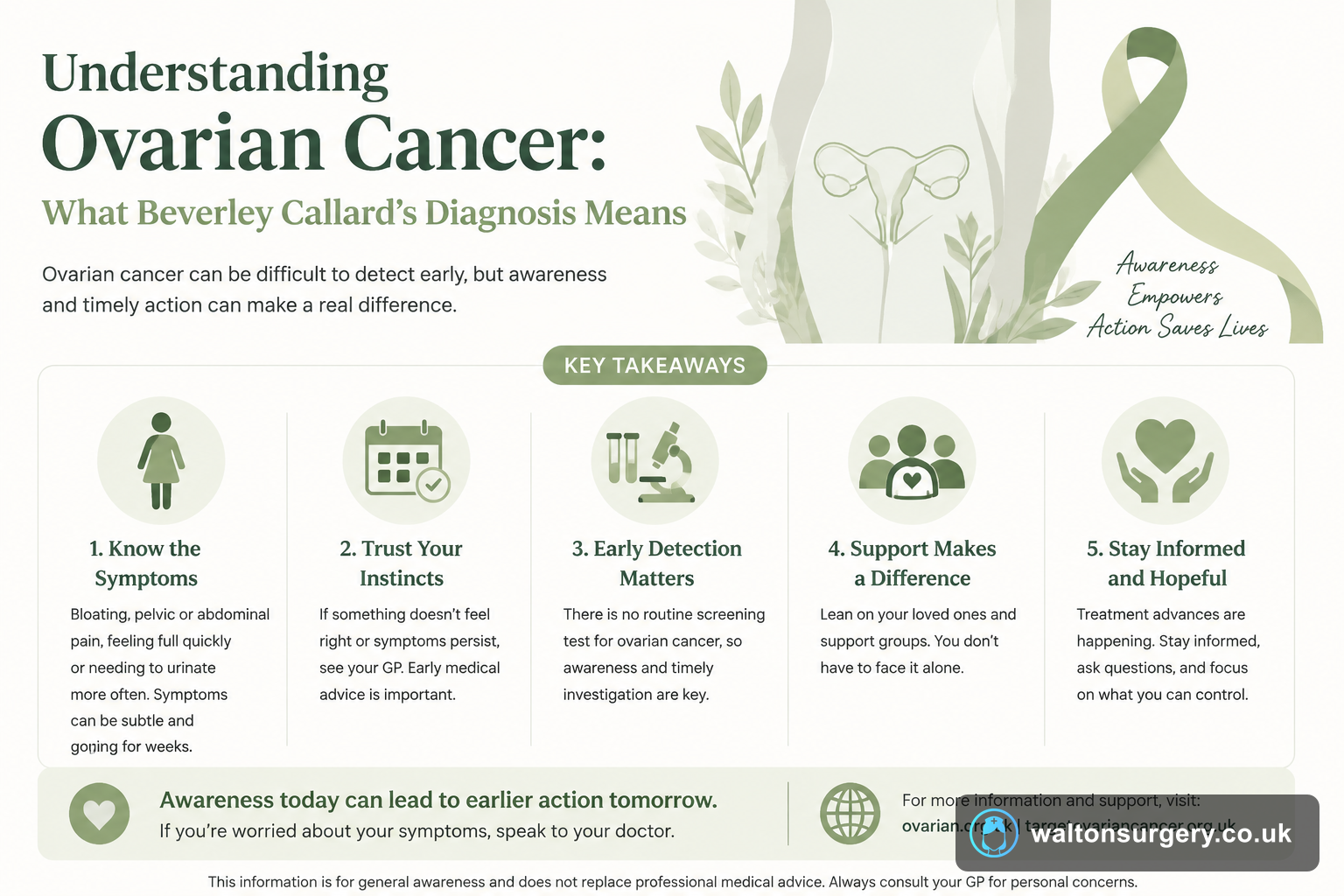
Beverley Callard’s openness about her diagnosis has cast a spotlight on a disease that too often flies under the radar until it’s reached an advanced stage. The symptoms — that persistent bloating, feeling full too quickly, and pelvic pain — are easy to shrug off, but they’re worth getting checked if they’re new and they’re not going away. If something feels wrong, get yourself to the GP. Earlier conversations lead to earlier tests, and earlier tests give you the best shot at effective treatment. Knowing what to look for is the first step.
Last updated: 2026-07-12 · Written by the Walton Surgery editorial team · Medical information is for educational purposes only and does not replace advice from a qualified healthcare professional.
