Mounjaro on the NHS in 2026: Who Qualifies, How It Works, Cost
⚡ Quick Answer
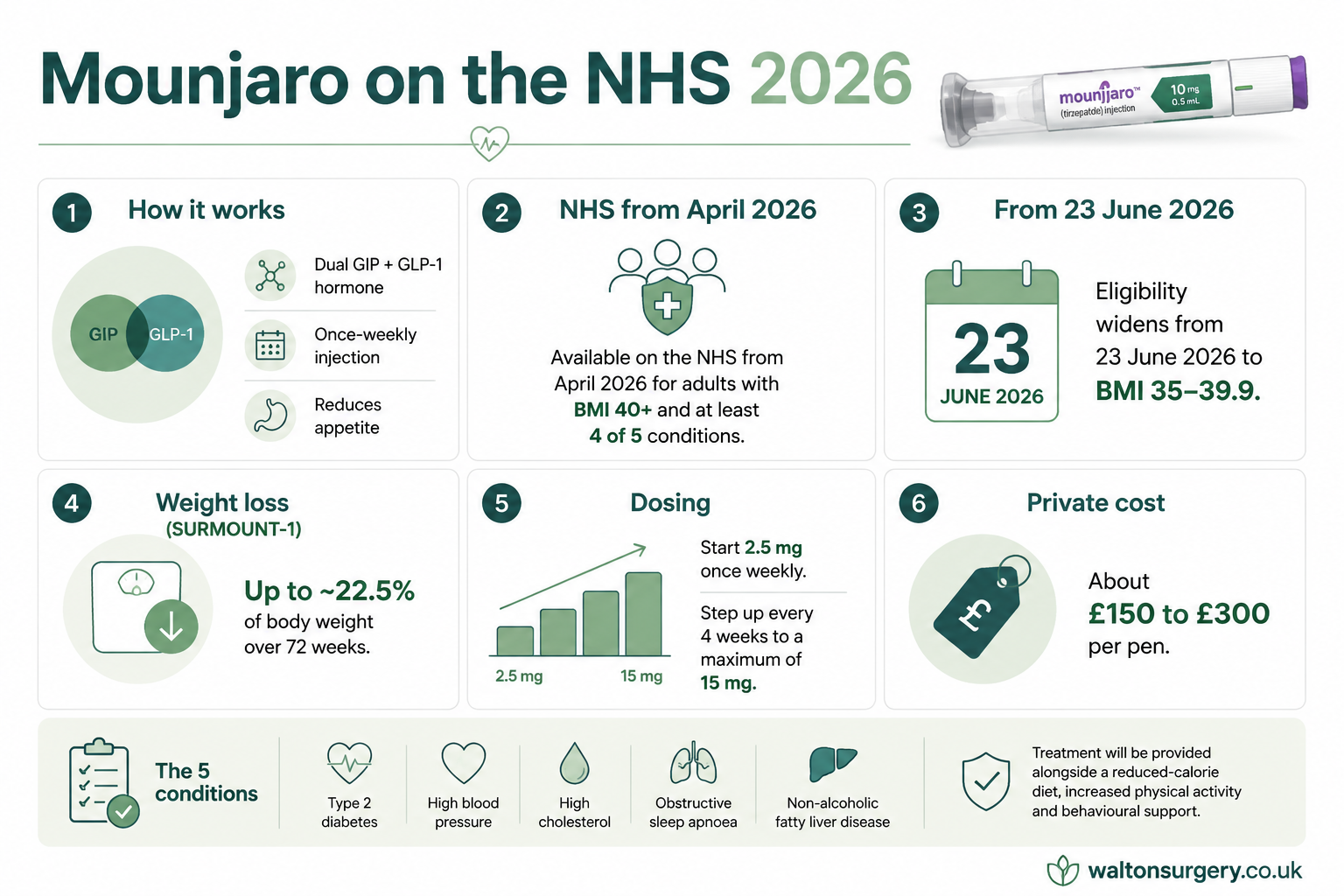
Mounjaro (tirzepatide) is a once-weekly self-injection for weight management, available on the NHS from April 2026 — though only for adults with a very high BMI and at least four long-term health conditions. In clinical trials, participants lost an average of 16–23% of their body weight when paired with lifestyle changes. If you don’t meet NHS criteria, private access costs roughly £150–£300 per pen, plus consultation fees.
You can now get Mounjaro on the NHS in England, but the rules are tight and most people won’t qualify straight away. From 1 April 2026, NHS England added tirzepatide prescribing for obesity to the GP contract, yet only a narrow group of patients are eligible in the first phase.
This article walks you through exactly who can get Mounjaro on the NHS, how the drug works, what the weight-loss evidence shows, and what it costs if you choose to go private. We’ve stuck to verified facts from NHS England, NICE, Diabetes UK and the SURMOUNT-1 clinical trial — no hype, no guesswork.
What Is Mounjaro (Tirzepatide) and How Does It Work?
Mounjaro is the brand name for tirzepatide, a prescription medicine licensed for weight management in adults. You inject it once a week under the skin (subcutaneously) — most people use a pre-filled pen on the abdomen, thigh or upper arm.
It works by mimicking two natural hormones your gut releases after you eat. These hormones — GIP (glucose-dependent insulinotropic polypeptide) and GLP-1 (glucagon-like peptide-1) — send signals to your brain and pancreas. When blood sugar is high, tirzepatide boosts insulin release, which helps bring glucose levels down. At the same time, it lowers glucagon (a hormone that raises blood sugar), slows how quickly your stomach empties, and reduces your appetite. The net result: you feel full sooner, eat less and lose weight over time.
NICE appraised tirzepatide and recommended it for NHS use under specific conditions, which is why NHS England has now rolled it into the 2026/27 GP contract. Diabetes UK has also noted its potential for people living with type 2 diabetes alongside obesity.
The “Dual Agonist” Difference
Most weight-loss injections you may have heard of — such as semaglutide (Wegovy) — work on one gut hormone receptor: GLP-1. Tirzepatide is different because it activates both GLP-1 and GIP receptors. Researchers behind the SURMOUNT-1 trial believe this dual action may explain why tirzepatide produced greater average weight loss than GLP-1-only treatments in head-to-head and comparable studies. The GIP pathway appears to add extra effects on appetite control and how the body processes fat. That said, everyone responds differently, and the drug isn’t suitable for all. Your prescriber will consider your full medical history before recommending it.
Can You Get Mounjaro on the NHS in 2026?
This is the question most people are asking, and the honest answer is: it depends. NHS England has phased the rollout, and eligibility is narrow — at least for now.
From 1 April 2026 (Phase 1), you may be eligible for tirzepatide on the NHS if you meet ALL of the following criteria:
- A BMI of 40 or more (or 37.5 or more with an ethnic adjustment, which applies to certain groups including people of South Asian, Chinese, other Asian, Middle Eastern, Black African or African-Caribbean descent, where health risks are higher at a lower BMI).
- At least four out of five qualifying long-term conditions: high blood pressure (hypertension), type 2 diabetes, obstructive sleep apnoea, high cholesterol (hyperlipidaemia), and cardiovascular disease.
- A commitment to lifestyle support — tirzepatide is only prescribed alongside structured help to improve your diet and increase physical activity. It is not a standalone treatment.
From April 2026
BMI 40+ and 4 of 5 conditions
BMI of 40 or more (37.5 with ethnic adjustment) plus at least four of: high blood pressure, type 2 diabetes, obstructive sleep apnoea, high cholesterol, cardiovascular disease.
From 23 June 2026 (Phase 2), the criteria widen slightly:
- BMI of 35–39.9 (or 32.5–37.4 with ethnic adjustment) plus four or more of the five qualifying conditions listed above.
From 23 June 2026
BMI 35–39.9 and 4+ conditions
Eligibility widens to BMI 35–39.9 (32.5–37.4 with ethnic adjustment) plus four or more of the same qualifying conditions.
A few important points that catch people out:
- Meeting the criteria does NOT guarantee a prescription. Availability depends on local services, your GP’s clinical assessment and whether your area has the infrastructure to support the programme.
- GP practices are not forced to prescribe tirzepatide. The 2026/27 GP contract includes new QOF (Quality and Outcomes Framework) indicators for tirzepatide, but participation is not mandatory for every practice. So access varies by region.
- Eligibility is widening over several years — NICE and NHS England have signalled that broader groups may become eligible in future phases, but no firm dates have been announced beyond 2026.
If you think you might qualify, the first step is to speak to your GP. They can review your BMI, your health conditions and whether you’ve already tried other weight-management approaches.
How Much Weight Do People Lose?
The most detailed evidence comes from the SURMOUNT-1 clinical trial, which ran for 72 weeks and included adults with obesity or overweight with weight-related health problems. Participants took tirzepatide alongside diet and physical-activity support — not as a standalone drug.
Here are the average results by dose:
- 5 mg once weekly: approximately 16.0% of starting body weight lost, which worked out to roughly 13.8 kg.
- 10 mg once weekly: approximately 21.4% lost, or around 19.8 kg.
- 15 mg once weekly: approximately 22.5% lost, or about 21.2 kg.
🔬 SURMOUNT-1 Trial (72 weeks)
Average weight loss with lifestyle changes
- → 5 mg: about 16.0% (~13.8 kg)
- → 10 mg: about 21.4% (~19.8 kg)
- → 15 mg: about 22.5% (~21.2 kg)
These are averages from a trial setting, which means your individual results may differ. Some people lost more, others less. The trial also showed that weight loss tended to continue throughout the 72 weeks, suggesting the benefits build over time rather than peaking early.
It’s worth remembering that SURMOUNT-1 participants received structured lifestyle support alongside the medication. NHS England and NICE both emphasise that tirzepatide must be prescribed with — not instead of — changes to diet and exercise. The drug makes those changes easier for many people, but it works best as part of a broader plan.
Dosing: How You Actually Take It
You don’t start on the full dose. Mounjaro follows a step-up schedule designed to help your body adjust and reduce the chance of side effects.
- You begin at 2.5 mg once weekly for the first four weeks. This is a starting dose — it’s not intended to produce significant weight loss on its own.
- After four weeks, your prescriber typically increases the dose by 2.5 mg, moving to 5 mg.
- This pattern continues: 7.5 mg, then 10 mg, then 12.5 mg and finally 15 mg, with roughly four weeks at each level.
- The maximum dose is 15 mg per week.
You inject the medicine yourself, usually on the same day each week. The pre-filled pen is designed to be straightforward — your prescriber or pharmacist will show you how to use it. If you experience side effects at a particular dose, your prescriber may slow the step-up or pause at a lower dose. Not everyone needs to reach 15 mg to see meaningful results.
Side Effects and Safety
Like all prescription medicines, Mounjaro has side effects. The most common ones, according to the SURMOUNT-1 trial data and the product information reviewed by NICE, are gastrointestinal:
- Nausea
- Vomiting
- Diarrhoea
- Constipation
- Stomach discomfort or pain
These tend to be most noticeable during the first few days after a dose increase and usually settle as your body adjusts. Many people find the gradual step-up schedule helps manage them.
Less common but more serious side effects can occur, including inflammation of the pancreas (pancreatitis) and gallbladder problems. The product information also carries warnings for people with a personal or family history of medullary thyroid carcinoma or multiple endocrine neoplasia syndrome type 2 — tirzepatide is not recommended in these cases.
If you experience severe or persistent symptoms — such as intense stomach pain, signs of an allergic reaction, or anything that worries you — contact your prescriber or GP promptly. Never adjust your dose or stop taking the medicine without medical guidance.
What Does Mounjaro Cost Privately?
If you don’t meet the NHS criteria — or you’d rather not wait for local availability — you can access Mounjaro through private clinics and online prescribing services. Here’s a rough breakdown based on current UK private pricing:
- The medicine itself typically costs around £150–£300 per pen, depending on the dose. A pen lasts roughly one month (four weekly doses).
- Many people pay around £293 per month for the medication at standard maintenance doses. Starter doses (2.5 mg) are often cheaper, while higher doses (12.5 mg and 15 mg) cost more.
- On top of the medicine, most private providers charge a consultation fee — typically £30–£150 — for an initial assessment and ongoing check-ins.
Private costs are not covered by the NHS, and prices vary between providers. Some offer subscription plans or bundle consultations into the monthly cost. If you’re considering private access, make sure the provider is registered with the Care Quality Commission (CQC) or equivalent regulator, and that you’ll have a proper clinical assessment — not just an online form.
Frequently Asked Questions
⭐ The Bottom Line
A powerful tool, tightly rationed
Mounjaro is a genuine option for weight management, and it’s now available on the NHS — but only for a specific group of adults with a very high BMI and multiple obesity-related health conditions. The eligibility criteria are strict, GP availability varies, and it must be prescribed alongside lifestyle support. If you think you might qualify, speak to your GP. If you don’t, private access is possible but comes at a cost of around £200–£300 per month. Whatever route you take, tirzepatide is a prescription medicine — not a shortcut — and it works best as part of a broader plan to improve your health.
For the official criteria, see NHS England’s weight-management injections guidance.
Last updated: July 2026 · Written by the Walton Surgery editorial team · Medical information is for educational purposes only and does not replace advice from a qualified healthcare professional. Always speak to your GP or pharmacist before starting any prescription medicine.