Understanding Fractured Vertebrae: Causes, Surgery & Recovery
⚡ Quick Answer
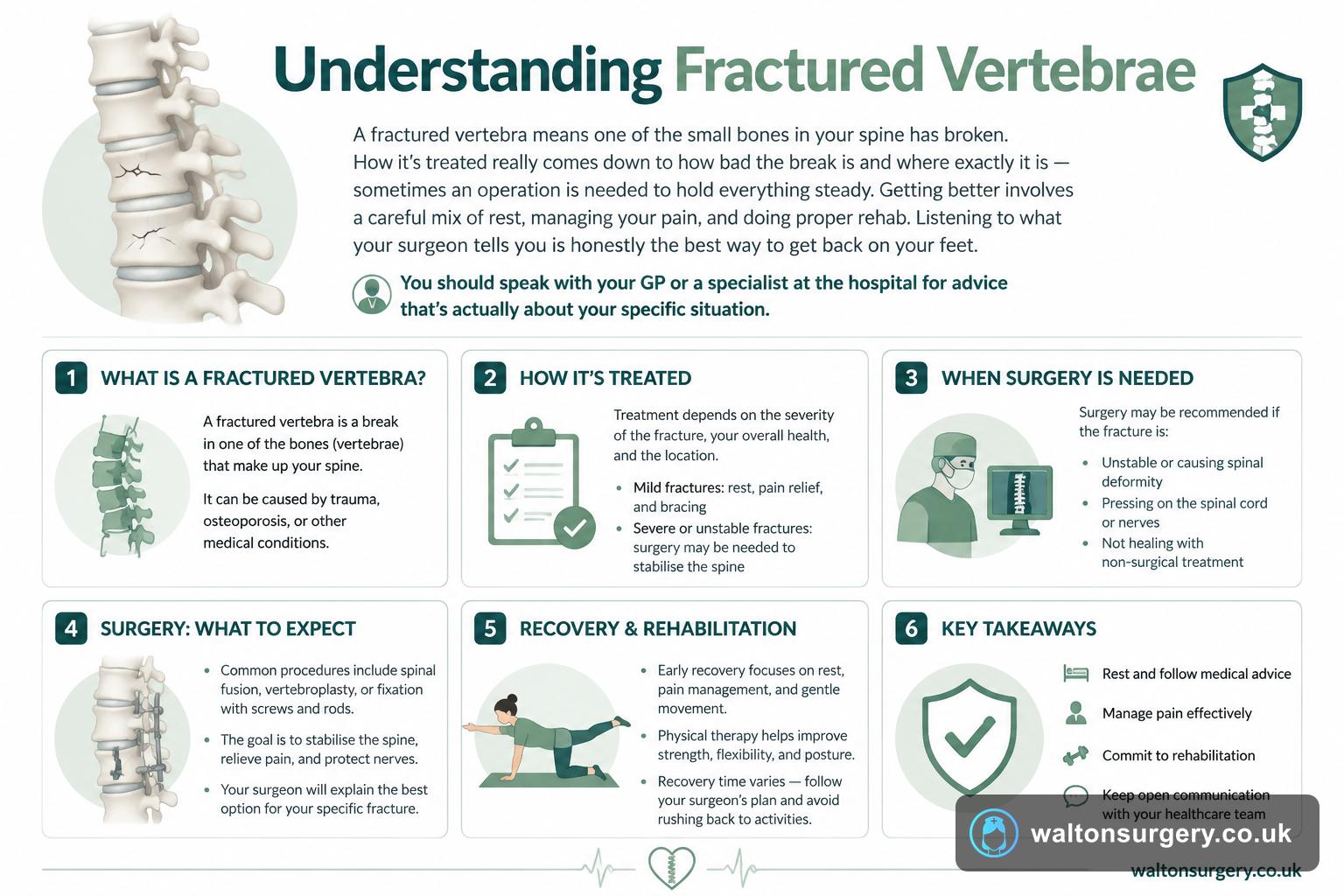
A fractured vertebra means one of the small bones in your spine has broken. How it's treated really comes down to how bad the break is and where exactly it is — sometimes an operation is needed to hold everything steady. Getting better involves a careful mix of rest, managing your pain, and doing proper rehab. Listening to what your surgeon tells you is honestly the best way to get back on your feet. You should speak with your GP or a specialist at the hospital for advice that's actually about your specific situation.
Thirty-three small bones make up your spinal column, and a fractured vertebra is simply a break in one of them. You might have seen that rock legend Joan Jett had to pull out of two shows recently because she needed surgery on a "fractured vertebrae" — a good reminder that these injuries don't care how fit or active you happen to be. The spine does so much, from holding you upright to protecting your spinal cord, that any kind of break is a serious business.
Knowing what brings these fractures on, what surgeons actually do to fix them, and how recovery tends to unfold can help you understand the headlines, but more practically, it arms you with real knowledge. This piece covers the main facts about fractured vertebra surgery recovery, drawing on information from the UK's National Health Service. Always get in touch with your GP or a hospital specialist for guidance tailored to your own body.
What Exactly Is a Fractured Vertebra?
Individual bones called vertebrae are stacked up to create your spine, one on top of the other. A fractured vertebra is what happens when one of those bones cracks or breaks entirely. The severity varies quite a bit — it could be a hairline crack in the outer shell of the bone, or a full collapse that actually alters the shape of your spine.
Based on how the bone breaks, the NHS classifies spinal fractures into a few types. Compression fractures occur when the front part of the vertebra caves in, which often leaves it with a wedge-like appearance. Burst fractures are more serious, involving the vertebra breaking in multiple spots, and bone fragments can sometimes end up in the spinal canal. Fracture-dislocations combine the break itself with ligament damage, which tends to make the whole spine unstable.
Location plays a role too. The thoracic spine, that's the mid-back, and the lumbar spine, your lower back, see the most fractures. The cervical spine, your neck, is hit less often. But when it is, there's extra risk — it sits close to the brainstem and some pretty major blood vessels. If you're interested in other complex spinal procedures, you might find our recent piece on pink cervical disc surgery recovery 2026 useful context. We cover this in more depth in pink cervical disc surgery recovery 2026.
How Do These Injuries Happen?
Generally, spinal fractures come from one of two things: either a big traumatic force or bones that have become too weak.
For younger people who are otherwise healthy, it's usually something with a lot of force behind it. Car crashes, falls from a decent height, and sporting accidents are the main culprits. Healthy vertebrae need quite a lot of energy to break, so you'll often find these fractures come packaged with other injuries too. High-impact trauma can cause all sorts of simultaneous damage, and stories like channing tatum shoulder surgery separated recovery 2026 highlight how a single accident can affect multiple areas of the body. We cover this in more depth in channing tatum shoulder surgery separated recovery 2026.
In older adults, though, the picture shifts — especially if osteoporosis is in the mix. Osteoporosis thins out your bones, making them much more fragile. For someone with the condition badly enough, a simple stumble, bending over to pick up a shopping bag, or even a particularly violent sneeze can be enough to cause a compression fracture. The NHS points out that osteoporosis affects around three million people in the UK, and it's one of the biggest drivers of vertebral fractures in the over-50s.
Some medical conditions and certain medications taken long-term, corticosteroids being a common one, can also wear down your bones over time. If you're worried about yours, your GP can set up a DEXA scan to check your bone density and see where you stand.
When Does Surgery Become Necessary?
Not every fractured vertebra needs an operation. The NHS way is to look at surgery when the fracture has made your spine unstable, when bits of bone are pressing on the spinal cord or a nerve, or when non-surgical options like bracing and pain control just haven't done enough.
Several things feed into that decision:
- The type of fracture. A stable compression fracture will often mend with rest and a brace. A burst fracture or a fracture-dislocation, though, is much more likely to require surgical fixation.
- Neurological symptoms. Things like numbness, weakness, tingling, or losing control of your bladder or bowels are serious warning signs. They usually mean bone fragments or swelling is squeezing a nerve somewhere, and surgery is generally the recommended way to relieve that.
- How much deformity there is. If the break has caused your spine to curve or collapse a lot, an operation can help put the alignment right and avoid longer-term issues.
- Your general health. Surgeons have to balance the benefits of surgery against the risks of the anaesthetic and the procedure itself, which matters a lot more if you're older and have other health problems.
If you're not sure whether your fracture needs an operation, ask your specialist to walk you through their thinking. They should be able to explain what's specific about your fracture and the reasons behind the treatment they're suggesting.
What Does Fractured Vertebra Surgery Actually Involve?
Vertebroplasty, kyphoplasty, and spinal fusion with instrumentation are the procedures you'll hear about most often for vertebral fractures.
With vertebroplasty, a special medical-grade cement gets injected straight into the broken vertebra through a narrow needle. It sets quickly, giving the bone stability. It's a minimally invasive procedure, typically carried out under local anaesthesia and some sedation.
Kyphoplasty works in a similar way but has an added stage. A small balloon goes into the fractured vertebra first, and then it's inflated to try and win back some of the bone's lost height. That balloon is then removed and the space it created gets filled with cement. Both techniques are quite commonly used for osteoporotic compression fractures.
When fractures are more severe or unstable, spinal fusion with instrumentation tends to be the go-to approach. The surgeon realigns the vertebrae and holds them in the correct position using metal screws, rods, or plates. Bone grafts might be used as well to encourage the vertebrae to gradually grow together. This is a bigger procedure, normally done under general anaesthesia, and it usually means a longer stay in hospital.
Your surgical team will tell you which operation they think is best and explain their reasons. Feel free to ask how long the operation is likely to take, what kind of anaesthesia will be used, and whether any hardware will stay in your body permanently.
What Does Fractured Vertebra Surgery Recovery Actually Look Like?
Most people want to know about this part, and it's where having a realistic picture really counts. Getting better after fractured vertebra surgery doesn't happen overnight, and how long it takes depends on the type of procedure you had and your overall health.
Following vertebroplasty or kyphoplasty, a lot of patients head home that same day or after just one night. Pain relief can kick in pretty quickly, sometimes within 48 hours, though a bit of soreness around the injection site is fairly normal. You'll usually be encouraged to get up and walk the same day or the morning after. Your surgeon will lay out specific restrictions, but many people are back to light daily tasks within a few weeks.
Recovery after spinal fusion takes a good deal longer. You'll probably spend three to seven days in hospital. Walking starts within a day or two, but you'll need to steer clear of bending, lifting, and twisting for several weeks — in some cases up to three months. A back brace might be prescribed to support your spine while it heals.
🔬 Key Facts
Recovery Timelines by Procedure
- → Vertebroplasty/Kyphoplasty: Many patients go home the same day or next morning.
- → Spinal Fusion: Hospital stay is typically three to seven days.
- → Bone Healing: Hardware gives instant stability, but the bone itself takes weeks to months to knit.
- → Restrictions: No bending, lifting, or twisting for several weeks to three months.
Bone healing, the NHS makes clear, takes its own time. The surgical hardware gives you stability right away, but the bone itself needs weeks to months to fully knit back together. Follow-up appointments with X-rays let your surgical team keep track of how well it's mending.
Controlling your pain is a big part of getting through recovery. Your team will probably put you on a mix of painkillers, which could include paracetamol, NSAIDs, and sometimes short courses of something stronger. If your pain isn't being managed well, tell your GP or hospital team — they can adjust things.
Rehabilitation and Returning to Normal Activities
Physiotherapy is a standard part of recovering from fractured vertebra surgery. A physiotherapist works with you on exercises built to strengthen the muscles that support your spine, get your flexibility back, and teach you to move safely.
The early weeks focus on gentle stuff: walking, light stretches, and breathing exercises — the breathing work helps prevent chest complications that can come with being less mobile. As your healing moves along, the programme gets gradually tougher. The NHS advises that rehabilitation should be supervised, particularly at the start, so you don't accidentally put too much strain on a bone that's still mending. It is always worth checking recovery details for specific procedures; for instance, the nuances of almond eye surgery uk cost recovery canthoplasty 2026 explainer show how different surgical fields have their own timelines and restrictions. If you want the fuller picture, our guide to almond eye surgery uk cost recovery canthoplasty 2026 explainer goes further.
When you can go back to work really depends on the job you do. Desk-based work might be feasible within four to six weeks after a less invasive procedure. If your role is physically demanding, you could be looking at three to six months or even longer. Your GP or an occupational health team can help plan a phased return and suggest adjustments at work.
Driving is usually possible once you can comfortably slam on the brakes in an emergency and sit without too much pain. That typically takes several weeks, but do check with your surgeon before you get behind the wheel.
Frequently Asked Questions
⭐ The Bottom Line
What this means for you
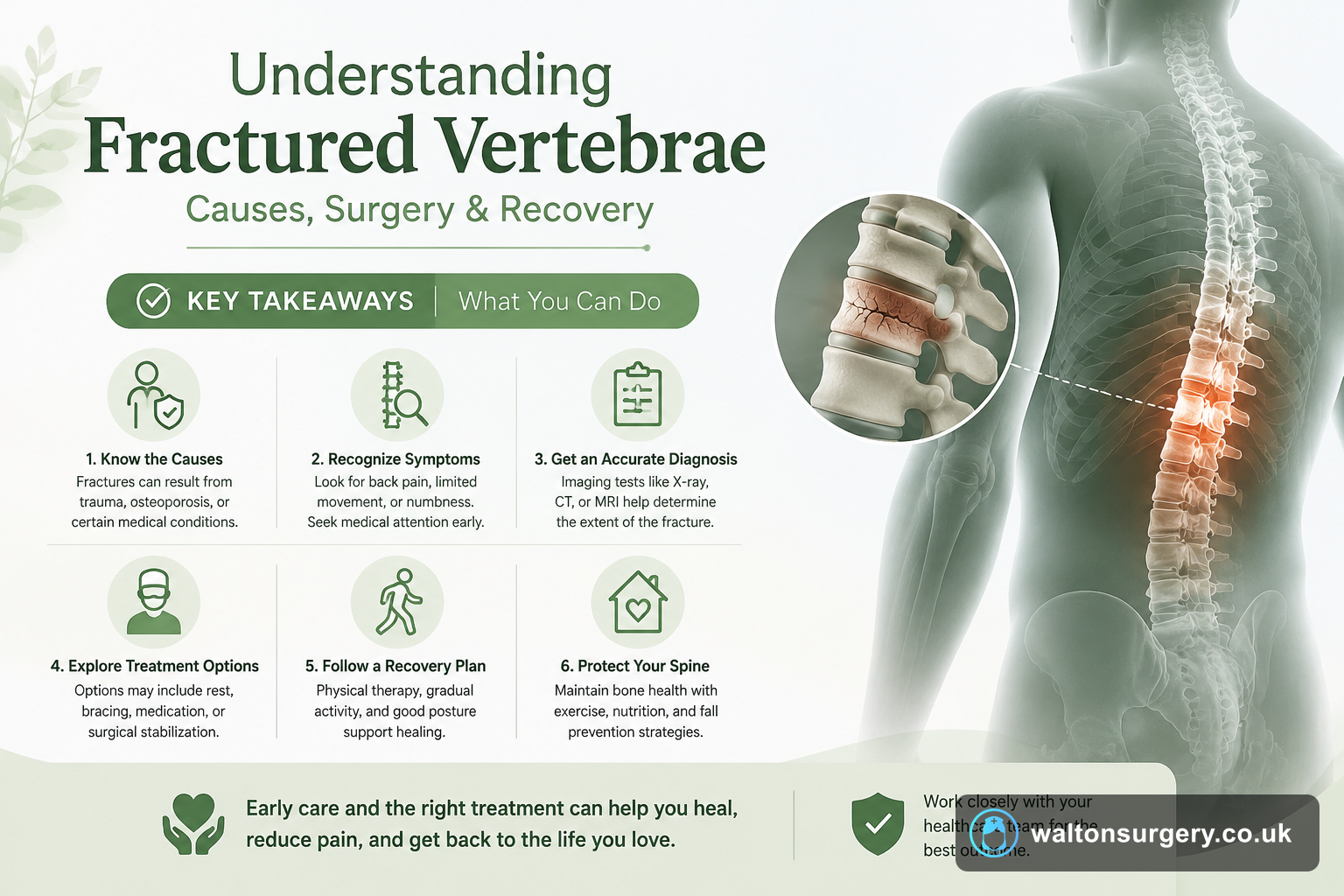
A fractured vertebra is a serious injury, but treatments have come a long way. Surgery isn't always called for, but when it is, the procedures used are tried and tested. Recovery from fractured vertebra surgery needs patience — think weeks to months depending on what was done — and sticking closely to your rehabilitation plan. Always have a conversation with your GP or specialist for advice specific to your own condition. If you're concerned about your bone health, ask about getting a DEXA scan.
Last updated: 2026-08-07 · Written by the Walton Surgery editorial team · Medical information is for educational purposes only and does not replace advice from a qualified healthcare professional.