

BPC-157 Supplement Review UK 2026: The Recovery Peptide Behind the Hype

⚡ Quick Answer
BPC-157 is a 15-amino-acid peptide with promising results in animal studies for tendon, ligament and gut healing, but very limited human data. It is not licensed by the MHRA in the UK in 2026, is banned by WADA for competitive athletes, and most published research uses injection rather than oral capsules. Treat anyone promising guaranteed results with strong scepticism. If you do consider trying it, speak to your GP first and only buy from clearly labelled, lab-tested sources.
Walk into any gym in the UK in 2026 and someone will tell you about BPC-157. The peptide — short for Body Protection Compound 157 — has built a reputation in the recovery and biohacking world as a kind of universal repair signal: tendons heal faster, gut linings settle, joint pain quietens down. It is one of the most discussed compounds in the wellness peptide space.
The reality is more interesting and more cautious than the marketing. BPC-157 has a genuinely intriguing biology and several decades of animal research behind it, but its evidence base in humans is still thin, its regulatory status in the UK is unsettled, and a lot of the bolder claims come from anecdote rather than data. One increasingly visible UK-accessible product is a 1000 mcg oral BPC-157 capsule from HealthBuy, but we will look at the science before we look at any product.
This guide walks through what BPC-157 actually is, what published studies have and have not shown, the UK regulatory picture in 2026, and how to think honestly about oral BPC-157 capsules versus the injectable form used in most research. Our aim is informational: to give UK readers a clearer picture than the marketing pages typically offer.
What BPC-157 actually is
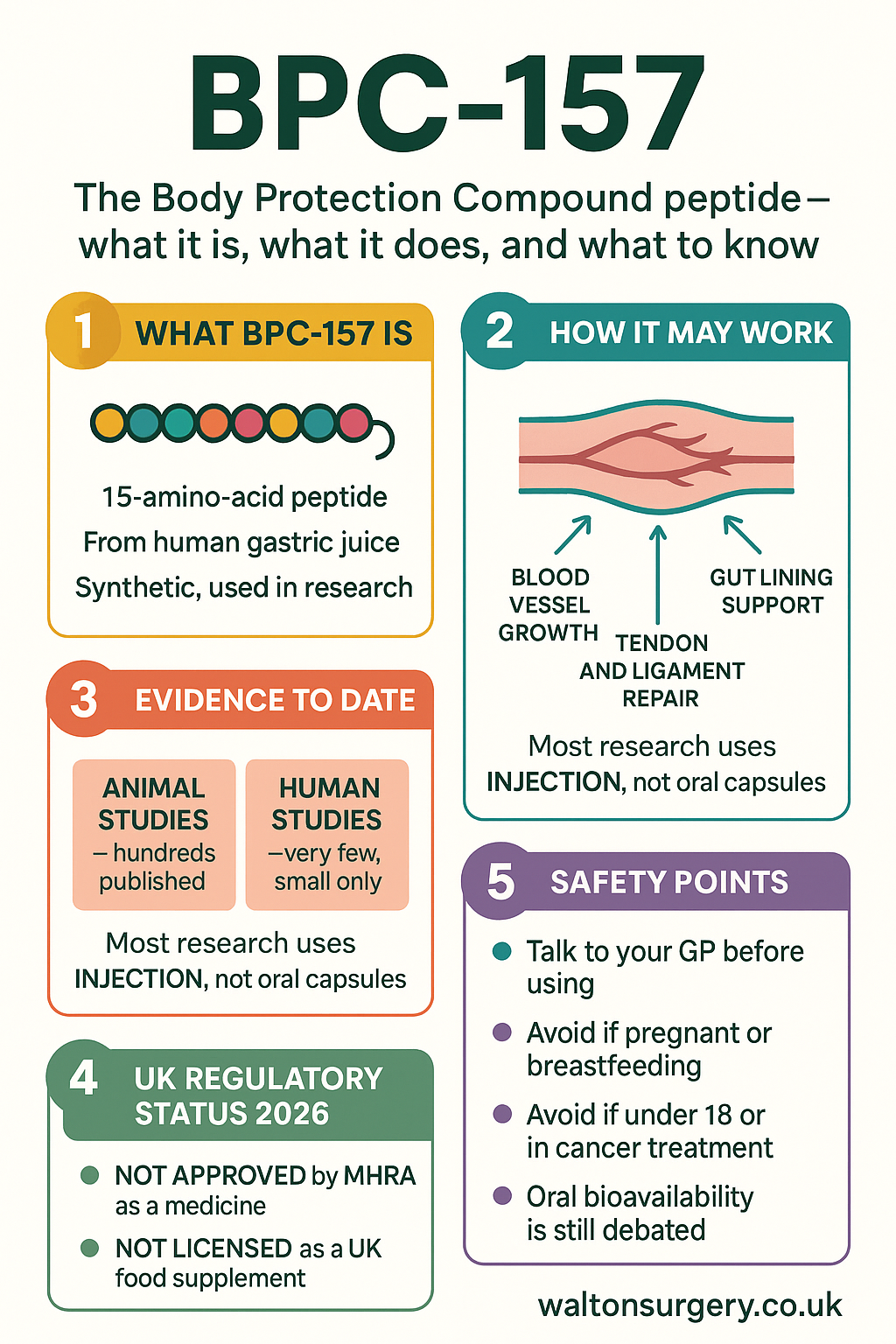
BPC-157 is a short synthetic peptide — a chain of 15 amino acids — derived from a fragment of a larger protein found naturally in human gastric juice. That gastric-juice origin is part of why researchers became interested in the first place: the stomach is one of the most hostile environments in the body, and proteins that survive there tend to have interesting protective properties.
The compound was first synthesised and studied in the 1990s by researchers at the University of Zagreb in Croatia, who gave it the rather ambitious name “Body Protection Compound” based on its broad cytoprotective effects in laboratory experiments. Hundreds of papers have followed since then, almost all of them in rodents. The peptide does not exist as a licensed medicine anywhere in the world.
In commercial form, BPC-157 is sold mainly in three formats. The most studied is an injectable preparation, given either subcutaneously or intramuscularly, which is also the form most often used illegally in performance sport. Oral capsules — a more recent commercial development — bypass the injection problem but raise questions about how much survives digestion. A small number of brands sell BPC-157 as a nasal spray, which has even thinner published support.
🧪 BPC-157 at a glance
The five things to know
- → Structure: synthetic 15-amino-acid peptide
- → Origin: fragment of a protective protein in gastric juice
- → Most studied use: tissue, tendon, ligament and gut repair
- → Most research format: injection in rodents
- → Regulatory status UK: not licensed as a medicine or food supplement
How BPC-157 may work — the proposed biology
The mechanisms proposed for BPC-157 are surprisingly varied. The clearest is its effect on blood vessel formation. Animal studies show that BPC-157 upregulates a receptor called VEGFR2, which is central to the growth of new blood vessels — a process known as angiogenesis. Better local blood supply is one of the rate-limiting steps in healing damaged tissue, and this is the leading candidate explanation for why BPC-157 seems to speed recovery from tendon and ligament injuries in rodent models.
A second proposed mechanism is its influence on the nitric oxide system, which regulates blood flow, inflammation, and cellular communication. A third, which is particularly relevant to gut-related claims, involves direct effects on the mucosal lining of the stomach and intestines — animal studies have repeatedly shown protection against ulcers caused by alcohol, NSAIDs, and other stressors. A fourth, more speculative, set of mechanisms involves nerve growth factor pathways and neuroprotective effects.
It is honest to say the picture is more like a busy intersection than a single clean pathway. BPC-157 appears to nudge multiple healing systems at once, which is both why advocates talk about it as a “universal repair signal” and why sceptics treat that framing with caution: a compound that does many things in animal models can also have many unintended effects in humans that we have not yet measured.
⚠️ A reality check on the claims
No high-quality randomised controlled trial in humans has confirmed any of the claims made for oral BPC-157. The strongest data is in rodents using injection. If a product page or influencer tells you BPC-157 is “clinically proven” to heal tendons in humans, that is marketing language running ahead of the published research.
The evidence: what we actually know in 2026
The animal literature is genuinely substantial. By 2026, the published research base on BPC-157 runs to hundreds of papers, with rodent models covering Achilles tendon injury, muscle crush injury, ligament damage, gastric ulcers, inflammatory bowel disease analogues, traumatic brain injury models, and bone healing. In most of these, BPC-157 outperforms placebo on healing markers — but, crucially, almost all use the injectable form and animal physiology.
Human data is a different story. A handful of small studies — mostly Croatian and East European — have reported reductions in pain or healing-time markers, but these are not large randomised controlled trials. They have not been replicated in the UK, the US or the EU at meaningful scale, and they do not satisfy the standard of evidence that would lead to MHRA or FDA approval. The honest summary is that BPC-157 is a research peptide with very promising preclinical data and a clinical evidence base that is still catching up.
The oral bioavailability question deserves a specific note. Peptides are normally broken down by digestive enzymes before they can be absorbed intact. BPC-157 was originally identified because it was unusually stable in gastric juice, which is why some researchers argue oral dosing may retain biological activity. A few rodent studies support this idea. But it is fair to say the case for oral BPC-157 working as well as injected BPC-157 is plausible rather than proven.
Regulatory status in the UK in 2026
BPC-157 occupies an unusual position in UK law. The MHRA — the regulator for medicines — has not licensed BPC-157 as a treatment for any condition. The Food Standards Agency has not authorised it as a permitted food supplement ingredient. Yet capsules and powders are widely sold online, usually marketed as “research compounds,” “for research use only,” or simply as wellness products.
For consumers, the practical implications are: there is no quality-controlled official supply chain, brands vary enormously in what they actually deliver, and the labelling you see is not subject to the checks that apply to a licensed medicine. Independent lab testing — the kind some reputable brands now publish certificates of analysis for — is the only realistic quality safeguard.
There is one absolutely clear regulatory point: BPC-157 has been on the World Anti-Doping Agency (WADA) Prohibited List since 2022. If you compete in any sport subject to anti-doping testing — including amateur events that follow WADA rules — using BPC-157 is a doping violation and can lead to a ban. Workplace drug testing in the UK does not generally screen for it, but the sporting regulation is unambiguous.
An oral BPC-157 option some UK readers ask about
Readers occasionally ask which BPC-157 capsule brands look reasonable, so for the same reason we covered a direct NAD+ option in a recent piece, we will outline one here as well. We have no exclusive arrangement with the brand, and we are not endorsing the underlying compound — we are noting one product some readers have asked about.
🔬 Product snapshot — HealthBuy BPC-157 1000 mcg
- Active ingredient: 1000 mcg (1 mg) BPC-157 per oral capsule
- Format: Oral capsule (not injection, not nasal spray)
- Stated claims: accelerated recovery, reduced inflammation, gut health support, cellular regeneration, brain and nervous system support — all phrased as support, not as cure
- Quality info: “Lab-tested for potency and purity,” 100% natural / non-GMO claim; no FDA or cGMP certification explicitly stated on the product page
- Price: $24.95 (≈ £20) per bottle at time of writing, with a 20% flash discount running
The £20 price point sits below many competing peptide products, which can run £40–£80 per bottle. As with any unregulated compound, the right question is not just “is this cheap?” but “do they publish an independent certificate of analysis so I can see what is actually in the capsule?” For BPC-157 specifically, a lab-test certificate is the single most important quality signal. If a brand will not share one on request, that is a strong reason to look elsewhere.
Important caveats: this is an oral peptide, so the bioavailability question we covered above applies. There is no large human trial showing it works at this dose, and there is no licensed medicine you can point to as a comparator. We would not recommend it as a first-line treatment for any injury — see your GP for that — and we would not recommend it at all to anyone competing in sport, anyone pregnant or breastfeeding, anyone under 18, or anyone undergoing cancer treatment.
Realistic expectations and who should skip it
If you do choose to try oral BPC-157, calibrate your expectations carefully. Any honest read of the evidence suggests effects, if they exist for the oral form in humans, are likely to be modest, gradual, and most apparent in the context of a real injury or recovery process — not as a general wellness boost. Anecdotal reports tend to describe four-to-six-week recovery improvements for tendon and joint complaints, but anecdotes are not data.
There are clear situations where the right answer is “do not use this.” If you are pregnant, breastfeeding, under 18, currently undergoing cancer treatment, or competing in a sport with anti-doping testing, BPC-157 is not appropriate. If you have an undiagnosed health problem — significant joint pain that is new, persistent abdominal symptoms, or unexplained weakness — please see a GP rather than self-treating with an unlicensed peptide.
For a strained tendon or a flare of gut symptoms, the evidence-based pathway is still well-known: a physiotherapist for the tendon, a GP for the gut symptoms, and the standard recovery toolkit of progressive loading, sleep, protein intake, and where appropriate, NHS-prescribed treatment. BPC-157 — if it does anything for you — would be an experimental add-on, not a substitute.
Frequently Asked Questions
What is BPC-157?
BPC-157 (Body Protection Compound 157) is a synthetic peptide made of 15 amino acids. The original sequence was derived from a fragment of a protein found naturally in human gastric juice. In laboratory and animal studies it appears to support blood vessel formation, tendon and ligament repair, and the lining of the gut. It is a research peptide, not a licensed medicine in the UK or EU.
Is BPC-157 legal in the UK in 2026?
BPC-157 is not authorised by the MHRA as a medicine and is not on the UK list of permitted food supplements. It is widely sold online as a research compound or wellness product, but it sits in a regulatory grey area. It is also on the World Anti-Doping Agency (WADA) prohibited list, which means competitive athletes risk a doping violation if they use it.
Does oral BPC-157 actually work?
This is genuinely unsettled. The vast majority of BPC-157 research uses injection in rodents. A small number of animal studies suggest BPC-157 may retain activity when taken orally, possibly because of its origin in gastric juice. Human trials of oral BPC-157 are very limited. If you are reading a confident claim about oral efficacy, it is running ahead of the published data.
What are the most common reported benefits?
Anecdotal reports — and a number of small studies, mostly in animals — describe faster recovery from tendon and ligament injuries, reduced joint pain, improved gut symptoms (in conditions like IBS or NSAID-related stomach irritation), and reduced inflammation. None of these effects are established by large UK or European clinical trials in humans.
Who should not take BPC-157?
Anyone pregnant or breastfeeding, anyone under 18, anyone currently being treated for cancer (peptides that promote blood vessel growth are theoretically risky during cancer treatment), and competitive athletes subject to WADA testing should not use it. Anyone on regular prescribed medication or with significant liver, kidney or cardiovascular disease should discuss it with their GP before starting.
Is BPC-157 the same as TB-500 or peptides like Ipamorelin?
No. BPC-157, TB-500 (Thymosin Beta-4) and growth-hormone-related peptides like Ipamorelin are all sold in the same recovery and longevity space, but they are different molecules with different mechanisms and different evidence bases. BPC-157 focuses on tissue and gut repair; TB-500 is researched for muscle regeneration; growth-hormone peptides aim to increase growth hormone release. None are licensed UK medicines for general use.
✅ The verdict
BPC-157 is one of the more interesting compounds in the recovery and longevity peptide space, with several decades of animal research suggesting genuine biological activity on tissue healing, blood vessel formation, and gut protection. The honest gap, in 2026, remains the human evidence base — small, scattered, and well short of the standard required for UK or EU regulatory approval. It is not a licensed medicine, it is banned in competitive sport, and the oral capsule format is more recent than the injectable research base.
If, knowing all of that, you decide you want to try an oral BPC-157 capsule for personal use, the HealthBuy 1000 mcg formulation discussed above is one of the more transparently labelled UK-accessible options at a relatively affordable price point. You can review the product page and current pricing here. Buy thoughtfully, give it a fair four-to-six-week trial, and stop if you notice any side effect that worries you.
For wider context on supplements, recovery and healthy ageing in the UK in 2026, you may also find these guides useful: NAD+ and healthy ageing — what the science says, creatine for women in menopause, and swimming for arthritis over 50.
🛒 Reader-recommended option
If, after reading the full picture above, you want to try an oral BPC-157 capsule, the HealthBuy 1000 mcg formulation is one of the more clearly labelled and reasonably priced UK-accessible products currently on offer.
View HealthBuy BPC-157 1000 mcg →
Affiliate link — see disclosure at the top of this article. Current price approx. £20 / $24.95 per bottle.
This article is informational and contains affiliate links. It does not replace personalised advice from your GP, pharmacist, or another qualified healthcare professional. BPC-157 is not a licensed medicine in the UK and is not authorised as a food supplement ingredient by the Food Standards Agency. It is included on the World Anti-Doping Agency (WADA) prohibited list. The information in this article is not intended to diagnose, treat, cure or prevent any disease.
