Comparing Salad Greens: Which Leafy Greens Are Healthiest?
PART C — HTML Body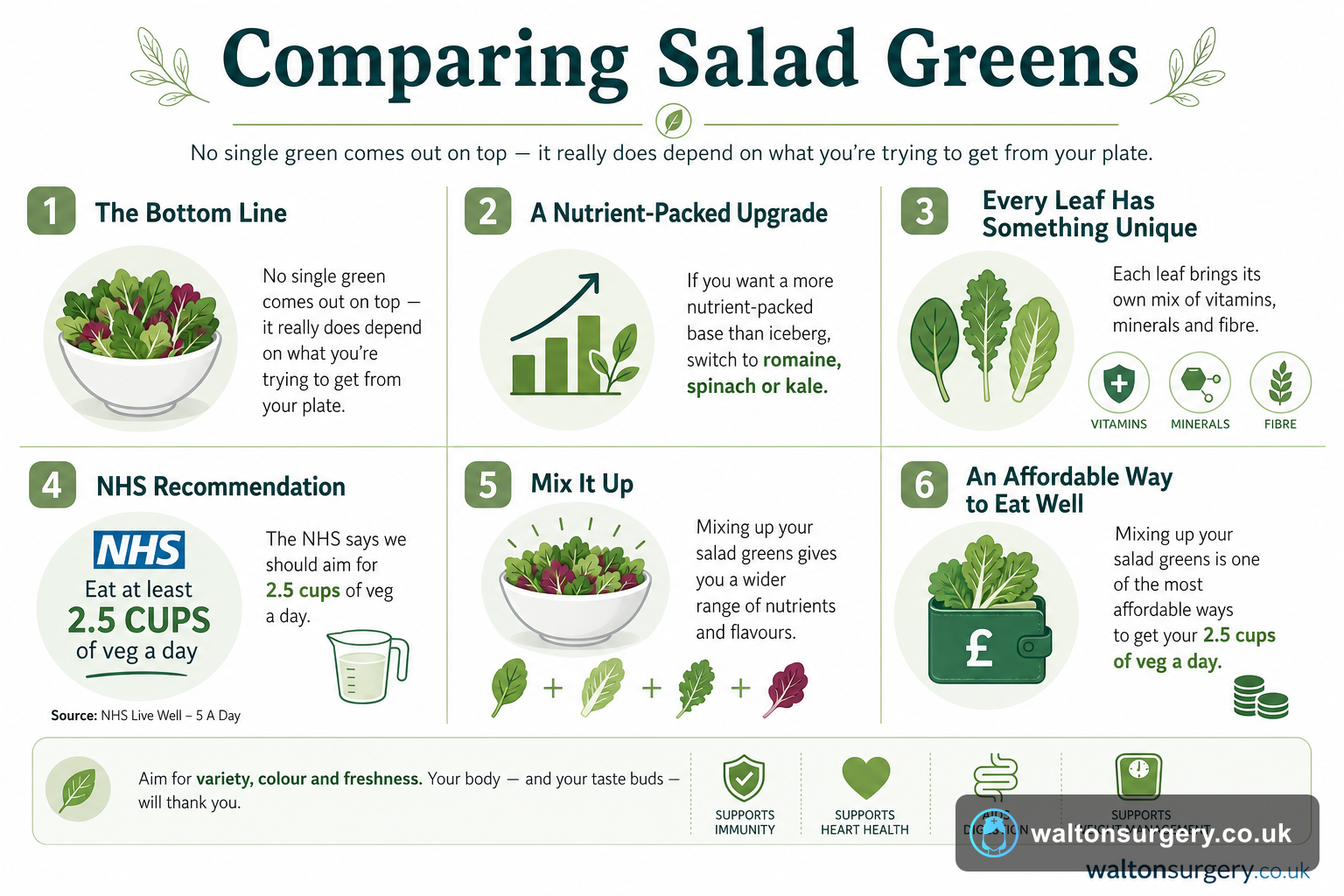
⚡ Quick Answer
No single green comes out on top — it really does depend on what you're trying to get from your plate. If you want a more nutrient-packed base than iceberg, switch to romaine, spinach or kale. Each leaf brings its own mix of vitamins, minerals and fibre. The NHS says we should aim for 2.5 cups of veg a day, and mixing up your salad greens is one of the most affordable ways to get there.
You've probably stood in the supermarket aisle wondering which bag of leaves to grab. The NHS recommends 2.5 cups of vegetables each day, and salad greens are one of the simplest routes to that target. But picking between iceberg, romaine, kale and the rest isn't only about flavour. The nutrition you get per handful varies quite a bit between them, and understanding those differences means you can make better choices without tying yourself in knots.
Iceberg used to be the only lettuce most people bought. These days though, supermarket shelves are loaded with romaine, red-leaf, butter lettuce, beet greens, bok choy, radicchio and rocket at all sorts of price points. This guide goes through what each green actually brings to the table, so you can figure out which one suits your needs — and your budget — best.
What Makes a Salad Green "Healthy"?
A salad green's worth comes down to its nutrient profile. Vitamins, minerals, fibre and water content are the main things to look at. Darker leaves tend to pack in more micronutrients than pale ones, which is a reasonable rule of thumb. But "healthy" depends on the person eating them too. Someone who's anaemic will get more from iron-rich greens. Someone managing blood pressure needs to think about potassium. No single leaf ticks every box for every person.
The NHS Eatwell Guide says a third of your plate should be fruit and vegetables. Salad greens are honestly one of the easiest ways to hit that. But they're not all equal. Some are mostly water with a bit of fibre thrown in, while others deliver useful amounts of vitamins A, C, K, folate and calcium in a normal serving.
Iceberg Lettuce – Hydrating but Nutrient-Light
People love to dismiss iceberg as nutritionally worthless. That goes too far, but it's fair to say it brings less to the party than darker greens. It's about 96 per cent water, so it's great for hydration and keeping things crunchy, but you won't get much fibre or a broad vitamin spread. There are small amounts of vitamin K and folate in there.
The thing is, if you genuinely like iceberg — the crunch, the mildness, the way it doesn't overpower anything — it's not a disaster. It adds bulk and texture to a meal without loading you with calories. Just don't make it the only vegetable in your bowl. You'll be leaving a lot of good nutrition on the table, or rather, on the shelf. Even in unrelated health conversations, such as the ongoing concern about toxic chemicals in disposable diapers, it pays to look beyond what's convenient and question what you're putting into — or onto — your body.
Romaine Lettuce – The Reliable Middle Ground
Romaine is a noticeable step up from iceberg. You get more vitamin A, more vitamin C, and a decent bump in folate. It's a reasonable source of fibre for how few calories it contains, too. The outer, darker leaves hold more nutrients than the pale inner ones — something worth remembering next time you're tempted to strip them off and bin them.
It works well as a base for salads because the leaves are sturdy enough to hold dressing and toppings without collapsing into a soggy mess straight away. For a lot of people, it hits the sweet spot between how it tastes, how it feels, and what it gives you nutritionally. Widely available across UK supermarkets, and usually cheaper than the more niche greens.
Spinach – Iron and Folate Powerhouse
Spinach is one of the most nutrient-packed greens you'll find on the shelf. Iron, folate, vitamin K, magnesium — it's got the lot, and in greater concentrations per gram than any standard lettuce. If you're trying to boost those minerals specifically, it's a smart pick.
One thing to bear in mind: spinach contains oxalates, which can get in the way of calcium absorption. So if you're eating spinach thinking you're sorting your calcium intake, you might absorb less than you'd expect. Cooking brings the oxalate levels down. A practical approach is to mix raw and cooked spinach throughout the week — you get the best of both worlds that way.
Kale – Nutrient-Dense but Not for Everyone
Kale gets called a superfood, which is more of a marketing label than anything scientific. What is true is that it's loaded with vitamins A, C and K. A single serving can blow past your entire daily vitamin K requirement. It also carries antioxidants that the paler lettuces simply don't have.
Problem is, raw kale is tough. It's bitter, and for some people it sits heavy in the stomach, causing bloating or discomfort. Rubbing it with a bit of olive oil or lemon juice helps soften the leaves and takes the edge off. If raw kale just doesn't work for you, there's no shame in cooking it lightly — steaming, sautéing, whatever you prefer. You still get most of what makes it worth eating.
Bok Choy, Beet Greens and Other Underrated Options
Bok choy belongs to the brassica family and has a mild, almost sweet flavour. It's a solid source of vitamins A and C. Most people use it in stir-fries, but shredded raw, it adds a nice crunch to salads as well. It's also lower in oxalates than spinach, which is worth knowing.
Beet greens — the leafy tops of beetroot — get thrown away far too often. That's a shame because they're genuinely rich in iron, calcium and vitamin A. Next time you buy beetroot with the stalks still on, keep them. Radicchio and arugula (or rocket, if we're being British about it) are bitter greens that bring a punch of flavour. Arugula in particular has good levels of vitamin K and folate.
🔬 Key Facts
Nutrient Density per Handful
- → Iceberg is ~96% water and provides only trace vitamin K and folate.
- → Spinach leads for iron, folate, vitamin K and magnesium per gram among standard lettuces.
- → A single serving of kale can exceed your daily vitamin K requirement and delivers antioxidants absent from pale greens.
- → Beet greens are rich in iron, calcium and vitamin A but are routinely discarded.
How to Choose the Right Green for You
The right green is the one that matches what you need. Chasing iron and folate? Spinach. After vitamin C and fibre? Romaine or kale. Watching what you spend? Iceberg and romaine are the most affordable in most UK shops.
Taste is a bigger factor than people give it credit for. If you can't stand the bitterness of kale, you won't eat it regularly — and a green that stays in the fridge until it wilts gives you nothing. The leaf you actually enjoy eating beats the one that's theoretically better for you. Rotating your greens matters too. It spreads your intake of different nutrients over time rather than overloading on one. That same logic — prioritising consistent, manageable changes over dramatic one-off fixes — applies across many areas of health, whether you're weighing up penis filler risks and effects or simply trying to eat more salad.
Frequently Asked Questions
The Bottom Line
⭐ The Bottom Line
What this means for you
No single green wins this contest outright. Darker options like spinach, kale and romaine consistently beat iceberg on nutrient density — that much is clear. But the healthiest green is the one you'll actually eat, week in, week out. Rotate your choices, buy what's in season and what you can afford, and aim for a bit of variety. A salad made from mixed greens will always be nutritionally stronger than one relying on a single type. Much like watching for solar retinopathy symptoms after eclipse, staying informed about what's on your plate helps you make smarter, safer choices every day.
Last updated: 2026-08-17 · Written by the Walton Surgery editorial team · Medical information is for educational purposes only and does not replace advice from a qualified healthcare professional.