New AI guidance for social care to cut paperwork and boost care
PART C — HTML BODY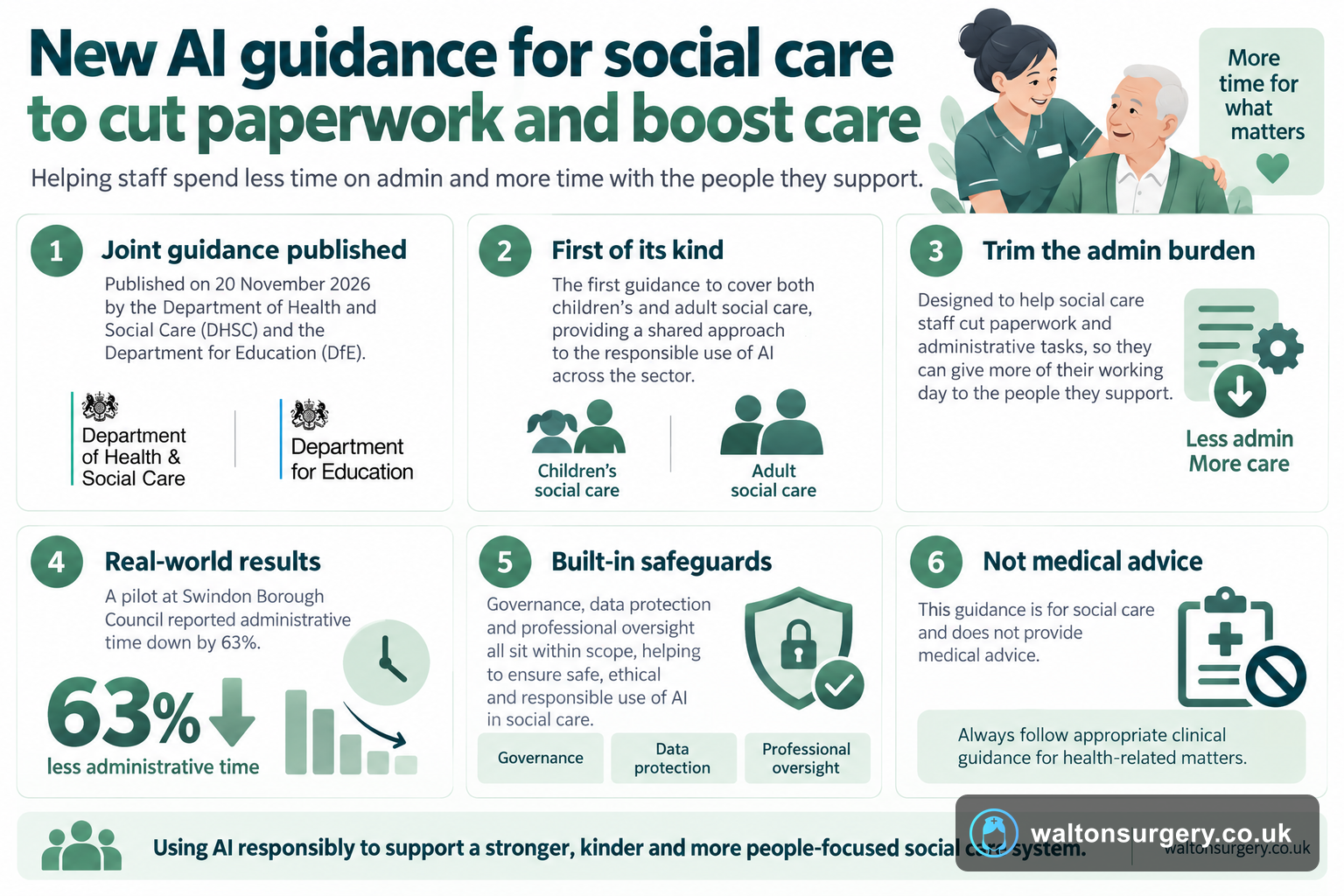
⚡ Quick Answer
Guidance published jointly on 20 November 2026 by the Department of Health and Social Care (DHSC) and Department for Education (DfE) is the first of its kind to cover both children's and adult social care. It's aimed at trimming the admin burden so that care staff can give more of their working day to the people they support. One pilot at Swindon Borough Council reported administrative time down by 63%. Governance, data protection and professional oversight all sit within scope. No medical advice here.
England's social care services, for children and adults alike, are heading for a bigger dose of artificial intelligence in day-to-day practice. 20 November 2026 is when the Department of Health and Social Care (DHSC) and the Department for Education (DfE) put out the first ever cross-sector guidance covering how those services can bring AI tools in safely, and use them responsibly.
What does that mean if you work in care, or care about someone who does? The paperwork sitting behind every visit, every case note, every assessment is about to get a shake-up. The whole point of the guidance is to reduce time spent writing things up, so that staff can actually be present with people. Now, if you're reading this because a specific health worry is bothering you today, don't wait around — ring your GP, pop into a pharmacy, call NHS 111, or 999 in an emergency. What follows is general information, nothing more.
What has actually been published?
So what is this document? In short, it's guidance from the DHSC and DfE on how artificial intelligence can be used in children's and adult social care, and it's being billed as the first ever cross-sector publication of its type anywhere in England. What it's really trying to do is give one national reference point, something leaders, practitioners and sector organisations can all point to.
Governance, accountability, data protection and professional oversight all appear, and there's practical advice on adoption too. A key goal — though I use that word with some caution given how often it gets thrown around — is to reduce the variation in how AI shows up across the sector, and to give local authorities and care providers a firmer footing when they're choosing which digital tools to bring in. It does not replace clinical or professional judgement. It's the kind of coordinated, cross-departmental push we've also seen with the new cancer care oversight board uk, where clearer national frameworks are being used to plug gaps in oversight.
How will AI change the working day for care staff?
Cutting the paperwork mountain
What the DHSC and DfE say is that AI can release care staff to give more time to people and families, simply because routine tasks get quicker. The examples given in the announcement are the kind of thing that eats into a shift: transcribing and summarising case notes, translating information for a family, searching back through a complex history, or picking up on gaps in someone's support package.
What they expect to happen is a real drop in admin load — while, at the same time, the quality of care should go up. The logic is simple enough. If you're not stuck writing things up, you're free to listen properly, watch for changes in someone's condition, and just be there. Sara McClinton, Chief Social Worker at the DHSC, has talked about AI supporting a more efficient, responsive and person-centred system.
What did the Swindon pilot actually find?
Time to get into the actual numbers. A pilot was run in Swindon Borough Council's adult social care service, where an AI tool was used alongside social workers doing their job. According to the DHSC and DfE, the result was administrative time down by 63 per cent, which in practice means those social workers got back time to spend with people.
Care Act assessment conversations dropped from 1.5 hours to 30 minutes on average, and the write-up afterwards went from 4 hours down to 1.5. The DHSC and DfE also flag that the tool turned out to be especially useful for colleagues living with visual impairments, and for anyone whose first language isn't English.
🔬 Key Facts
The Swindon pilot in numbers
- → Administrative time down by 63 per cent
- → Care Act assessment conversations down from 1.5 hours to 30 minutes
- → Write-ups down from 4 hours to 1.5 hours
- → Especially useful for colleagues with visual impairments and for people whose first language isn't English
What does this mean for children's services?
On the DfE side, the whole thing rests on a fairly simple principle: good children's social work grows out of relationships. Josh MacAlister, the Children and Families Minister, has been straightforward about it — no piece of technology is going to swap out for the knowledge and skill a social worker brings. Supportive framing, not substitutional.
Take the admin away and the thinking is that social workers can point their skills at what really matters, which is listening to kids, working alongside families, and making sure each child gets the protection and support they're entitled to. Isabelle Trowler, Chief Social Worker at the DfE, has put it as recognising what AI can offer while keeping practitioners and their professional judgement in the middle of everything. Of course, protecting children's wellbeing also means being straight with families about contentious areas — the debate around gender affirming care for minors uk shows how much careful professional judgement matters when evidence and policy shift.
Look at the real-world examples
Swindon isn't the only thing worth looking at. Over at Peterborough council, the DHSC and DfE point to staff who built themselves a bespoke AI assistant, named Hey Geraldine, using the accumulated knowledge of an experienced occupational therapist as its foundation. It gives people on the ground instant answers.
1,200 or so questions answered, according to the DHSC and DfE, with roughly 15 minutes saved on each interaction. For a care worker in the middle of a busy shift, that 15 minutes per query isn't trivial — it compounds. The other thing Peterborough shows is that you don't have to buy something off the shelf; AI tools can be shaped around the know-how of experienced local practitioners.
How does this fit with digital records in care?
AI adoption isn't happening in isolation — it's riding along with a much bigger move to digital records across the whole of care. The DHSC and DfE put the figure at 4 in 5 care providers now using digital social care records, which covers close to 90 per cent of people who draw on care. They describe this as delivering millions more caring hours.
Going digital also cuts down on the same conversation happening twice, and on mistakes and inaccuracies creeping in. What government says it wants is for all care providers to be fully digitised by the end of this Parliament. If you're a family member, what this looks like from the outside is fewer times you have to explain the same story, and fewer chances for detail to slip through the cracks between one visit and the next. It also raises the bar for data security generally — a reminder that everyday information habits still matter, much as they do when something as mundane as summer foot care sandals uk can quietly cause problems if details go unnoticed.
How to raise a concern about care
Not happy with how someone's being cared for — whether that's digital records or not — the place to start is the service itself. Every care provider runs a complaints process, and the local authority that commissions or regulates that service should be able to tell you how to access it.
For a health worry about a particular person, get in touch with their own GP, or call NHS 111 out of hours if it's urgent but not life-threatening. 999 is for emergencies. Not sure where to go? NHS 111 will point you to the right place. Walton Health News publishes general information and doesn't see, treat or book patients.
Frequently Asked Questions
⭐ The Bottom Line
What this means for you
First ever cross-sector guidance on AI in children's and adult social care, out on 20 November 2026 from the DHSC and DfE. The aim: less admin, more human contact. Swindon's pilot came back with administrative time cut by 63 per cent. If you work in care, or care about someone who does, this is worth getting your head around. Health worry? Speak to your own GP, a pharmacist, NHS 111, or 999 in an emergency.
Last updated: 2026-11-20 · Written by the Walton Editorial Team · Walton Health News is an independent health information site, not a GP practice. Information is for educational purposes only and does not replace advice from your own GP, pharmacist or NHS 111.