Gender-Affirming Care for Minors: What UK Patients Need to Know
PART C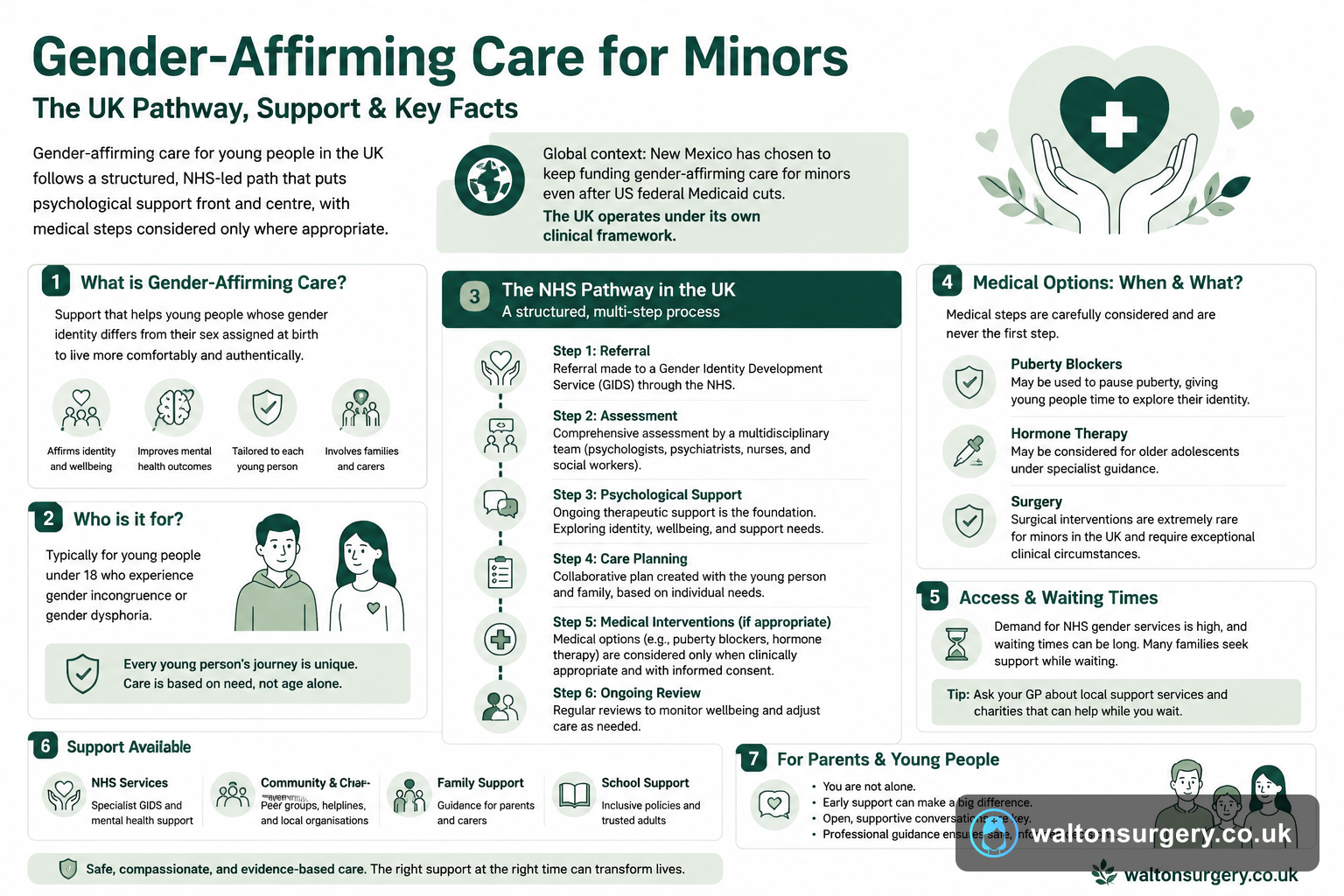
⚡ Quick Answer
For young people in the UK, gender-affirming care follows a structured, NHS-led path that puts psychological support front and centre, with medical steps considered only where appropriate. Global debates continue — New Mexico, for instance, has chosen to keep funding this care for minors even after US federal Medicaid cuts — but the UK operates under its own clinical framework. Access through the NHS can involve waiting, though. This article walks through the current UK system, the support available, and answers questions parents and young people commonly ask.
If you're a young person in the UK exploring gender identity, or a parent trying to understand what support exists, the NHS pathway is where most of the action happens. It's built around psychological support and thorough assessment — not a rush to medication. The system has its own clinical oversight and guidelines, which run independently of what's happening elsewhere.
That said, international developments do shape the conversation. New Mexico's recent move to keep funding gender-affirming care for minors, even after US federal Medicaid cuts, is one example of how differently countries approach this. The UK model is distinct, though. It's publicly funded, clinically guided, and designed to prioritise each young person's wellbeing over politics.
For families here, knowing what's actually available — and what to expect at each stage — matters more than headlines. This guide lays out the facts as they stand, drawn from established NHS procedures and the support services that exist alongside them.
What Does Gender-Affirming Care for Minors Involve in the UK?
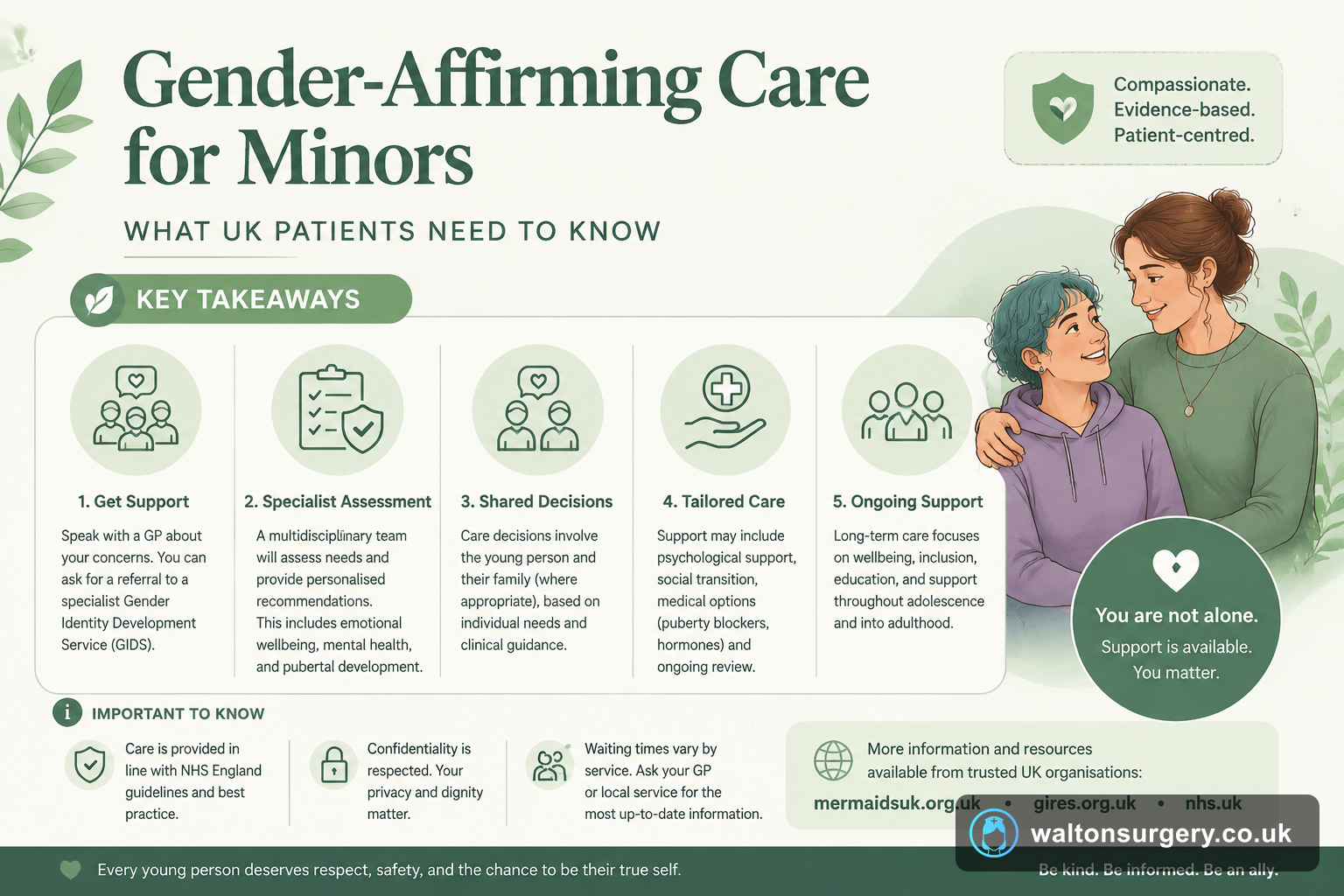
Care for young people in the UK doesn't start with medication. It starts with a referral, usually from your GP, to the NHS Gender Identity Development Service (GIDS) — that's the specialist service handling under-18s. The early stages are really about psychological assessment and support. A young person and their family get the chance to explore feelings and identity in a structured way, with professional guidance.
Medical interventions like puberty blockers or hormone therapy only come into the picture after extensive assessment, and they're not offered to everyone. The whole approach is cautious and tailored to the individual. The aim, throughout, is to support the young person's wellbeing as they develop — not to push them down any particular path.
How Does the NHS Pathway Work?
Your GP is the starting point. If a young person is experiencing gender dysphoria, the GP can refer them to GIDS. One thing worth knowing upfront: waiting times for a first appointment can be significant. The NHS acknowledges this and is working on it, but it's a reality families need to prepare for.
Once the young person is seen, the service provides psychological support and assessment over a period of time. Decisions about any medical treatment are made together — the young person, their family, and the clinical team all have input, and strict clinical protocols guide the process. The NHS is clear that this isn't a quick journey. Psychological support is a core part of the pathway regardless of whether medical steps follow.
What Medical Treatments Are Available?
🔬 Key Facts
Medical Treatments on the NHS
- → Puberty blockers (GnRH analogues) may be prescribed to pause physical developments and are fully reversible if stopped.
- → Cross-sex hormones (oestrogen or testosterone) are generally considered for those aged 16 and over.
- → Surgical interventions are not performed on minors in the UK — that's a firm line.
- → Not every young person who is referred will seek or be recommended medical treatment, and that's entirely normal.
Medical treatments, when they're considered at all, happen on a case-by-case basis and only after thorough assessment. For some young people in early puberty, puberty blockers — GnRH analogues — may be prescribed to pause physical developments. These are fully reversible if stopped. That's an important point the NHS makes explicitly.
Cross-sex hormones, such as oestrogen or testosterone, are generally considered for those aged 16 and over. Again, extensive assessment and discussion come first. Surgical interventions are not performed on minors in the UK — that's a firm line. All medical treatments are provided within the NHS and require ongoing monitoring. Not every young person who is referred will seek or be recommended medical treatment, and that's entirely normal.
What Support Is Available Beyond Medical Treatment?
Support extends well beyond the medical pathway. Psychological counselling, peer support groups, and educational resources all play a part for many young people and their families. Organisations like Mermaids and Gendered Intelligence offer support, information, and community for transgender and gender-diverse young people and their families — though they're independent charities, not part of the NHS.
Schools have a role too in providing a supportive environment, though how well they do this varies. Your GP can also refer you to local Child and Adolescent Mental Health Services (CAMHS) for broader mental health support if that's needed. Honestly, the medical side gets most of the attention, but the non-medical support can make just as much difference to a young person's day-to-day life.
How Does UK Care Compare to International News?
Recent news from the United States — New Mexico's decision to continue funding gender-affirming care for minors after a federal rule ended Medicaid support for such care, for instance — highlights how different the political and funding landscapes are internationally. The UK system is publicly funded through the NHS and guided by clinical guidelines from bodies like NHS England. It doesn't depend on state-level politics or insurance coverage in the same way.
While debates exist globally, the UK pathway is based on a model of careful assessment and staged intervention. That's distinct from some insurance-based or state-funded models abroad. The focus remains on individual clinical need within the NHS framework, not on political positioning.
Frequently Asked Questions
The Bottom Line
⭐ The Bottom Line
What this means for you
Gender-affirming care for minors in the UK is a structured, NHS-led process focused on psychological support and careful, staged medical intervention where appropriate. While international funding debates continue, the UK model operates on clinical guidelines and individual assessment. For parents and young people, the starting point is a conversation with a GP. Support is available from the NHS and reputable charities, and the process is designed to prioritise the young person's long-term wellbeing and safety.
Last updated: 2026-08-24 · Written by the Walton Surgery editorial team · Medical information is for educational purposes only and does not replace advice from a qualified healthcare professional.