Tattoo Health Risks: What to Know Before You Ink
PART C — HTML body: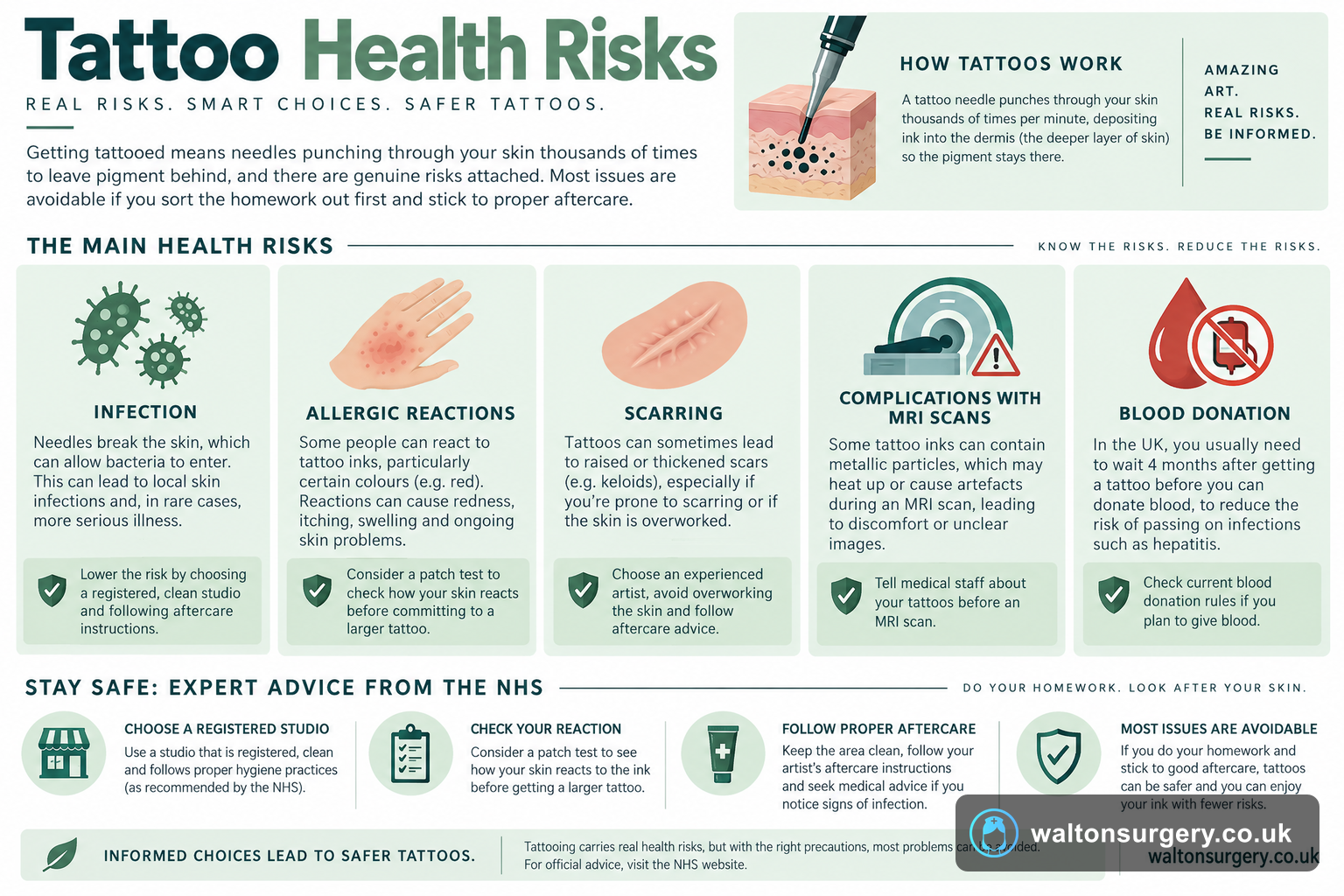
⚡ Quick Answer
Getting tattooed means needles punching through your skin thousands of times to leave pigment behind, and there are genuine risks attached: infection, allergic reactions, scarring, plus complications with MRI scans and blood donation. The NHS says to pick a registered, clean studio and to check how your skin reacts to ink before committing. Most issues are avoidable if you sort the homework out first and stick to proper aftercare. This piece goes through what the actual risks look like and what you can do about them.
Tattoos are everywhere in the UK now, but they're still unregulated cosmetic procedures that puncture the skin barrier — that outer layer being the body's first line of defence against infection. The UK Health Security Agency (UKHSA) has warned before about bacterial infections tied to unlicensed tattooists, including some cases of serious skin infection that landed people in hospital. Knowing the tattoo health risks and safety essentials isn't meant to scare you off; it's about getting you through the process without something preventable going wrong.
Every tattoo session involves needles going through the skin thousands of times over to push pigment into the dermis. According to the NHS, the main risks are infection, allergic reactions to ink, scarring, and trouble with medical imaging and blood donation. Three things do most of the heavy lifting on risk reduction: choosing a registered studio, knowing roughly what's in the ink, and following aftercare guidance properly.
What Happens to Your Skin During a Tattoo
Rather than one sharp point, a tattoo needle is actually a cluster of tiny needles punching through the outer skin layer (the epidermis) over and over to deposit pigment into the dermis beneath. The dermis is the thicker layer, full of blood vessels, nerves and connective tissue. Because the pigment ends up below the surface, your body reads it as a foreign substance — the immune system is what holds the ink in place, and also what can react against it.
Each puncture leaves behind a micro-wound. Thousands of these happen in a single session, and bigger pieces — say something a metre long — can run for many hours. Session length matters quite a bit here: the longer your skin's under the needle, the more inflammation builds up, the greater the chance of ink going in too deep, and the more unevenly it might sit in the skin afterwards.
According to the UKHSA, tattooing equipment — needles, tubes, ink caps — has to be single-use and sterile. Reusing any of it, even within the same sitting, opens the door to bacterial infection and blood-borne viruses like hepatitis B, hepatitis C, and HIV. Decent studios will open needle packets right in front of you and drop sharps into dedicated bins.
How Do You Choose a Safe Tattoo Studio?
Most tattoo-related problems in the UK trace back to unlicensed operators working out of homes, hotels or dodgy premises, not to registered studios. So this is where you actually prevent trouble.
Look at registration first. Local authorities in England, Wales, and Scotland run tattoo registration or licensing schemes. A registered studio should have its certificate on show somewhere, and the staff there follow hygiene procedures which environmental health officers from the local authority come in to inspect. Ask to see the registration — any legitimate business will show it to you without blinking.
Then go and physically visit before you book anything. The NHS advises looking for clean, well-lit premises where there's a hand-washing sink separate from the tattooing area. Surfaces ought to be wipeable and covered with disposable barrier film. Sharps bins should be visible in the room. Ink ought to come from sealed, single-use bottles or single-use ink caps, never poured from big shared containers where it could pick up contamination between one client and the next.
Ask about their sterilisation procedure too. There should be an autoclave (steam steriliser) on site and in date for servicing. The tattooist should be able to walk you through how equipment gets sterilised and what happens to single-use items afterwards. Vague answers, or someone getting defensive about hygiene questions — that tells you plenty.
A portfolio and some reviews are worth checking. Look for healed photos rather than only fresh work. Healed stuff shows you how their technique actually plays out in terms of long-term skin health. Read what people say about hygiene and the aftercare advice they got.
And please don't just price-shop for the cheapest quote. Unlicensed operators undercut registered studios because they're skipping hygiene protocols, insurance and registration fees entirely. A cheap tattoo from an unregulated setting is the single most common route to a tattoo infection in the UK.
Can Tattoo Ink Cause Allergic Reactions?
Yes — and it's one of the tattoo health risks and safety points that gets underestimated all the time. Allergic reactions are listed by the NHS as one of the main tattoo risks. They might crop up during the session itself (the skin swelling, itching or weeping around the work) or weeks, months, even years down the line.
Particular pigment colours can trigger it. Red pigments are the most commonly reported cause of tattoo-related skin reactions, although in theory any colour can set off a response in someone who's susceptible. What you might see is a raised, itchy rash over the tattooed area — sometimes only when the sun's on it, which is called a photoallergic response.
Delayed reactions can also show up as granulomas — small firm bumps where the immune system walls the ink off. These aren't infections, they're immune responses. Steroid treatment from a GP or dermatologist might be needed to settle them down.
Anyone with a history of skin allergies, eczema, psoriasis, or reactions to metal jewellery (nickel especially) should say so to their tattooist, and might want to ask a GP about a patch test before going for a full piece. A patch test means tattooing a tiny area with the intended pigment and watching for a reaction over 24 to 48 hours. Plenty of studios don't routinely offer these, so ask outright.
What Are the Infection Risks and How Do You Spot One?
Infection is the most common preventable tattoo complication. The UKHSA has looked into outbreaks of bacterial skin infection tied to unlicensed tattooing, with some cases serious enough to need hospital treatment. Bacteria can get in during the tattoo itself, or later during healing if aftercare goes to pot.
After the first 24 to 48 hours (some redness early on is normal), watch out for redness and swelling getting worse, pus or cloudy discharge, heat around the tattoo, red streaks spreading away from the tattooed area, fever, or swollen lymph nodes. NHS guidance is to contact a GP if you spot these signs — don't sit on it and hope it settles.
Infections that can be transmitted during tattooing include:
- Staphylococcus aureus and streptococcal skin infections
- Hepatitis B and hepatitis C (blood-borne viruses)
- HIV (rare but possible with contaminated needles)
- Mycobacterial infections from contaminated ink or water
What the UKHSA keeps pointing to is that sterile, single-use needles and properly sterilised equipment are what stop these infections happening. Aftercare does its share as well: washing the tattoo with mild soap and water, using recommended aftercare products, staying out of swimming pools, hot tubs and open water while it heals, and not picking at scabs.
Spreading redness, a fever, or just feeling grim after a tattoo — call your GP or NHS 111. Emergency, call 999. General information here, not personal medical advice.
Do Tattoos Affect MRI Scans and Medical Treatment?
Surprising bit of tattoo health risk and safety lore that catches people out: the NHS flags that tattoos can sometimes cause problems during magnetic resonance imaging (MRI) scans. Pigments — older or darker inks in particular — may contain metallic compounds that interact with the MRI's magnetic field.
What's been reported is a burning or warming feeling over the tattooed area during an MRI, and occasionally swelling around it. Modern MRI scanners and protocols have cut down how often this happens, but it's still worth telling your radiographer about any tattoos before the scan.
On a practical note as well: big tattoos sitting over a mole or a skin lesion can make it trickier for a dermatologist to spot changes in the skin underneath. Family history of skin cancer, or moles you want to keep an eye on — think carefully about placement. Dermatologists will generally tell you not to tattoo directly over moles.
Blood donation gets affected too. NHS Blood and Transplant asks donors to hold off for a period after a tattoo before giving blood, which is about reducing the chance of passing on blood-borne viruses picked up during early healing. Check the current guidance on the NHS Blood and Transplant website before you book a slot.
Understand What's Actually in Tattoo Ink
Not a single substance at all — tattoo ink is a mix of pigments, carriers and additives. Pigments give you the colour; carriers are the liquids that spread it evenly (usually water, glycerol, alcohol, or glycerine); additives might be preservatives, binding agents, fragrances.
Chemicals in tattoo ink are regulated in the European Union under REACH (Registration, Evaluation, Authorisation and Restriction of Chemicals). The REACH restrictions that came in during 2022 put limits on certain hazardous chemicals in tattoo and permanent makeup inks — specific pigments, carcinogenic or mutagenic substances, and things that cause skin sensitisation. Where the UK stands on matching restrictions has been a subject of ongoing regulatory conversation, so it's reasonable to ask your tattooist about the inks they use and where they're from.
Some pigments turn up in skin reaction reports more than others. Red inks are the most commonly reported. Black inks, used in most tattoos, can contain carbon black and other compounds that raise questions about long-term safety — although large-scale human studies here are still limited.
Honest answer is that we don't have long-term population-level data on modern tattoo ink safety of the kind we take for granted with medicines. The NHS says you should weigh that uncertainty before getting inked, especially if you've got a history of skin sensitivity.
🔬 Key Facts
What's Actually in Tattoo Ink
- → Tattoo ink is a mix of pigments, carriers and additives — not one substance.
- → EU REACH restrictions from 2022 limit hazardous chemicals in tattoo and permanent makeup inks.
- → Red inks are the most commonly reported cause of tattoo-related skin reactions.
- → There is no long-term population-level safety data on modern tattoo ink of the kind taken for granted with medicines.
Who Should Think Twice Before Getting a Tattoo?
Higher complication risk applies to some people, so a chat with a GP before booking makes sense if any of these describe you:
- Weakened immune system (from a medical condition or medications like chemotherapy, biologics, or long-term steroids). Healing is slower and infection risk goes up.
- Bleeding disorder or blood-thinning medication (anticoagulants such as warfarin or direct oral anticoagulants). Tattooing may cause more bleeding and bruising.
- History of keloid scarring (raised, overgrown scars). Tattoos can spark keloids in skin that's prone to them.
- Pregnant or breastfeeding. The NHS advises against getting tattooed during pregnancy because of infection risk and the absence of safety data on inks in that situation.
- Active skin conditions where you want the tattoo (eczema, psoriasis, acne, infections). Wait until the skin's clear first.
- Known allergy to tattoo ink or metal jewellery. A patch test is worth considering first.
Not an exhaustive list, and nothing here is personalised medical advice. Unsure whether tattooing's safe for you — talk to your GP, practice nurse, or a dermatologist before booking.
Frequently Asked Questions
⭐ The Bottom Line
What this means for you
Cosmetic procedure with real tattoo health risks and safety considerations attached: infection, allergic reactions, scarring, MRI interference, blood donation restrictions. The single most effective thing you can do is choose a registered, hygienic studio, get a handle on the inks being used, and follow aftercare properly. Medical condition, medication, history of skin reactions — talk to a GP first. This article is general information, not personalised medical advice.
Last updated: 2026-10-27 · Written by the Walton Surgery editorial team · Medical information is for educational purposes only and does not replace advice from a qualified healthcare professional.
INTERNAL LINKS (embedded in body paragraphs): 1) In the "What Happens to Your Skin During a Tattoo" section, second paragraph — modify the existing paragraph to:Each puncture leaves behind a micro-wound. Thousands of these happen in a single session, and bigger pieces — say something a metre long — can run for many hours. Session length matters quite a bit here: the longer your skin's under the needle, the more inflammation builds up, the greater the chance of ink going in too deep, and the more unevenly it might sit in the skin afterwards — much like other risks we've covered in our guide to hot weather health risks, where environmental exposure compounds everyday skin stress.
2) In the "Who Should Think Twice Before Getting a Tattoo?" closing paragraph — replace with:Not an exhaustive list, and nothing here is personalised medical advice — a lesson that also applies when weighing up cousin marriage health risks UK families may be weighing, where getting the facts from a clinician beats guessing. Unsure whether tattooing's safe for you — talk to your GP, practice nurse, or a dermatologist before booking.
3) In the "Can Tattoo Ink Cause Allergic Reactions?" section, third paragraph — replace with:Delayed reactions can also show up as granulomas — small firm bumps where the immune system walls the ink off. These aren't infections, they're immune responses. Steroid treatment from a GP or dermatologist might be needed to settle them down, and it's the same caution we raise when unpacking the celebrity health advice risks that can mislead people about skin treatments.