Cousin Marriage: What Are the Health Risks for Your Children?
PART C — HTML Body Content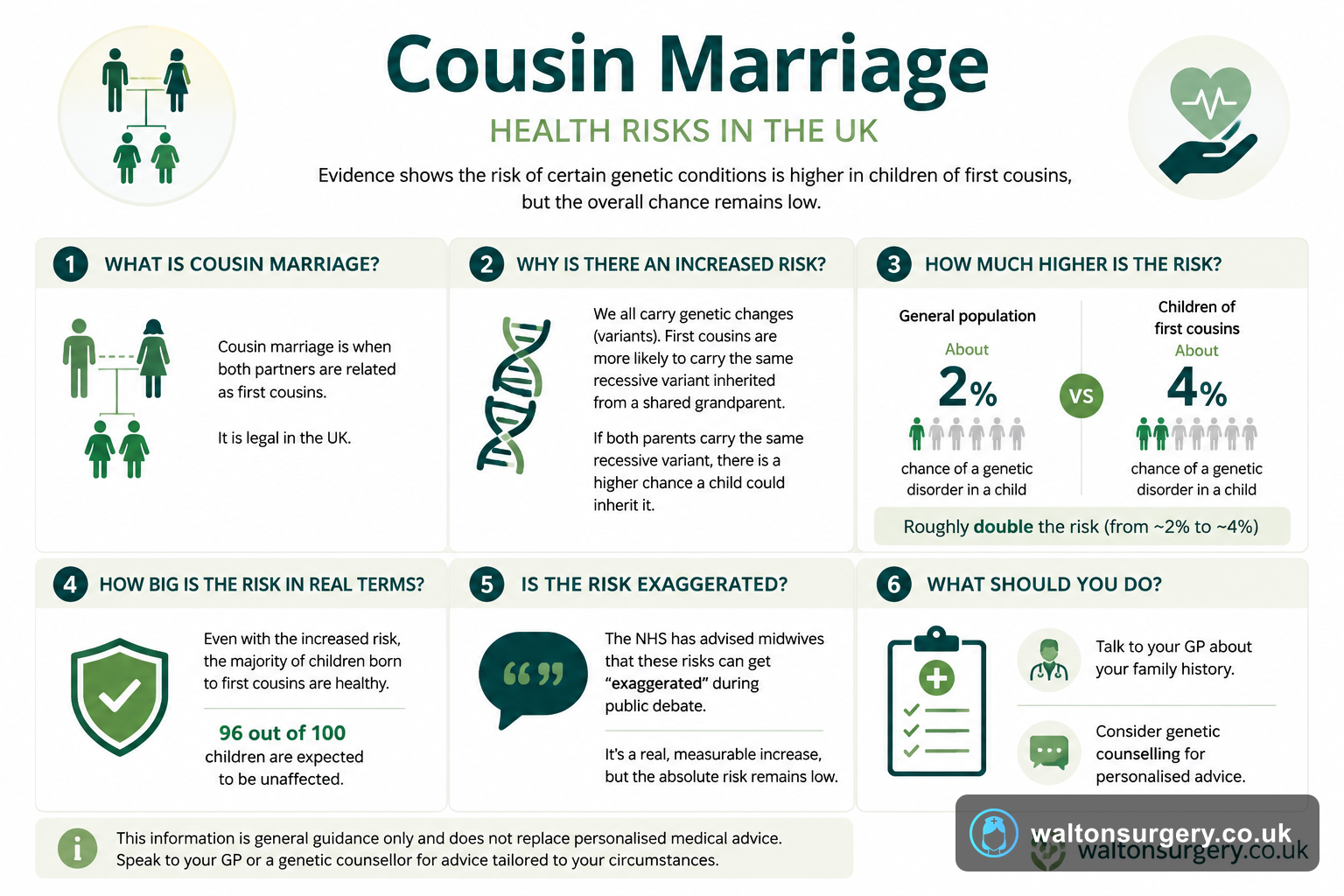
⚡ Quick Answer
The chance of a genetic disorder appearing in a child of first cousins is roughly double what you'd see in the general population, going from about 2% to 4%. It's a real, measurable increase, though the NHS has told midwives these risks can get "exaggerated" during public debate. For most couples the absolute risk is still low, but it's sensible to have a chat with your GP about family history and think through genetic counselling.
When first cousins have a child together, there's a higher chance that child could inherit a recessive genetic condition. This isn't about new birth defects appearing from nowhere — it's more that both parents might be carrying a copy of the same faulty gene, something they could've picked up from a shared ancestor. The NHS recently said the risks linked to cousin marriage have been "exaggerated," but the genetics behind it are well-understood and the principle is solid.
For UK couples who happen to be first cousins, the background risk of having a child with a serious congenital abnormality goes up from roughly 2-3% to 4-6%. People often describe this as a "doubling" of risk. What does that actually mean day-to-day? Most children born to first-cousin couples are perfectly healthy. Still, the elevated probability is worth a proper conversation with someone in healthcare.
Why Does Cousin Marriage Increase Genetic Risk?
Each of us carries two copies of most genes — one comes from mum, one from dad. Nearly everyone walks around with several faulty gene variants tucked away without realising, because a single working copy usually does the job. The problem starts when both parents hand down the same faulty copy to their child. That's when you get what geneticists call a recessive condition.
First cousins share a set of grandparents. Because of this, they're more likely to have inherited the same faulty gene variant from that common ancestor. When both parents carry the same recessive variant, every pregnancy has a 1-in-4 shot of the child ending up with two faulty copies and developing the condition. The closer the genetic relationship, the more DNA overlap you're dealing with, and the higher the odds of this scenario playing out.
How Common Are These Recessive Conditions?
There are thousands of recognised recessive genetic conditions. Cystic fibrosis, sickle cell disease, certain forms of deafness — these are just a few examples. Many of them are incredibly rare across the general population.
When the NHS guidance says risks are "exaggerated," it isn't suggesting they're zero. What it reflects is that for any single, very rare condition, the absolute chance stays low even after you double it. The real concern is cumulative. The odds of any one rare disorder are small, sure, but when you stack up the possibility of inheriting *any* one out of a large pool of potential recessive conditions, that's where the overall risk starts to climb. This is true even when you filter out the noise from celebrity health advice risks that can distort public understanding. There's more on this in our perez hilton health condition blood explainer. There's more on this in our celebrity deaths july 2026 health conditions explainer.
What Does the NHS Actually Say?
The NHS recently sent guidance to midwives — The Telegraph reported on it — saying the genetic risks of cousin marriage had been "exaggerated." This was meant as a communication to healthcare professionals about framing the issue sensitively and getting the facts right, not as a denial of the biology involved.
The guidance pushes for a balanced conversation. Midwives are told to give factual information about the modest increase in absolute risk without causing unnecessary worry. The NHS position also acknowledges the cultural context of cousin marriage in some communities, while still encouraging informed decision-making through access to genetic counselling and screening.
Should You Be Worried? Assessing Your Personal Risk
It comes down to your family history. The general doubled-risk figure is a population average. Your own risk could sit lower or higher than that.
If neither family has any known history of a recessive genetic disorder, your risk is closer to the lower end. But if there is a known condition — say a child in a previous generation had something diagnosed — the risk goes up considerably. That's exactly why talking to your GP matters. They can work out whether a referral to a genetic counsellor makes sense for your situation.
🔬 Key Facts
Understanding the Genetic Overlap
- → Recessive inheritance: Both parents must pass on a faulty copy for the condition to appear.
- → Shared ancestry: First cousins share grandparents, increasing the chance of sharing the same faulty variants.
- → The 1-in-4 chance: If both parents carry the same variant, each pregnancy has a 25% risk of the child having the condition.
What Is Genetic Counselling and How Can It Help?
Genetic counselling is available through the NHS. Basically, you sit down with a specialist and talk through your family history in detail, along with the potential genetic risks any future children might face.
A counsellor can walk you through how specific conditions get inherited. They're also able to arrange carrier screening — a blood test that checks whether you and your partner carry variants for the same recessive conditions. Armed with that information, you can make properly informed choices about pregnancy. That might include the option of prenatal diagnosis if you want it.
Frequently Asked Questions
⭐ The Bottom Line
What this means for you
Cousin marriage pushes the absolute risk of a child having a recessive genetic disorder from a low base to a still-low but doubled figure. The NHS is aware of this and advises a factual, non-alarmist approach. If you're in a consanguineous relationship, the most practical step is sitting down with your GP to go over your family history. They can point you toward an NHS genetic counsellor for personalised advice, which helps you understand your specific situation and the options available. This isn't about scaremongering. It's about being informed.
Last updated: 2026-08-07 · Written by the Walton Surgery editorial team · Medical information is for educational purposes only and does not replace advice from a qualified healthcare professional.