Symptoms of POTS: Signs, Causes and When to Seek Help
⚡ Quick Answer
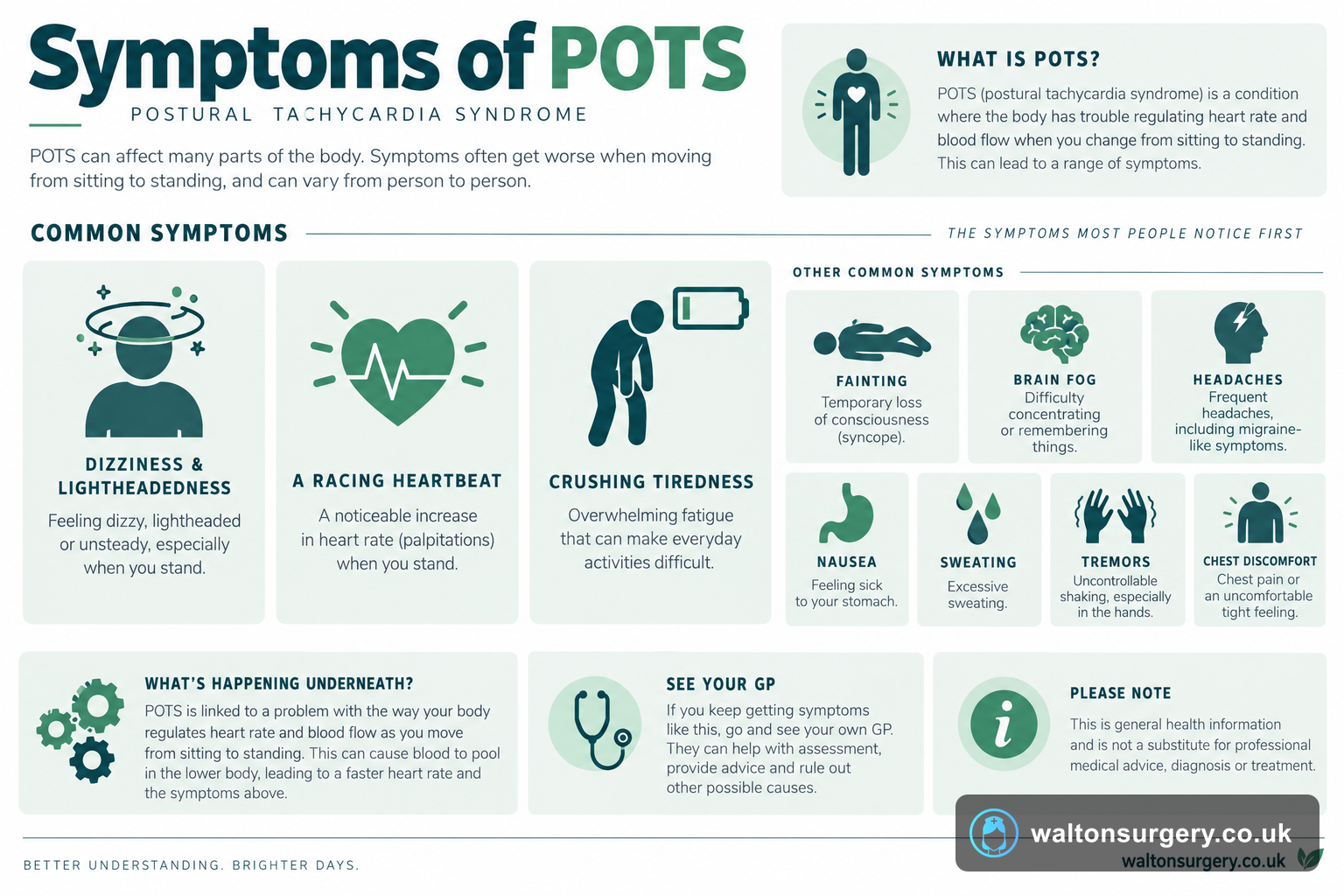
Dizziness, lightheadedness, a racing heartbeat when you stand and a crushing tiredness are the symptoms most people with POTS (postural tachycardia syndrome) notice first. Fainting, brain fog, headaches, nausea, sweating, tremors and chest discomfort also come up often. What's happening underneath is a problem with the way your body sorts out heart rate and blood flow as you shift from sitting to standing. Keep getting symptoms like this? Go and see your own GP. This is general health information, nothing more.
What happens with postural tachycardia syndrome (POTS) is that your heart rate climbs abnormally the moment you get up on your feet, and the body answers back with dizziness, light-headedness, palpitations and fatigue. Medical sources frame it as a heart-rate regulation disorder, and headaches and fainting can be part of the picture too. For most people the first thing they notice is the dizziness — or the light-headedness.
Plenty of people spend years with these symptoms before anyone says the word POTS out loud to them. They overlap with a whole pile of other conditions, and how they show up shifts from one person to the next. That's not an invitation to diagnose yourself at home, but if you know roughly what to look for you can describe things properly to your own GP and get assessed properly.
What is POTS, exactly?
The letters POTS stand for postural orthostatic tachycardia syndrome. Certain UK sources shorten it to postural tachycardia syndrome and write the abbreviation as PoTS. Breaking it down: "postural" is about your position — standing as opposed to sitting or lying flat. "Tachycardia" simply means a fast heart rate. And "syndrome" describes a cluster of symptoms that keep appearing together.
In medical language POTS is characterised by an abnormal heart rate rise triggered by moving upright. Put less formally: stand up and your heart speeds up far more than it ought to, and the symptoms follow from that. How badly it affects people varies enormously. Now and then it's a bit of a nuisance. For others it's disabling to the point where work, study and routine things like shopping or showering become hard work.
Let's be blunt about one thing. This article is general information only. A diagnosis of POTS — or of anything else — can only come from your own GP or a hospital specialist who actually examines you and orders tests.
Symptoms of POTS you might recognise
The symptom list for POTS is wide, and nobody's combination looks quite the same as anyone else's. A Google summary drawing on UK patient information puts the headline symptom as feeling dizzy, light-headed or faint, and it also flags abdominal pain and joint aches as things that can crop up.
Light-headedness, palpitations and fatigue are the trio most commonly reported, according to other medical sources. There's a US-focused medical overview that lists what tends to happen when someone with POTS gets upright: racing heart, lightheadedness, passing out, tiredness, anxiety and nausea.
A cardiology source runs through its own list — dizziness, fainting, heart palpitations, shaking, sweating, weakness and fatigue, headaches, lack of or poor sleep, and chest discomfort. Add to that a UK-focused summary, which brings in brain fog, difficulty concentrating, tremors, and difficulty on standing.
If you're keeping tabs on your own body, having a list like this in front of you can be a decent starting point for spotting patterns. Note down what goes on, the time it happens, how long it sticks around for. Then take that to your GP — it's honestly one of the more useful things you can do before an appointment. If your dizziness turns out to have a different cause entirely, that same record can still help a doctor work through other possibilities, from symptoms of kidney stones to neurological or cardiac conditions, all of which can present with their own sets of warning signs.
A POTS symptoms checklist to work through
No official, universally agreed "POTS symptoms checklist" exists for patients to self-score against. What's below is a plain-English digest of what medical and patient sources actually list, put together to help you get your thoughts in order ahead of seeing a doctor. Treat it as a planning tool. Not a diagnosis.
Heart and circulation:
- Racing heart or palpitations when standing up or standing still.
- Dizziness or lightheadedness on standing.
- Feeling faint, or actually fainting (syncope).
- Shortness of breath on standing, sometimes described with tremors or shakiness.
- Chest discomfort.
Brain and concentration:
- Brain fog and difficulty concentrating.
- Headaches (sometimes described as pain in the head or shoulders).
- Tunnel vision or blurred vision on standing.
- Poor sleep.
Digestive and other:
- Nausea and, in some people, vomiting.
- Abdominal pain.
- Excessive sweating (or sometimes reduced sweating).
- Joint aches and pains.
- Weakness and fatigue that lasts a long time or comes in waves.
- Anxiety symptoms alongside the physical ones.
🔬 Key Facts
How often each symptom shows up
- → Lightheadedness and dizziness: 99 per cent of patients
- → Tachycardia on standing: 97 per cent
- → Near-fainting: 94 per cent
- → Headache: 94 per cent
One symptom summary that reports figures puts lightheadedness and dizziness at 99 per cent of patients, tachycardia on standing at 97 per cent, near-fainting at 94 per cent, and headache at 94 per cent. Those numbers come from one published source only and how it plays out individually differs a lot — please don't read them as your personal forecast.
What causes POTS?
Careful here. The research we've looked at describes POTS as a disorder of heart rate regulation, but there isn't one agreed cause set out anywhere. Broadly, in general medical understanding, it's a syndrome — a pattern of symptoms — and what sits underneath can differ from person to person.
Some people come down with POTS after a viral illness. Others say symptoms started up after surgery, injury, pregnancy, or a stretch of bed rest. Some develop it alongside other long-term conditions. It turns up more often in young women, but any age or sex can be affected. A KidsHealth description notes that people with POTS can experience racing heart, lightheadedness, passing out, tiredness, anxiety and nausea on standing.
One thing that's safe to say outright: you didn't bring this on by worrying, and it's not "just anxiety". Anxiety can turn up alongside POTS. They are not the same condition.
Want to get a handle on your own triggers? Keep a diary — time of day, what you were up to, what you ate and drank, which symptoms showed up. Hand that over to your GP. It helps them decide which tests are worth running. The same approach of writing symptoms down is useful for other long-term conditions too, whether that's keeping track of endometriosis symptoms and treatment flare-ups or monitoring chest and posture-related concerns.
How is POTS diagnosed?
No single blood test exists that will say "you have POTS". Diagnosis is clinical, which means a doctor takes your history, listens to your symptoms, and checks heart rate and blood pressure in various positions.
What usually happens is your heart rate and blood pressure get measured lying down, sitting, and standing. An active stand test or a tilt table test might also be arranged — with the tilt table you're slowly raised upright on a special table while everything's monitored. Blood tests and heart monitoring, an ECG or a 24-hour ECG say, may be used to rule out other causes of fast heartbeat, dizziness or fainting.
Practically speaking, first move if you reckon it could be POTS is a chat with your own GP. Talk through your symptoms, when they strike, what they do to your daily life. Should it be needed, the GP can refer you on to a hospital specialist — usually a cardiologist or a neurologist with an interest in autonomic conditions — for extra testing.
Do not attempt to diagnose yourself from the internet or from a home heart-rate monitor. Symptoms of POTS overlap with many other conditions, some of which need urgent treatment. A chest-related complaint is not always cardiac — chest wall shape can be an issue too, as we explain in our guide to pectus excavatum symptoms and treatment — so self-diagnosis really isn't reliable.
POTS treatment: what's available
Treatment is tailored to the individual. No one medication or lifestyle tweak fixes it for everybody — the plan depends on your symptoms, your overall health, and how much the condition is getting in the way of your life.
Approaches commonly discussed in medical sources include:
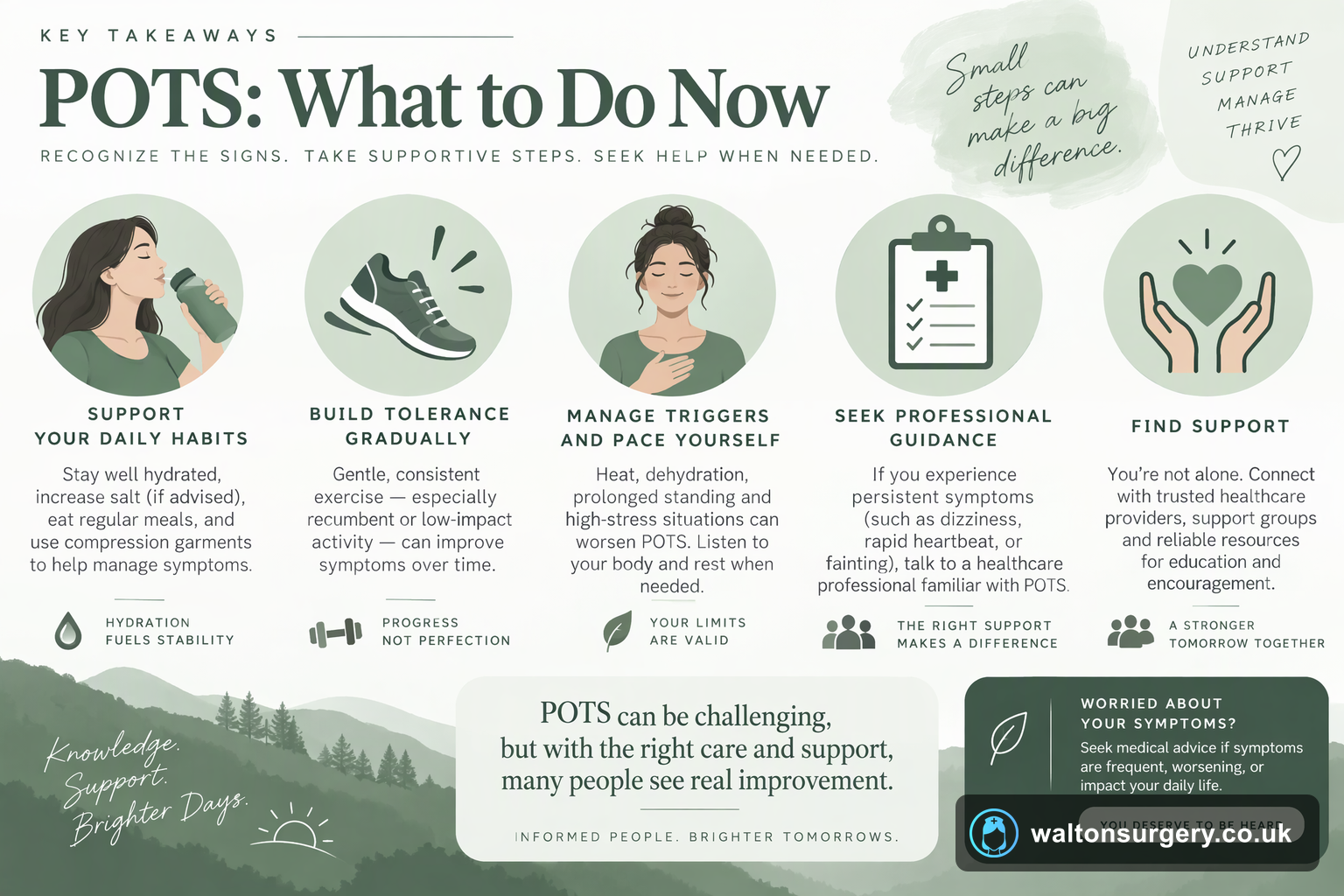
- Lifestyle changes: increasing fluid intake, increasing salt intake (this should only be done on medical advice, especially if you have high blood pressure, kidney or heart problems), wearing compression stockings, and pacing physical activity so you don't push yourself into a crash.
- Gradual exercise programmes: some people find that a slow, staged increase in physical activity helps them build tolerance to standing and exercise. The approach needs to be gradual and is best discussed with a physiotherapist or specialist who understands POTS.
- Medication: various medicines are used to slow heart rate, help the body hold onto fluid, or raise blood pressure. Only a doctor can decide whether medication is appropriate for you.
- Treating any underlying condition: if POTS developed after an illness or alongside another condition, managing that condition can help.
Thinking of upping salt or fluids? Talk to your own GP or pharmacist before you do. Especially so if you're on medication for blood pressure, heart problems or kidney conditions.
Is POTS deadly? Can it go away?
Anxiety about this one comes up a lot in the consulting room and it warrants a straight answer. Medical descriptions of POTS set it out as a heart rate regulation disorder that produces symptoms like dizziness, light-headedness, headaches and fainting. They do not describe it as a life-shortening condition in itself.
Fainting though, carries genuine risks — falls, head injuries, accidents if it strikes while you're driving, swimming or using machinery. For that reason alone, symptoms of POTS should always get looked at by a healthcare professional and not brushed off.
Does it go away or fade into remission? For some, symptoms ease over time — especially once the right lifestyle adjustments and treatment are in place. For others it stays long-term and needs ongoing management. No single rule fits every case, and the most useful answer will come from a specialist who knows your medical history.
Frequently Asked Questions
When to see your own GP, call NHS 111 or call 999
Notice the pattern set out in this article — dizziness, racing heart when upright, fainting or near-fainting, brain fog, fatigue that keeps returning — and it's time to talk to your own GP. Note down the timing, the duration, and how much it's denting your daily routine. That record is the single most useful thing you can walk in with.
Get on the line to NHS 111 if you're feeling unwell, fainting repeatedly, unable to hold fluids down, or watching symptoms worsen and you need advice quickly without it being an emergency.
Ring 999 if you faint and hit your head, get chest pain, struggle to breathe, faint at the wheel or operating machinery, or genuinely fear for your life. Those are not the moments to wait for a GP slot.
The Bottom Line
Symptoms of POTS come down to what your body does when you stand: dizziness, racing heart, faintness, fatigue, brain fog, plus the nausea, sweating, headaches and joint pain that some people also report. This is a genuine medical condition, not anxiety or laziness. A doctor has to make the diagnosis. If the pattern fits you, write it down, book in with your own GP, and reach for NHS 111 or 999 when things turn urgent.
⭐ The Bottom Line
What this means for you
If you recognise the pattern — dizziness, a racing heartbeat on standing, faintness, crushing fatigue, brain fog — keep a simple diary and take it to your own GP. POTS is real, diagnosable and manageable, but it needs a professional opinion, not an online guess. Reach for NHS 111 when symptoms worsen quickly, and 999 if you faint and injure yourself, get chest pain or struggle to breathe.
Last updated: 2026-11-24 · Written by the Walton Editorial Team · Walton Health News is an independent health information site, not a GP practice. Information is for educational purposes only and does not replace advice from your own GP, pharmacist or NHS 111.