Endometriosis: Symptoms, Treatment and Work Impact
PART C — HTML BODY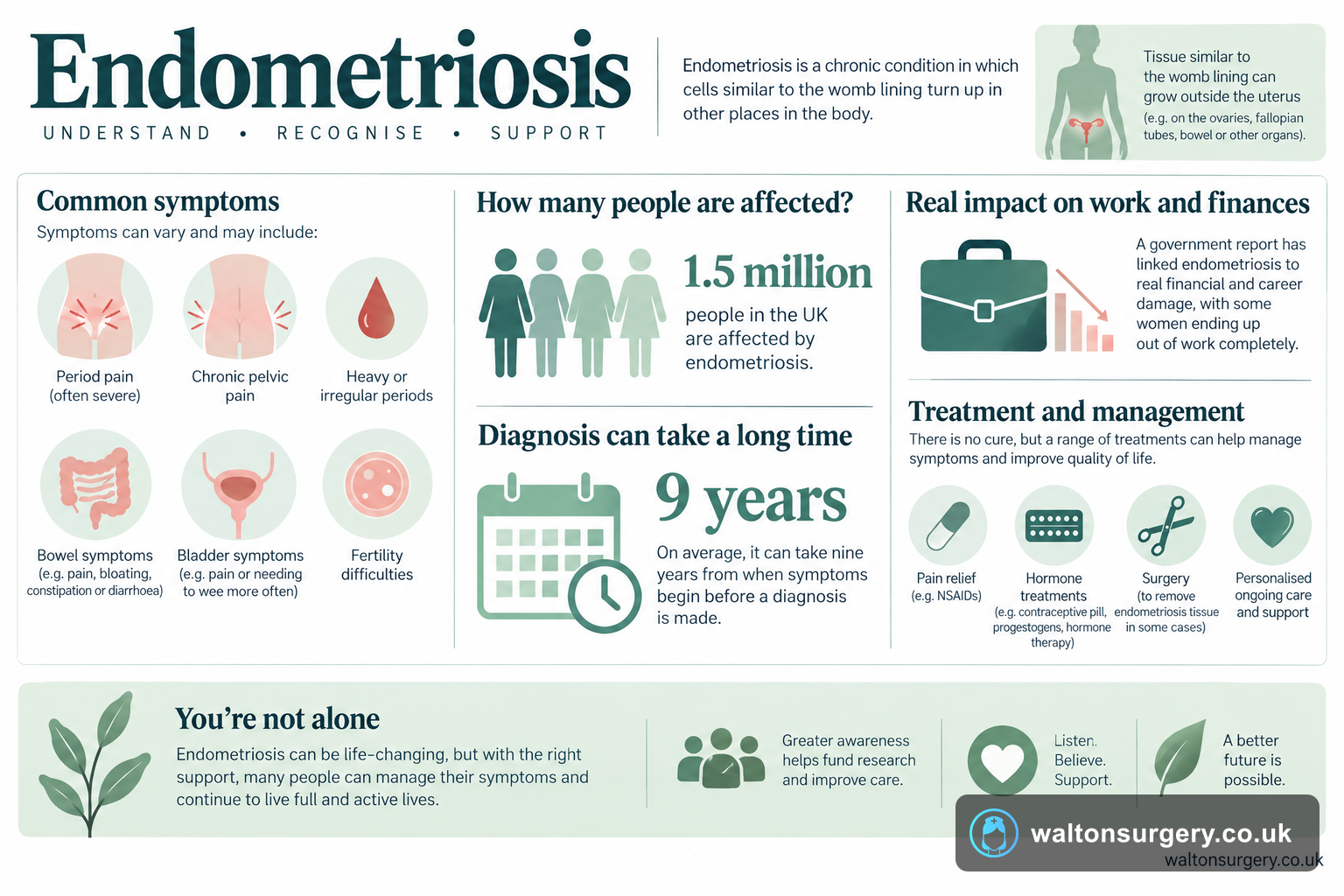
⚡ Quick Answer
Endometriosis is a chronic condition in which cells similar to the womb lining turn up in other places in the body. 1.5 million people in the UK are affected, and once symptoms begin it can take an average of nine years before anyone actually names what's wrong. A government report has linked the condition to real financial and career damage, with some women ending up out of work completely.
Pelvic pain that won't let up, periods that flatten you, and no real answers yet. If that sounds like your situation, endometriosis might be part of the explanation. It affects 1.5 million people in the UK, and it can seriously change the shape of your health and your day-to-day life. Your working life too.
What follows is a plain-English guide to what the condition actually is, the symptoms worth watching for, how diagnosis tends to work, and which treatments are on the table. We'll also look at the conversation that's been building around careers and money, prompted by a recent government report and the experience of one young woman who had to walk away from her job. There's more on this in our cancer symptoms and treatment UK explainer. There's more on this in our depression signs symptoms treatment uk explainer.
What is endometriosis?
A chronic illness in which cells much like the womb lining start growing in places they shouldn't. Once a month, those cells build up, break down and bleed, just as the womb lining does. Only there's nowhere for that blood to escape to, so it hangs around and causes inflammation, pain and eventually scar tissue.
It affects women and people assigned female at birth. For many, symptoms turn up somewhere around puberty, though plenty of people notice them later. And it doesn't really go away on its own — this is something you manage over the long haul rather than something a single treatment tidies up for good.
How common is endometriosis and why does diagnosis take so long?
1.5 million people in the UK live with endometriosis. That places it among the country's more widespread gynaecological complaints. Even so, from the first symptom to an actual diagnosis, an average of nine years can pass.
For most sufferers, that waiting is the worst part. Symptoms blur into other conditions, and getting anywhere involves appointment after appointment, referrals, scans, tests. If you've had unexplained pelvic pain or periods that leave you unable to function for ages now, it's reasonable to ask your GP outright whether endometriosis could be behind it.
🔬 Key Facts
Prevalence and diagnostic delay
- → 1.5 million people in the UK live with endometriosis, placing it among the country's more widespread gynaecological complaints
- → An average of nine years can pass from the first symptom to an actual diagnosis
- → Symptoms blur into other conditions, and getting anywhere involves appointment after appointment, referrals, scans and tests
- → Unexplained pelvic pain or periods that leave you unable to function warrant asking your GP outright whether endometriosis could be behind it
What are the symptoms of endometriosis?
Nobody experiences this identically. Some people get off lightly with hardly a symptom; others find it takes over everything. What follows are the signs most often tied to the condition.
Pelvic and period pain
Painful periods, called dysmenorrhoea, are the giveaway for many. Not the usual discomfort. It's the kind of severe, flattening pain that barely shifts even with standard painkillers. Some people also get pain between periods or during ovulation.
Pain during or after sex
Pain during sex or afterwards is common, and it isn't always easy to bring up. Still, tell your GP. That detail helps them build a much fuller picture of what's happening.
Bladder and bowel symptoms
Where the cells are growing determines a lot. You might feel pain going to the toilet, especially around your period. Bloating, constipation and blood in urine or stools at certain points in the month are other things people report.
Fatigue and difficulty conceiving
Tiredness that outstays its welcome is a frequent complaint, and some people struggle to get pregnant on top of it. Been trying for a while without success and also ticking some boxes above? Raise it with your GP.
Any of this affecting how you live your days warrants a trip to the doctor. This article is general information, nothing more — it can't replace advice tailored to you.
How is endometriosis diagnosed?
Reaching a diagnosis can be a slow business. Given that the symptoms overlap with other conditions, a GP may start by testing for other causes before handing you over to a gynaecologist.
Confirmation usually comes via laparoscopy: a small operation that puts a camera through a cut in the tummy to check for endometrial-like cells. What helps enormously is being straight with your doctor. Spell out the type of pain you get, when it turns up, how it messes with work or ordinary life. That sort of detail gives your GP the material to make sensible referrals.
What treatments are available?
No cure exists at this point, but plenty can be done to control symptoms. What suits you will depend on your symptoms, whether you hope to get pregnant, and how severe things are.
Pain management
Painkillers and anti-inflammatory medicines do a lot of the day-to-day work. Your GP or pharmacist will know what's appropriate for you.
Hormonal treatments
These act by cutting down or halting ovulation, which slows the build-up of endometrial-like tissue. Options include hormonal contraceptives as well as other hormonal treatments that a specialist might prescribe. Not everyone can use them — trying for a pregnancy rules them out, for instance — so it's a discussion to have with your doctor rather than a decision to make alone.
Surgery
Sometimes surgery is suggested to remove or destroy patches of endometrial-like tissue. For severe cases, a laparoscopy pulls double duty: diagnosis and treatment in one go. If you're weighing surgery up, sit down with your gynaecologist and go through both the possible benefits and the risks.
Treatment plans vary, person to person. What works brilliantly for one woman may do nothing for you, so expect some trial and error before you settle on the right thing.
The impact of endometriosis on work and finances
The national conversation on this has shifted of late. In November 2026, BBC News covered the story of Charlotte Samphire, a 21-year-old beauty therapist from East Yorkshire, who was forced out of her job because her symptoms were too bad to work around. Charlotte has stage 4 endometriosis, with debilitating pain that goes back to when she was just 10 years old.
Stories like hers are, sadly, ordinary. Alongside the Hull-based charity Hey Endo!, she is calling for things to change. She told the BBC: "People need to know that women shouldn't have to choose between their careers and their health." Her own boss happened to be understanding, she added, though she knows plenty of others wouldn't be so lucky.
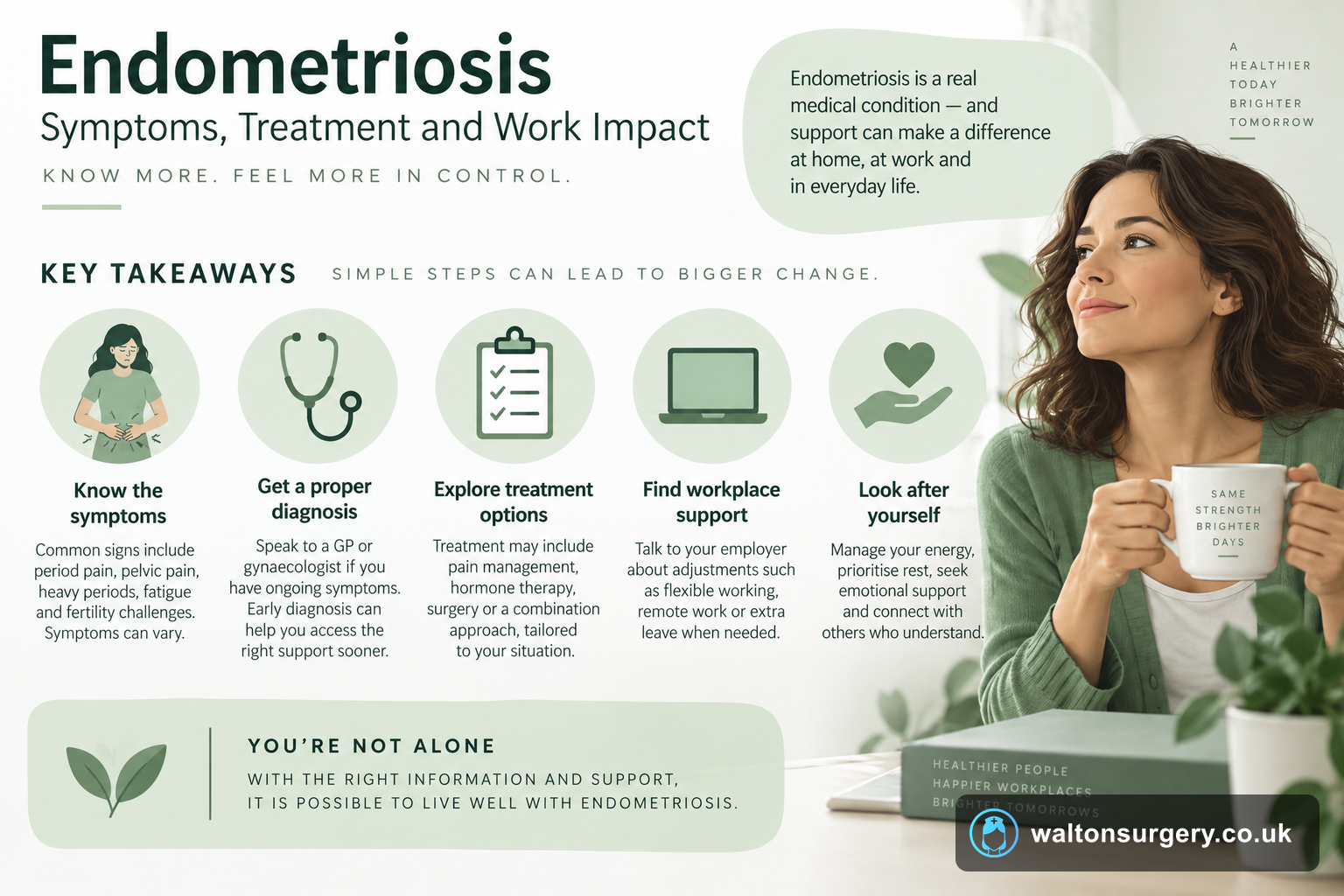
A report has been published by the All-Party Parliamentary Group (APPG) on Endometriosis, and a government report has since established the condition's toll on women's finances and careers. For some, that shows up as sick days and reduced hours. For others like Charlotte it's the end of employment altogether. Money worries stacking up — lost income on one side, the cost of managing a chronic condition on the other — pile on a whole extra layer of stress.
If your work is suffering, it may be worth asking your GP about a fit note or an occupational health referral. An honest chat with your employer about reasonable adjustments can help as well. You aren't the first person to be in this position, and there are charities and organisations who can walk you through your rights.
What to do if you think you have endometriosis
Book a GP appointment. That's the single most useful thing you can do next. Before you go, jot down your symptoms — timing, severity, how they interfere with work or ordinary living. It makes the appointment run far better and gives your GP something concrete to work with.
Don't play your symptoms down. Pelvic pain and impossible periods are real medical complaints, not things you must simply endure. Feeling unheard? Ask for a second opinion. Request a referral. That's well within your rights.
Frequently Asked Questions
⭐ The Bottom Line
What this means for you
1.5 million people in the UK have endometriosis, and diagnosis takes an average of nine years even so. Pelvic pain or difficult periods shouldn't be ignored. Go and talk to your GP. Treatments exist to bring symptoms under control, and there's no reason your health, your work and your finances all have to suffer at once. Help is available. We cover this in more depth in health anxiety symptoms and treatment.
Last updated: 2026-11-10 · Written by the Walton Surgery editorial team · Medical information is for educational purposes only and does not replace advice from a qualified healthcare professional.