Pectus Excavatum: Symptoms, Causes and Treatment Options
⚡ Quick Answer
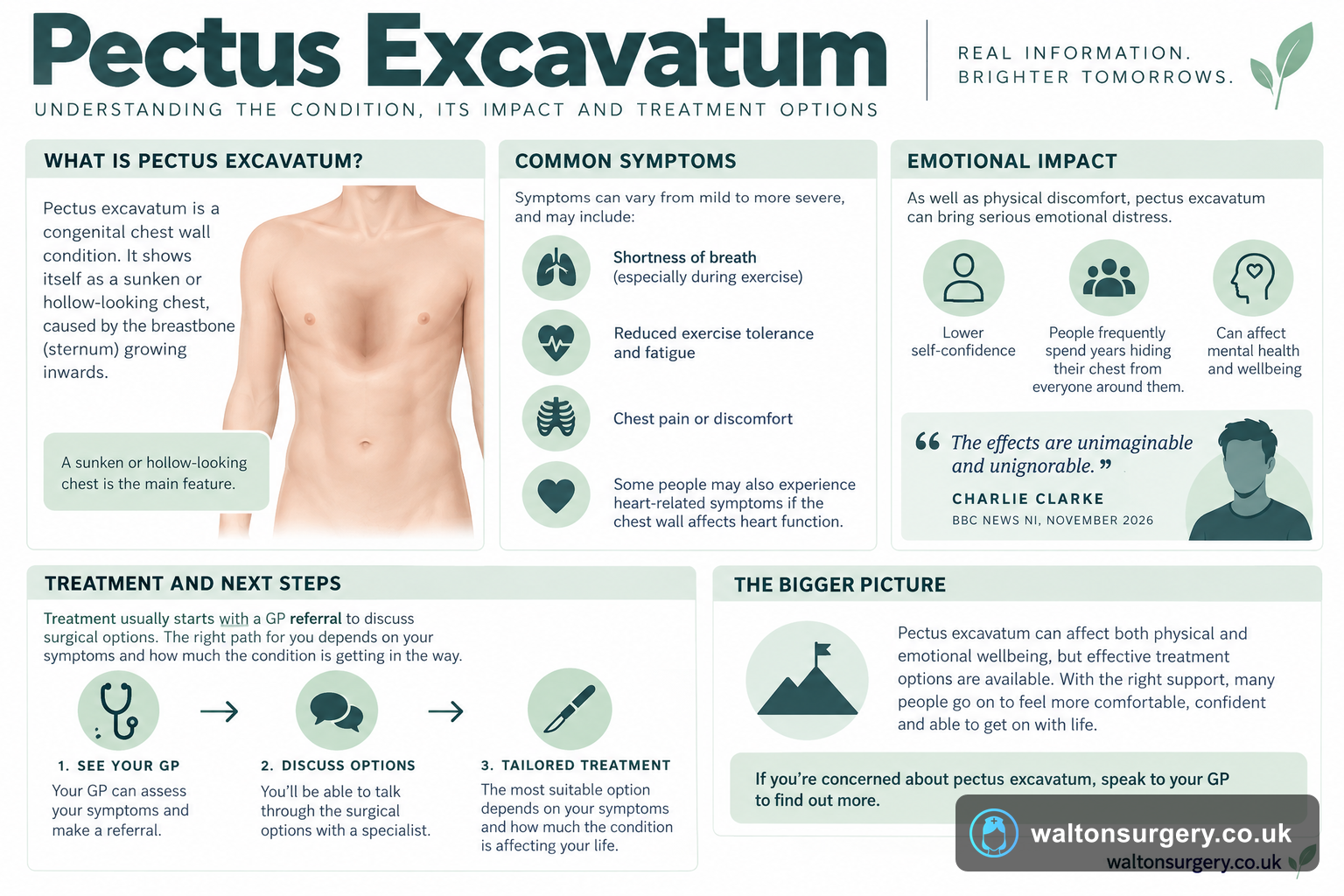
Pectus excavatum is a congenital chest wall condition, and it shows itself as a sunken or hollow-looking chest. On top of physical discomfort it can bring serious emotional distress — people frequently spend years hiding their chest from everyone around them. In November 2026, BBC News NI reported on Charlie Clarke, who called the effects "unimaginable" and "unignorable". Treatment usually starts with a GP referral to talk through surgical options, but which path suits you depends on your symptoms and how much the condition is getting in the way of ordinary life.
Born with a chest wall that dips inward instead of sitting flush, people with pectus excavatum often carry more than a physical difference — it can eat into self-confidence too. You might be recognising it in yourself or in your child. Either way it's worth understanding what's going on. On 13 November 2026, BBC News NI carried the story of Charlie Clarke, a 26-year-old from County Down, who said the physical and emotional effects of the condition were "unimaginable" and "unignorable".
Noticed a sunken chest and don't know where to go from here? What follows covers what pectus excavatum actually is, the ways it creeps into daily life, and what treatment options exist in the UK. Please treat it as general information — a GP or specialist needs to look at your particular situation before anything gets decided.
What is pectus excavatum, exactly?
It's there from birth. That's what congenital means in this context: the breastbone and ribcage form in a way that pushes inward, leaving the chest looking sunken or hollow rather than flush with the chest wall. How pronounced it appears varies enormously between one person and the next, and the NHS describes the condition in exactly those terms.
No diet, no posture habit, no exercise routine brought it on. Charlie Clarke, talking to BBC News NI in November 2026, put it as "a disability and a deformity under my shirt" — which captures something real about a condition that sits awkwardly between a medical problem and a visible difference. It may show itself in childhood and then grow more noticeable across the teenage years as the body itself grows.
School is where many people first feel it land properly. Charlie recalled feeling "awful wearing my school uniform because of how I looked", and because of what other people said about her chest. That social weight is often just as heavy to carry as anything physical. Sometimes heavier, in fact.
🔬 Key Facts
Pectus excavatum at a glance
- → Congenital from birth — the breastbone and ribcage form pushing inward, leaving the chest sunken or hollow.
- → Grows more noticeable in childhood and the teenage years as the body itself grows.
- → No diet, posture or exercise brought it on — nothing a person did caused it.
- → Social weight is real — Charlie Clarke felt "awful wearing my school uniform" because of comments about her chest.
How does pectus excavatum show up in everyday life?
Everyone's version of this looks different. For some there's a mild dip they hardly ever think about; for others a much deeper hollow that shows even through a jumper. What tends to bind people's experiences together is the double act of how it looks and how it feels.
Physically, you might get discomfort or a feeling of restriction across the chest, especially during exercise or while the body is growing. Emotionally though — and this is the part that usually pushes people through a doctor's door — the impact can be severe. Charlie Clarke told BBC News NI the condition made her life "hell at times", and described the physical and emotional effects as "unimaginable" and "unignorable".
Everyday habits warp around it as well. Charlie talked about pulling her dressing gown tight at home so it would hide her chest, and she didn't even tell her parents what she was doing. Secrecy like that shows up constantly in people living with visible differences, and over years it quietly wears you down.
What causes pectus excavatum?
It develops as the chest wall forms in the womb, so injury, bad posture, anything you did later — none of that is behind it. The NHS lists it among conditions people are born with, even though it often isn't obvious until the teenage years arrive and the shape becomes harder to hide.
No single trigger exists that a parent could avoid or a person could change, and honestly that's worth sitting with for a moment. If you or your child has pectus excavatum, nobody did anything wrong to cause it. BBC News NI's reporting on Charlie Clarke reflects this: the condition was simply part of her body early on, and what followed was the harder work of living with it and finding treatment that helped.
Congenital conditions like this one do sometimes run in families. If you have pectus excavatum and you're planning children, mentioning it to a GP or paediatrician gives them a heads-up on what to watch for. That kind of family history is also worth mentioning when you speak to a GP about other chronic concerns, such as endometriosis symptoms and treatment, where inherited patterns can shape what gets investigated first.
Recognising pectus excavatum symptoms and treatment needs early
"pectus excavatum symptoms and treatment" is the phrase people reach for, and underneath it is a simpler pair of questions: what should I be looking at, and what can actually be done? Catching the signs early shapes the kind of support you or your child ends up getting.
What to look for in yourself
A sunken or hollow-looking chest is the headline sign. It'll be most obvious shirtless or in something tight-fitting. Beyond that, keep an eye on whether you feel discomfort, restriction, or odd tiredness during physical activity. And don't write off the emotional side. If you're arranging your whole wardrobe to hide your chest — layering up, avoiding swimming, skipping PE — the condition is already affecting your life, whatever the medical paperwork says.
What to look for in your child
Kids don't always find the words. Watch how they behave around sport, PE, swimming, changing rooms. Charlie Clarke hid in the school bathroom during PE so the other girls wouldn't comment on her having "four breasts" — a genuinely cruel thing to say to someone, and it shows how fast kids can turn on a visible difference. Sudden avoidance of things they used to enjoy is worth gently asking about.
When to involve a GP
See a GP as the starting point, whether it's yourself or your child you're worried about. They'll look at the physical side and help you think through next steps. This article isn't a stand-in for personalised medical advice, and only a GP or specialist can tell you what's appropriate in your case.
What are the treatment options for pectus excavatum?
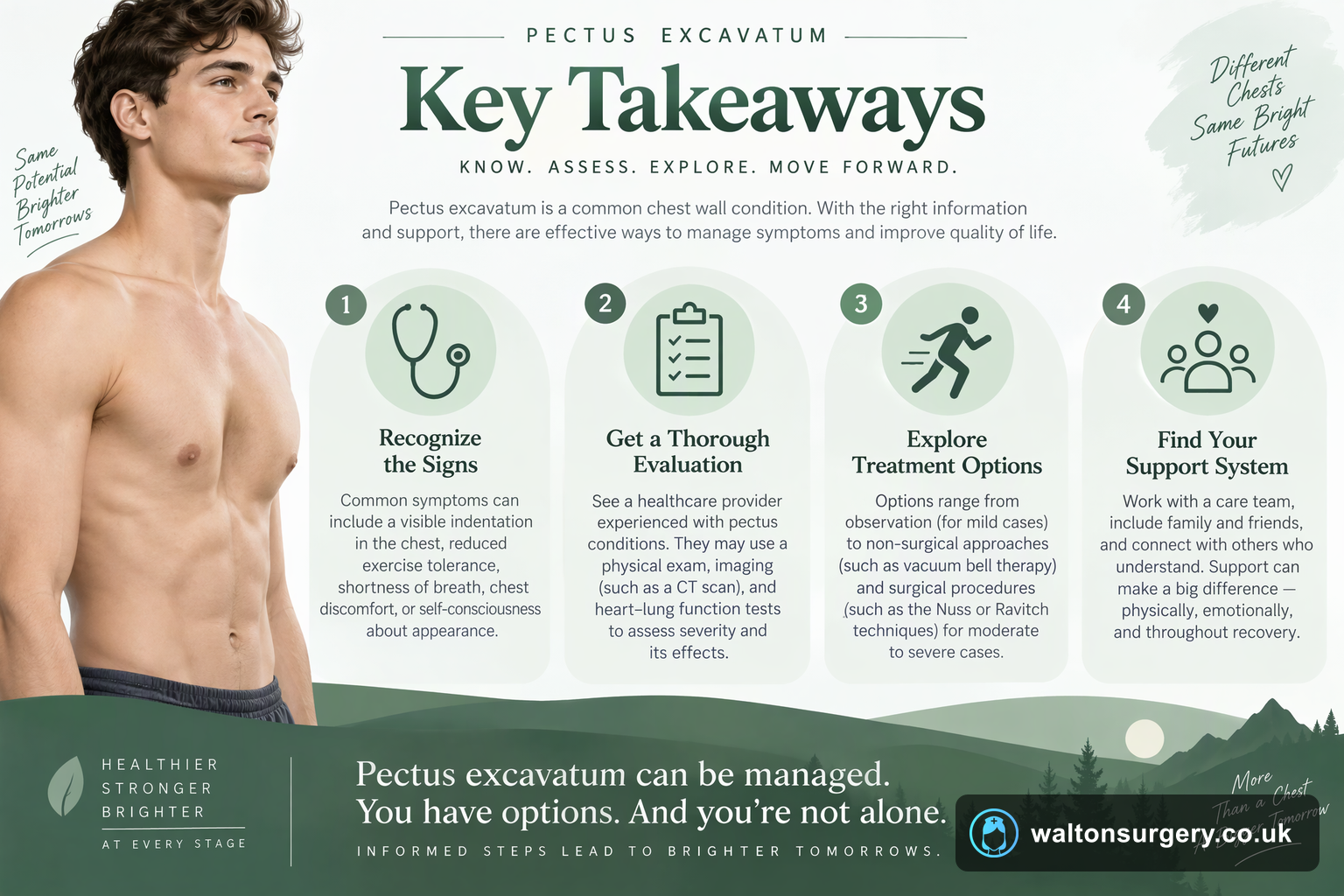
One size does not fit all here. What's right depends on how the condition looks, how it feels physically, and how much it's interfering with daily living. NHS guidance puts a GP at the starting point, and from an appointment there a referral can be raised to discuss surgical or other options.
Surgical treatment
Surgery comes into the conversation for a lot of people who end up being treated. As of the BBC News NI report on 13 November 2026, Charlie Clarke is awaiting surgical treatment. The aim is to address the shape of the chest wall and, for some, to ease physical discomfort. Whether it's appropriate for you is a decision a specialist needs to make, and the specifics of your case are what drive it.
Non-surgical approaches
Surgery isn't required for everyone. Plenty of people have a mild version where the main worry is emotional or cosmetic rather than physical. For others, monitoring and supportive care covers it. A GP can talk through what's available in your area and what makes sense for where you are.
Getting referred in the UK
Usual route in the UK: book a GP appointment. From there a referral to a hospital specialist might follow — often a surgeon or a chest specialist, who'll assess the condition properly. Waiting times and pathways aren't the same everywhere across the UK, so your GP is the person who'll know what's happening locally.
Living with pectus excavatum day to day
Treatment isn't always immediate, and in the meantime there's the day-to-day business of living with the thing. Charlie Clarke told BBC News NI that having pectus excavatum was "at times hell", and her story shows how far the condition can reach into social life, school, self-image — all of it.
Clothes you actually feel comfortable in, physical activity that suits your body, and — where you can — talking to someone about it. Those are the practical levers. Charlie kept it hidden for years, including from her own parents. That silence is completely understandable, but it does isolate you.
For parents reading this, making room for your child to talk without any judgement attached is one of the handiest things you can do. Children pick up on adult anxiety quicker than we'd like, so a calm and matter-of-fact tone goes a long way. If you're also watching for changes in mood alongside physical concerns, guidance on depression signs symptoms treatment uk can help you separate passing low patches from something worth flagging to a GP.
Frequently Asked Questions
⭐ The Bottom Line
What this means for you
A congenital chest wall condition, pectus excavatum leaves the chest sunken or hollow-looking. Physical discomfort comes with it, and just as importantly so does serious emotional distress — the account Charlie Clarke gave BBC News NI on 13 November 2026 makes that plain. Sunken chest, in you or in your child? Start with a GP. Treatment options do exist, but the right one depends on your symptoms and on how you actually live. When symptoms are vague or overlapping, it also helps to read up on cancer symptoms and treatment UK guidance so you can give your GP a fuller picture.
Last updated: 2026-11-14 · Written by the Walton Surgery editorial team · Medical information is for educational purposes only and does not replace advice from a qualified healthcare professional.