Symptoms of Flu: What to Look For and When to Seek Help
PART C — HTML BODY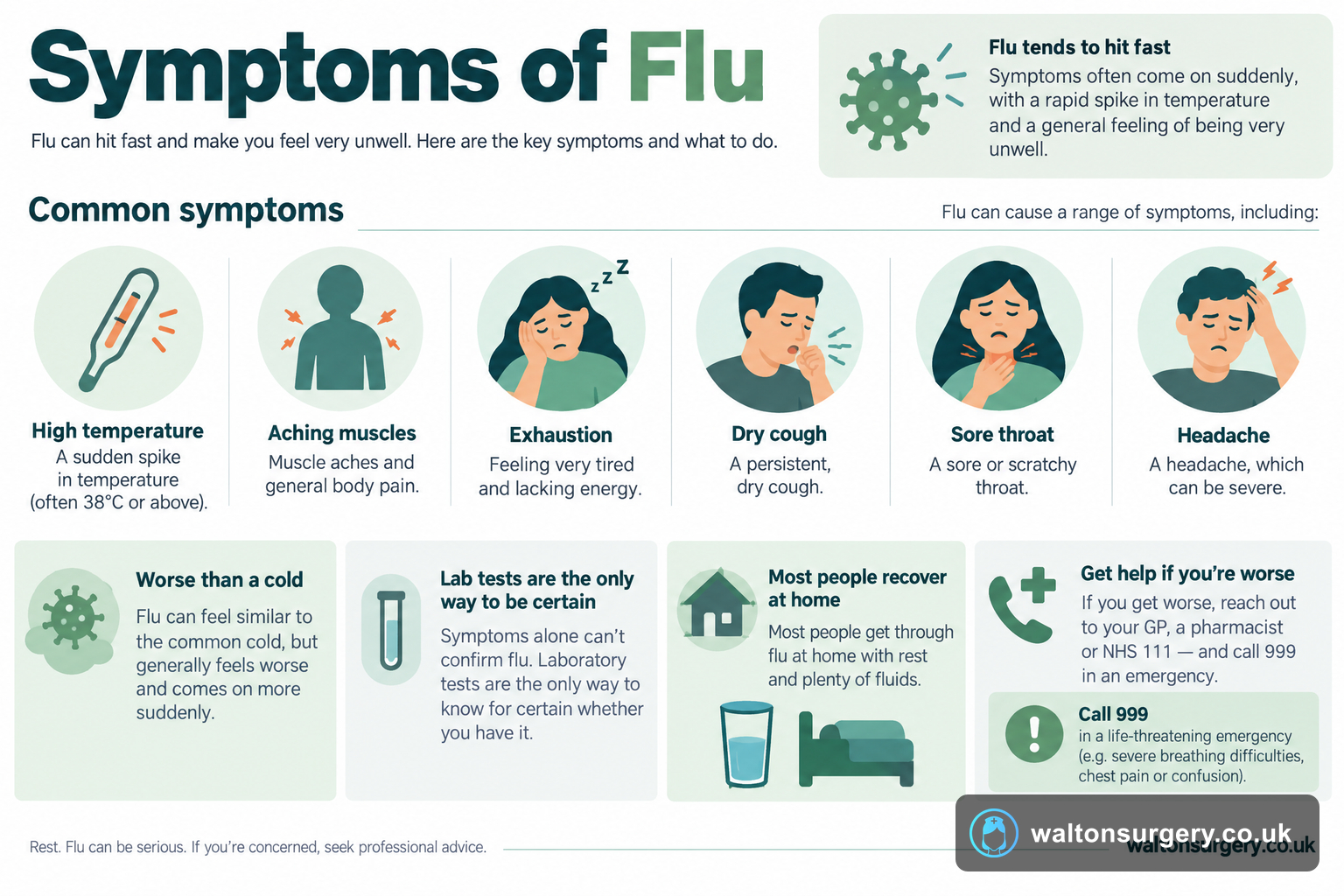
⚡ Quick Answer
Flu tends to hit fast, bringing a sudden spike in temperature, aching muscles, exhaustion, a dry cough, sore throat and headache. It overlaps with the common cold but generally feels worse, and lab tests are the only way to know for certain whether you've got it. Most people get through it at home with rest and plenty of fluids. If you get worse, reach out to your GP, a pharmacist or NHS 111 — and call 999 in an emergency.
Influenza might look like a heavy cold at first glance, except it's considerably more punishing — the kind of illness where your muscles ache and you feel genuinely depleted. People usually notice a sudden fever, crushing tiredness, aching limbs, a dry cough, a sore throat and a headache arriving within a very short space of time.
Telling flu apart from a cold or COVID-19 by symptoms alone is genuinely tricky, because there's a lot of overlap. What follows covers the signs to watch for, the practical differences between flu and a cold, roughly how long recovery takes, and the right moment to pick up the phone — whether that's your GP, a pharmacist, NHS 111 or, in the worst case, 999.
What are the main symptoms of flu?
Typically, flu announces itself quickly — think sudden high temperature, whole-body aches, a tiredness that flatlines you, dry cough, sore throat and headache. Shivering can happen too, and that's often a useful hint that you're dealing with something more than an everyday cold. Alongside the sore throat you may get a dry cough, and the exhaustion tends to sit alongside the muscle pains rather than after them.
What does "comes on very quickly" actually look like in day-to-day terms? Usually it means going downhill across a handful of hours, not several days. You could wake up fine and be in a markedly worse state by bedtime. That speed of onset is one of the things that separates flu from most colds.
Headaches and sore throats sit on that same list alongside the fever and body aches. Swollen lymph nodes, coughing and sneezing may show up too — the body throwing everything at the infection, basically. Trouble is, that same list covers a dozen other winter bugs, so no individual symptom is proof of anything on its own.
🔬 Key Facts
The core flu symptom cluster
- → Sudden high temperature, whole-body aches, dry cough, sore throat and headache
- → Shivering and swollen lymph nodes, with coughing and sneezing possible too
- → Onset over hours, not days — you could wake up fine and be markedly worse by bedtime
- → No single symptom proves flu on its own — the same list covers many winter bugs
How can you tell if it's flu or a cold?
Picture a nastier version of a bad cold — that's the flu, where weakness sets in and muscles start to protest. The symptoms do resemble a cold's, only they tend to be harsher. Flu also brings body aches and, more often than not, shivering.
What usually tips you off is the tempo and how rough you feel overall. Colds tend to creep in over a couple of days, often with sneezing and a blocked or runny nose leading the charge. Flu, on the other hand, arrives with a sudden temperature and aches that reach everywhere. Not every fever means flu, obviously — but a fast onset combined with full-body symptoms is worth taking seriously as a flu pattern.
Without lab tests, it is usually not possible to tell if you have flu or another similar illness. That's worth sitting with for a moment. Even seasoned clinicians, working through flu season, are often working off symptoms alone — and when COVID-19 is doing the rounds at the same time, the picture gets muddier still. If you need a definite answer, say because you're in a higher-risk group, get in touch with your GP, a pharmacist or NHS 111.
Flu symptoms in adults: what to expect
What you'll notice in adults is the usual cluster: sudden high temperature, aching body, bone-deep tiredness, dry cough, sore throat, headache. If you're otherwise healthy, it's nasty but usually manageable at home with rest, fluids and — where suitable — over-the-counter relief. A pharmacist can tell you what works alongside anything else you're taking.
Exhaustion is what surprises most people. Feeling very tired or exhausted sits right at the core of the symptom list, alongside the fever and aches, and plenty of people find they simply can't function normally even once the temperature has come down. Weakness and muscle pain show up as characteristic features, and the tiredness tends to outlast the worst few days by quite some way.
Since flu mirrors a cold but hits harder, self-care for adults usually boils down to pacing yourself and being patient, not forcing it. If things aren't picking up as you'd expect, or if you fall into a group at higher risk of complications, get hold of your GP or NHS 111 instead of sitting it out.
Flu treatment: what actually helps
No treatment exists that clears flu symptoms overnight — that's just the reality. For most people, management is about rest, staying hydrated and letting time do its work. Over-the-counter stuff from a pharmacist can take the edge off individual symptoms like headache or sore throat, and a pharmacist is ideally placed to flag anything that clashes with your existing medication or conditions.
There are antiviral medicines for flu and they may be suggested in particular cases, though they aren't handed out to everyone — typically they're held back for those at higher risk of complications or people who are seriously unwell. It's a prescriber's call, so your GP or NHS 111 will advise whether antivirals make sense for you.
Antibiotics won't touch flu itself, since it's viral in origin. They only come into play when a bacterial complication stacks on top — a chest infection, for example — and that judgement belongs to a clinician. If things seem to shift in a way that suggests a secondary infection, maybe you're deteriorating after an initial improvement, contact your GP or NHS 111.
Worth remembering as a caveat: this is general information, not advice tailored to you. Any treatment decision, prescription or otherwise, should be made together with a pharmacist, your GP or NHS 111 based on your own situation.
How long does the flu last?
It's probably the question people ask most — how long does it actually go on for? Most people start to turn a corner within a week or thereabouts, though the tiredness and general washed-out feeling can stretch well past the acute phase. Hitting that extended exhaustion is genuinely dispiriting when you expected a quick bounce-back.
The fever and aches usually clear first, while cough and fatigue tend to dig their heels in. If you find yourself searching "flu symptoms for 2 weeks now" or "flu symptoms for 3 weeks now", you're not describing anything unusual — that scenario happens more often than people think. Cough and fatigue are the pair that lag behind.
That said, symptoms which refuse to improve, or which take a turn for the worse after settling down, are a genuine reason to get advice. Two weeks in and no better, or three weeks down the line with a cough that won't budge? That's when you contact your GP or NHS 111 to be assessed rather than assuming it's just slow healing. They can rule out complications like a chest infection.
Flu causes and influenza B symptoms
Influenza viruses cause flu, and in the UK they circulate most commonly through the colder months — hence the phrase "flu season", which is basically a shorthand for that seasonal pattern. These viruses pass between people via coughs, sneezes and close contact, and you can be infectious even before symptoms peak and during the worst of it.
Several types of flu virus exist. When someone looks up "influenza B symptoms", what they're really asking is whether type B presents differently. The honest answer: the reported symptom list is broadly the same — sudden high temperature, body aches, crushing tiredness, dry cough, sore throat and headache. The symptoms of flu don't really change dramatically depending on which type you've caught.
Since flu is viral and passed person to person, the same sensible measures used against other winter illnesses apply here: wash your hands, cover coughs and sneezes, keep your distance from others when you're poorly. Those steps help shield the people around you, particularly anyone at higher risk.
When to see your GP, call NHS 111 or call 999
Knowing where to turn counts for a lot — arguably as much as knowing what symptoms to expect. The pointers below reflect general signposting used across UK health guidance. This isn't a personal assessment; if you're unsure, speak to a healthcare professional.
See your GP
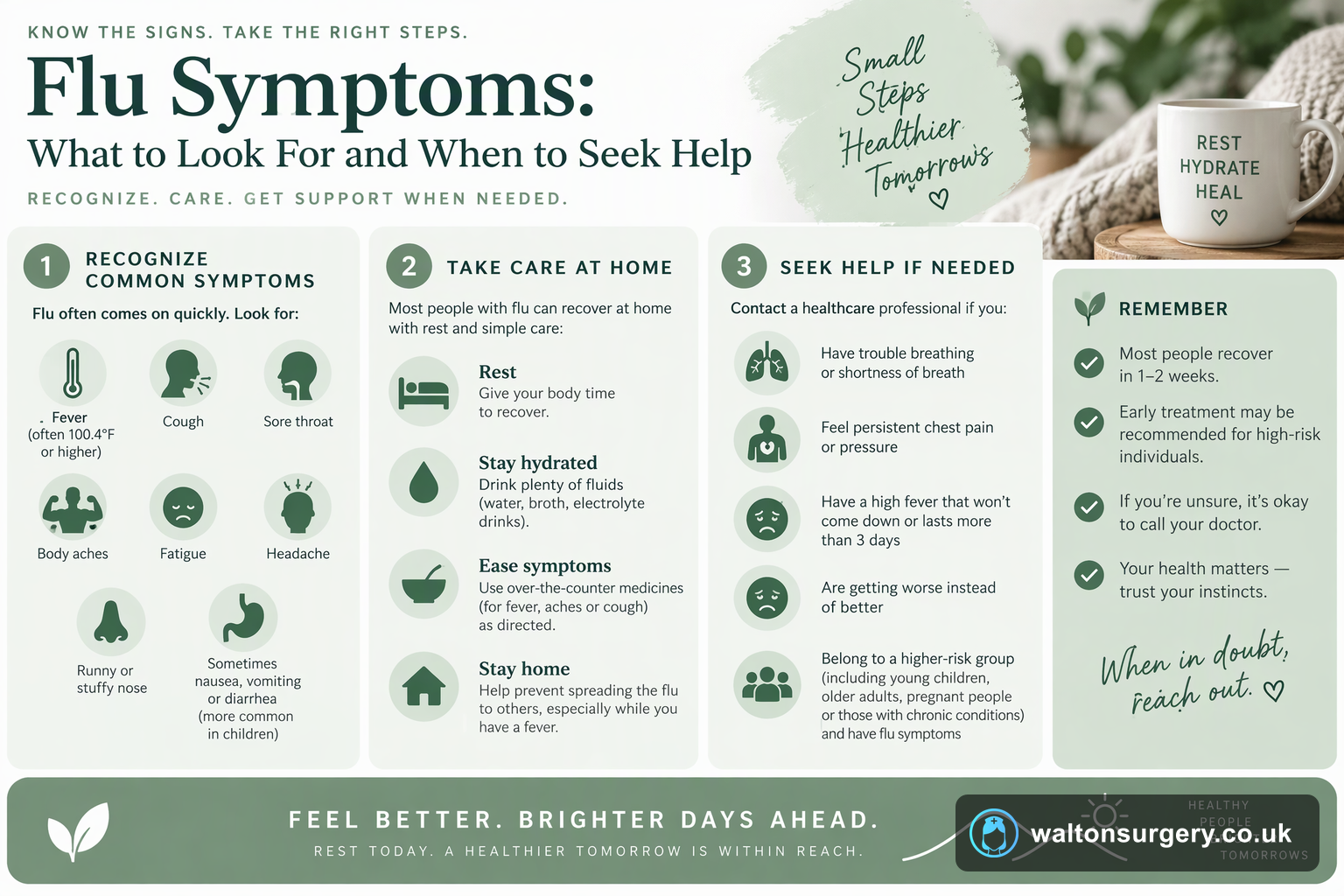
Get in touch with your GP if things aren't improving as time goes on, if you're in a higher-risk group and suspect flu, or if symptoms pop up that suggest a complication — say, a cough that intensifies after you seemed to be on the mend. Your GP can assess you, weigh up whether antivirals are appropriate, and look for bacterial infections that might need antibiotics.
Call NHS 111
Use NHS 111 for urgent-but-not-life-threatening situations. Say you're worried about symptoms and can't get a routine appointment soon enough, or you simply can't tell whether you ought to be seen. It's a sensible route when you need answers fast but nothing is an emergency.
Call 999
In an emergency, call 999. Red flags reported for flu include symptoms severe enough that you need urgent help. If you feel very unwell, are struggling to breathe, or someone near you is seriously ill, dial 999 instead of waiting.
Frequently Asked Questions
The Bottom Line
⭐ The Bottom Line
What this means for you
Flu comes on fast: sudden high temperature, body aches, exhaustion, dry cough, sore throat and headache. The symptoms look like a cold but are harsher, and without tests you can't be certain it's flu. Most people recover fine with rest and fluids. If you're worried, speak to your GP, a pharmacist or NHS 111. In an emergency, call 999.
Last updated: 2026-11-27 · Written by the Walton Editorial Team · Walton Health News is an independent health information site, not a GP practice. Information is for educational purposes only and does not replace advice from your own GP, pharmacist or NHS 111.