Perimenopause: how to tell if you've started it
PART C — HTML BODY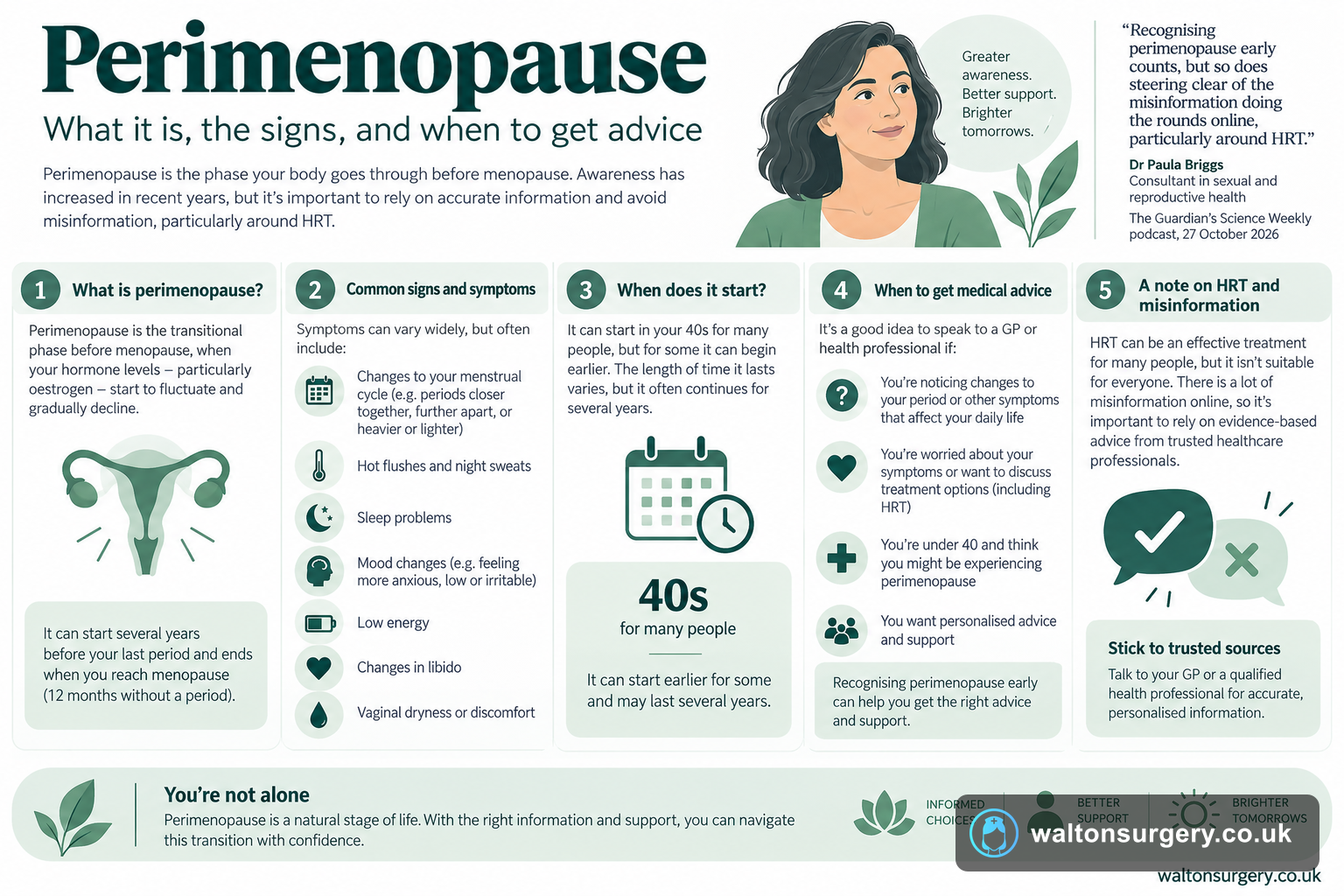
⚡ Quick Answer
Perimenopause is the phase your body goes through before menopause proper, and right now everyone seems to be talking about it — partly because of celebrity stories and partly because awareness generally has gone up. Dr Paula Briggs, a consultant in sexual and reproductive health, spells it out in The Guardian's Science Weekly podcast (27 October 2026): recognising it early counts, but so does steering clear of the misinformation doing the rounds online, particularly around HRT. Below is what the evidence currently backs up, plus when it's worth booking in with your GP.
Everyone's talking about perimenopause at the moment, and it isn't hard to see why. Celebrities are sharing their stories, doctors are posting advice online, and suddenly there's a name for things that plenty of women had been quietly putting up with for years. But there's a less helpful side to it. As Dr Paula Briggs, a consultant in sexual and reproductive health, points out in The Guardian's Science Weekly podcast (27 October 2026), more visibility has come bundled with a rising volume of misinformation about treatments such as HRT, and that combination — attention and confusion sitting side by side — is exactly why so many women in their forties and fifties are asking one particular question: how do I know if I'm perimenopausal?
What follows here draws on the Science Weekly discussion featuring Dr Paula Briggs and lays out what the evidence actually supports. It's aimed at women aged 40–55 who are picking up on new symptoms and want something clearer than an online forum. Think of it as general background, not personalised medical advice. Anything that worries you on a personal level should go to your GP or pharmacist.
What exactly is perimenopause?
The stage before menopause, which itself is the point where you've gone twelve consecutive months without a period. Dr Paula Briggs, a consultant in sexual and reproductive health, calls it the transitional window in which hormone levels start doing their own thing and symptoms creep up — frequently before your cycle has visibly altered at all.
Now, "perimenopause" as a word is a fairly new arrival in everyday UK speech, but the biology behind it has been there all along. What's actually changed is how loudly we're talking about it. Celebrities share, doctors post tips, and perimenopause has become a hot topic. That visibility does real good: women can put a name to their experiences, and more GPs are having these conversations than used to be the case.
Still, there's a downside, and Madeleine Finlay's conversation with Dr Paula Briggs in The Guardian's Science Weekly podcast (27 October 2026) makes it plain — a rising number of women are now encountering misinformation about treatments such as HRT. Knowing what perimenopause genuinely is, as distinct from what gets claimed about it in a Facebook comment thread, is where sensible answers start.
How do I know if I'm perimenopausal? The question everyone's asking
Ask a search engine and you'll find this one is now among the most typed health questions in the UK. Dr Paula Briggs takes it head-on in The Guardian's Science Weekly podcast (27 October 2026). The plain answer, and it's slightly unsatisfying, is that there isn't one test, one symptom, or one dramatic moment that settles it. It's a process. The signals arrive in bits and pieces.
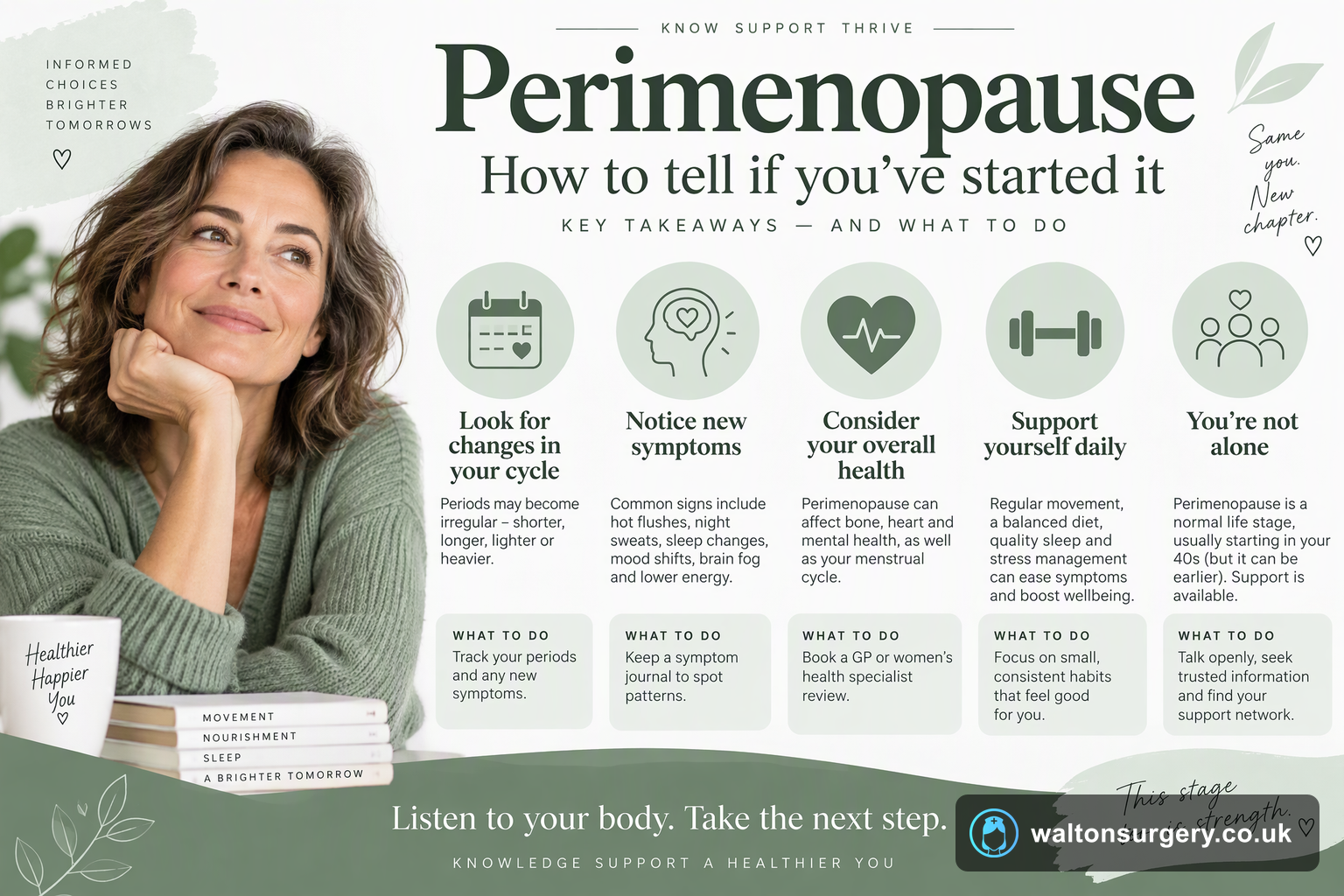
What you can rely on is change itself. New symptoms cropping up — sleep going to pieces, moods doing unexpected things, periods changing character, hot flushes, brain fog, energy that isn't what it was — in someone sitting in that usual 40 to 55 band, that's frequently perimenopause. The pattern counts more than any one symptom on its own, since a lot of these experiences could come from somewhere else entirely. For some women the visible changes to skin and general appearance raise their own questions too, and it is worth knowing that can you tell ferritin levels from your face is a genuinely common concern alongside the hormonal picture.
And that is precisely the limit of self-diagnosis. Dr Paula Briggs, a consultant in sexual and reproductive health, is firm on this: an actual conversation with a GP, or in certain situations a sexual and reproductive health service, is what moves you from "I think I might be" to "I know where I stand." If new symptoms are showing up and interfering with your normal days, that's the moment to get professional eyes on it.
Spotting the signs — what to look for
Signs of perimenopause, as Dr Paula Briggs, a consultant in sexual and reproductive health, puts it, are varied and personal. No two women go through it quite alike, and the symptoms tend to build slowly over months rather than arriving in one go. Getting a feel for the common patterns helps you separate a passing phase from something worth raising with your GP.
Periods that don't behave
Often the first thing anyone notices. Your periods might get heavier or lighter, move closer together or spread further apart, turn unpredictable in flow or length. For a lot of women, this is when they first type "how do I know if I'm perimenopausal" into a search bar.
Sleep and mood
Sleep falling apart and moods shifting are commonly reported through perimenopause. Women talk about waking at 3am and not getting back to sleep, or feeling emotionally like a different person for no obvious reason. It hits work, it hits relationships, it knocks general quality of life around — which is exactly why Dr Paula Briggs's appearance on The Guardian's Science Weekly podcast (27 October 2026) centred on putting accurate information in front of women instead of guesswork.
Hot flushes and physical shifts
Hot flushes and night sweats are the symptoms everybody recognises, but they're only part of a broader physical picture: energy shifting, concentration wandering, general wellbeing taking a dip. The overlap with other conditions is wide here, which is why a rising number of women are now meeting misinformation online about what counts as "normal" and what actually needs treating.
🔬 Key Facts
What the signs of perimenopause actually look like
- → Periods often change first — heavier, lighter, closer together, further apart, or unpredictable in flow and length
- → Sleep and mood are commonly affected — 3am waking, unexplained mood shifts, and a knock-on hit to work and relationships
- → Hot flushes and night sweats are the most recognised signs, but sit within a broader picture of energy and concentration shifts
- → Symptoms build slowly over months and vary widely from woman to woman — the pattern counts more than any single symptom
Why the current explosion of interest is a double-edged sword
Visibility has done some genuinely useful things. More women now have language for what they're living through, and more clinicians are willing to open the conversation. Perimenopause has become a hot topic, with celebrities sharing their experiences and doctors offering tips and advice online. Silence around it never helped a single person.
The catch, as Madeleine Finlay hears from Dr Paula Briggs, a consultant in sexual and reproductive health, in The Guardian's Science Weekly podcast (27 October 2026), is that a rising number of women are now encountering misinformation about treatments such as HRT. Social media has become a place where confidently phrased claims move faster than carefully-checked ones, and where a personal testimonial can look exactly like clinical evidence if you aren't looking closely.
That difference matters, a lot. A woman reading a persuasive post about some supplement or a specific HRT regimen isn't necessarily getting anything that applies to her own situation. Dr Paula Briggs's central point: growing awareness is welcome, but it has to sit alongside accurate, evidence-based guidance, and that's where a GP or a sexual and reproductive health specialist comes in.
Getting the facts on HRT — and the misinformation around it
Hormone Replacement Therapy, or HRT, is talked about constantly and, almost as constantly, misrepresented. Dr Paula Briggs, a consultant in sexual and reproductive health, confronts this in The Guardian's Science Weekly podcast (27 October 2026), where she warns that a rising number of women are now encountering misinformation about treatments such as HRT.
What does that misinformation actually look like? Blanket claims about risk and benefit that ignore individual circumstances, for one. Products flogged as "natural alternatives" with evidence that hasn't been verified. Dosing or formulation advice passed around with no medical oversight behind it. None of which reflects how HRT gets prescribed in the UK — case by case, after a proper clinical assessment.
You might be wondering "how do I know if I'm perimenopausal and whether HRT is right for me," and you won't find the answer in a comments section. Dr Paula Briggs's position, set out in The Guardian's Science Weekly discussion, is that HRT decisions belong inside a consultation with a qualified clinician who knows your history. Your GP, a practice nurse trained in menopause, or a sexual and reproductive health service are all reasonable places to start. A pharmacist can also tell you what's on the shelves and what isn't.
Being straight with you here: the evidence around different HRT approaches is still being discussed and revised by bodies including the NHS, and personalised medical advice is the only safe basis for a decision about your own treatment.
Where to get reliable help in the UK
Reading this because you keep asking "how do I know if I'm perimenopausal"? The practical step is a chat with a healthcare professional who can look at your particular picture. Your GP is the standard first stop in the UK, and they can rule out other explanations for the symptoms before landing on a perimenopause reading.
Sexual and reproductive health services offer another route, one Dr Paula Briggs — herself a consultant in sexual and reproductive health — is well placed to talk about in The Guardian's Science Weekly podcast (27 October 2026). They're used to conversations about hormonal change and can advise on symptom management and treatment options.
Then there's your pharmacist, an often-overlooked resource. They can walk you through what's sold for milder symptoms and flag when something warrants a GP appointment instead. None of these professionals is going to hand you personalised advice through a blog post or a social media thread. That's exactly the hole misinformation fills.
Frequently Asked Questions
The Bottom Line
Perimenopause has become a hot topic, with celebrities sharing their experiences and doctors offering tips and advice online — and visibility isn't the same thing as accuracy. The question "how do I know if I'm perimenopausal," as Dr Paula Briggs explains in The Guardian's Science Weekly podcast (27 October 2026), is one for a GP or sexual and reproductive health professional rather than a social media feed. Watch the patterns. Tune out the noise. Get advice built around you.
If broader health questions are on your mind alongside the hormonal picture — including family history and what to do with it — our guides on hereditary cancer risk genetic testing and, for anyone weighing up longer-term appearance questions after an operation, a tattoo to cover surgery scars set out what the evidence supports in plain terms.
⭐ The Bottom Line
What this means for you
Perimenopause is a process, not a single moment, and there's no one test or one symptom that settles it. Watch for the pattern of change — periods, sleep, mood, hot flushes — in that usual 40 to 55 band, and don't lean on online forums or social media for treatment decisions. Recognising it early counts, and so does steering clear of the misinformation doing the rounds, particularly around HRT. Book in with your GP or a sexual and reproductive health professional and get advice built around you.
Last updated: 2026-10-27 · Written by the Walton Surgery editorial team · Medical information is for educational purposes only and does not replace advice from a qualified healthcare professional.