Understanding Hereditary Cancer Risk and Genetic Testing
PART C — HTML BODY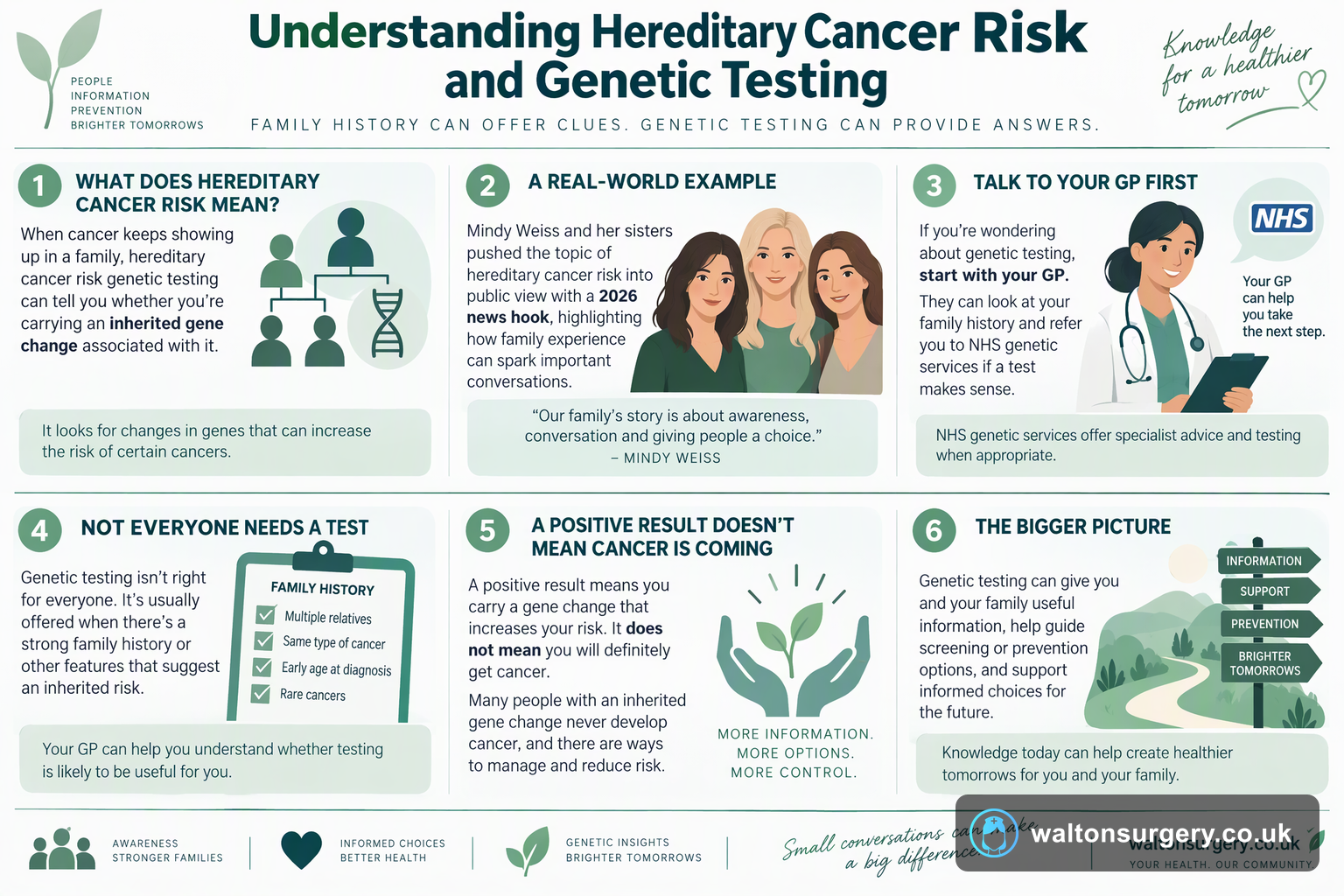
⚡ Quick Answer
When cancer keeps showing up in a family, hereditary cancer risk genetic testing can tell you whether you're carrying an inherited gene change associated with it. Mindy Weiss and her sisters pushed the topic into public view with a 2026 news hook. Talk to your GP first — they can look at your family history and refer you to NHS genetic services if a test makes sense. Not everyone needs one. And a positive result doesn't mean cancer is coming.
Some cancers cluster in families, and that's often because of inherited changes to genes that normally keep cell growth in check. Mindy Weiss and her sisters spoke publicly about hereditary cancer risk in an October 2026 news feature, and that sort of honesty gets other families talking about things they've been quietly avoiding. The question everybody lands on eventually is pretty simple: should I get tested?
That depends on your family history, not on how anxious you feel at 2am. Hereditary cancer risk genetic testing exists on the NHS for people whose background points to an inherited cause. Below we cover who it's for, what a test actually involves, and what your results might and might not mean.
What does "hereditary cancer risk" actually mean?
The majority of cancers aren't inherited at all — they happen by chance as we get older, or they're driven by lifestyle and environmental exposures. A smaller slice comes from inherited gene changes handed down through families. You're born with these changes, and they can lift your odds of developing certain cancers above what most people face. High-profile coverage has kept this conversation alive too, with stories like the kim kardashian psoriasis cancer risk feature prompting readers to look more closely at how personal and family factors combine.
Carrying one doesn't mean cancer is a certainty. Not even close. What it does mean is that your risk runs higher than the general population's, and lifestyle still plays a part, as do screening programmes that catch things early. Genetic testing hunts specifically for those inherited changes, which makes it a rather different animal from a screening test like a mammogram or a bowel scope.
Who should consider hereditary cancer risk genetic testing?
Honestly, most people don't need one. Testing tends to be offered when family history sets off some sort of alarm — several close relatives with the same or related cancers, say, or cancers turning up at unusually young ages, or rare tumour types with a strong inherited link. Breast cancer is one of the areas where family history most often comes up, which is why general questions such as can anyone get breast cancer are worth understanding before you assume a family pattern means anything specific.
Your GP is where this starts. Always. They'll want to know who in your family has had cancer, which types, and how old each person was when it was diagnosed. If the pattern smells like an inherited cause, they can put in a referral to an NHS regional genetics service, where a specialist takes a closer look at whether testing is worth doing for you.
What happens during genetic testing?
Before the test
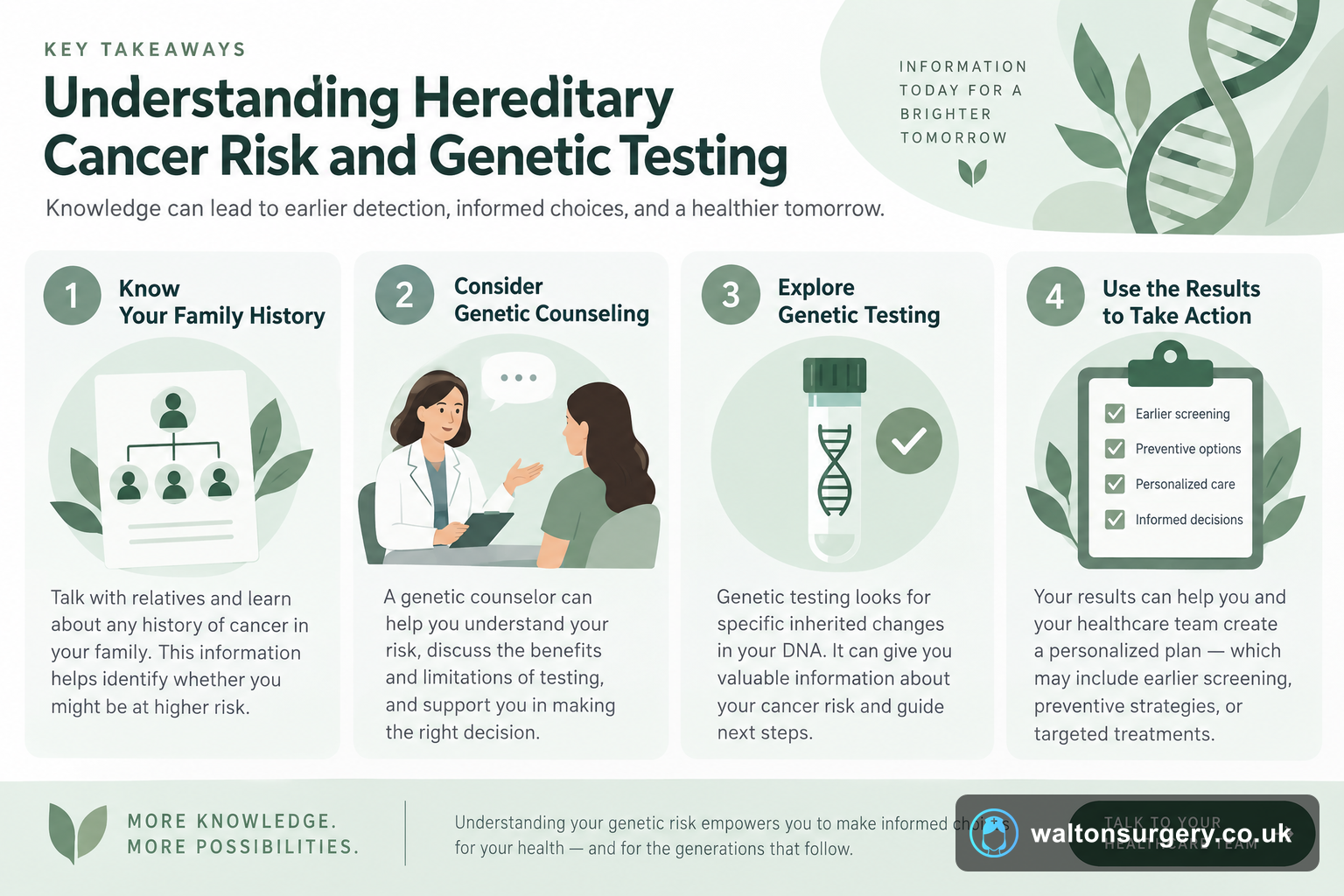
Referrals usually lead to a genetics appointment before any needle appears. A specialist sits down with you, walks through the family history, lays out what testing can and can't tell you, and talks about what the results might mean for you and for your relatives. Nobody expects an answer on the spot. Taking time to think is normal and, if anything, encouraged.
The test itself
Going ahead means giving a blood sample, or occasionally a saliva one. The lab then looks for specific inherited changes in genes tied to cancer risk. Results timelines aren't fixed — how long you'll wait depends on the case, and your genetics team will tell you roughly what to expect.
Receiving your results
Results get explained by a genetics professional rather than shoved through your letterbox with no context. You'll have a conversation covering what the result actually says, what shifts for you medically (if anything), and whether relatives might want to think about testing themselves.
What can your results tell you?
A result lands in one of a few buckets. Positive means an inherited change linked to cancer risk turned up. Negative means no such change was found, and it's worth being careful here because that does not drag your risk down to zero — especially with a strong family history behind you. Occasionally a result comes back uncertain, which is exactly what it sounds like: a change was spotted but nobody can yet say what it means.
Whatever comes back, treat it as a starting point and not a verdict. Your genetics team and GP help you work out what it means for screening, for risk-reducing options, and for what you tell your family.
What are the practical implications of a positive result?
Finding an inherited change sets several things in motion. You might be moved onto earlier or more frequent screening through the NHS. Risk-reducing surgery or medication can enter the conversation with your specialist too, though those calls are deeply personal and shouldn't be hurried.
🔬 Key Facts
What a positive result sets in motion
- → Earlier or more frequent NHS screening may follow
- → Risk-reducing surgery or medication can enter the specialist conversation
- → Brothers, sisters and children each carry some chance of the same change
- → Genetics services help with telling family and testing adult relatives
Relatives get pulled into the picture as well, since brothers, sisters and children each carry some chance of having the same change. Genetics services can help with the awkward business of telling your family, and they can organise testing for adult relatives who want it. Don't underestimate the emotional side either — plenty of people find sitting down with a genetic counsellor genuinely useful.
What genetic testing can't do
Genetic testing is not a crystal ball. A positive result doesn't hand down a cancer diagnosis, and a negative one doesn't hand you immunity. Testing also misses some inherited causes entirely, so families with a strong history sometimes come back negative purely because the relevant gene change hasn't been pinned down yet.
Be careful with commercial tests sold straight to the public. They're often not equivalent to the clinical testing your NHS genetics team would arrange, and the results can be genuinely confusing without a specialist to interpret them. If a direct-to-consumer test is already sitting on your shelf and it's bothering you, book a GP appointment. It also helps to keep perspective on headline stories in this space — coverage such as the jessie j cancer free breast cancer mastectomy update 2026 is encouraging, but individual outcomes don't replace your own clinical assessment.
Frequently Asked Questions
The Bottom Line
⭐ The Bottom Line
What this means for you
Cancer running through a family is unsettling, and hereditary cancer risk genetic testing is one practical way to get a handle on your risk — though it's not for everyone and it certainly isn't a prediction. See your GP first; they can assess family history and refer you onward to NHS genetic services where appropriate. Whatever the outcome, results deserve a specialist's eye, and nothing here counts as personalised medical advice.
Last updated: 2026-10-23 · Written by the Walton Surgery editorial team · Medical information is for educational purposes only and does not replace advice from a qualified healthcare professional.