How to Get Rid of Tonsil Stones: Safe Home and Medical Options
PART C — HTML BODY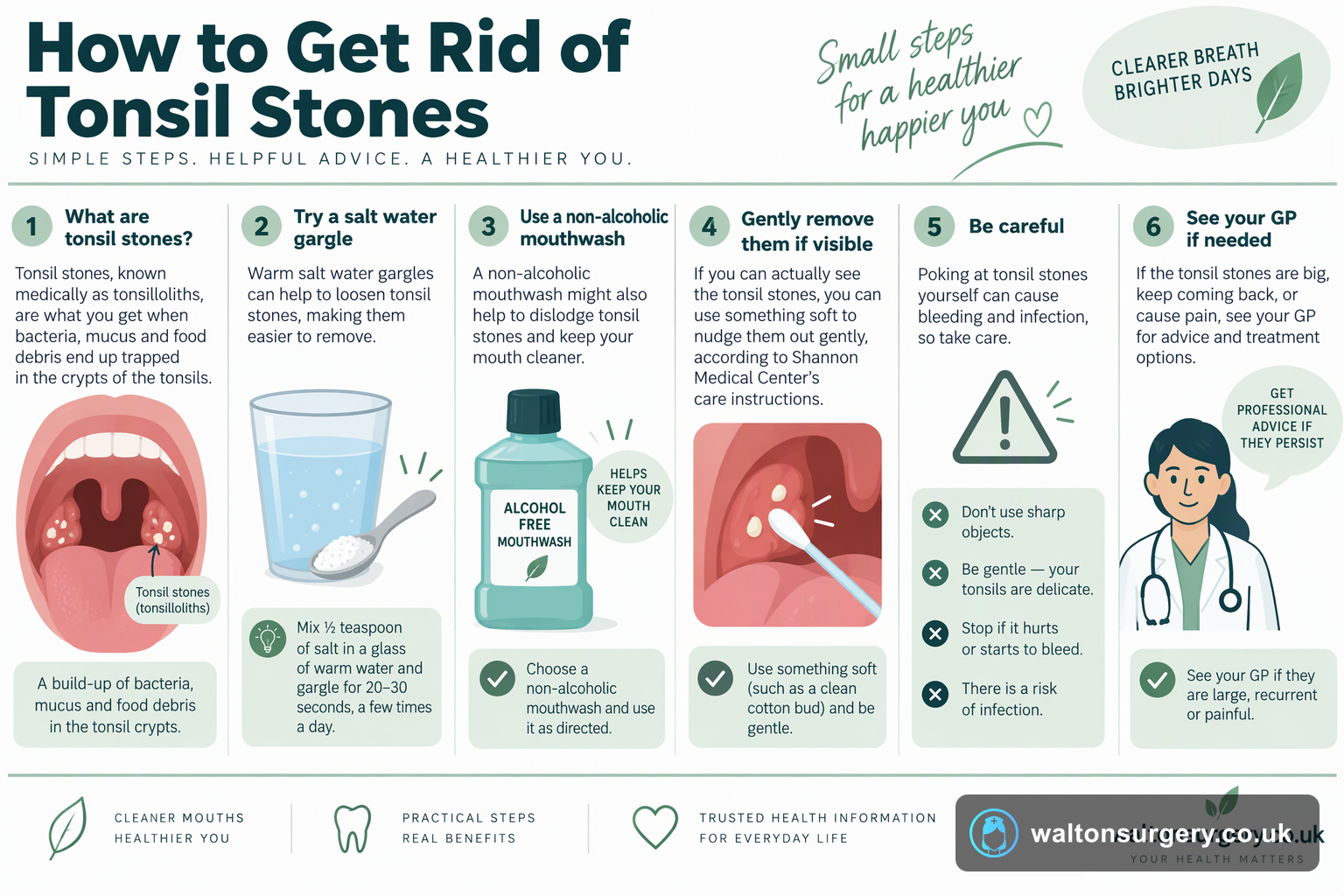
⚡ Quick Answer
Tonsil stones, known medically as tonsilloliths, are what you get when bacteria, mucus and food debris end up trapped in the crypts of the tonsils. Warm salt water gargles or a non-alcoholic mouthwash might help work them loose. Shannon Medical Center's care instructions say you can use something soft to nudge them out gently if you can actually see them. Do be careful though — poking at them yourself can cause bleeding and infection, and if they're big, keep coming back or hurt, see your GP.
Plenty of people get tonsil stones — they're called tonsilloliths too — and Google turns up a fair amount about them. They sit in the crypts, the little holes and folds in the tonsils, and they grow slowly over time. What they're actually made of is a build-up of bacteria, mucus, food particles and whatever else collects in those pockets. Most people spot them as small white or yellowish lumps at the back of the throat, and they often come with bad breath attached.
If you've typed "how to get rid of tonsil stones" into a search bar, you're in very large company. Here's what's known about getting rid of them at home, which methods are risky, when a pharmacist or GP ought to be involved, and how to stop them returning. This is general information — not a replacement for advice from someone who's actually examined you.
What Are Tonsil Stones and How Do You Know You Have Them?
What happens, in short, is that debris collects in the crypts — those small holes and folds in the tonsils at the back of your throat. Bacteria, mucus, food particles and other bits make up that debris, as one article on removing tonsil stones naturally puts it. Give it enough time and the collected material hardens into little lumps, usually yellowish-white.
Whether you'd notice a tonsil stone depends a lot on how big it is and where it's sitting. Some are tiny and cause nothing at all — you only find out when you happen to look in a mirror and there are white lumps hanging around near the tonsils. Others leave you with a constant bad taste, or that annoying feeling that something's stuck at the back of your throat, or, and this is the symptom people report most, bad breath that survives normal brushing. You might get earache or a bit of discomfort on swallowing too. Those last two have plenty of other explanations as well — persistent pain and discomfort in one area can be a feature of lots of conditions, and if you're comparing notes with other sufferers it can be worth reading up on the symptoms of kidney stones too, since the pattern of hard little deposits forming inside the body shows up in several different places.
Not everything that looks like a stone is one. If whatever you're seeing doesn't resemble a typical soft white lump, or if there's a sore throat, a fever, or you're struggling to swallow, get it looked at instead of assuming. A GP or pharmacist can sort out the difference for you.
What Causes Tonsil Stones?
So why do some people keep getting them? It mostly comes down to the shape of your tonsils. Deeper crypts, or more of them, mean more spots where debris can settle and go hard. The Google-listed guidance notes that tonsil stones are caused by a build-up of bacteria, mucus, food particles and other materials that collect in those crypts.
As for how long formation takes — there's no fixed timeline in the reviewed material. Debris might gather over days or possibly weeks and slowly compact together. Which is why people find stones showing up again after they thought they'd cleared them; the crypts that made the first one are still sitting there.
Oral hygiene that isn't up to scratch can add to it, since bacteria and food residue get more of a chance to build up. Things like recurrent throat infections, post-nasal drip and a throat that's chronically inflamed may play a part too, although those are common conditions with loads of other causes. If infections keep happening along with stones, that's something to take to your GP rather than battle on your own.
How to Get Rid of Tonsil Stones at Home — Safely
Most of you have probably scrolled straight to this bit. Various non-medical sources talk about home methods, though the level of risk isn't the same across them. What follows is a run-through of the approaches that keep appearing in the material Google currently ranks for "how to get rid of tonsil stones", along with where you need to be careful.
Gargle with warm salt water
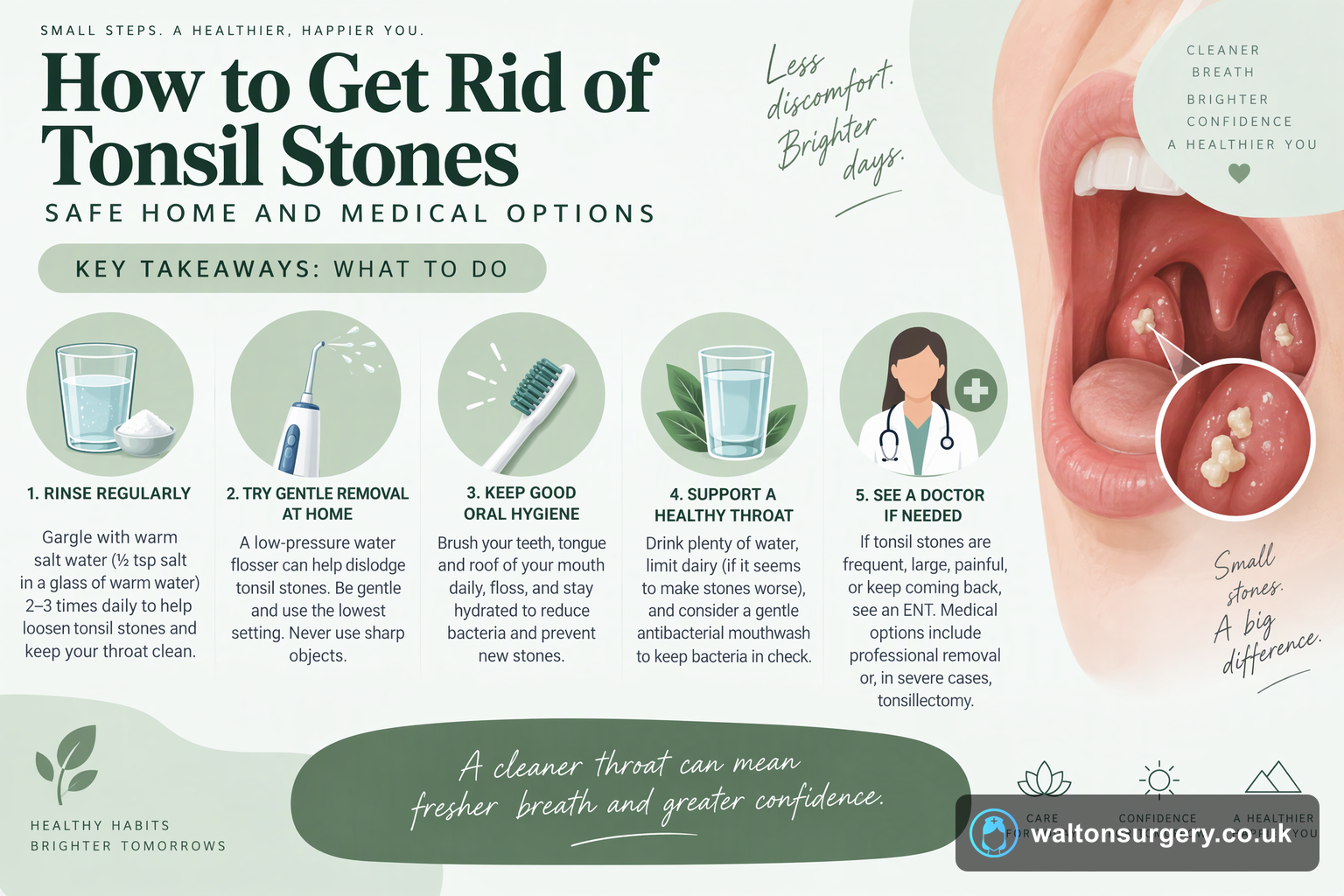
Warm salt water gargling is what Shannon Medical Center's care instructions recommend. It can ease swelling and discomfort and it may help shift stones as well. Use water that's warm, not hot, and gargle gently a few times a day if your throat's sore or you think a stone's on the move. Those same instructions describe gargling as one of the easier self-care things people tend to try first.
Gargle with non-alcoholic mouth rinse
One source quotes guidance saying that "vigorous rinsing with a mouthwash can lower bacteria levels and potentially loosen your tonsil stone". What's specified is a non-alcoholic rinse — alcohol-based products are more likely to sting on throat tissue that's already irritated. A separate piece on getting rid of tonsil stones at home mentions disinfectant mouthwash gargling as something you can do alongside the salt water. Worth saying: neither source suggests gargling on its own will reliably clear a big stone. It's more of a supporting act.
Use something soft to remove stones gently, if you can see them
Shannon Medical Center also say you can use something soft to take tonsil stones out gently. Soft cotton buds are what online guides tend to mention for this. Two things to keep in mind. This works only when the stone is out in the open and near the surface — pushing at ones you can't properly see can injure the tissue around them. And doing removal by hand at home carries real risks, like bleeding and infection, as one reader-question response on removing tonsil stones at home explains. If it won't lift out with barely any pressure, leave it.
What about dedicated tonsil stone remover tools?
Search results are full of products sold as tonsil stone removers — irrigation devices, vacuum-style tools, kits aimed at exactly this. Videos and product listings for these appear in the current Google results. Walton Health News can't confirm they're safe or effective from the material we've looked at, and not one piece of the UK guidance reviewed recommends them. Your throat is delicate and it injures without much effort; anything generating suction or pressure near the tonsils could do damage. Approach these tools the way you would any unregulated gadget being used near your airway — and it's worth noting that digital health innovations such as ai in social care guidance uk show how the sector is looking to technology, but gadgetry sold direct to consumers sits a long way from regulated clinical tools.
What Not to Do When Removing Tonsil Stones
Hard or sharp objects are a no. Fingernails, tweezers, toothpicks, pen lids, bits of metal — none of them belong near your tonsils. Shannon Medical Center's care instructions specifically say to use something soft and not rigid or sharp, and that's because tonsils bleed easily and damage there is prone to infection.
Scraping away at the same spot over and over won't help. When a stone isn't budging, extra pressure is far more likely to injure you than to shift it. If there's persistent bleeding after you've tried to remove one, that's the point to stop and get help.
And don't write off symptoms that don't fit the picture. A stone that keeps getting bigger no matter what you do, throat pain getting worse instead of better, trouble swallowing or opening your mouth, a high temperature — each of those points to something beyond a simple tonsillolith. Those signs belong with a GP or, out of hours and urgent but not life-threatening, NHS 111.
How to Prevent Tonsil Stones Coming Back
Clearing one stone doesn't clear the reason it appeared, because the crypts are still there. What prevention actually means is cutting down on the debris that collects in the first place.
Look after your mouth properly — that's the foundation. Brush teeth and tongue often, clean between the teeth, rinse after eating where it's practical. Gargling, either warm salt water or a non-alcoholic mouth rinse, comes up in the reviewed sources as a way to bring bacteria levels down and possibly loosen stones before they set firm.
Drink enough water. A dry mouth is bacteria's friend. Dealing with any ongoing nasal congestion or post-nasal drip matters too, since that can drop debris straight onto the tonsils — worth mentioning to your GP or pharmacist if it keeps happening for you. If the irritation leaves you coughing repeatedly, it's worth looking at how to stop coughing, because a persistent tickle at the back of the throat often travels with the same post-nasal drip that feeds tonsil stone formation.
Self-care alone won't get rid of tonsil stones "forever" when your tonsils have deep crypts, and that's just the reality. For people with stones that genuinely keep coming back and are affecting how they live, a GP can talk through whether more assessment or, sometimes, removal of the tonsils — a tonsillectomy — makes sense. That call is a clinical one, not a bathroom-mirror one.
🔬 Key Facts
What causes tonsil stones, in brief
- → Deeper crypts, or more of them, mean more spots where debris can settle and go hard
- → Stones are a build-up of bacteria, mucus, food particles and other materials collecting in the crypts
- → There's no fixed formation timeline — debris might gather over days or possibly weeks and slowly compact
- → Poor oral hygiene, recurrent throat infections and post-nasal drip can all add to the problem
When to See Your GP, NHS 111 or 999
Harmless and manageable at home — that's most tonsil stones. But there are moments when self-managing should stop.
See your GP if:
• Tonsil stones keep coming back and bother you.
• You have a stone that's large, painful or visible but won't come out.
• Bad breath persists despite good oral hygiene and treated stones.
• You have recurrent sore throats or throat infections.
• You notice something at the back of the throat that doesn't look like a typical stone — any lump, ulcer or asymmetry that's new or growing needs assessment.
Call NHS 111 if your symptoms are urgent but not life-threatening — for example, worsening throat pain out of hours, a stone causing noticeable difficulty swallowing, or mild bleeding that isn't settling.
Ring 999 or head to A&E for heavy bleeding from the throat, trouble breathing, drooling because you can't swallow your own saliva, or being unable to open your mouth. Those are emergencies.
Walton Health News is an independent health information site. It isn't a GP practice and doesn't see, treat or book patients. Your own GP, a pharmacist, NHS 111 and 999 are the right routes for personal care.
Tonsil Stones in Children
Searches like "how to get rid of tonsil stones in child" come up a lot, yet none of the material reviewed gives specific paediatric advice. That gap matters. Children's throats are smaller and easier to damage, and something that's fine for an adult to try may not be suitable for a kid at all. Don't try to remove stones manually from a child at home.
If you reckon your child might have tonsil stones, raise it with your GP or practice nurse, or ask a pharmacist about mouth rinses that are safe for children. A sore throat, a fever, swallowing difficulty — take those to a doctor rather than sitting on them, since plenty of things cause them and they deserve a proper look.
Frequently Asked Questions
⭐ The Bottom Line
What this means for you
What you're dealing with, if you have tonsil stones, is bacteria, mucus and food debris caught in the tonsil crypts. Warm salt water gargles or a non-alcoholic mouth rinse might loosen them, and Shannon Medical Center's care instructions also say you can use something soft to lift out visible stones gently. Poking at them manually risks bleeding and infection, so don't force it. Recurrent, large or painful stones — or anything unexplained happening in your throat — go to your GP, pharmacist, NHS 111 or 999 depending on how urgent it is.
Last updated: 2026-11-23 · Written by the Walton Editorial Team · Walton Health News is an independent health information site, not a GP practice. Information is for educational purposes only and does not replace advice from your own GP, pharmacist or NHS 111.