How to Stop Coughing: Causes and Effective Remedies
PART C — HTML BODY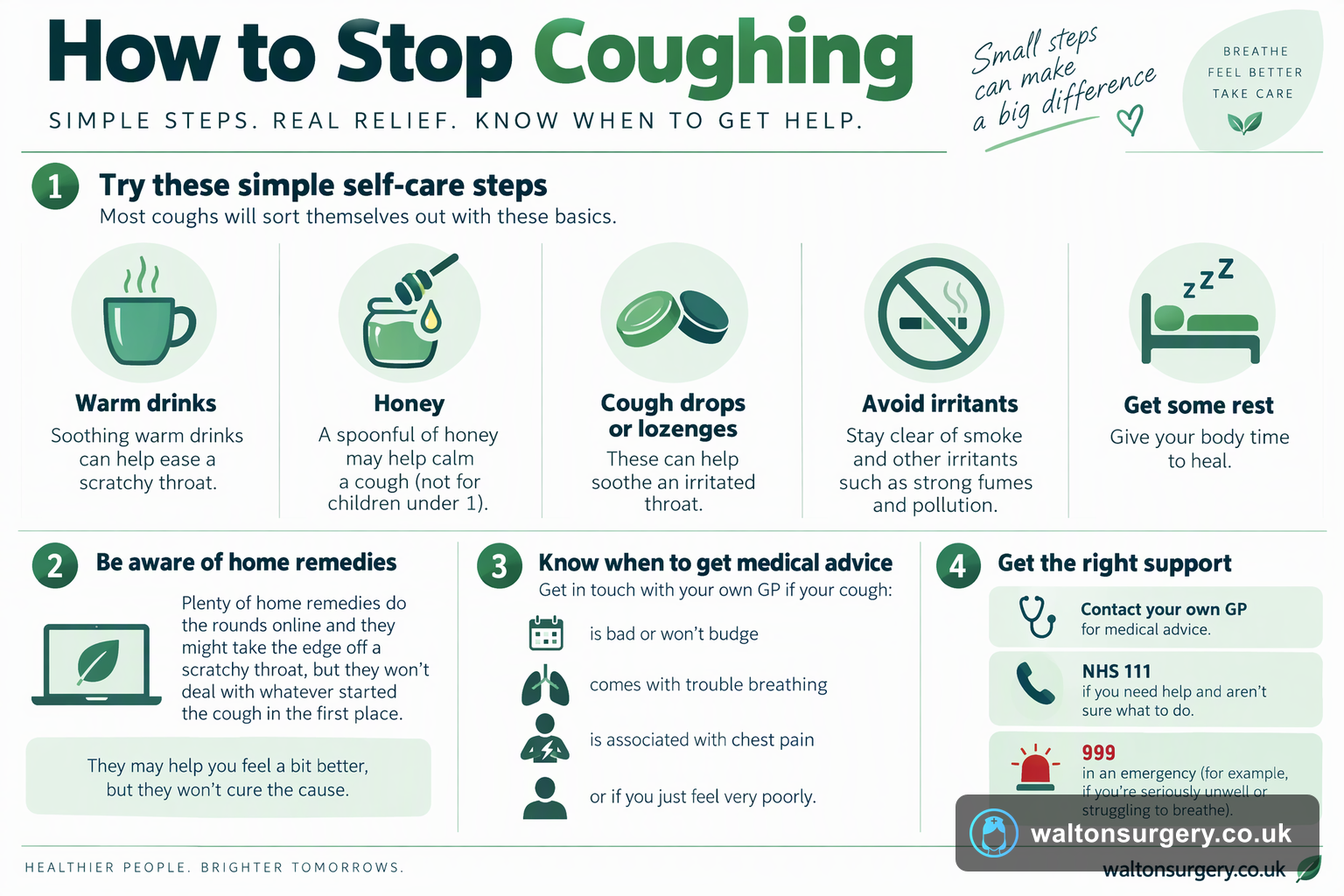
⚡ Quick Answer
Most coughs will sort themselves out with basic self-care — warm drinks, honey, cough drops or lozenges, staying clear of smoke and other irritants, and getting some rest. Plenty of home remedies do the rounds online and they might take the edge off a scratchy throat, but they won't deal with whatever started the cough in the first place. If yours is bad, won't budge, or comes with trouble breathing, chest pain, or you just feel very poorly, get in touch with your own GP, NHS 111, or 999 in an emergency. If you want the fuller picture, our guide to how to stop periods immediately home remedies uk goes further.
Usually, when people want to stop coughing, they start at home — and the widely shared home-remedy content out there backs that up. Warm liquids, honey or ginger-based teas, cough drops or lozenges sucked slowly, a rinse with warm salt water, keeping away from smoke and other triggers. Rest matters too. All of it is about settling irritation in the throat rather than sorting out the thing that caused the cough to begin with.
Coughing has a job to do, by the way. It clears the airways out. Which is exactly why going all-out to shut up every single cough isn't necessarily the right move. What you really need to get your head around is which self-care steps make sense, which over-the-counter options might be worth a chat with a pharmacist, and — above everything — when a cough stops being a minor nuisance and starts needing proper assessment. Those three things are what this article covers.
What actually helps when you want to stop coughing fast?
Need it gone now? The home measures people recommend most often are pretty consistent across the content that shows up when you search for this. Warm drink first, usually tea, because it keeps you hydrated and calms an irritated throat down. Honey turns up again and again in online guides, sometimes in tea on its own. Ginger is the other one that gets flagged a lot — most often dropped into a hot drink.
For a dry, tickly cough, lozenges and cough drops are the go-to suggestion. Home-remedy content puts it like this: let them dissolve slowly rather than crunch through them, give the throat a chance to feel soothed. A rinse with warm salt water comes up frequently too, and again, it's aimed at making the throat more comfortable, not at fixing a cause.
Two things come up over and over in the self-help content ranking for this search: steer clear of smoke and irritants, and get plenty of rest. Busy people overlook both, but they always sit alongside the drinks and the lozenges. If your cough is bad, won't shift, or comes with difficulty breathing or chest pain, that content says it outright — get medical help instead of leaning on home measures.
🔬 Key Facts
The most consistently recommended home measures
- → Warm drinks first — usually tea, because it keeps you hydrated and calms an irritated throat down.
- → Honey and ginger turn up again and again in online guides, most often dropped into a hot drink.
- → Lozenges and cough drops for a dry, tickly cough — let them dissolve slowly rather than crunch through them.
- → Avoid smoke and irritants, and rest — both sit alongside the drinks and the lozenges every single time.
Understanding dry coughs versus coughs with mucus
Coughs don't all behave the same way, and the type you've got decides which self-care steps actually make sense. Dry and tickly means nothing's coming up — no phlegm. It's the kind of cough that'll keep you staring at the ceiling at 2am or wreck a conversation halfway through a sentence. Guidance aimed at dry coughs generally points at soothing the throat: lozenges, warm drinks, honey, hydration without the steam. There's more on this in our ai in social care guidance uk explainer.
Chesty coughs, the mucus-producing kind, work differently. The coughing itself is doing something useful by pushing mucus up and out of the airways. One piece of community advice floating around online points at a mucolytic (a medicine that thins mucus) for anyone struggling with thick, stubborn stuff. Before you go down that road, though — talk to a pharmacist. They'll tell you if it's right for you and what side effects to keep an eye on.
Something home-remedy content does flag, and it's worth listening to: when mucus is thick and yellow or green, or you're feeling worse alongside it, don't just put up with it. That pattern can warrant a conversation with your own GP. On the other hand, a dry cough with a blocked or runny nose in someone who otherwise feels fine — simple throat-soothing measures and time are usually where you start.
Do home remedies like honey, ginger, and salt water actually work?
Videos, blog posts, forum threads — there's plenty of home-remedy content on the internet offering honey and ginger teas, cider vinegar mixes, nasal rinses, you name it. Straight answer: these are mostly comfort measures, not cures. Making an irritated throat calmer can reduce the urge to cough, but it's not going to shift an underlying infection or allergy by itself.
Honey pops up on multiple home-remedy lists, normally stirred into warm water or tea. Ginger tends to get included in the same sorts of drinks. Warm salt water rinses, suggested for throat comfort. Cough drops and lozenges are in the same bucket — they help your throat feel better while the cough works through its course. Self-help content doesn't present any of these as treatments for a particular condition.
Let's be honest about the evidence picture here, because it's mixed and people's experiences differ a lot. These are traditional comfort measures rather than proven medical treatments. Honey isn't suitable for babies under one — always check age guidance before giving any remedy to a child. And if you're pregnant, on other medicines, or managing a long-term condition, ask a pharmacist before trying anything new. NHS guidance on honey and under-ones is pretty blunt about this, so it's not a grey area.
Cough drops, lozenges and throat soothers
When you've got a dry, tickly cough, most people reach for lozenges or cough drops before anything else. Simple appeal: they keep the throat moist and can take the bite out of irritation. Let them dissolve slowly rather than chew through them quickly — that way the soothing effect hangs around as long as possible.
Pharmacy shelves carry loads of varieties — menthol ones, eucalyptus ones, sugar-free ones, ones aimed specifically at nighttime use. Not sure which is right for you? A pharmacist can point you towards something that fits your symptoms and works with any other medicines you take. Worth remembering, this isn't personalised medical advice — it's general information meant to help you walk into that conversation better informed. We cover this in more depth in symptoms of kidney stones.
Lozenges and young children aren't a good mix — choking risk. Ask a pharmacist about age-appropriate options for kids. And if a sore throat arrives alongside a high temperature, difficulty swallowing, or a rash, lozenges on their own aren't going to cut it — get in touch with your own GP or NHS 111.
Cough suppressants and cough medicines — what to ask a pharmacist about
Walk into any pharmacy and you'll see shelves packed with cough medicines, and the names can be genuinely confusing. Broadly there are two categories. Suppressants (antitussives, sometimes called) aim at cutting down the urge to cough. Expectrorants or mucolytics do the opposite job: making mucus thinner and easier to shift. Dry and tickly versus chesty decides which one you want, which is exactly why a pharmacist's input helps.
Robitussin and other well-known cough syrups get searched for by name a lot. Some products use ingredients like pholcodeine linctus for dry coughs, which shows up in community discussions of cough relief. Whatever you're picking up, the rule stays the same: read the label, stick to the dosing instructions, and check it's safe with anything else you're already taking.
You'll find plenty of "dry cough medicine" and "best cough suppressant" searches, which reflects a pretty understandable hope — one product, problem over. Doesn't work that way. Cough medicines manage symptoms while your body deals with the cause. If you've been buying bottles of over-the-counter stuff for more than a few days and nothing's shifting, that's your cue to go see your own GP instead of restocking.
Stopping coughing at night — practical steps that help
Night coughs are among the most disruptive things people describe. Content aimed at nocturnal coughing suggests a few steps: warm, caffeine-free drink before bed, honey in warm water, ginger-based drinks, cough drops or lozenges to settle the throat before you lie down.
Positioning matters too, more than people expect. Propping yourself up with an extra pillow can sometimes dial down the tickle that sets coughing off when you're flat. Bedroom air that's comfortable — not too dry, not too stuffy — and kept clear of smoke, dust, or strong fragrances may cut irritation down as well. If you smoke, keeping it outside is one immediate way to reduce how much of that trigger you're breathing in.
Some online threads about night coughs raise nasal rinses or lavage (washing out the nose with a prepared saline solution) as a way to cut post-nasal drip, which can set coughing off at night. If you want to try it, use a proper kit or prepared solution rather than just tap water, and ask a pharmacist if you're unsure. Persistent night coughing, or anything that's wrecking your sleep regularly, should get raised with your own GP.
Allergies, irritants and triggers you can control
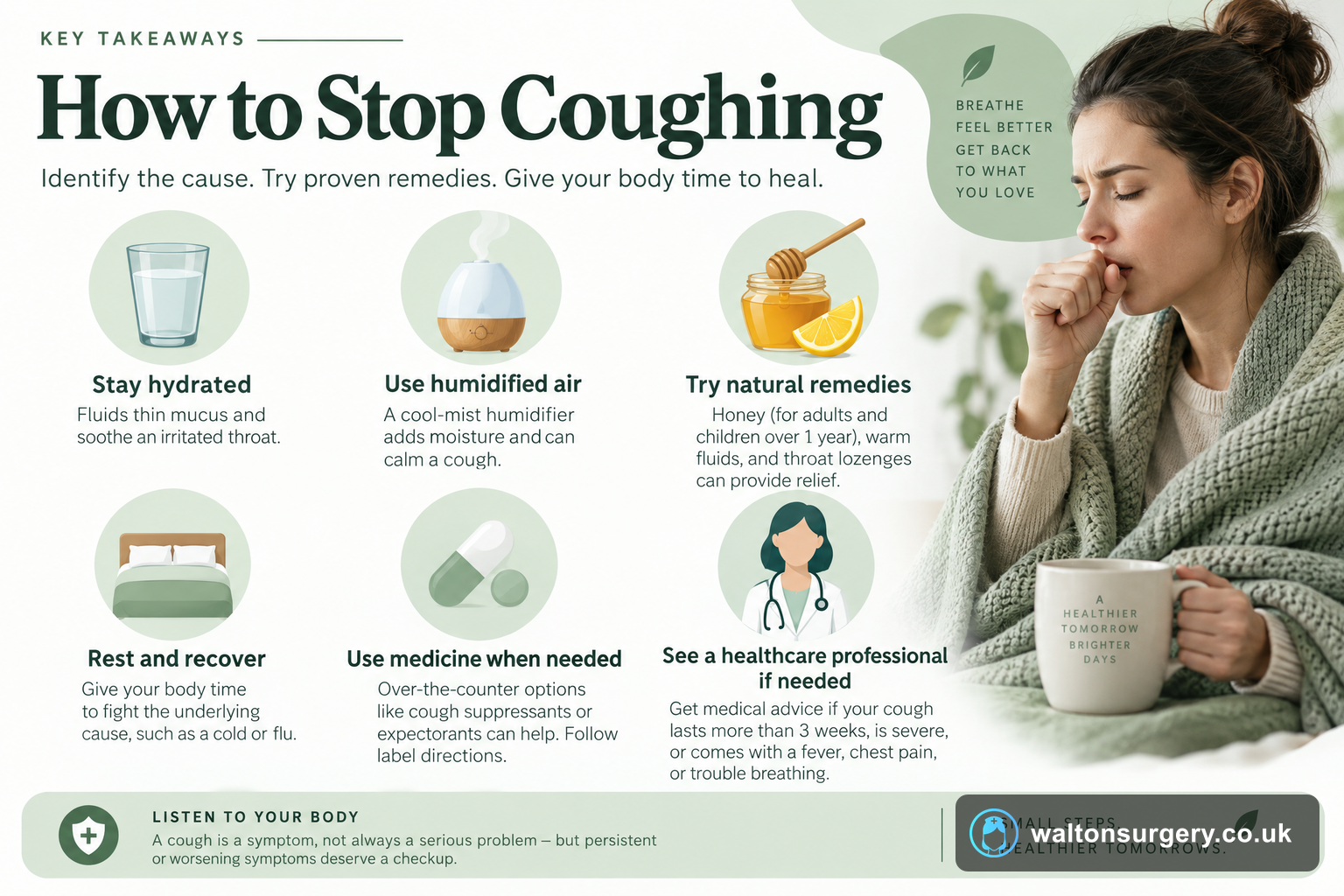
Not every cough is down to an infection. Allergies and environmental irritants are common culprits, especially when the cough's dry, comes and goes, or shows up in particular places. Dust, pollen, pet dander, strong perfumes, cleaning products, smoke — all of these can set coughing off in people who are susceptible. Figuring out your triggers is usually the single most useful thing you can do.
Steering clear of smoke and irritants is one of the most consistently repeated bits of self-help advice across the content ranking for "how to stop coughing". Exposed at work or at home? Reducing that exposure where you can genuinely makes a difference. For allergy-driven coughs, a pharmacist can walk you through antihistamines and other over-the-counter options.
If you reckon an allergy is behind a persistent cough, your own GP can help you get to the bottom of it and talk about tests or referral if appropriate. Sudden, severe breathing difficulty — which can happen in a serious allergic reaction — needs 999 called immediately.
When to contact your own GP, NHS 111, or 999
Most coughs improve on their own with simple self-care. But there are moments when you need proper advice, and honestly, asking early beats waiting around.
Get in touch with your own GP if your cough has been going more than a few weeks without improving, keeps coming back, or if you're coughing up blood. Make an appointment too if you've got a persistent cough alongside weight loss, night sweats, a hoarse voice that won't settle, or chest pain that can't be explained away by all the coughing. These symptoms deserve proper assessment.
Feel unwell and need advice fast but it's not a life-threatening emergency? Call NHS 111. Examples: struggling to manage symptoms at home, can't keep fluids down, worried about a child's cough. NHS 111 can direct you to the right service.
Call 999 for severe difficulty breathing, blue lips or face, chest pain, confusion, or difficulty staying awake — either in you or someone else. These are signs of a medical emergency. Don't sit around waiting for things to sort themselves out.
Frequently Asked Questions
⭐ The Bottom Line
What this means for you
Stopping a cough usually means managing it while the cause settles. Warm drinks, honey, lozenges, avoiding smoke, and rest — the consistent starting points in widely shared self-care advice. Over-the-counter cough medicines can help, and a pharmacist can guide you. But persistent or severe coughs deserve proper assessment — contact your own GP, NHS 111 if urgent, or 999 in an emergency.
Last updated: 2026-11-22 · Written by the Walton Editorial Team · Walton Health News is an independent health information site, not a GP practice. Information is for educational purposes only and does not replace advice from your own GP, pharmacist or NHS 111.