How to Get Rid of Dandruff: Causes, Treatments and Home Remedies
PART C — HTML BODY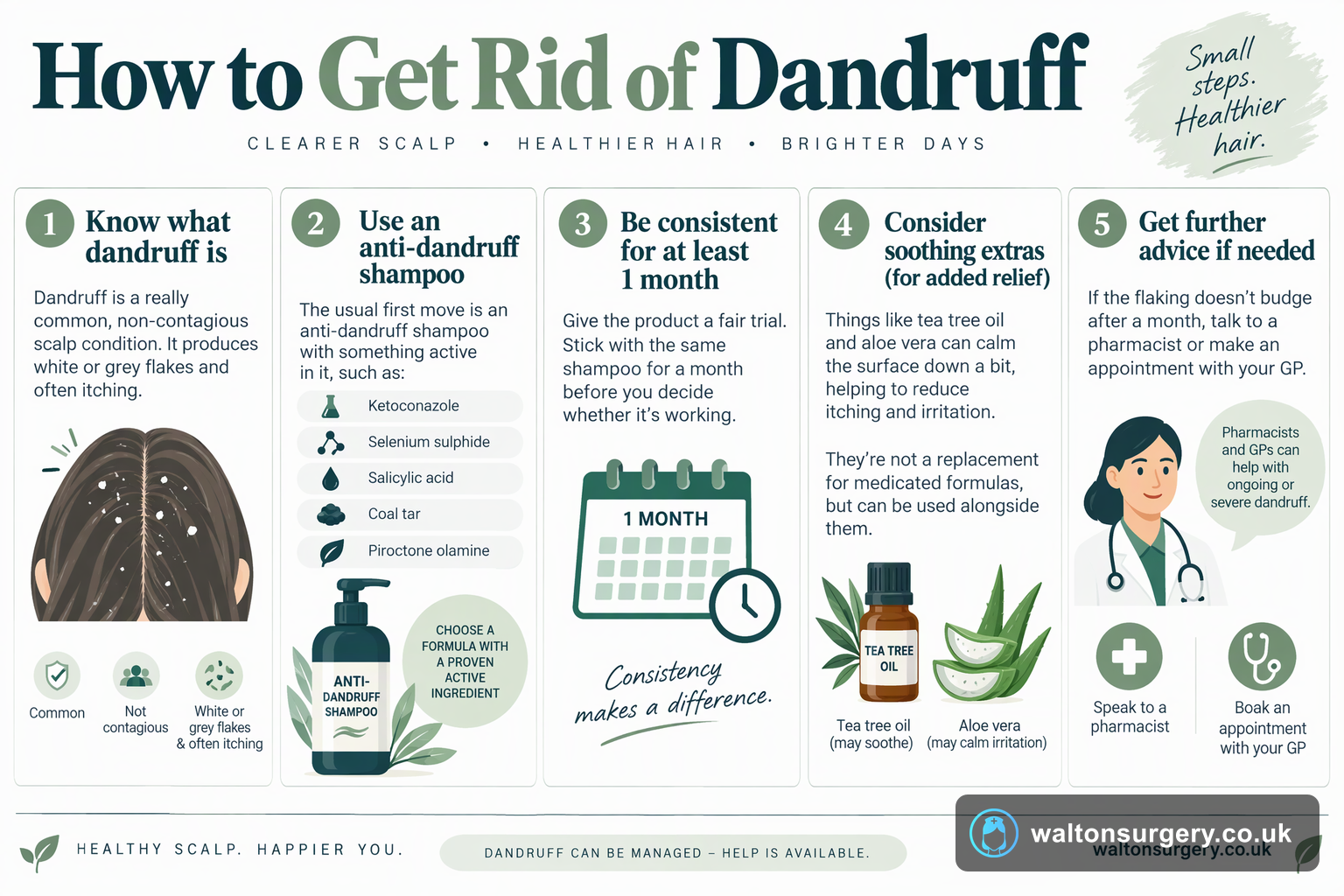
⚡ Quick Answer
Dandruff is a really common, non-contagious scalp condition — it produces white or grey flakes and often itching. The usual first move is an anti-dandruff shampoo with something active in it: ketoconazole, selenium sulphide, salicylic acid, coal tar or piroctone olamine. Stick with one product for a month before you decide whether it's working. Things like tea tree oil and aloe vera can calm the surface down a bit, but they're not a replacement for medicated formulas. If the flaking doesn't budge, talk to a pharmacist or make an appointment with your GP.
Among the complaints people bring up at UK pharmacies and GP surgeries, dandruff ranks near the top. It's also one of the easiest to live with once you know what you're doing. Guidance used across UK health services puts anti-dandruff shampoos at the front of the queue, and you can pick them up at Boots, Tesco, anywhere really, without a prescription.
What follows covers why flaking starts, which ingredients in shampoo bottles actually do something, the right way to use them, and the point at which you should stop tinkering at home and involve a pharmacist, your own GP or another NHS service. General information only here. Not personal medical advice, because scalps are individual and what sorts one person's out might leave someone else's worse.
What is dandruff, exactly?
A scalp condition that shows up as loose white or grey flakes of skin, often with itching alongside. You can't catch it from anyone, and it has nothing to do with how clean your hair is — although washing frequency does play a role in how visible those flakes look. For the vast majority of people, it's a persistent annoyance rather than something dangerous, and the right shampoo used regularly handles it well.
Things make it worse. Things make it better. Central heating during a British winter dries the air out and the scalp gets irritated; stress does the same trick; so does leaving it too long between washes. Because the whole process is tied to how your scalp sheds dead skin and how it responds to a yeast that lives there naturally, dandruff tends to creep back once you stop the shampoo. Ongoing management, then, is the honest goal rather than some permanent cure.
What causes dandruff?
Multiple culprits, not one. At the core of it: skin cells on the scalp are being shed faster than they should be, and a handful of different factors can push that rate up.
- Oil and yeast on the scalp. Sebum is produced by your scalp constantly, and there's a yeast called Malassezia that feeds off it. Tip the balance between the two and the skin gets irritated, then flaky.
- Infrequent washing. Oil plus dead skin equals visible flakes. Washing more often using a gentle shampoo is one of the self-care steps the NHS page on dandruff, which was last reviewed a while ago, sets out plainly as a first thing to try.
- Hair products. Styling sprays, mousses, even some shampoos can wind up irritating certain scalps. Moving to a gentler formula is often all that's needed.
- Stress and lifestyle. Places that talk about how to get rid of dandruff tend to flag stress as a factor. Cutting back on screen time, building regular exercise in, finding time to read or do some yoga or meditate, that sort of thing, may take the edge off flare-ups.
- Underlying scalp conditions. Seborrhoeic dermatitis, scalp psoriasis — both cause heavy flaking and both are far more stubborn than ordinary dandruff. Proper diagnosis needed, so if the flaking looks or feels like more than run-of-the-mill dandruff, book with your GP.
The best shampoo ingredients to look for
Here's where the real work of dandruff management gets done, and it pays to know what's actually inside the bottle before you buy. Anti-dandruff shampoos operate on one of three fronts: cutting down yeast numbers on the scalp, slowing how fast skin cells turn over, or loosening and washing away the flakes already sitting there. UK health guidance on dandruff names several actives and chances are you'll spot at least one on the back label.
🔬 Key Facts
The shampoo actives that actually do something
- → Ketoconazole is an antifungal that goes after the yeast tied to flaking; the 2% version is a pharmacy medicine in the UK.
- → Selenium sulphide does two jobs — slows cell production and works as an antifungal.
- → Salicylic acid softens flakes and helps lift them off, but won't fix the root cause alone.
- → Coal tar slows skin turnover and calms the itch, but can stain fair, blonde or bleached hair.
Ketoconazole
An antifungal. It goes after the yeast that's tied to flaking. Nizoral, the brand most people know, comes up often and tends to get recommended where dandruff is more stubborn or heavier. The 2% version counts as a pharmacy medicine here in the UK; weaker ones sit on general sale.
Selenium sulphide
Does two jobs — slows down the rate at which scalp cells are produced and also works as an antifungal. Vichy Dercos is a product people will find easily.
Salicylic acid
What it does is soften the flakes and help lift them off. It won't fix the root cause on its own, but paired with another active it earns its place.
Coal tar
Slows skin turnover, calms the itch. Worth knowing in advance though: it can stain fair, blonde or bleached hair. Wrong choice for some people, that one.
Piroctone olamine
A more recent antifungal ingredient, found in modern anti-dandruff ranges like Head & Shoulders. It works by laying down the active on the scalp across your regular wash cycle.
Zinc pyrithione
Turns up in a lot of the everyday anti-dandruff shampoos sitting on UK supermarket and pharmacy shelves.
How to use an anti-dandruff shampoo properly
Most people who claim the shampoo did nothing haven't given it the time or haven't applied it properly. Genuinely the most useful thing anyone can tell you: give a new anti-dandruff shampoo four weeks of steady use before deciding.
A practical routine, then.
1. Wash your hair on a regular basis. Once a week is pushing it. Try washing more often. The washing itself clears out surplus oil and any flakes that have already come loose.
2. Lather into the scalp rather than just dragging it through the hair. Give it a couple of minutes sitting there before rinsing so the actives get a chance. Head & Shoulders guidance puts forward a two-minute method that's focused on getting the active ingredients down onto the scalp where they need to be.
3. Stick with the same bottle for a month. UK guidance on dandruff specifically recommends using a shampoo for one month before judging whether your dandruff has improved.
4. Alternate if that suits you better. Plenty of people will use the medicated one alongside a gentle everyday shampoo, particularly if the medicated stuff leaves their hair feeling dry.
5. Consider rotating actives. If ketoconazole hasn't worked after a month, try a shampoo with selenium sulphide or salicylic acid instead. Different actives suit different scalps.
Pharmacists are good at this stuff. They can tell you which ingredient matches your hair type and flag anything to be careful about if you're pregnant, breastfeeding, or sorting out a child's scalp.
How to get rid of dandruff naturally
Loads of people search for how to get rid of dandruff naturally, and there's a decent pile of home remedies they land on. Honest answer up front: the research behind most of these is far thinner than what backs medicated anti-dandruff shampoos, and none of them will do the job of a proven active if you've got persistent flaking. Some are popular though, and generally they don't cause problems when used sensibly.
Tea tree oil and lemongrass oil
Both keep appearing on natural dandruff remedy lists. Essential oils must be diluted before anything touches your scalp. Never neat, never on broken skin.
Aloe vera gel
Reported as soothing on inflammation. Guidance on this suggests rubbing in fresh gel, leaving it for around 30 minutes and rinsing off.
Coconut oil
Used as a scalp moisturiser, often applied overnight, to help with dryness and flaking.
Aspirin
Crush it and you've got salicylic acid in there, which is precisely the reason it shows up in natural remedy lists. Care needed when putting any medicine on your skin topically and if you've ever had an aspirin allergy then skip this one entirely.
Baking soda, zinc and omega-3 fatty acids
These also feature in natural dandruff remedy lists. Zinc in particular is a mineral involved in skin health and is available as a supplement, but it's sensible to speak to a pharmacist before starting any supplement routine.
Want to give the natural route a go? Do it in parallel with an evidence-based shampoo, not instead of one. And stop the moment you see any irritation.
How to get rid of dandruff permanently
Ask the internet this and you'll get a flood of answers. The straight one: for most people, dandruff keeps coming back. It's recurring, not a thing that vanishes after a single round of treatment and never returns. The scalp processes driving the flaking don't simply switch off.
Which isn't the same as saying you're stuck with visible flakes on your shoulders forever. Most people get on top of dandruff with steady anti-dandruff shampoo use and a haircare routine they actually follow. Track down the one that works and carry on with it — often once or twice a week mixed in with your regular shampoo — and the symptoms stay controlled.
Stop entirely and flakes tend to return within a few weeks. Think of it as maintenance. Like moisturising dry skin through winter, except for your scalp. That framing tends to be closer to the truth than a cure mindset.
Is it just dandruff, or something else?
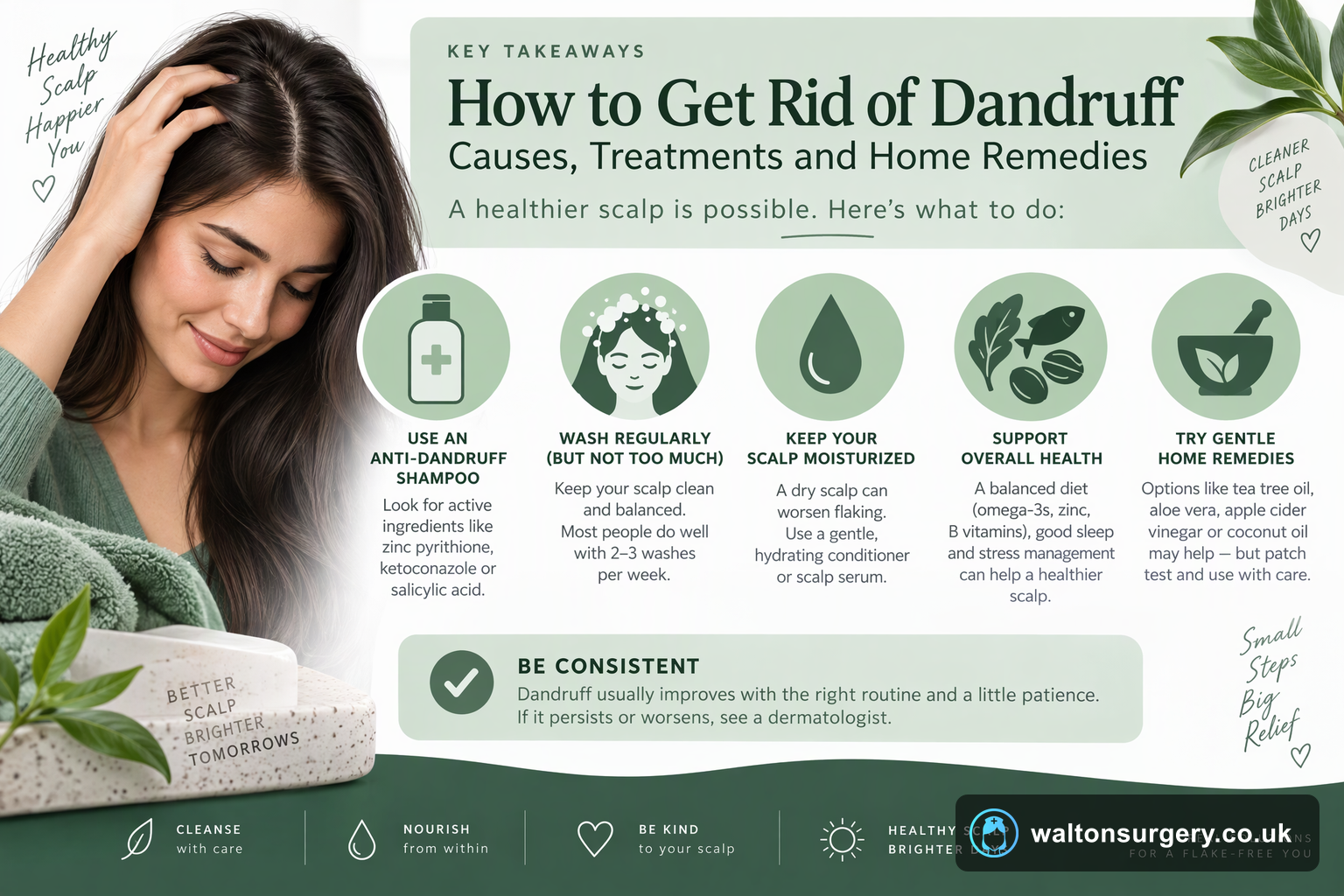
Flaky doesn't always mean dandruff. Worth knowing the alternatives since the treatment for each one is different.
Seborrhoeic dermatitis
Greasy yellowish flakes plus red skin, and it can spill over past the scalp into eyebrows, the sides of the nose, chest. Stronger treatment than ordinary anti-dandruff shampoo is usually the order of the day.
Scalp psoriasis
Thick silvery scales over well-defined red patches. Other body areas may be involved and management looks different from plain dandruff.
Contact dermatitis
Your hair product, dye or treatment has caused a reaction. Take the trigger away and things usually settle.
Dry scalp
Occasionally what appears to be dandruff is only dryness. Winter air, heated rooms, that kind of thing.
A month of careful anti-dandruff shampoo use that produced no improvement? Or thick scales appearing, hair coming out, weeping, crusting, real pain? Book in with your GP. What this article can't do is look at your scalp and tell you what's happening.
Frequently Asked Questions
When to see your GP, call NHS 111 or call 999
Most dandruff sorts itself out at home. Certain situations need a professional involved though.
See your own GP if:
- Your dandruff hasn't improved after a month of using an anti-dandruff shampoo correctly.
- Your scalp is very red, painful, swollen or weeping.
- You have thick silvery scales, greasy yellow flakes or patches that spread beyond your scalp.
- You're losing hair along with the flaking.
- Flaking is affecting your sleep, work or confidence.
Speak to a pharmacist if you'd like help choosing between anti-dandruff shampoos, if you're pregnant or breastfeeding and want advice on what's suitable, or if you're treating a child's flaky scalp.
Call NHS 111 if you need urgent advice but it isn't life-threatening — for example, if your scalp suddenly becomes very painful, swollen or infected and you can't get a GP appointment.
Call 999 or go to A&E if you have a severe allergic reaction with difficulty breathing, swelling of the face, lips or tongue, or collapse. These are medical emergencies.
⭐ The Bottom Line
What this means for you
Common thing. Manageable thing. Absolutely nothing to be embarrassed about. Shampoos that carry proven actives — ketoconazole, selenium sulphide, salicylic acid, coal tar or piroctone olamine — sit at the front of the line, and one month of steady use tells you whether yours is working. Natural options can sit alongside them, but not in their place. Still flaking after all that? See your GP.
Last updated: 2026-11-24 · Written by the Walton Editorial Team · Walton Health News is an independent health information site, not a GP practice. Information is for educational purposes only and does not replace advice from your own GP, pharmacist or NHS 111.
INTERNAL LINK WOVEN TEXT — for clarity, the three anchor placements are embedded in the paragraphs above at these exact sentences (please paste each paragraph exactly as shown below, replacing the corresponding plain paragraph): Replace the second intro paragraph with:What follows covers why flaking starts, which ingredients in shampoo bottles actually do something, the right way to use them, and the point at which you should stop tinkering at home and involve a pharmacist, your own GP or another NHS service — services that are themselves changing as policy makers push things like ai in social care guidance uk to cut paperwork and free up clinical time. General information only here. Not personal medical advice, because scalps are individual and what sorts one person's out might leave someone else's worse.
Replace the "Pharmacists are good at this stuff" paragraph with:Pharmacists are good at this stuff. They can tell you which ingredient matches your hair type and flag anything to be careful about if you're pregnant, breastfeeding, or sorting out a child's scalp — and they can also point you towards our guide on how to get rid of a stye if the problem you're dealing with is actually around your eye rather than on your scalp.
Replace the "Stop entirely and flakes tend to return" paragraph with:Stop entirely and flakes tend to return within a few weeks. Think of it as maintenance. Like moisturising dry skin through winter, except for your scalp. That framing tends to be closer to the truth than a cure mindset — the same way that steady at-home routines are what sort out other stubborn nuisances, such as the methods we cover in how to get rid of tonsil stones, where consistent simple habits beat one-off fixes every time.