How to Get Rid of a Stye: Treatment and Home Remedies
PART C — HTML BODY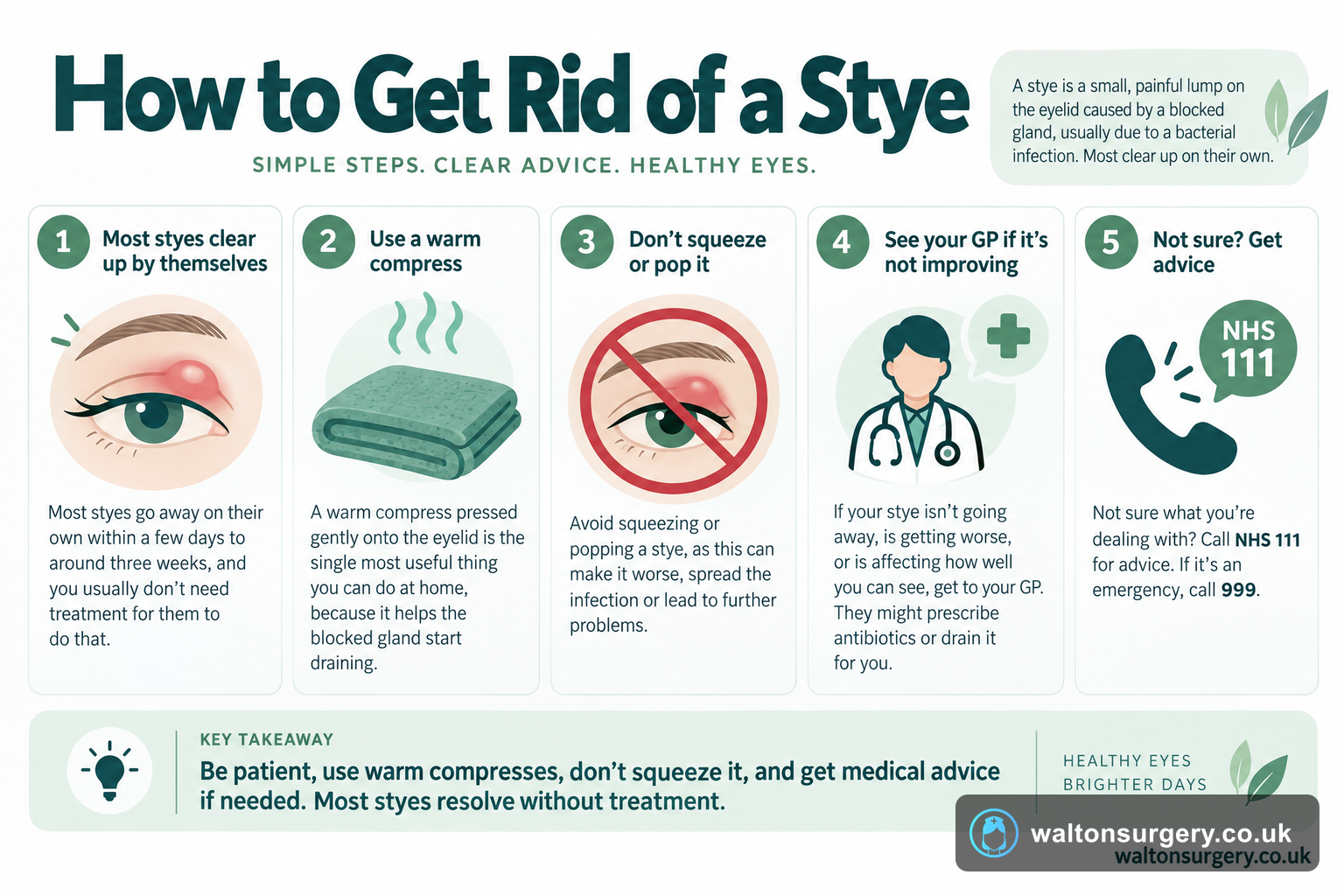
⚡ Quick Answer
Most styes clear up by themselves within anything from a few days to around three weeks, and you don't usually need treatment for them to do that. A warm compress pressed gently onto the eyelid is the single most useful thing you can do at home, because it helps the blocked gland start draining. Don't squeeze or pop one, though. If yours isn't going away, is getting worse, or is affecting how well you can see, get to your GP — they might prescribe antibiotics or drain it for you. Not sure what you're dealing with? Call NHS 111. Emergency? 999.
A small, painful lump on the eyelid — that's what a stye is, and it usually crops up because of an infection either at the base of an eyelash or in one of the tiny oil glands that line the lid margin. If you've come here looking for ways to get rid of one, the short version is that most settle without much fuss, and warm compresses are where you start.
Moorfields Eye Hospital points out that your GP is the person to speak to about getting rid of a stye, and that treatment in a practice setting can involve antibiotics or drainage with a sterilised needle. Below you'll find what genuinely helps at home, what doesn't, and the point at which medical advice becomes sensible. This is general information, not advice tailored to you, so do talk to your own GP or pharmacist about your particular symptoms — and if a nagging cough is keeping you awake alongside it, we've also covered how to stop coughing in a separate guide.
What Is a Stye, and Why Does It Hurt So Much?
What you're looking at is a small abscess, or infection, that's developed on the eyelid — the medical word for it is a hordeolum. Typically it shows up as a tender red lump right at the lid edge, near where the lashes come out, and blinking makes it ache. The soreness comes from both the infection itself and the swelling that builds up around whichever tiny gland has got blocked.
Every lid margin is studded with little oil-producing glands. Block one and the oily secretions have nowhere to go, which gives bacteria a nice trapped place to multiply, and the lump grows from there. Styes are extremely common and mostly nothing to lose sleep over, though ironically they can cost you sleep anyway, along with reading time and screen time while you've got one.
How Long Does a Stye Last?
Not long, is the reassuring answer. Guidance summarised by McAters Opticians says most styes improve without treatment across a period of a few days or weeks. An article titled "Styes: a real pain in the eye" puts the typical window at one to three weeks, during which most settle without anything being done about them. There's more on this in our ai in social care guidance uk explainer.
🔬 Key Facts
How long a stye typically lasts
- → Most styes improve without treatment across a few days or weeks
- → Typical window is one to three weeks
- → Most settle without anything being done about them
- → Hanging around past that window, returning, or not shifting is a reason to see your GP
Given that they usually resolve by themselves, a lot of the "how to get rid of a stye" material you find online is really about staying comfortable while your immune system does the clearing up. If, on the other hand, yours has hung around past that window, keeps returning, or simply hasn't shifted at all after a few weeks — those are reasons to book in with your GP rather than carry on waiting.
How to Get Rid of a Stye at Home: What Actually Works
This is where most people want the detail, so it's the practical steps spelled out properly here.
Use warm compresses
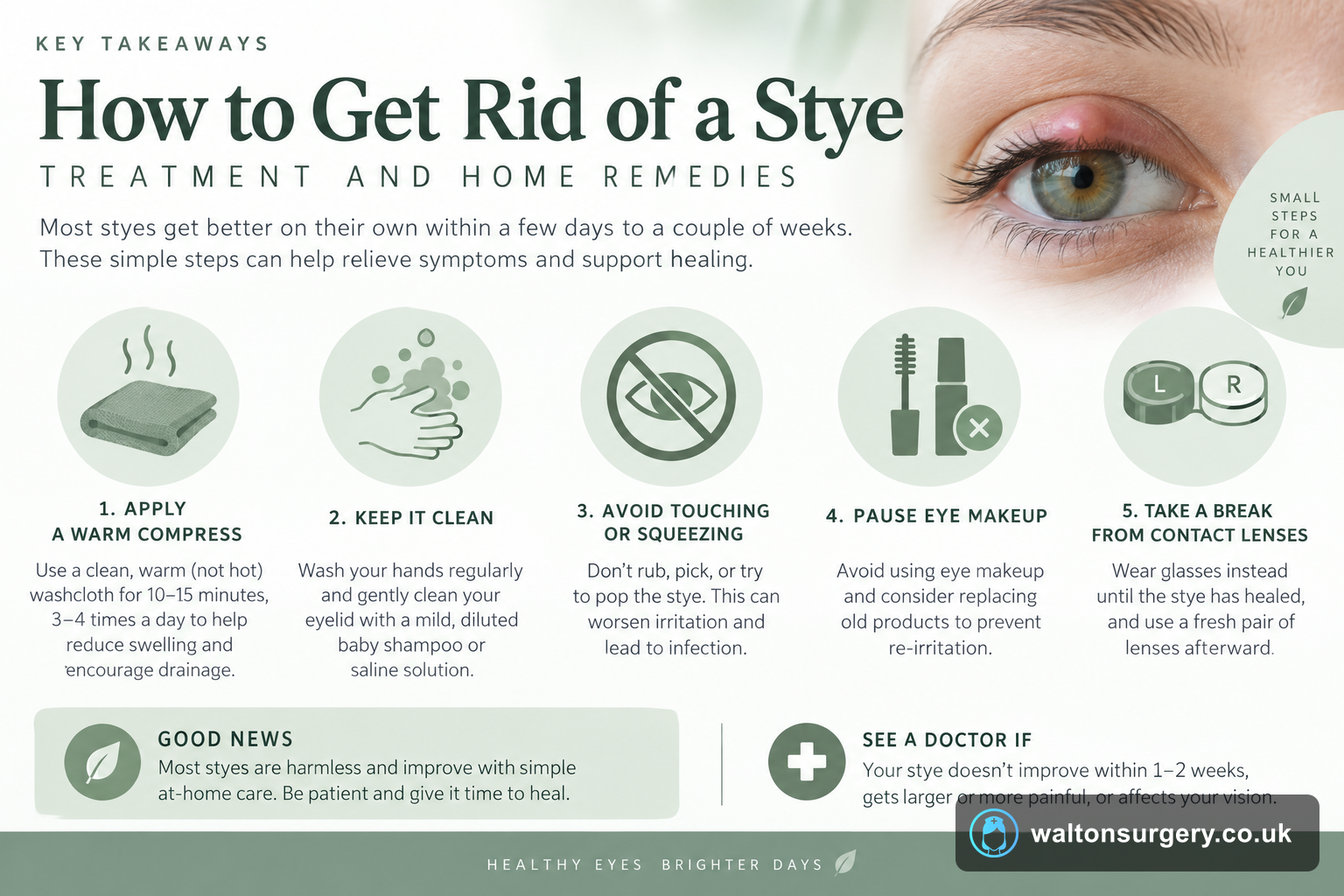
The mainstay of treatment at home, without any real competition, is the warm compress. In a guide called "What Is a Stye and How Do You Treat Them?", applying warm compresses to the eye several times a day is described as a way to help a stye drain and heal. You do it like this: soak a clean washcloth in warm water (hot is too hot), wring it out, and hold it gently against the closed eyelid. AccuVision, the eye clinic, suggests pressing a warm clean cloth on for roughly five minutes at a time to encourage the blocked gland to drain, done regularly, as your first move.
Some practical things people tend to get wrong or forget:
- Warm, not hot. Skin around the eye is thin and easily damaged, and a cloth that's too hot will burn it before you've noticed.
- Clean every time. Freshly washed cloth or flannel per application, otherwise you're just putting bacteria straight back on.
- Repeat through the day. Short sessions spread out beat one long one, and they fit around work more easily anyway.
- Be patient. What the compress does is help drainage — it doesn't vanish the infection on contact.
Keep the area clean
Because a stye is, at heart, a small infection, keeping the lid margin clean is worth doing. Crust or discharge can be gently wiped away with warm water and a clean cloth. General eye-care material associated with styes often draws a link to blepharitis — long-term inflammation of the eyelid margins — which itself is partly managed through decent lid hygiene. Contact lens wearers should make sure their cleaning routine is up to scratch, and honestly it's worth switching to glasses until things have calmed down.
Leave the lump alone
Tempting as it is, popping or squeezing or bursting a stye is a bad idea. The infection sits right next to the eye in very delicate tissue, and any pressure you apply can shove it deeper into the surrounding area and leave you worse off than before. A video titled "How to get rid of a stye" says it outright: stop before you try to pop it. Just let it drain by itself, with the warm compress doing the encouraging.
Plucking the eyelash
According to McAters Opticians, pulling out the infected eyelash can release any pus that's collected — it will hurt for a few minutes, admittedly. Most people shouldn't be attempting this at home without someone guiding them, though, and it is worth raising with your GP or pharmacist first. That goes double if you're not entirely sure the lump on your lid is actually a stye.
What about over-the-counter treatments?
Lubricating eye drops and lid-warming products do get sold in pharmacies, and some people find them soothing. Products vary quite a bit though, and eye symptoms aren't always caused by styes in the first place, so the sensible thing is to ask a pharmacist what's right in your case. They can take your age, your symptoms and any other conditions into account.
Should You Try Tea Bags, Apple Cider Vinegar or Other Home Remedies?
Big culture around home remedies for styes, this, and the honest answer about evidence is worth saying plainly. Search terms like "does a tea bag get rid of a stye", "apple cider vinegar on chalazion" and "eye infection earth clinic" show just how many people try these things — but nothing in the research pack behind this article contains trial evidence that tea bags, apple cider vinegar or similar remedies actually clear styes.
A damp tea bag brings warmth, which is doing broadly the same job as a warm compress, so if it feels soothing that's the heat working, not the tea. Trouble starts when people put acidic things like vinegar directly on or near the eye, which can irritate or burn both the thin skin and the surface of the eye itself. If you want to try something beyond compresses, go and ask a pharmacist before you start daubing food products or household liquids onto your eyelid.
What Gets Mistaken for a Stye?
Lumps on the eyelid aren't always styes. "What gets mistaken for a stye?" turns up in searches all the time, and getting the answer right matters because you'd treat the different things differently. A chalazion is the main lookalike, being a blocked oil gland that's turned into a firm and often painless swelling rather than an active infection. The article "Why do I have lingering styes on my eyes?" mentions that a persistent chalazion-type situation may be dealt with either by injection of a steroid medication or by surgical incision carried out under local anaesthetic.
Swelling tied to blepharitis, infected cysts, and other kinds of eyelid lump can also be confused with a stye. Private clinics around the UK do offer chalazion removal — an East London clinic, for instance, lists it from £500 with no GP referral needed — but whether that route is right for you is a decision for proper medical advice, not a Google search. Hard, painless, growing steadily, refusing to budge: any lump doing those things isn't behaving like a stye, and you should see your GP about it. And because long-standing lumps and irritations in the head and neck region get searched constantly alongside other complaints like those covered in our guide to how to get rid of tonsil stones, it's worth recognising which symptoms belong where.
Can Eye Drops Help a Stye?
People search "eye drops for stye" constantly, so a straight answer seems fair. Lubricating drops can take the edge off gritty, uncomfortable feelings on the eye's surface while a stye is hanging around, and a pharmacist can point you to something suitable. Antibiotic drops or ointment are a different matter entirely, since those are actual medicines and would normally need to be prescribed by someone like your GP where an infection isn't responding to anything else.
On the Moorfields Eye Hospital stye information sheet it says your GP may administer antibiotics as part of eye stye treatment. If prescription treatment looks like the route you need rather than something off the pharmacy shelf, that's a discussion to have with your own GP or practice — not something to obtain informally. And should your vision be affected at any stage, seek advice without delay.
When to See Your GP, Call NHS 111 or Call 999
Most styes being minor, the vast majority of people deal with them at home and never set foot in a surgery. Still, there are moments when medical input is what you need, and it helps to know which number fits which situation.
See your GP if
- No improvement has started after a few weeks, or the thing is still there past the one-to-three-week window that guidance from McAters Opticians and "Styes: a real pain in the eye" indicates is typical.
- It keeps coming back, or styes are a recurring problem for you.
- The lump is getting bigger, harder or more painful in spite of the warm compresses.
- You're not at all sure the lump is a stye.
As Moorfields Eye Hospital notes, a GP can advise on getting rid of a stye and may treat it with antibiotics or drain it with a sterilised needle. Ophthalmology referral happens occasionally where problems persist or recur.
Call NHS 111 if
You need advice and it can't wait, but it's not an emergency — the skin around your eye is turning red and swollen, say, or you're feeling unwell alongside it, or you simply can't get a GP appointment and you're worried. NHS 111 will point you to the right place.
Call 999 or go to A&E if
You have a medical emergency — sudden loss of vision in the eye, severe eye pain, or redness and swelling that's spreading fast across the eye area or the face. 999 covers emergencies. A&E is for serious problems that can't wait for an appointment.
Frequently Asked Questions
The Bottom Line
Common, short-lived, mostly self-clearing: that's a stye, and the typical time from start to finish is a few days up to three weeks. Warm compresses, gentle cleaning, and leaving the lump well alone are what's safe to do at home. Popping is off the table, and internet remedies deserve a fair bit of scepticism. If it isn't going away, comes back, or simply nags at you, see your own GP — NHS 111 if it's urgent, 999 if it's an emergency.
⭐ The Bottom Line
What this means for you
A stye is a short-lived, self-clearing eyelid infection — most settle within a few days to three weeks without anything being done. A warm compress, gentle cleaning and leaving the lump well alone are the safe things to do at home. Don't pop it. If it isn't going away, keeps returning, or your vision is affected, see your own GP — call NHS 111 if it's urgent and 999 if it's an emergency.
Last updated: 2026-11-23 · Written by the Walton Editorial Team · Walton Health News is an independent health information site, not a GP practice. Information is for educational purposes only and does not replace advice from your own GP, pharmacist or NHS 111.