


⚡ Quick Answer
News of a famous actor passing away from cancer recently is a stark prompt to pay attention to your own body. If you spot a change you can’t explain and it hangs around for three weeks or longer, the NHS says that’s your cue to get to the GP. Knowing the common red flags—like weight loss you didn’t plan for, unexpected bleeding, or a lump that won’t quit—can catch things earlier, when treatment tends to work better.
When a big name dies of cancer, it’s natural to feel a bit rattled. The headlines hit differently. It can also be a useful moment to actually think about what’s going on with your own health. The NHS wants people to be what they call “cancer aware,” which really just means having a handle on the sorts of signs and symptoms that deserve a second look.
This doesn’t mean you need to become a hypochondriac, jumping at every ache. Most things you notice will turn out to be nothing serious. But some things do need checking out. The whole point is getting unusual changes looked at by a doctor without hanging about for months. What follows covers the main signs flagged by the NHS, tells you when to actually pick up the phone and book that GP slot, and clears up what happens after you do.
What Are the Most Common Signs of Cancer?
The NHS has put together a list of signs and symptoms that get linked to cancer. You have to keep in mind, though, that these same symptoms are very often caused by something else entirely, something benign. That said, if you get one and it just will not shift, you need to get it looked at.
The signs that come up most often are:
- A new lump or a swelling that stays put.
- Losing weight without trying.
- Bleeding you can’t explain—blood in your poo, in your pee, or when you cough.
- A pain or an ache that won’t go away for no clear reason.
- A cough or hoarse voice that carries on for more than three weeks.
- Your bowel habits changing, maybe going more often, or getting constipated or having diarrhoea.
- Breathlessness that’s new and doesn’t make sense.
- Trouble swallowing food.
- A new mole appearing, or one you’ve had changing its size, shape, or colour.
- A sore or ulcer that just won’t heal after a few weeks.
- Losing your appetite, feeling full after barely eating, or nausea.
- Sweating heavily at night.
Unexplained Bleeding: What to Watch For
There’s no getting around it, seeing blood when you shouldn’t be is alarming. The NHS is straightforward about this: any bleeding that happens without a known cause needs to be checked by a doctor. The type of bleeding can point to different things.
Blood turning up in your urine—doctors call it haematuria—can be a pointer towards bladder or kidney cancer. It can make your pee look pink, red, or a dark brownish colour. Even if it only happens once, you should be seeing your GP about it.
If there’s blood in your stool, that’s a potential sign of bowel cancer. It might be bright red or very dark, nearly black. Now, bright red blood is more commonly down to piles, haemorrhoids, but you still need to get it investigated. The story of Mel Schilling colon cancer symptoms highlighted how important it is not to dismiss such signs as minor. Any vaginal bleeding that happens between your periods, or after sex, or after the menopause, also warrants a conversation with your doctor. Coughing up blood, even a small amount, needs a GP visit too, as it can be a symptom of lung cancer.
Lumps, Swellings, and Skin Changes
Spotting a lump you’ve not noticed before is unsettling. “Lump” is a catch-all word for a bump or a swelling under the skin. Most of the time they’re harmless, like a fatty lump—what medics call a lipoma—or a swollen gland fighting off an infection. The NHS guidance is simple though: see your GP if a new one turns up or an old one starts growing.
The lumps doctors worry about with cancer tend to be hard, don’t cause pain, and don’t really move when you push on them. You might find one in your breast, a testicle, your neck, an armpit, or the groin area. Honestly, any lump in the breast, painful or not, should be checked out, a point reinforced by stories like the recent Jessie J cancer free breast cancer mastectomy update 2026.
Changes to your skin are another thing to have on your radar. A sore that refuses to heal, a brand new mole, or a mole you already had altering its appearance. The ABCDE checklist for moles is quite handy for this: check for Asymmetry, an uneven Border, Colour that isn’t consistent, a Diameter over 6mm, and whether it’s Evolving in size, shape or colour. If it starts to itch, crust over, or bleed, that’s another clear sign to get yourself to a doctor.
🔬 Key Facts
The ABCDE Mole Checklist
- → Asymmetry: One half of the mole doesn’t match the other.
- → Border: The edges are ragged, notched, or blurred.
- → Colour: The colour is not the same all over and may include shades of brown, black, pink, red, white, or blue.
- → Diameter: The mole is wider than 6mm across (the size of a pencil eraser).
Persistent Pain and Unexplained Weight Loss
Pain is how your body gets your attention. Most aches are down to injury or common things like arthritis. But pain that sticks around and you can’t explain it? That can sometimes be cancer. It might be localised, like a constant ache in your tummy or your back. It could be more widespread, a bone-deep sort of pain. Cancer Research UK points out that pain from cancer is often constant, it doesn’t really come and go in waves. It tends to get worse over time and may not respond to ordinary painkillers like paracetamol. For certain aggressive types, such as anaplastic thyroid cancer symptoms, the progression can be rapid.
Losing weight when you’re not trying is something the NHS flags. The general rule of thumb is if you shed more than 5% of your normal body weight over six to twelve months with no obvious reason. So for someone weighing 12 stone (76 kg), that would be a loss of over 9 pounds (4 kg). This kind of weight loss can be a sign of many different cancers, and it happens because the disease changes how your body uses energy.
Changes in Bodily Functions: Bowel, Bladder, and Stomach
The routines your body has can actually tell you a lot. A lasting change to how your bowels or bladder normally work is something to pay attention to. We’re not talking about a 24-hour stomach bug here, but a shift that sticks around for three weeks or more.
For your bowels, that might mean you’re going to the toilet more often, or your stools are looser than usual, or you get that feeling you haven’t fully emptied yourself out. New, persistent constipation is also a reason to get in touch with your doctor. With your bladder, you might find you need to urinate more frequently, or it hurts when you do, or you get a sudden, urgent need to go.
Indigestion or heartburn that just won’t quit, even after treatment from your pharmacist, can be another symptom, especially of oesophageal or stomach cancer. Feeling full very soon after you start eating, or a loss of appetite that doesn’t go away, are things you should be reporting to your GP as well.
That Persistent Cough or Hoarse Voice
Coughs are everywhere, especially once cold and flu season kicks in. The NHS has a specific definition for “persistent”: a cough that goes on for more than three weeks. So if yours is new, doesn’t seem to be from a cold, and just won’t go away, you should be booking in with your GP.
A cough connected to cancer might get steadily worse. It can also change, becoming hoarser. You might bring up blood or phlegm that’s a rusty colour. A hoarse voice that doesn’t clear up after a few weeks is another symptom worth mentioning, as it can be linked to throat or lung cancers, or even a tumour in the chest pressing on a nerve.
Shortness of breath is another one. This is the kind of breathlessness that’s new and doesn’t have an obvious cause like getting less fit, a chest infection, or a known condition such as asthma. People often describe it as just not being able to pull enough air into their lungs.
When Should You Actually See Your GP?
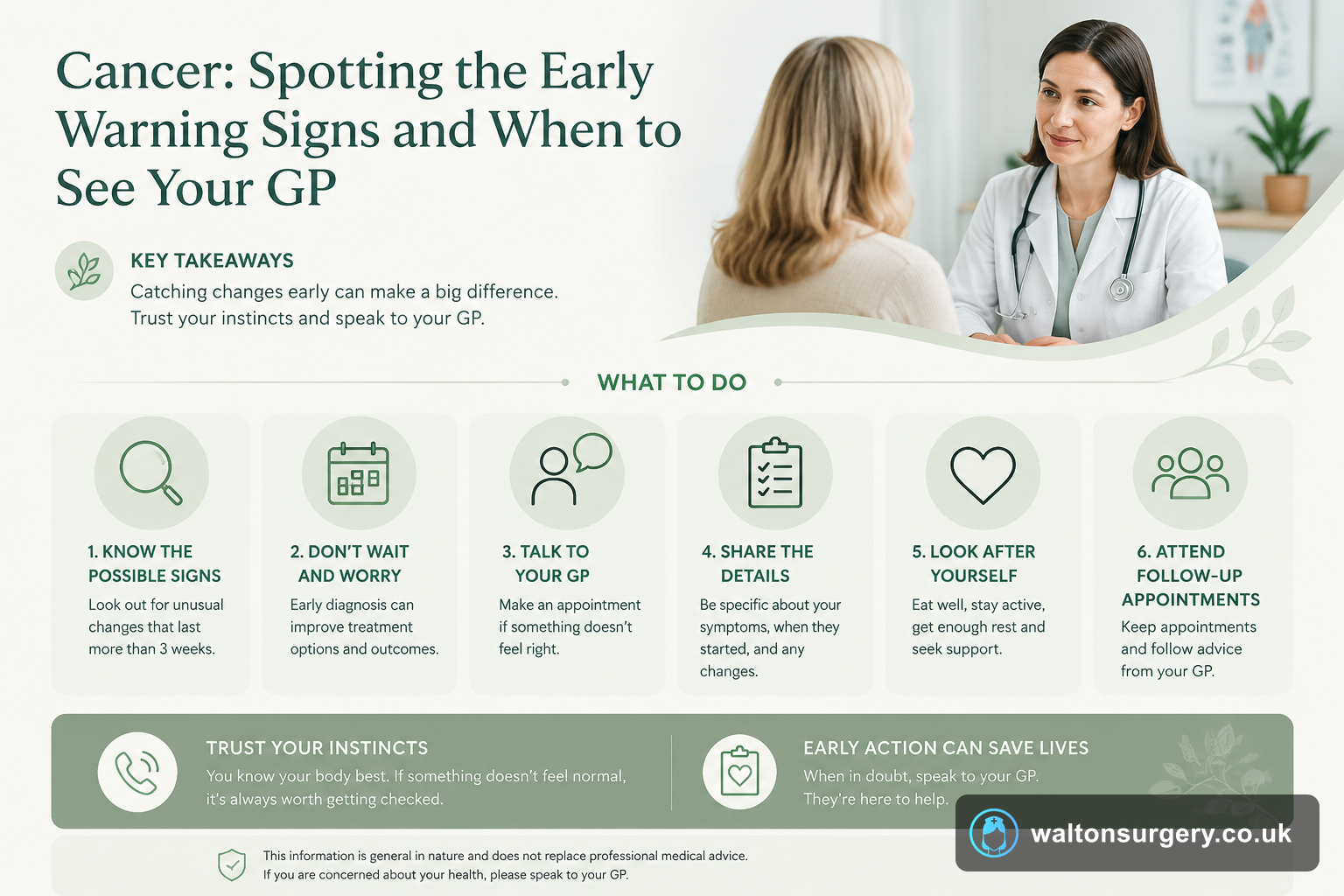
The NHS has a really clear, simple rule on this: if you have a symptom you can’t explain and it lasts for three weeks or more, see your doctor. That three-week timeframe is a general guide. For some things, like coughing up blood or finding a new, hard lump, you should be making that appointment straight away.
Lots of people put it off. They’re worried about being a time-waster, or they’re scared of what the doctor might say. The thing is, GPs genuinely want to see you with these symptoms. They would much rather investigate something that turns out to be harmless than let an early cancer slip through the net. Your GP is trained to sort through symptoms and decide what needs doing next.
You don’t need to diagnose yourself. Nobody expects you to know whether your symptom is cancer or not. Your job is simply to notice a change and report it. The GP’s job is to investigate. Please don’t try to manage persistent, weird symptoms by yourself with shop-bought remedies for months on end. Just book the appointment.
Frequently Asked Questions
⭐ The Bottom Line
What this means for you
The recent news is a stark reminder that cancer doesn’t pick and choose. Knowing the common signs and symptoms the NHS has listed is one of the most practical things you can do for your own health. The rule is simple: if you have a change you can’t explain that sticks around for three weeks or more, make an appointment with your GP. Getting things checked early leads to earlier diagnosis, and for many cancers, that means treatment has a much better chance of working. Don’t put it off.
Last updated: 2026-07-14 · Written by the Walton Surgery editorial team · Medical information is for educational purposes only and does not replace advice from a qualified healthcare professional.
