

NAD+ and Healthy Ageing: What the Science Actually Says About This Cellular Coenzyme

⚡ Quick Answer
NAD+ is a coenzyme that every cell needs for energy production and DNA repair. Levels drop sharply from your forties onwards, and restoring them is one of the most actively studied ideas in healthy-ageing science. Lifestyle (exercise, sleep, time-restricted eating) raises NAD+ for free; direct NAD+ capsules or its precursors NMN and NR are optional add-ons. Evidence in humans is promising but still early — sensible expectations beat miracle claims.
If you spend any time on health social media, you have probably seen the claim: “NAD+ reverses ageing.” The reality is more interesting, more boring, and more useful than the headlines. NAD+ — short for nicotinamide adenine dinucleotide — is a real molecule, doing real work inside every cell in your body right now, and its decline with age is well documented in peer-reviewed research.
This guide explains, in plain UK English, what NAD+ actually does, why levels fall as we get older, what the published trials in humans have found so far, and what to look for if you are thinking about a direct NAD+ supplement in 2026. One increasingly popular UK-accessible option — discussed in detail later — is a 400 mg pure NAD+ vegan capsule from HealthBuy, but we have no incentive to oversell it: NAD+ is one tool in a healthy-ageing toolbox, not a fountain of youth.
We will start with the science (what NAD+ does, why it declines), move to the free lifestyle levers that raise it, then look at supplement choices and how to think about direct oral NAD+ versus the older precursor capsules.
What NAD+ actually does inside your cells
NAD+ is a coenzyme — a small helper molecule that lets larger enzymes do their job. It is one of the busiest molecules in the body. Think of it as the cellular equivalent of a contactless payment card: it shuttles charge between reactions, and almost nothing important happens without it.
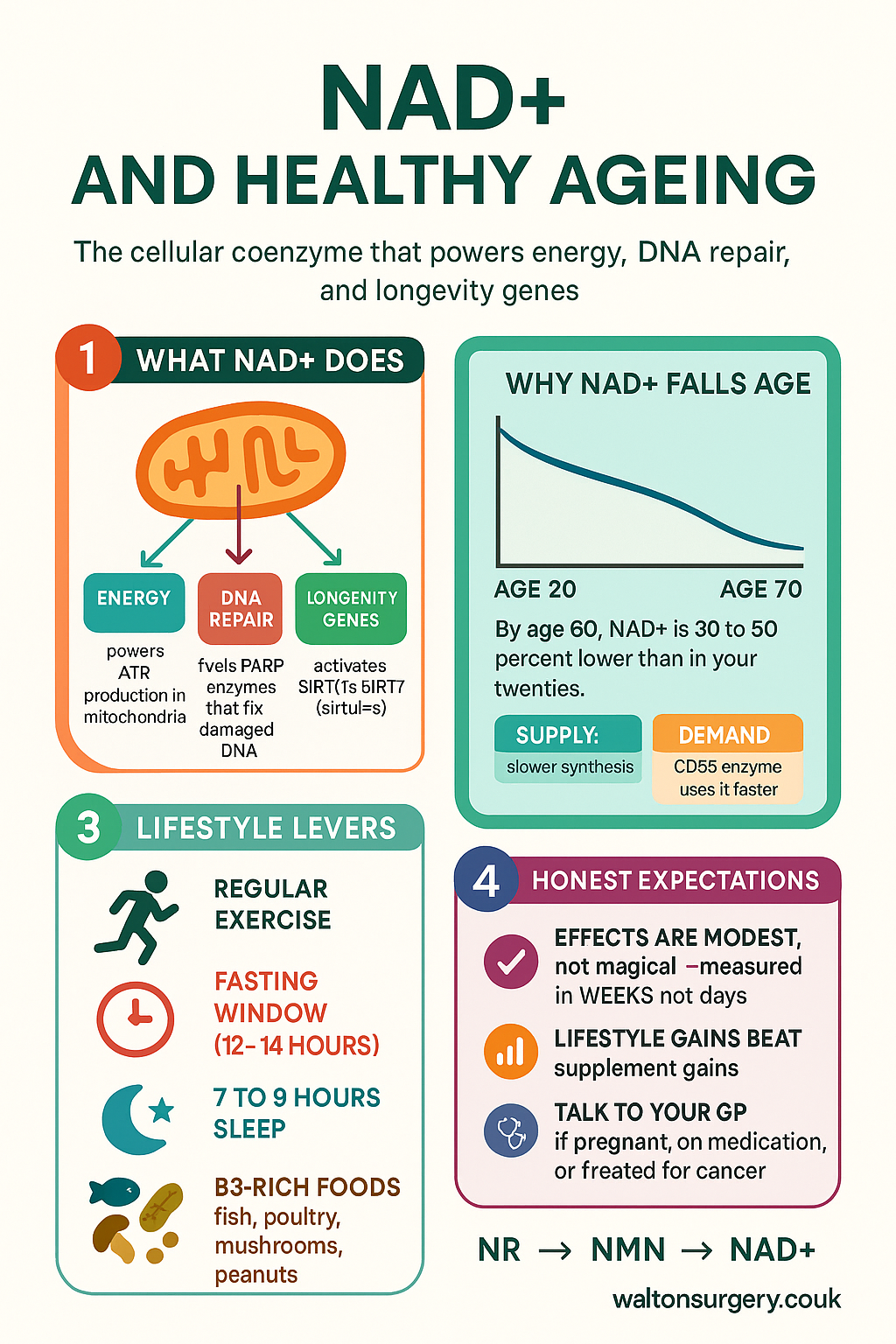
Three jobs in particular matter for healthy ageing. First, NAD+ is essential for mitochondrial energy production: every ATP molecule your body makes — and you make your own body weight in ATP every single day — depends on NAD+ cycling between its oxidised (NAD+) and reduced (NADH) forms. Second, NAD+ is the fuel for the sirtuin family of enzymes, sometimes called “longevity genes,” which regulate inflammation, fat metabolism and stress responses. Third, NAD+ powers PARP enzymes, which repair the constant damage your DNA picks up from UV light, normal metabolism, and environmental stressors.
When NAD+ is plentiful, all three systems run smoothly. When NAD+ is scarce, the body has to choose between making energy, repairing DNA and silencing inflammatory genes. The mounting view in ageing research is that this hidden trade-off contributes to many of the gradual changes we associate with getting older.
🧬 NAD+ at a glance
Three reasons your cells care
- → Energy: needed for every ATP your mitochondria produce
- → DNA repair: fuels PARPs that fix daily DNA breaks
- → Longevity genes: activates sirtuins (SIRT1–SIRT7)
- → Immune balance: influences how strongly inflammation switches on
- → Metabolic flexibility: supports the switch between burning fat and glucose
Why NAD+ levels fall with age
Multiple peer-reviewed studies have measured NAD+ in human tissues across the lifespan. The general pattern is striking: by the time most adults reach their sixties, tissue NAD+ levels are roughly 30–50% lower than in their twenties. The drop is not linear — it accelerates after the mid-forties.
Why does this happen? Researchers point to two parallel processes. On the supply side, the body becomes less efficient at recycling and synthesising NAD+ from dietary B3 (niacin). On the demand side, ageing tissues actually use NAD+ faster — chronic inflammation activates an enzyme called CD38, which chews through NAD+ aggressively. The result is the metabolic equivalent of a leaky bucket with a slowing tap.
The same decline is observed in conditions where chronic inflammation is high: type 2 diabetes, obesity, cardiovascular disease, and neurodegenerative conditions. This does not prove that low NAD+ causes these conditions — the relationship may run in either direction — but it has put NAD+ at the centre of one of the most active areas in healthy-ageing science.
⚠️ A reality check on the claims
No supplement, including NAD+, has been shown in large UK or European clinical trials to extend human lifespan. What trials have shown is more modest: measurable rises in blood NAD+ levels, small improvements in markers like walking speed, insulin sensitivity, and inflammatory markers. Useful, but not magic. If a product promises to “reverse ageing” or “add 10 years to your life,” step away.
Lifestyle: the cheapest way to support NAD+
Before anyone reaches for a capsule, it is worth knowing that several free or low-cost habits raise NAD+ in animal and human studies. The evidence here is strong enough that any honest NAD+ article should put it first.
Exercise — particularly the combination of aerobic activity (brisk walking, cycling, swimming) and resistance training — reliably raises NAD+ in skeletal muscle. A 2020 study in the journal Aging Cell found that older adults who completed a structured exercise programme had measurably higher NAD+ levels in muscle biopsies than sedentary controls. The current UK NHS recommendation of 150 minutes of moderate activity a week plus two strength sessions is also, conveniently, an NAD+ recommendation.
Time-restricted eating — eating within a 10–12 hour window each day — appears to support NAD+ recycling, probably because the fasting period downregulates the NAD+-consuming enzyme CD38. You do not need to do a dramatic 16:8 protocol: even shifting from a 14-hour eating window to a 12-hour one is a measurable improvement.
Sleep, alcohol and diet matter as well. Chronic short sleep elevates inflammation and accelerates NAD+ consumption. Heavy alcohol intake depletes NAD+ directly (the liver uses huge amounts to process ethanol). Foods rich in B3 — chicken, turkey, tuna, salmon, mushrooms, peanuts, brown rice, fortified wholegrain bread — provide the building blocks the body uses to make its own NAD+.
NAD+ versus its precursors: NMN, NR, and the “direct NAD+” question
If you have started shopping for an NAD+ supplement, you will quickly meet three letters: NR, NMN and NAD+. Here is the practical difference.
NR (nicotinamide riboside) and NMN (nicotinamide mononucleotide) are precursors. They are smaller molecules that the body converts into NAD+ in a few enzymatic steps. NR has the most published human safety data, with multiple randomised trials in the 250–1000 mg/day range. NMN has accumulating data and is widely sold, though regulatory status varies between countries.
Direct oral NAD+ supplies the finished coenzyme. Until recently, the worry was that NAD+ is too large a molecule to survive digestion intact. Newer formulations and capsule technologies are designed to address this. The argument from manufacturers is that supplying NAD+ directly bypasses the precursor-to-NAD+ conversion steps, which can be inefficient in older or inflamed tissues. The argument from sceptics is that human trial data on direct oral NAD+ is still smaller than on the precursors. Both arguments have merit.
🧪 If you do buy, what to look for
- Clearly stated dose per capsule, not “per serving of three”
- Manufactured in a cGMP-registered or FDA-registered facility
- Third-party certificate of analysis available on request
- Honest claims — “may support cellular energy” not “reverses ageing”
- Vegan/vegetarian capsule if that matters to you
- Transparent pricing per gram of active ingredient
A direct NAD+ option some UK readers ask about
Readers regularly ask us which specific NAD+ products are reasonable. We do not have an exclusive deal with any brand, but one direct NAD+ capsule that has been showing up in UK and US wellness circles is a 400 mg pure NAD+ vegan capsule from HealthBuy, marketed under the somewhat dramatic name “The Secret to Aging Backwards.” Stripping away the marketing, the actual product specification is fairly sober:
🔬 Product snapshot — HealthBuy NAD+ 400 mg
- Active ingredient: 400 mg pure NAD+ per vegan capsule (no NMN/NR precursor swap)
- Facility: FDA-registered, cGMP-compliant
- Format: One capsule daily; 30 capsules per bottle
- Stated benefits: cellular energy, focus, metabolic efficiency, healthy ageing — phrased as support, not cure
- Price: $24.95 (roughly £20) per bottle at time of writing, with a 20% launch discount running
At around £20 a bottle, the price compares favourably to many UK-marketed NMN and NR brands, which often sit between £35 and £60. That is not, by itself, a reason to buy it: the only reason to buy any supplement is that you have decided you want to try it after weighing the evidence. But for readers who have already made that decision, it is one of the more reasonably priced direct NAD+ options currently available.
A few honest caveats. Long-term human trial data on direct oral NAD+ is still smaller than for the precursors. If you have any chronic condition, are on regular medication, or are being treated for cancer, please speak to your GP or pharmacist before starting. And if you take it, give it a fair trial — usually four to eight weeks — before drawing conclusions, and stop if you notice any side effect that concerns you.
What to realistically expect — and when to skip the supplement
If you do try an NAD+ supplement, calibrate your expectations. Published trials of NAD+ precursors in adults aged 55+ have shown modest but real changes: small improvements in walking speed and grip strength, lower blood pressure, better insulin sensitivity, reductions in some inflammatory markers. None of these effects are dramatic. None will be obvious from one capsule.
Some people report better energy, sharper focus, or improved sleep within the first month. Others notice nothing at all. Both experiences are common and consistent with the trial data. If three months pass and you genuinely cannot tell whether you are taking it or not, the honest answer is that it is probably not doing much for you specifically — and there is nothing wrong with stopping.
There are clear situations where the right answer is “not yet”: if you smoke, drink heavily, sleep less than six hours a night, or do no regular exercise, fix those first. The NAD+ gains from sorting those habits will dwarf anything a capsule can offer, and they cost you nothing.
Frequently Asked Questions
What is NAD+ and why does it matter for ageing?
NAD+ (nicotinamide adenine dinucleotide) is a coenzyme found in every living cell. It is essential for turning food into cellular energy, repairing damaged DNA, and switching on the sirtuin family of longevity genes. Tissue NAD+ levels in healthy adults fall by roughly half between age 40 and 60, and this decline is now linked in laboratory studies to many features of biological ageing.
What is the difference between NAD+, NMN and NR?
NMN (nicotinamide mononucleotide) and NR (nicotinamide riboside) are precursors — building blocks the body has to convert into NAD+. Direct NAD+ supplements supply the finished coenzyme. Precursors have more published clinical data; direct NAD+ is newer to oral supplement form but appeals to people who want to skip the conversion step.
Is NAD+ safe to take as a supplement in the UK?
NAD+ and its precursors are classed as food supplements in the UK and are generally well tolerated in clinical trials at typical doses. Mild side effects such as nausea, flushing or headaches have been reported. They are not licensed medicines, are not a substitute for prescribed treatment, and should be discussed with your GP if you are pregnant, breastfeeding, on regular medication, or being treated for cancer.
How quickly should I expect to feel a difference?
Honest answer: most people who notice anything describe gradual changes in energy, focus or sleep quality over four to eight weeks, not next-day effects. Trials of NAD+ precursors typically run 8 to 12 weeks before measuring outcomes such as blood NAD+ levels, walking speed or insulin sensitivity. If you feel nothing after three months, it is reasonable to stop and reassess.
Can lifestyle alone raise NAD+ levels?
Yes — and lifestyle is the cheapest place to start. Regular aerobic and resistance exercise, time-restricted eating or intermittent fasting, adequate sleep, limiting alcohol, and eating foods rich in B3 (poultry, fish, peanuts, mushrooms, whole grains) all support endogenous NAD+ production. A supplement is best thought of as an optional add-on, not a replacement for these habits.
Who should not take an NAD+ supplement?
Anyone pregnant or breastfeeding, anyone under 18, anyone currently being treated for cancer (some pre-clinical work suggests NAD+ may interact with tumour metabolism), and anyone on multiple regular medications should talk to a GP or pharmacist before starting. People with significant liver or kidney disease should also seek medical advice first.
✅ The verdict
NAD+ is a real molecule, doing real work in every one of your cells, and its decline with age is one of the better-documented biochemical features of getting older. Restoring it — through exercise, fasting windows, sleep, and optionally through a precursor or direct NAD+ supplement — is a reasonable, low-drama strategy for supporting healthy ageing. It is not a fountain of youth, and any product that promises one is selling marketing, not biology.
If you want to try a direct NAD+ capsule, the HealthBuy 400 mg option discussed above is one of the more transparently labelled and reasonably priced choices on the UK-accessible market at the time of writing. You can check current pricing and stock here. As with any supplement, give it a fair trial of two to three months, watch for side effects, and stop if it does not earn its place.
For wider context on healthy ageing in the UK in 2026, you may also find these guides useful: 15 signs of B12 deficiency in women over 40, creatine for women in menopause, and swimming for arthritis over 50.
🛒 Reader-recommended option
If you have read this far and want to try a direct NAD+ capsule, the HealthBuy 400 mg vegan formulation is one of the more transparently labelled and reasonably priced direct NAD+ products currently shipping to the UK.
Affiliate link — see disclosure at the top of this article. Current price approx. £20 / $24.95 per 30-capsule bottle.
This article is informational and contains affiliate links. It does not replace personalised advice from your GP, pharmacist, or another qualified healthcare professional. Supplements are not licensed medicines and are not intended to diagnose, treat, cure or prevent any disease.
