US Vaccine Policy Disputes: What UK Patients Need to Know
PART C — HTML Body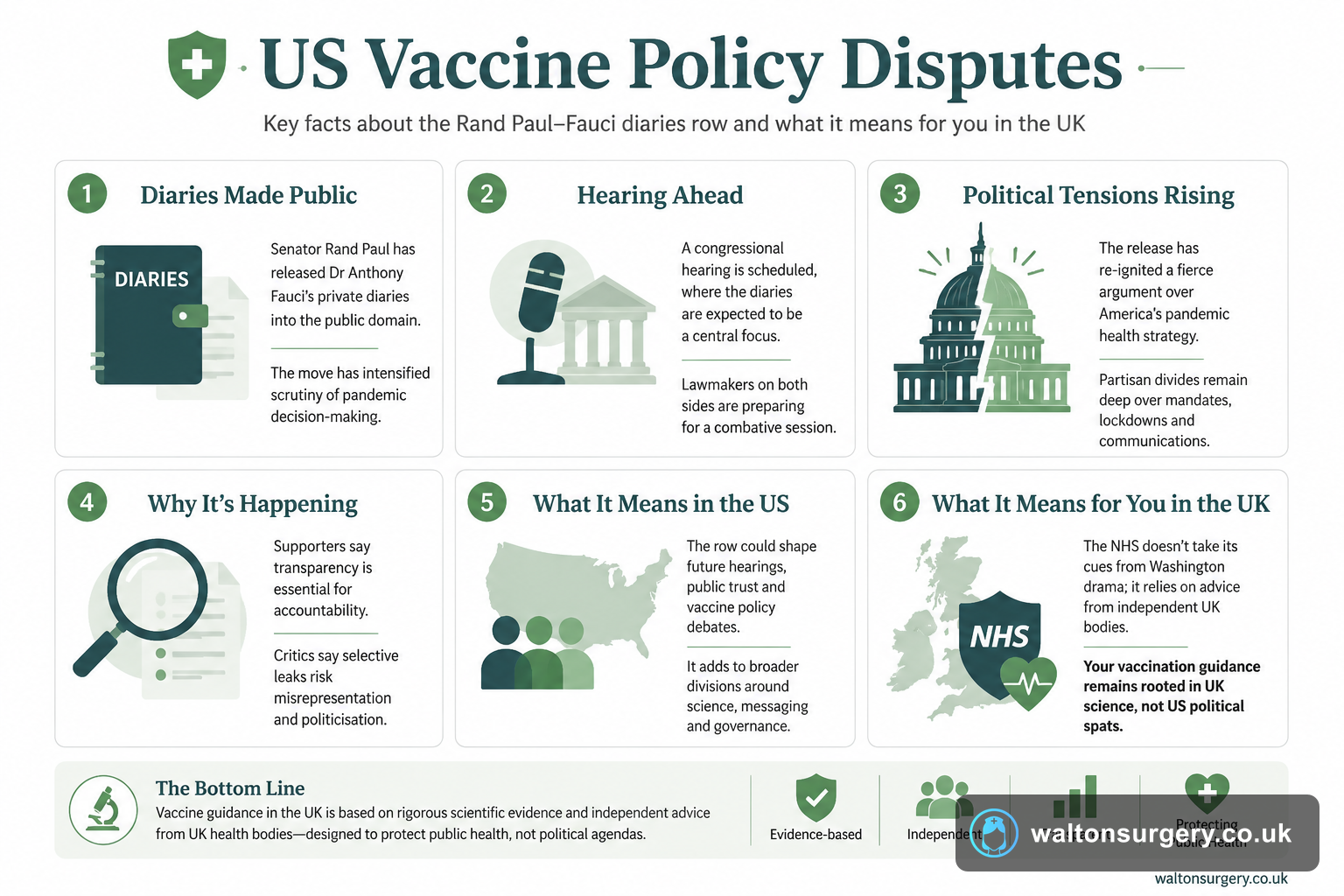
⚡ Quick Answer
Senator Rand Paul has put Dr Anthony Fauci’s private diaries into the public domain, ramping up tensions ahead of a scheduled hearing and re-igniting a fierce argument over American pandemic health strategy. If you are in the UK, the story is a useful reminder of just how political public health messaging can become. The NHS doesn't take its cues from Washington drama; it relies on advice from independent UK bodies. Your vaccination guidance remains rooted in UK science, not US political spats.
Before a long-awaited hearing even gets underway, Senator Rand Paul has dropped a bit of a bombshell: he has released Dr Anthony Fauci's diaries. It's the latest move in a drawn-out fight over how the United States managed its top health officials during the pandemic, and it has sparked a fresh round of arguments about transparency and who knew what, and when.
You might see this headline and think it's all a bit American, a bit far removed from your life. Fair enough. But it does raise real questions. Can a political argument in the US have any effect on vaccine safety over here in the UK? Why should you care about another country's internal health squabbles? Thinking it through properly helps you work out the difference between political theatre and actual medical science.
What exactly has Rand Paul released?
The news, which broke on 30 July 2026, is that Senator Rand Paul has made public what are described as the personal diaries of Dr Anthony Fauci. This wasn't a random data dump; it happened just before a major hearing, suggesting a clear attempt to shape the narrative before the official proceedings even start. The move is being sold as an effort to let the public and lawmakers see behind the curtain of the American pandemic response.
But you have to remember the context. In US politics, releasing documents like this is a strategic play, a way to build a case or set a specific tone ahead of a formal inquiry. For anyone watching from across the Atlantic, it's a stark example of how health policy and political point-scoring can get tangled up together, often inseparably.
Why does a US political hearing matter to UK patients?
On the face of it, a hearing in the US Senate shouldn't have anything to do with your NHS care. Our vaccination programme is steered by our own experts, not by what's happening in Washington. Yet, these sorts of disputes don't happen in a vacuum. News of very public, high-profile arguments can start to chip away at trust in the very idea of expert-led public health, and that erosion doesn't respect borders.
When well-known figures are publicly disagreeing about vaccines or how the pandemic was handled, it inevitably stokes debate and doubt, especially online and in the press. That environment can make anyone second-guess their choices. The important thing is to see the source for what it is: a political process in the United States, not a new piece of science that changes anything about vaccine safety.
How does UK vaccine guidance actually work?
Your faith in UK vaccine guidance should really be placed in its own, separate system. Here, vaccination schedules are recommended by the Joint Committee on Vaccination and Immunisation (JCVI). This is a group of independent experts who advise the UK government and the NHS after they have sifted through all the available scientific evidence.
It is a different setup to the US. JCVI members are scientists and clinicians, not political appointees. They work independently of the government. What they recommend gets published, and the NHS then puts it into practice. This whole structure is built to keep public health advice free from political pressure, so it can focus purely on the data about safety and effectiveness for people in the UK.
Should I be worried about vaccine safety because of this?
No. The release of these diaries and the hearing itself are about US governance and how officials communicated during a crisis. They are not about the fundamental safety of the vaccines themselves. Vaccine safety is watched over continuously. Here, that job falls to systems like the MHRA's Yellow Card scheme, which gathers real-world data from the millions of doses given out across the country.
If a genuine safety signal ever cropped up from that global monitoring, it would be looked at and acted on by regulators like the MHRA and the EMA. That process would happen regardless of any political hearing in America. This current dispute is about the actions and words of officials, not about any new clinical evidence that would alter the safety profile of the vaccines available on the NHS.
Can political disputes affect public health confidence?
Yes, and honestly, this is probably the bit that matters most to patients here. Public health runs on a certain level of public trust. When that trust gets questioned very publicly by famous people—even if they're in a different country—it can make some of us more hesitant or doubtful about listening to advice from our own health service. It's not just about vaccines; similar dynamics can surround other health concerns, for example, understanding leukemia symptoms treatment uk.
It's a form of misinformation by association. A political argument about process can easily get misread as proof that there's a problem with the product, i.e. the vaccine. For you, the practical move is to get your information directly from UK-based, authoritative sources. Think the NHS, GOV.UK, or a chat with your local GP. Don't try to filter your health decisions through the lens of US political commentary, and this applies to all health news, whether it's about a child critical condition after car accident or the latest vaccine data.
What’s the best way to follow such news without getting confused?
First thing's first: check who is reporting it and when. The core of this story is from 30 July 2026. Then ask yourself: is this about a political event or a brand new scientific study? Here, it's clearly the former.
Second, look for the named sources. Credible reporting will always mention specific bodies like the JCVI, MHRA, or the NHS when talking about vaccine guidance. Be wary of any article that just says "experts say" without telling you who those experts are or where they work. And a final thought: the NHS website has a whole section on vaccines that gives straightforward, factual answers. It's a good, steady place to refer to when the news gets noisy, and it's equally important for getting the facts on issues like nhs nurse abuse uk.
🔬 Key Facts
UK Vaccine Guidance & US Political Disputes
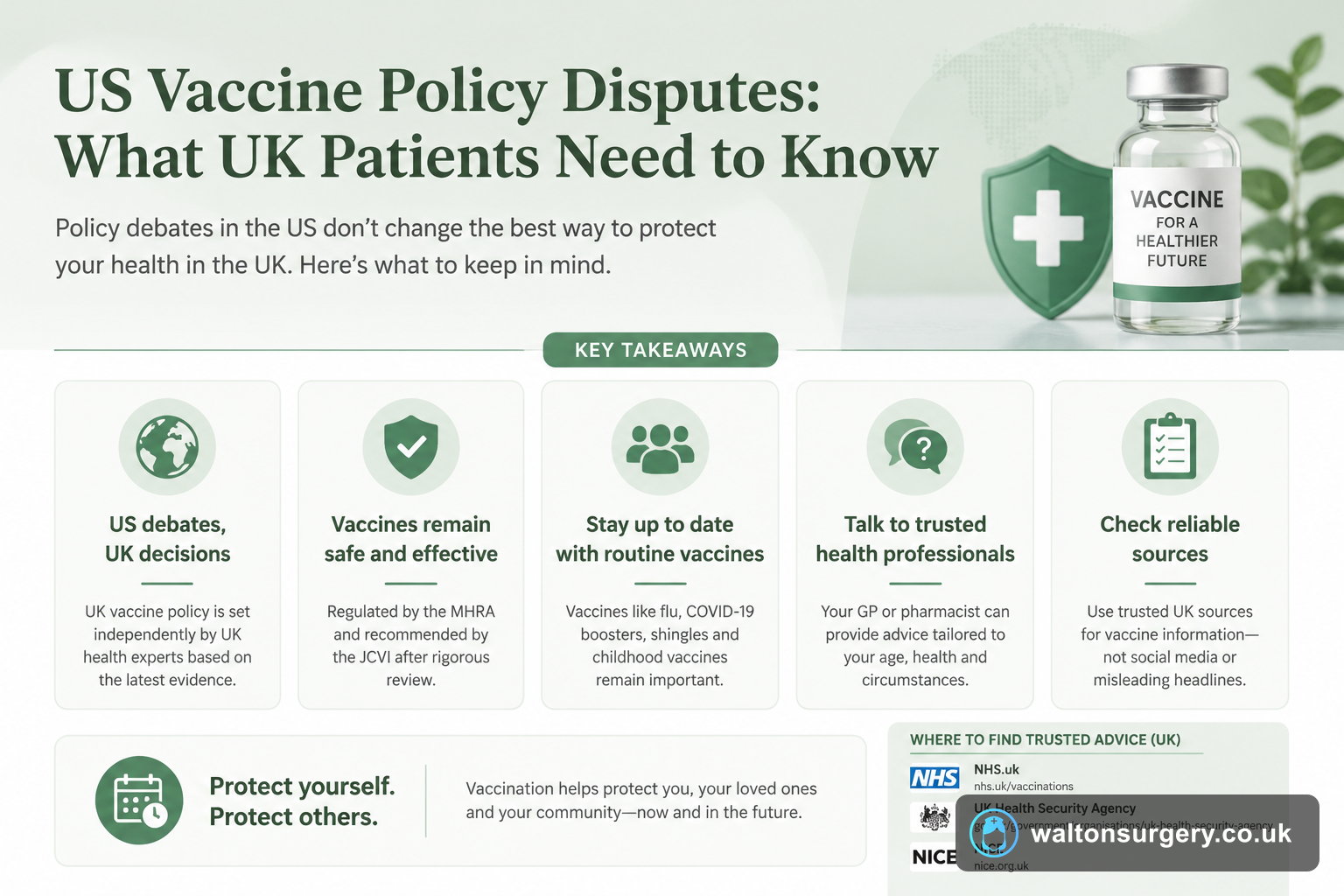
- → UK advice is independent, coming from experts at the JCVI and MHRA, not from US political hearings.
- → Vaccine safety is continuously monitored in the UK through systems like the Yellow Card scheme.
- → The diaries are about US governance and communication, not new clinical safety data.
- → Trust sources like the NHS and GOV.UK for your personal health decisions.
Frequently Asked Questions
⭐ The Bottom Line
What this means for you
The release of Dr Fauci’s diaries ahead of a US hearing is a political event happening in the United States. It is not a fresh look at vaccine science. Patients in the UK can keep this news separate from their own health decisions by focusing on the UK’s independent regulatory and advisory system—led by the MHRA and JCVI—which gives guidance based on evidence, not politics. If you are ever unsure, your GP and the NHS website remain your most reliable guides.
Last updated: 2026-07-30 · Written by the Walton Surgery editorial team · Medical information is for educational purposes only and does not replace advice from a qualified healthcare professional.