Squatting or Sitting on the Toilet: What Helps You Go?
PART C — HTML BODY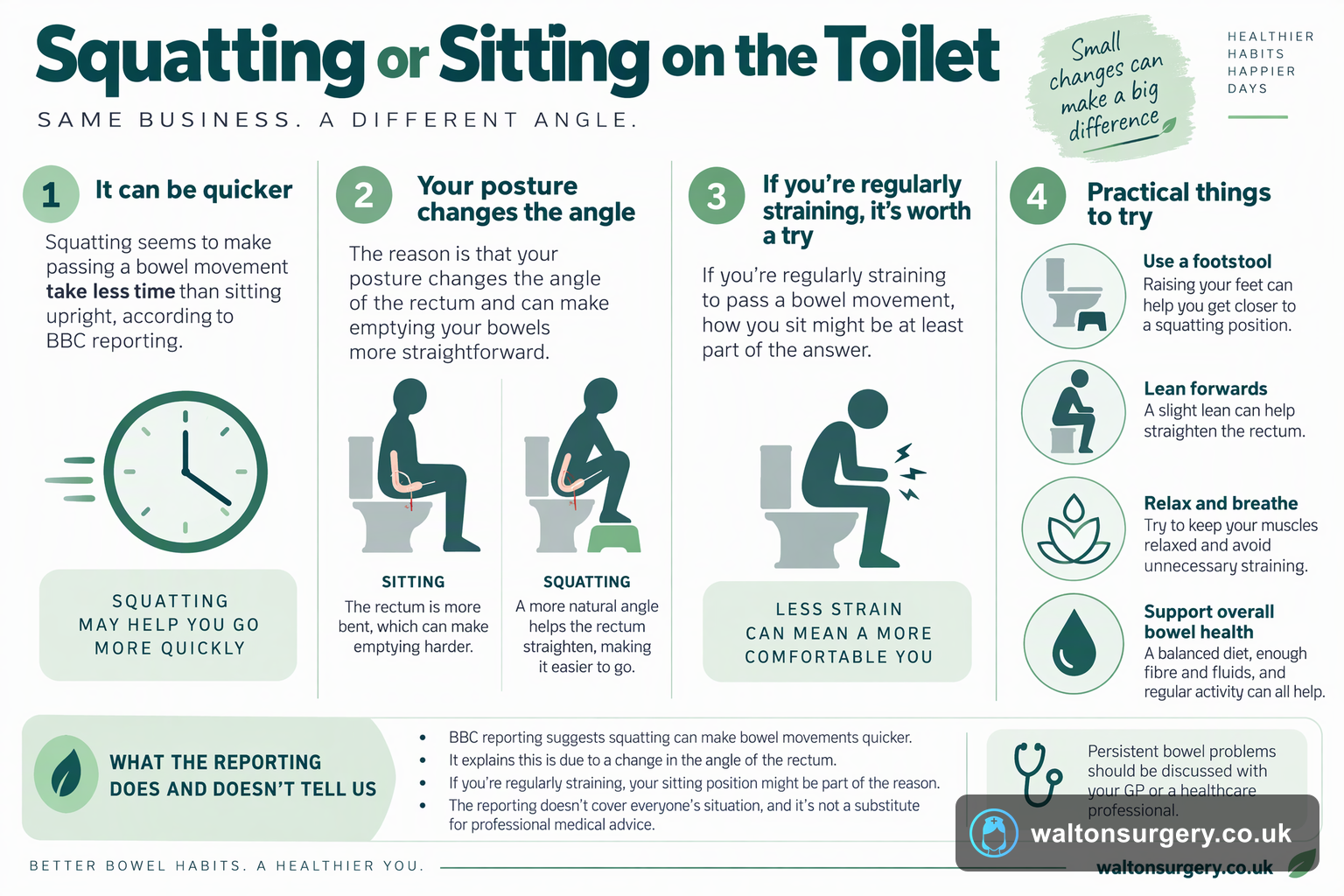
⚡ Quick Answer
Squatting seems to make passing a bowel movement take less time than sitting upright, according to BBC reporting. The reason is that your posture changes the angle of the rectum and can make emptying your bowels more straightforward. If you're regularly straining, how you sit might be at least part of the answer. Below is what the reporting does and doesn't tell you, alongside some practical things to try.
On 15 November 2026 the BBC published a video called "Toilets: Are you a squatter or a sitter?" — presented by Josie Peters, and the headline observation is this: squatting takes less time, on average, than sitting upright when you pass a bowel movement. That one point has clearly got people wondering whether their own toilet habits are slowing them down or making them push harder than they should.
For most of us in the UK, a standard WC and a seated posture is just what you get when you walk into the bathroom. You haven't picked it for any ergonomic reason. Still, if opening your bowels is regularly a slog — pushing, waiting, straining — then your posture is worth having another look at. What follows is what the BBC piece actually covers, the places where information is thin on the ground, and a few things to try at home before you bother a pharmacist or a GP.
What's actually going on with your posture?
Anna Lavelle filmed it and it went out as part of BBC Ideas' "Here for the History" strand. The question the film poses is blunt enough: are we doing this wrong? Its answer is that sitting bolt upright on the loo can work against you. Squatting — knees lifted up past your hips — is the posture that comes with a shorter average time to pass a bowel movement, at least as presented in the film.
That's really the sum of the specific claim. No figure is given for how much quicker it is. The underlying study isn't named. And there's no quantification of how much easier squatting makes it for the average person to empty their bowels. So the direction of travel is plain — squatting is faster on average — but the sort of detail most people want isn't in the published material, which is a bit frustrating if you were hoping for numbers.
How does squatting compare with sitting on the toilet?
Most people come to this article asking exactly that, so let's take our time over it.
Sitting on a modern WC puts your hips and knees at something close to a right angle. Your rectum curves, and that posture doesn't do much to straighten the curve out. Squatting lifts your knees well above your hips, and in doing so changes the angle where the rectum meets the anal canal. The route out becomes straighter and less restricted. It's a bit like trying to pour liquid through a kinked hose — bend it the right way and things move.
That straightening is the reason given in the BBC piece for why squatting is quicker on average. Less resistance means less pushing, less straining, and a faster and cleaner empty. Anyone who's been to a country where squat toilets are the norm and noticed that things went easier has felt the difference themselves.
What the reporting fails to do is compare the positions across a proper population sample, or lay out how much difference squatting makes if you already find going pretty easy. It frames squatting as the shorter option, averaged over people. But for someone who opens their bowels comfortably within a minute or two in a sitting position, swapping to squatting is unlikely to move the needle much.
Straining, pushing, sitting there for ten minutes on the other hand — for those readers posture could well be part of the picture. It's one variable among several, mind. Fibre, fluid, physical activity, medication and any underlying conditions matter too. Broader NHS pressures and organisational failures such as those covered in our explainer on the nhs grampian what went wrong story are worth keeping in view when thinking about how accessible timely advice really is, and technology failures like the microsoft outage health impact can disrupt everyday care in ways patients notice.
🔬 Key Facts
What the BBC comparison actually shows
- → Squatting is quicker on average than sitting upright to pass a bowel movement, per BBC reporting.
- → No specific figure is published for how much quicker, and the underlying study isn't named.
- → The mechanism is anatomical — knees above hips straighten the rectum's curve and reduce resistance.
- → Not a fix-all — if you already go comfortably, swapping posture is unlikely to change much.
Why does the average time matter?
How long you're on the loo is a fair proxy for how hard you're working. Longer than you'd like usually means pushing at some stage, and sustained pushing raises the pressure on the veins around the anus and rectum. Piles (haemorrhoids) and chronic constipation are exactly the sort of thing GPs and pharmacists talk about with patients when this comes up.
What makes the BBC's finding worth taking notice of is that it flags posture as something you can actually do something about. Your anatomy and your age are fixed. How you sit on the toilet isn't.
Try this if you don't have a squat toilet
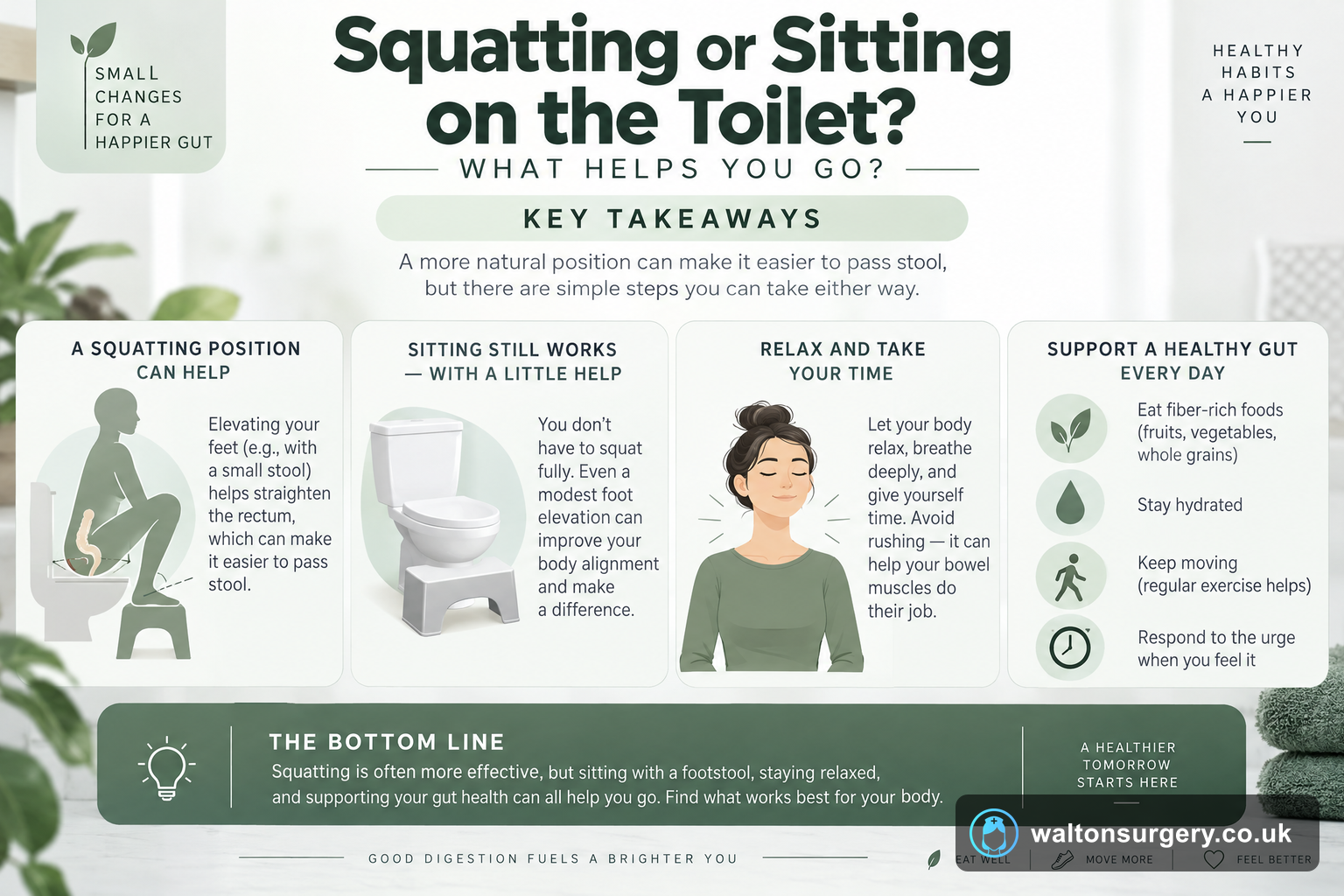
Squat toilets are rare in UK homes and putting one in isn't remotely realistic for most people. There is a workaround though, and it costs very little: pop a low footstool in front of the WC. Lifting your feet so your knees end up above your hips pushes you towards something nearer the squatting posture while you still get to use the seat.
A couple of things worth flagging. The stool has to be stable. A wobbly one is a fall waiting to happen, and that's a real concern for older readers or anyone with balance problems. And this is a posture tweak, not a treatment. If you have been constipated for more than a few days, or you notice blood in your stool, changes to your bowel habits that have come on recently, or weight loss you can't explain — get yourself booked in with the GP rather than putting your faith in a footstool.
Does this mean everyone should squat?
Simply put, no.
Squatting to defecate is the traditional posture across a lot of the world, and the BBC's finding does point its way on average. That said, "quicker on average" is not the same claim as "right for everyone", and it's worth being careful about the distinction.
Getting up and down from a deep squat is difficult, or painful, or both, for a fair number of readers. Arthritis in the knees or hips, recent surgery, later stages of pregnancy, balance issues — all of those can make the position impractical or even unsafe. A footstool is a kinder middle ground, but even then, if it feels awkward or you're struggling to get up once you're done, there's no particular virtue in pushing through with it.
What else affects how easily you go?
Posture is one lever. It's not the only one, and treating it as a fix-all would be a mistake.
NHS guidance on constipation — the page, that is, the one most GPs point patients towards — lists several lifestyle factors that shape how easily you open your bowels. These include:
Fibre: fruit, vegetables, wholegrains and pulses all add bulk to stool and help it move along the gut.
Fluid: enough water keeps stool soft. Dehydration does the reverse.
Physical activity: regular movement helps gut motility.
Toilet routine: going when you feel the urge, rather than holding on, helps keep things regular.
Medication: certain medicines — some painkillers and iron supplements among them — can cause constipation as a side effect. Check the patient information leaflet or ask your pharmacist.
Honestly, most people wait far too long before booking an appointment. If posture changes and lifestyle adjustments haven't shifted things, a pharmacist can talk you through over-the-counter options like laxatives. Persistent symptoms are a job for your GP. Structural chest conditions that can affect breathing and general comfort are covered in our guide to pectus excavatum symptoms and treatment if you want to understand how anatomy elsewhere in the body can shape everyday health.
Frequently Asked Questions
⭐ The Bottom Line
What this means for you
The reporting points one way, and it's fairly unambiguous: squatting gets a bowel movement out faster on average than sitting upright does. For most UK readers a footstool is the practical way into that posture. But posture sits alongside other factors — fibre, fluid, activity, medication — and none of them should be ignored. Regular straining is worth raising with a pharmacist or your GP. This is general information rather than advice tailored to you.
Last updated: 2026-11-15 · Written by the Walton Surgery editorial team · Medical information is for educational purposes only and does not replace advice from a qualified healthcare professional.