Microsoft Outage: What It Means for Your GP and Health
PART C — HTML body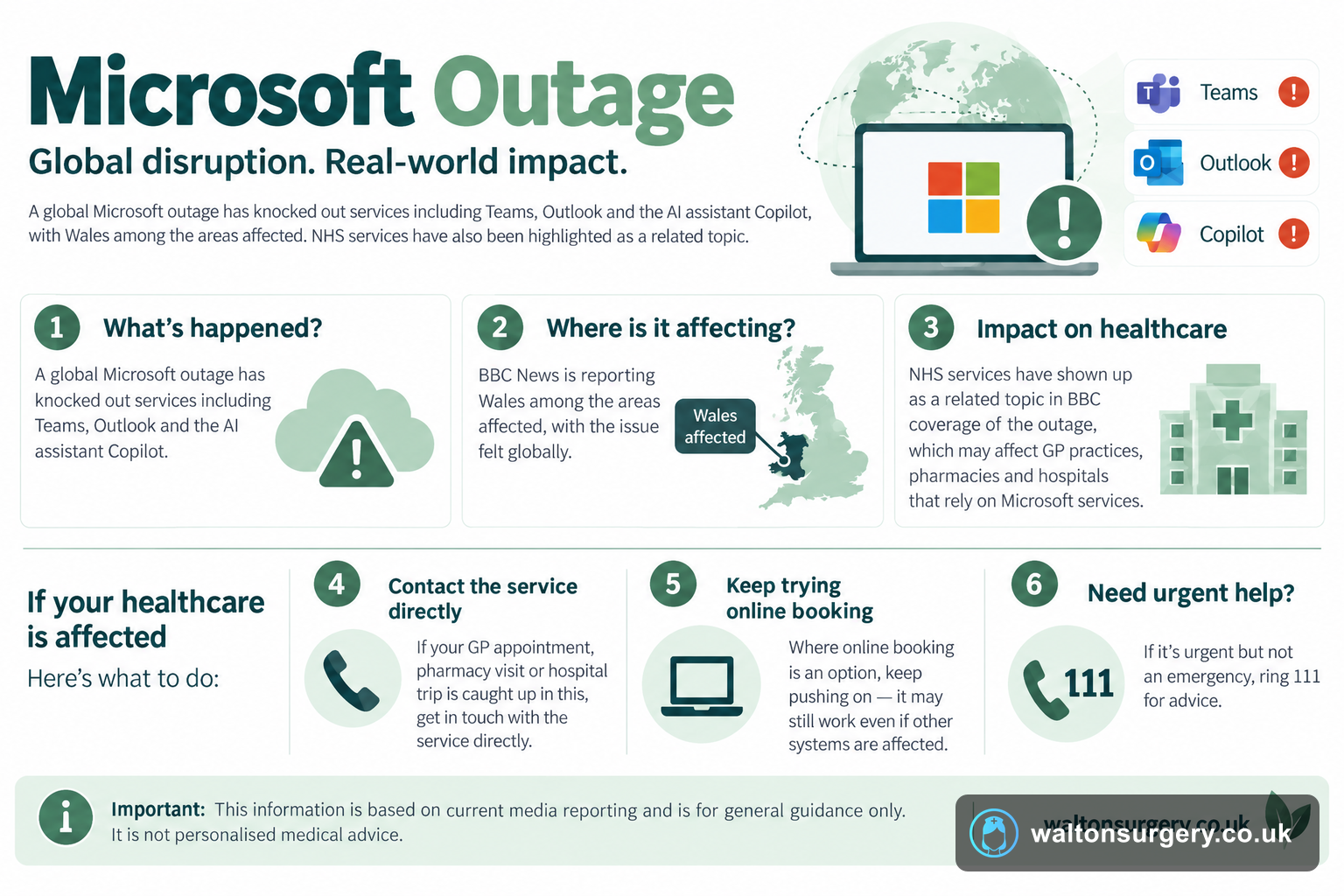
⚡ Quick Answer
A global Microsoft outage has knocked out services including Teams, Outlook and the AI assistant Copilot, and BBC News is reporting Wales among the areas affected. NHS services have shown up as a related topic in BBC coverage of it. If your GP appointment, pharmacy visit or hospital trip is caught up in this, get in touch with the service directly, keep pushing on online booking where that's an option, and ring 111 if it's urgent but not an emergency. None of this is personalised medical advice.
Teams, Outlook and the AI tool Copilot are all down as part of a Microsoft outage, and according to BBC News the disruption has reached Wales along with everywhere else. Because BBC coverage lists NHS among the related topics, plenty of readers across the UK are now quietly panicking about whether their appointment still exists, whether prescriptions will go through, and what happens to that hospital letter they were waiting for.
If your normal route into a health service runs on Microsoft email, video calls or booking software, there is a decent chance bookings are delayed and reminders have gone missing or calls are just ringing out. Here's what is actually confirmed, what it might mean for your care, and the things worth doing right now.
What exactly has Microsoft confirmed?
Several mainstream Microsoft tools are disrupted: Teams, Outlook and the AI assistant Copilot. Those three sit behind a startling amount of the daily admin in UK offices, schools and, importantly for you, health service back rooms. Outlook runs the email. Teams runs video appointments and internal calls. Copilot is woven into newer Microsoft 365 workflows.
That is the scope that is actually confirmed. What hasn't been pinned down in any reporting I've come across is the cause, the expected duration, or a proper list of which UK organisations are hit. Treat any numbers flying around on social media with real suspicion unless they are sourced to Microsoft or a named outlet like the BBC.
Why does a Microsoft outage affect your GP at all?
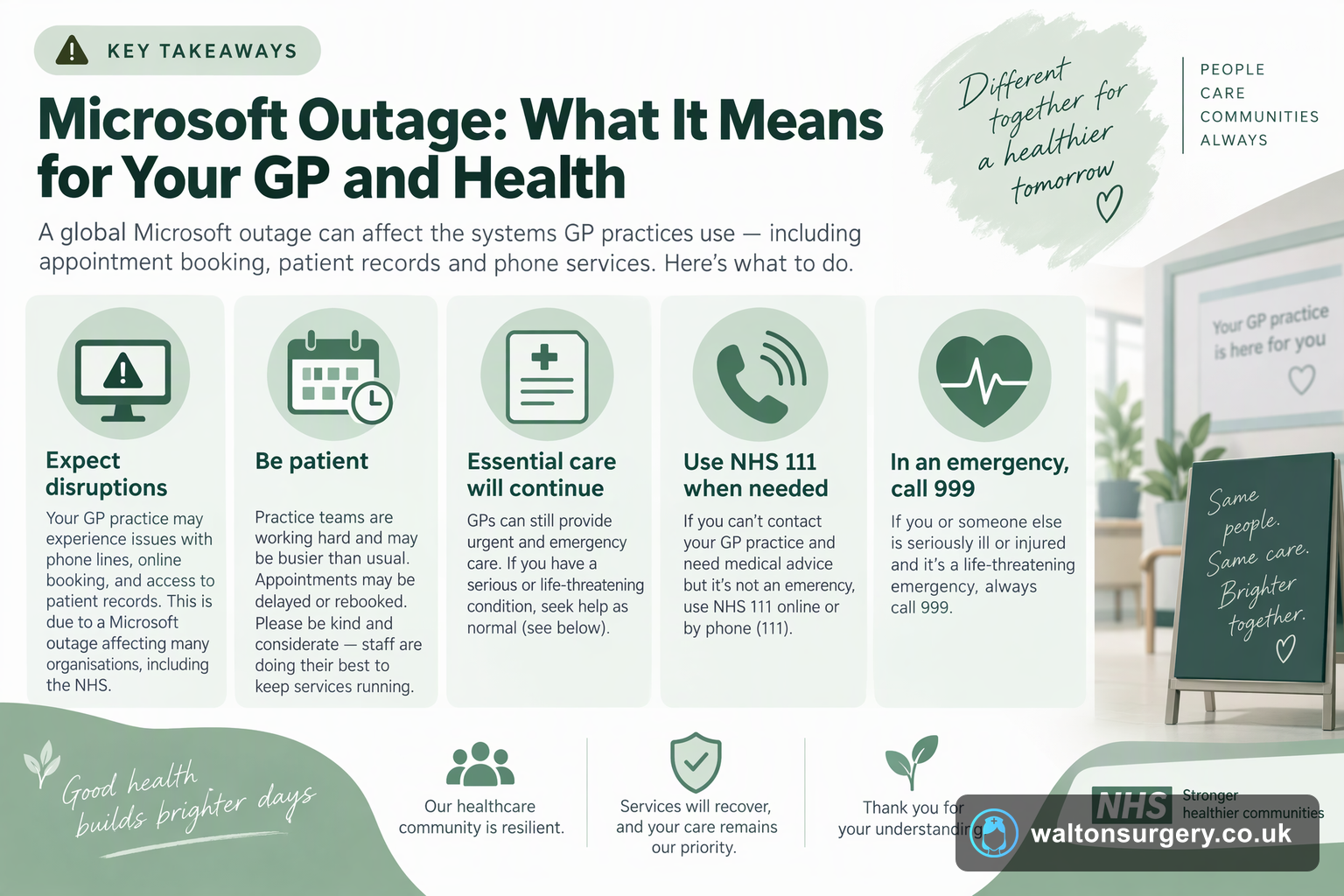
GP practices and the wider NHS lean on Microsoft 365 for email, video consultations, staff messaging, document sharing — a lot of it. When that stuff wobbles, receptionists lose the shared inbox, practice managers lose the rota, and the clinician who was due to see you down a webcam suddenly can't. Everything grinds a bit.
BBC News listing the NHS as a related topic of this Microsoft outage tells you how tangled up these systems have become. It is not a sign that clinical care stops — hospitals and GP surgeries all have continuity arrangements in place for exactly this kind of thing. Admin does slow down though. Letters don't get sent. A few appointments end up shuffled.
Should you still turn up to your appointment?
Got a confirmation for an appointment today? Safest bet is that it is still happening unless somebody has told you it isn't. The usual casualty in an IT outage is communication. The appointment carries on, but the reminder text or the email just never lands in your inbox.
Ring the practice or clinic if you can actually get through to anyone. When phone lines are blocked solid, the online consultation form or the repeat-prescription portal are worth a go — those frequently run on completely different infrastructure. And for anything that is urgent without being an emergency, NHS 111 will triage you and tell you where to go.
What to do when your GP phone lines are jammed (the most useful steps)
This is the situation most people reading this is going to hit, so being methodical about it pays off.
One — stick with the online route
Loads of GP practices use online consultation tools — eConsult or AccuRx are the common ones — and these sit outside Microsoft 365 so they can keep taking requests even while Outlook or Teams are down. Normally you describe the symptom, attach a photo if it helps, and get an answer within one to two working days. These digital tools are exactly the kind of thing covered in our guide to tattoo health risks and safety, where remote triage and clear symptom descriptions matter just as much.
Two — open the NHS App
Repeat prescriptions, your record, checking whether anyone has actually messaged you. The NHS App isn't built on Microsoft 365, so it is often still humming along fine when practice email is dead.
Three — ring NHS 111 if you need to be seen today
If you need to be seen today and it isn't a 999 situation, ring NHS 111. The advisors are trained to assess you and can book you into things like urgent treatment centres. In Wales the urgent advice line is also 111.
Four — running out of a regular medicine? Ring the pharmacy
Pharmacists are allowed to sort out emergency supplies in a lot of circumstances, though exactly what they can do depends on the drug and on you, so put the question to them directly.
Five — if you are in a mental health crisis
This is the one not to get wrong. If you are in a mental health crisis, do not sit on hold waiting for admin to sort itself out. NHS 111 has a mental health option in England, Samaritans are on 116 123 free of charge, and A&E is always there. Both NHS 111 and A&E are built for demand spikes and none of it depends on your GP's Outlook inbox. Plenty of people also find creative outlets genuinely steadying through the wait — our look at whether is art good for your mental health goes through the evidence on that.
Six — if a letter, result or referral hasn't turned up
If a specialist letter, a scan result or a referral simply hasn't turned up, don't leap to the worst conclusion. Assume the outbox. Note when the delay started, and get in touch with the referring team once systems are back. Writing down any symptoms in the meantime is genuinely useful, because you will be able to give a much better history later.
What about prescriptions, referrals and test results?
Prescriptions, referrals and test results. Three admin processes, all of them more exposed to a Microsoft outage than anything else, since each leans on email and shared documents and electronic messages passing between different organisations.
Prescriptions first: ordering through the NHS App or a pharmacy app is usually still fine. Ordering through a GP website form is generally OK too — check whether that form is hosted somewhere separate from the practice's email, because many of them are. Worried about stock or timing? Ring the pharmacy.
Referrals and results are trickier to unpick. These normally travel from hospital systems to GPs and back again. Teams or Outlook being down means messages queue up. They almost always arrive once things are restored.
🔬 Key Facts
Prescriptions, referrals and results in an outage
- → Prescriptions ordered via the NHS App or a pharmacy app are usually still fine
- → GP website forms are generally OK if hosted separately from practice email
- → Referrals and results queue up between hospital and GP systems, then arrive once restored
- → Stock or timing worries — ring the pharmacy directly
Should you be worried about your medical records?
Nothing in the public reporting points to any data loss from this Microsoft outage. Outages like these affect Teams, Outlook and Copilot — access problems, not data breaches. Microsoft and whoever else is affected normally put out security updates if the picture changes at all.
Worth saying though: if a suspicious email lands claiming to be from the NHS right now, handle it like a hot coal. Scammers love confusion. Don't click anything and do not send NHS numbers or bank details by email. Ring the number printed on a letter you already hold, or go to the official NHS website yourself. And if what you actually wanted was last night's TV gossip rather than a systems update, our GP's take on what is Gogglebox celebrity health chatter really tells you is a lighter read.
Frequently Asked Questions
⭐ The Bottom Line
What this means for you
Teams, Outlook and Copilot being down is going to slow admin across UK health services, Wales included. The exposed bits are appointment reminders, emails and video consultations. Keep going on the online routes, use the NHS App and pharmacy apps where you can, and ring NHS 111 for anything urgent-but-not-emergency. General information only here, not personalised medical advice — your GP or pharmacist is who you should actually be speaking to about your own situation.
Last updated: 2026-11-14 · Written by the Walton Surgery editorial team · Medical information is for educational purposes only and does not replace advice from a qualified healthcare professional.