When Politicians Talk Health on TV: A GP's Perspective
PART C — HTML body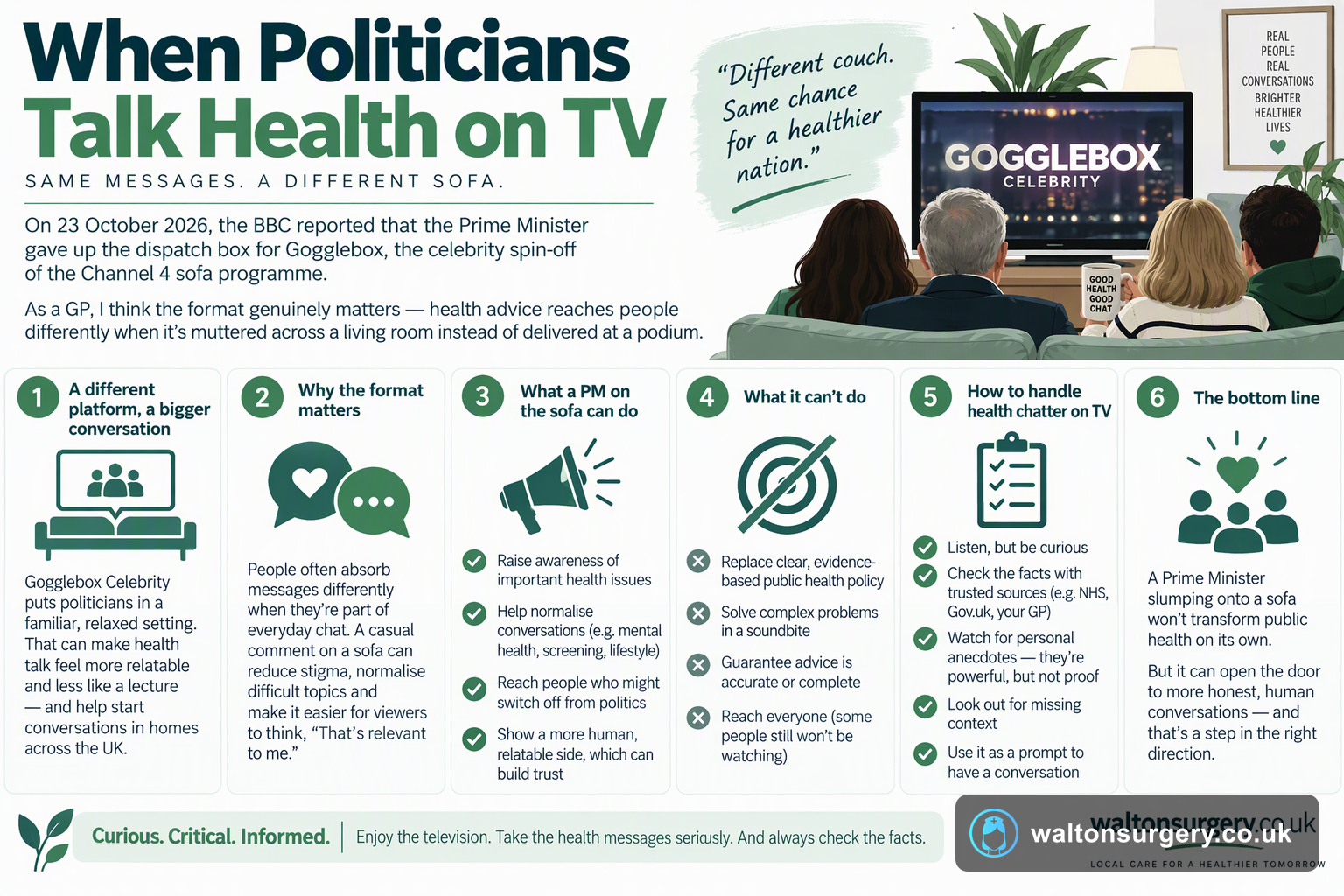
⚡ Quick Answer
The BBC reported on 23 October 2026 that the PM gave up the dispatch box for Gogglebox, the celebrity spin-off of the Channel 4 sofa programme. Speaking as a GP, I think the format genuinely matters — health advice reaches people differently when it's muttered across a living room instead of delivered at a podium. What comes next is my take on what a PM slumping onto a sofa can and can't do for public health, plus how to handle health chatter on TV without getting led up the garden path.
On 23 October 2026, the BBC confirmed the Prime Minister had swapped the dispatch box for the Gogglebox sofa. Which is odd, and which tells you a fair bit: these days health messages travel through entertainment about as fast as they travel through official briefings.
I've spent years in consulting rooms explaining health to patients whose entire understanding of their own body comes from a screen. So what does a politician on a sofa actually accomplish — and where do you need to watch yourself? Below, I want to look at the format, the real risks, and what you should actually do with any health claim you catch on telly.
What Actually Happened on Gogglebox
If you've never seen it, Gogglebox is the Channel 4 thing where ordinary folk sit on their own sofas and react to whatever's been on that week. There's a celebrity iteration — the one the Prime Minister turned up on — where famous names get recast as armchair critics. It is light, it is funny, and it runs on reaction rather than anything instructional.
Framed by the BBC's report of 23 October 2026, the whole thing was pitched as a swap: dispatch box down, sofa up. No policy statement, no briefing notes, just a politician watching telly alongside everyone else. That framing isn't accidental. It paints the Prime Minister as relatable — which matters when public health messaging so often lands as distant and remote from the business of daily living.
From where I sit in a GP's chair, what the format is actually doing is quite specific. It drags health conversation out of the clinic and into the living room, which is where the majority of people do their actual thinking about their own bodies. That's not nothing. But it can't stand in for proper medical advice, either. It's the same territory we explored in our piece on celebrity health documentaries, where the line between entertainment and education gets blurrier than most viewers realise.
Why TV Format Shapes Health Messaging
Where information comes from shapes how you soak it up. Press conference: performance. Formal, pre-prepared, easy to scroll past without reading a word. Sofa chat: disarming, off-the-cuff, much harder to ignore.
Problem is, that disarming quality also blunts the nuance. Health messages which depend on caveats — "this works for most people but not all", "check with your GP first" — don't compress well into a quip squeezed between adverts. A politician reacting to a programme is delivering a vibe. That's what it is. Vibes, for what it's worth, do not come with dosage instructions.
So treat what you see as a prompt, not a prescription. If a Gogglebox moment leaves you curious about blood pressure screening, say, that's genuinely useful. Acting on the specific medical content of something said across a sofa? Less so. And if you'd like a structured list of programmes worth your time instead, our guide to what to stream health benefits this week sets out shows that do more than simply generate a vibe.
Recognise What a GP Consultation Actually Does
The parts that TV can't replicate
Three things happen in a proper GP consultation that a TV appearance simply cannot manage. It's personal, for a start — we look at your medical history, the medications you're on, your family background. It's interactive: you ask questions, we adjust accordingly. And it's accountable — there's a record kept, and follow-up arranged.
🔬 Key Facts
What a GP consultation delivers that TV cannot
- → It's personal — we look at your medical history, the medications you're on, your family background.
- → It's interactive — you ask questions, we adjust accordingly.
- → It's accountable — there's a record kept, and follow-up arranged.
- → Format matters — an interview with an NHS clinician carries far more weight than a sofa reaction.
When to book in rather than watch
If a programme plants a health worry that refuses to go away — chest discomfort, weight loss you can't explain, low mood that just won't shift — book an appointment. Don't sit around waiting for the next sofa segment to reassure you. And if you're already on some treatment and a TV appearance has you tempted to tinker with it, talk to your pharmacist or GP before doing anything. This article is general information only. It is not personal medical advice.
Reading Celebrity Health Talk Without Getting Confused
Celebrities and politicians both face one identical incentive when the camera's on them: be interesting. And that pushes towards absolutes — "I cut out X and felt amazing", "we should all be doing Y". Actual health advice is much messier than that. Our recent coverage of celebrity health crises 2026 showed how quickly absolutes unravel once the full clinical picture emerges.
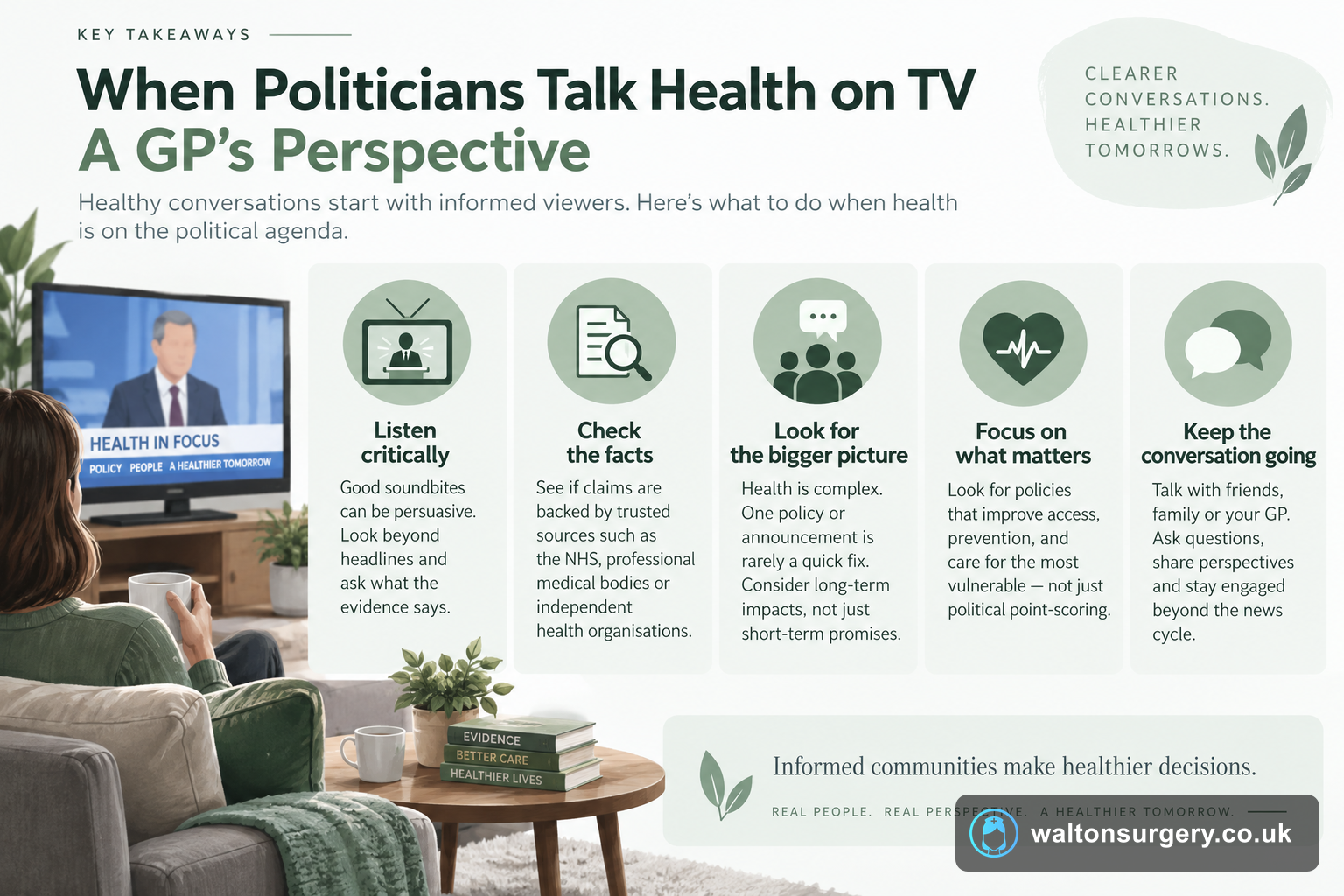
Three questions are worth running through whenever you hear a health claim on Gogglebox or anywhere else. Who's saying it — do they have any clinical training, or are they just reacting as a viewer? What's the source — is there a named body behind the claim, the NHS or similar? And what's the context — one individual's experience, or an actual recommendation aimed at the general population?
Where any of those answers stay fuzzy, file the claim under "interesting but unverified" and get on with your day.
What a Political Appearance on Gogglebox Signals
In the UK, politics and health have been tangled together for a very long time — smoking bans, sugar reduction, vaccination campaigns all being cases in point. Placing a Prime Minister on a celebrity sofa show sends a signal: health messaging is now competing for your attention in the entertainment arena, not solely inside the news cycle.
Whether that's a good thing is going to depend on how it's done. Done well, it normalises conversations that lots of people find awkward — mental health, screening, changes to how you live. Done badly, it turns health into content, where the point is engagement rather than accuracy. The BBC's coverage pitched it as an event. Your job, as a member of the public, is to take it as a prompt. Not as a policy.
Frequently Asked Questions
⭐ The Bottom Line
What this means for you
The Prime Minister's Gogglebox appearance on 23 October 2026 is a media moment, not a medical one. Use TV health talk to spark curiosity, then verify it with named sources like the NHS or a clinician who knows your history. If a health worry sticks, book an appointment — that's where real, personalised advice happens, not on a sofa.
Last updated: 2026-10-23 · Written by the Walton Surgery editorial team · Medical information is for educational purposes only and does not replace advice from a qualified healthcare professional.