Mental Health Support: How Small Acts of Gratitude Can Boost Wellbeing
PART C — HTML Body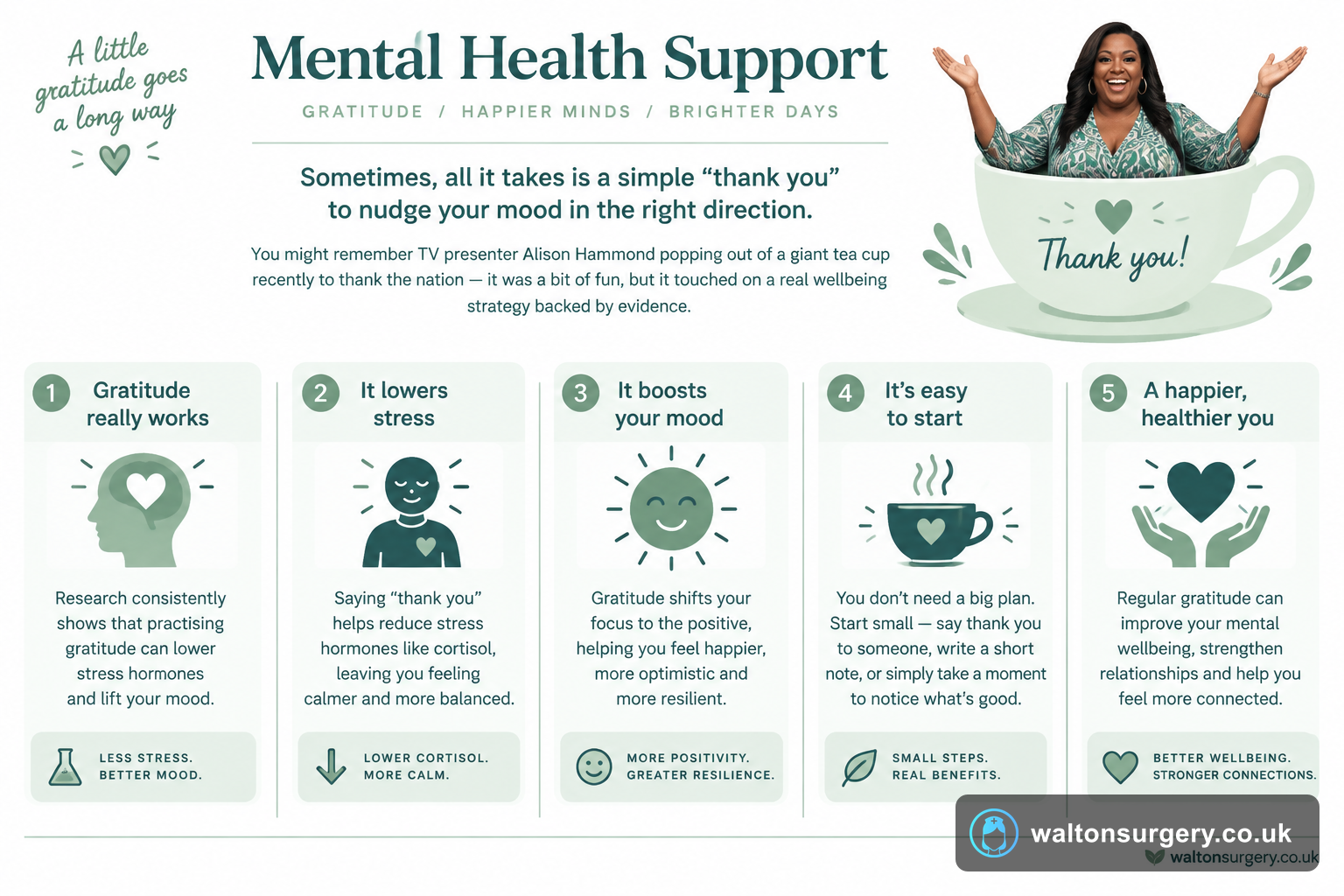
⚡ Quick Answer
Sometimes, all it takes is a simple "thank you" to nudge your mood in the right direction. You might remember TV presenter Alison Hammond popping out of a giant tea cup recently to thank the nation — it was a bit of fun, but it touched on a real wellbeing strategy backed by evidence. Research consistently shows that practising gratitude can lower stress hormones and lift your mood. This article looks at the mental health benefits behind saying thank you and offers some practical, easy ways to begin.
A "thank you" does more than just tick a social box. It's actually a genuine tool for better mental health. Acknowledging kindness — whether it's a grand gesture like presenter Alison Hammond emerging from a giant tea cup to thank her audience or something far quieter — connects you to a proven way to support your own wellbeing.
You really don't need a giant prop or a TV studio to begin. What makes a difference is small, consistent acts of gratitude. This isn't about pretending life's problems don't exist, rather it's about giving your perspective some balance. So let's look at how this actually works and how you might start weaving it into your daily routine.
How Does Saying Thank You Help Your Brain?
Your brain sits up and takes notice when something positive happens. Express gratitude, and it releases dopamine and serotonin — two neurotransmitters tied to feelings of happiness and contentment. Think of it as your brain giving itself a small, natural reward.
Over time, this can build a positive feedback loop. The more you actively notice things worth being grateful for, the more your brain starts seeking them out automatically. Gradually, this can help shift your thinking away from the constant negativity or stress that often comes with conditions like anxiety and depression. It isn't a cure by any means, but it is a supportive practice for mental health.
What's the Link Between Gratitude and Lower Stress?
Feeling thankful has a direct, calming effect on your nervous system. Back in 2007, a study published in Psychotherapy Research found that participants who wrote about what they were grateful for had measurably lower cortisol levels — that's the stress hormone. Their heart rate variability was also better, which is one of the signs your body is coping with stress effectively.
🔬 Key Facts
The Science of Gratitude & Stress
- → Dopamine & Serotonin: Gratitude triggers the release of these 'feel-good' neurotransmitters.
- → Cortisol Reduction: A 2007 study linked gratitude journaling to lower levels of the stress hormone.
- → Breaks Rumination: It acts as a 'circuit breaker' for the negative thought loops associated with anxiety.
- → Nervous System: Saying thank you has a direct, calming effect on your body's stress response.
When gratitude takes centre stage in your mind, you're far less likely to ruminate. Rumination, for those unfamiliar, is the exhausting loop of worrying or negative thoughts that spins round and round. It's a major engine behind stress and anxiety. Gratitude acts as a sort of circuit breaker, pulling your attention toward what's good or stable in your life, even on days when everything feels rough. External factors also play a huge role in our daily stress levels, and researchers are increasingly looking at air pollution and mental health links.
3 Simple Ways to Practise Gratitude Today
Start small. What matters here is consistency, not getting everything perfect.
First, try a "three good things" list. Each night before you go to sleep, jot down three specific things that went well that day — and, crucially, why they went well. Maybe it was a really nice cup of tea, a colleague who helped you out, or the rain finally stopping. That "why" is what makes it stick.
Second, say it out loud to someone. Thank your partner for cooking dinner, your friend for ringing you, or a shop assistant for being helpful. Speaking the words aloud makes it more concrete somehow.
Third, use a prompt if you're stuck. Ask yourself: "What's one thing I have today that I didn't have a year ago?" or "Who made my life a bit easier this week?" Prompts are useful for building that gratitude muscle when it feels weak or unfamiliar.
Is There Scientific Evidence for This?
There is. The NHS, in its mental health advice — which was last updated fairly recently — includes practising gratitude as one way to look after your mental wellbeing. They recommend it because of the weight of evidence from psychological research that's built up over the years.
One of the most well-known studies comes from psychologists Dr. Robert Emmons and Dr. Michael McCullough. Their experiments found that groups who kept gratitude journals reported feeling more optimistic and more positive about their lives than groups who didn't journal at all. The journaling group also exercised more frequently and visited the doctor less often. It's a simple tool, but the effects are measurable.
How Can You Make Gratitude a Habit?
Habits tend to stick when you tie them to an existing routine. Relying on remembering to do it at some random point during the day rarely works for long.
So, for instance, while you're brushing your teeth in the morning, think of one thing you're looking forward to. When you sit down with that first cup of tea or coffee, silently note one thing you're grateful for that morning. Or, as already mentioned, link it to your bedtime routine.
A physical reminder can help as well. A note stuck by the kettle, a particular screensaver on your phone, or even a gratitude jar where you drop in a slip of paper — anything that keeps the practice visible. The easier you make it for yourself, the more likely it becomes something you actually stick with.
What if I Don't Feel Grateful?
This is a common challenge and completely understandable. On a bad day, forcing yourself to feel positive can come across as fake or even harmful. The answer is not to pretend you're happy when you're not.
Start with neutral things. You can express gratitude for basic comforts: "I have a warm bed." "The kettle boiled." "I'm safe inside." Or try gratitude for your own endurance: "I'm grateful I got through today." It's really about acknowledging what is, not what you wish were true.
If you're dealing with prolonged low mood or anhedonia — that's the inability to feel pleasure — that's a signal you should talk to your GP. Gratitude practice works best as a helpful supplement to professional support, never as a replacement for it. If you or someone you know is in acute crisis, understanding services like the rapid relief team uk mental health crisis service explained 2026 can be vital. Furthermore, for younger people, the effects of racist abuse mental health effects children can make finding genuine gratitude much harder.
Frequently Asked Questions
⭐ The Bottom Line
What this means for you
Alison Hammond's giant tea cup moment was a joyful example of public gratitude, and it got people talking. The private benefits are just as real though. A simple "thank you," whether you whisper it to yourself or write it down in a notebook, is a low-cost, accessible way to support your mental health. It helps calm stress and builds a more balanced perspective over time. Start with one small thing today. If you're struggling with your mental health, please reach out to your GP for personalised advice and support.
Last updated: 2026-09-19 · Written by the Walton Surgery editorial team · Medical information is for educational purposes only and does not replace advice from a qualified healthcare professional.