Air Pollution and Suicide Risk: What the Latest Research Says
PART C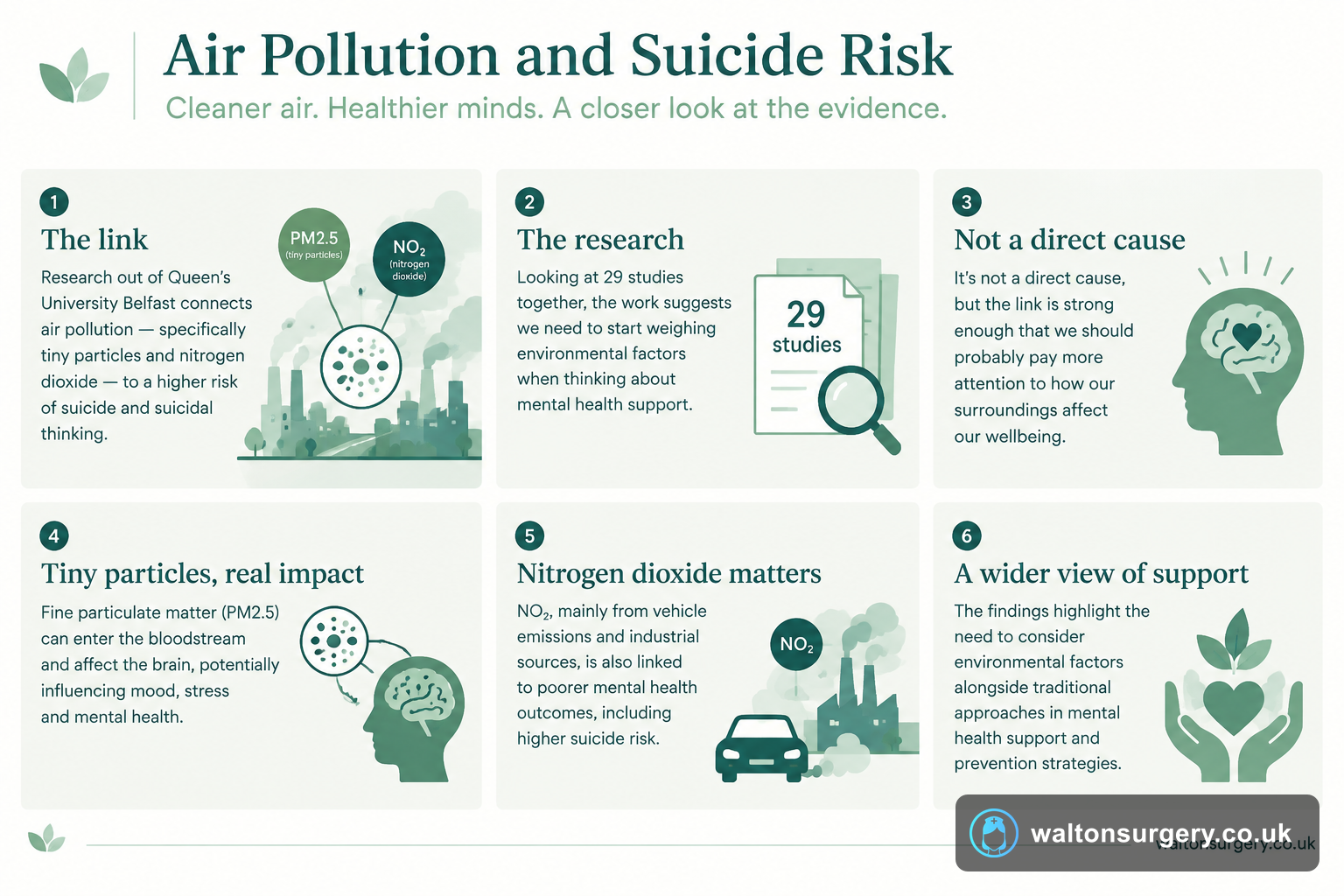
⚡ Quick Answer
Research out of Queen's University Belfast connects air pollution—specifically tiny particles and nitrogen dioxide—to a higher risk of suicide and suicidal thinking. Looking at 29 studies together, the work suggests we need to start weighing environmental factors when thinking about mental health support. It's not a direct cause, but the link is strong enough that we should probably pay more attention to how our surroundings affect our wellbeing.
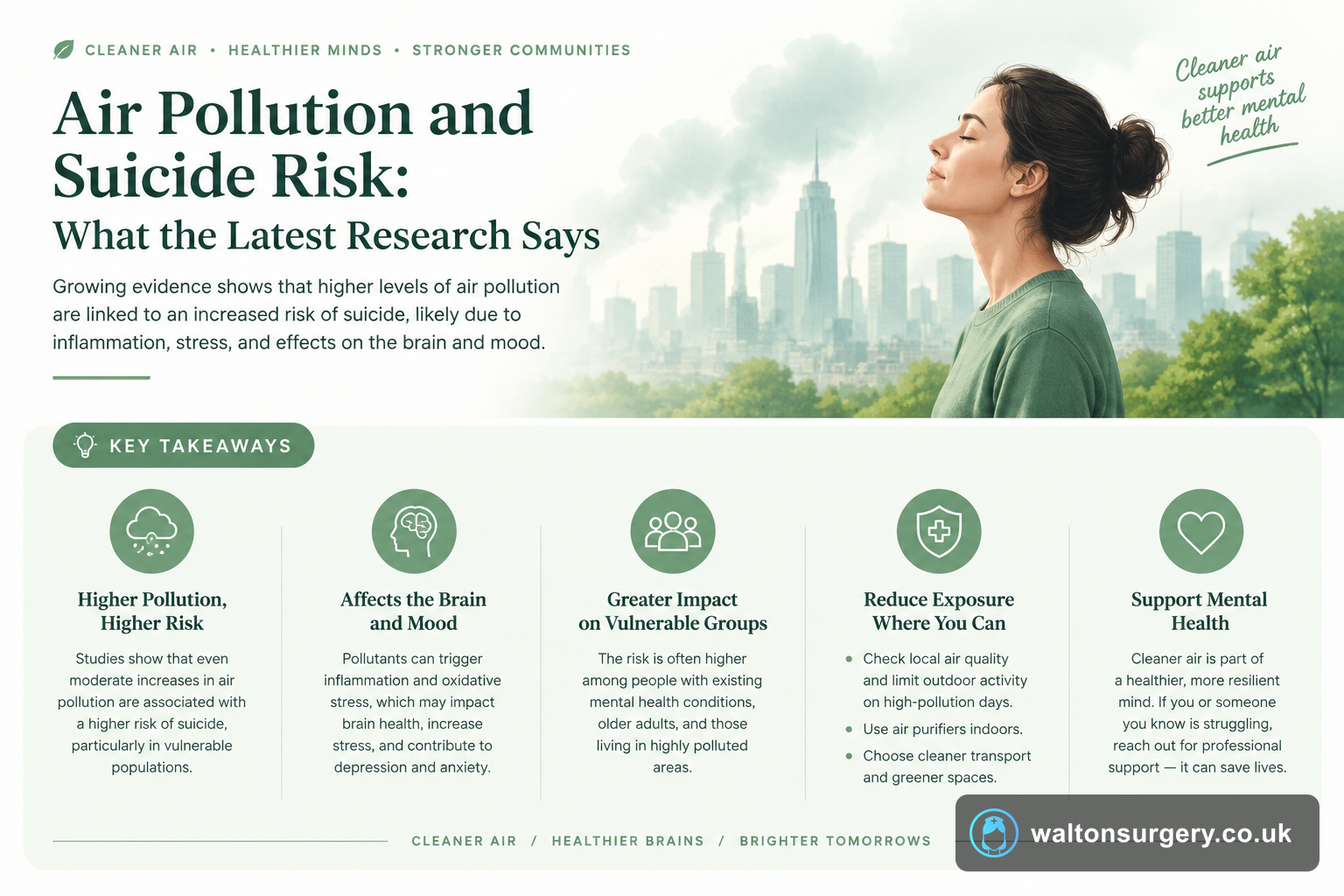
Air pollution has been tied to a higher chance of suicide and suicidal thoughts, based on recent findings. It shifts the usual conversation about what clean air means for us — beyond just protecting our lungs, there's growing reason to think it touches our mental health too. The association hints at a bigger picture for how we understand psychological wellbeing, one where what's outside our windows matters alongside our genes and what's happened in our lives. Similar biological mechanisms are implicated in research on racist abuse mental health effects children.
If you're worried about the environment and how it might be playing on your mind, this research offers a fresh angle. It doesn't show pollution directly causes suicide, but it does point to a measurable connection that researchers are still trying to untangle. For anyone living somewhere with poor air quality, this is more about raising awareness than sounding any alarm.
What Exactly Did the Research Find?
A team at Queen's University Belfast pulled together 29 different studies to look at how air pollution and suicide are linked. Their findings came out in the Journal of Epidemiology & Community Health, and they flag a possibly greater danger from breathing in small particulate matter (PM2.5) and nitrogen dioxide (NO2). You'll find these pollutants mainly in traffic fumes and what comes out of industrial sites.
What the analysis showed is that when these pollutant levels go up, so does the risk of suicide and suicidal thinking. But this is an association — it hasn't been proven as a direct cause. The researchers behind it think pollution could be something to factor into suicide prevention plans, which would be a real shift in how mental health support gets approached, much like how understanding the rapid relief team uk mental health crisis service explained 2026 helps contextualise modern support systems.
🔬 Key Facts
The Belfast Meta-Analysis
- → Scope: Analysis combined 29 separate studies on pollution and suicide.
- → Pollutants: Specific risk identified with PM2.5 and NO2.
- → Status: Shows a strong association, but not yet proven as direct causation.
- → Source: Published in the Journal of Epidemiology & Community Health.
How Might Air Pollution Affect the Brain?
We don't have the full biological story mapped out yet, though there are a couple of theories that keep coming up. One centres on inflammation. Breathing in PM2.5 can set off an inflammatory reaction in your body, and there's some indication this inflammation can make its way into the brain, possibly messing with mood and how you think.
Another idea looks at the blood-brain barrier. Really tiny particles might get past this protective wall and cause oxidative stress — a kind of damage at the cellular level. That stress has been connected to various neurological and psychiatric problems. For someone already dealing with depression or anxiety, it's possible this extra biological burden could chip away at their ability to cope. The symptoms kind of creep up on you sideways, and it's hard to pin down exactly when things got worse.
Who Is Most at Risk from This Association?
The risk applies broadly, but some people are more exposed than others. Those in cities with heavy traffic or near industrial areas will breathe in more of these pollutants. If someone's already managing a mental health condition, the neurological effects of pollution might hit them harder too — their defences are already stretched.
It's also worth thinking about people who exercise outdoors a lot — runners, cyclists — in polluted spots, since they're breathing deeper and faster, pulling more pollutants in with each breath. Still, this is one piece of a much larger puzzle. Social factors, economic pressures, personal history — these remain the central drivers. Even complex political debates, such as those covered in the US health report on gender identity, can contribute to the broader mental health landscape. Pollution is an added environmental weight, not the whole story.
What Can You Do to Minimise Your Exposure?
You can't fix the air across your whole city, but there are things you can do for yourself. When pollution levels spike, check the Daily Air Quality Index from the Department for Environment, Food & Rural Affairs (DEFRA). Cutting back on intense outdoor exercise during the worst hours of the day helps too.
Sorting out your indoor air is another practical move. An air purifier with a decent HEPA filter in the bedroom can make a difference, and ventilating the house when outdoor air is cleaner is sensible. Keeping windows shut during rush hour keeps some of the traffic fumes out. None of it's complicated, but together these steps contribute to a healthier home.
What Should You Do If You're Worried About Your Mental Health?
If you're feeling low for a long stretch, anxious in a way that won't lift, or having thoughts about harming yourself, you need to get support. This pollution research is a public health thing, but what you're feeling is personal and it needs personal attention. Your GP is the natural first step. They can give you a proper assessment and talk through options — that might be talking therapies like CBT, or medication, or both.
You can also ring Samaritans on 116 123 or text SHOUT to 85258 for immediate, confidential help. Don't put your feelings down to environmental factors alone. Professional support works for treating mental health conditions, and it works regardless of what's caused them.
Frequently Asked Questions
⭐ The Bottom Line
What this means for you
Work from Queen's University Belfast has pinned down a clear association between air pollution exposure and a raised risk of suicide. It's not a direct cause, but it does show that our surroundings can nudge our mental health one way or another. For you, that means focusing on what's within your control — cutting personal exposure on bad air days and, far more importantly, getting professional help for any mental health worries without putting it off. Your mental health is worth proper attention from trained people, not just cleaner air.
Last updated: 2026-09-16 · Written by the Walton Surgery editorial team · Medical information is for educational purposes only and does not replace advice from a qualified healthcare professional.