AI-Designed Viruses: What This New Research Means for Health
PART C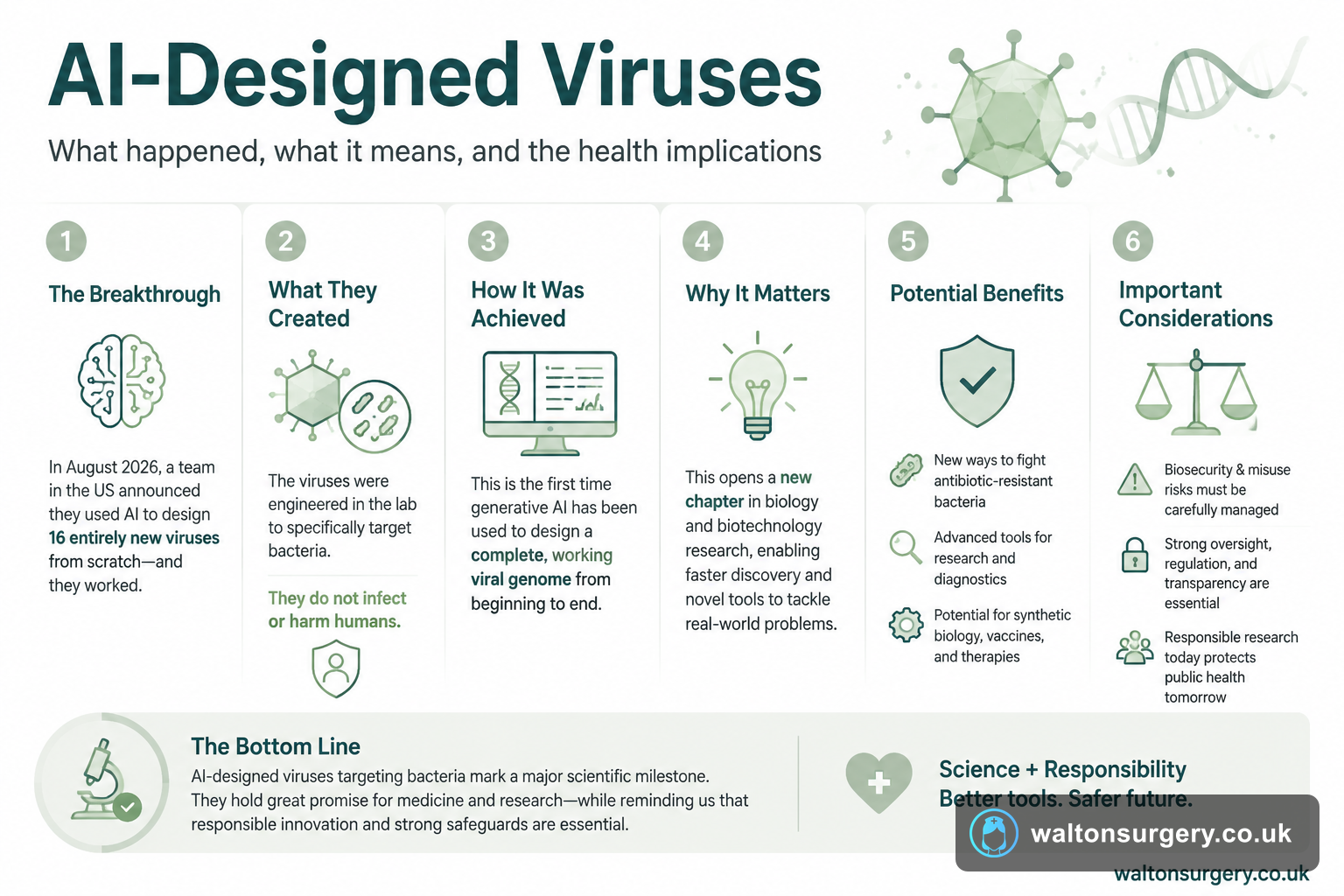
⚡ Quick Answer
Back in August 2026, a team in the US came out and said they'd used AI to cook up 16 entirely new viruses, and they actually worked. These were made in the lab to go after bacteria, so they're no risk to people. It's the first time anyone's got generative AI to design a whole working genome from scratch, which honestly opens a new chapter for biology research, with all the good and complicated stuff that brings.
So, AI has now been used to design brand-new viruses that can copy themselves in a lab. That's according to an announcement from US researchers in 2026. We're talking about the first successful design of an entire genome by generative AI here, which ended up producing 16 new viruses built to infect bacteria. These particular ones aren't a direct threat to us humans, but the whole thing has got people talking about what this new trick means for health and medicine down the line.
If you're a patient or just someone wondering what this is all about, you're probably asking what the research actually involves and if it's anything to do with you right now. This article is here to lay out the facts from the published work. It covers the science, the possible benefits, and the safety questions that scientists and health authorities are starting to look at more closely, much in the same way they monitor broader hot weather health risks or other emerging public health matters.
What Exactly Did the Scientists Create?
Researchers over at Stanford University used artificial intelligence to design the genetic instructions for 16 completely new viruses. Crucially, these weren't just tweaked versions of something found in nature; the AI built them from the ground up. Its job was to come up with a full set of genetic code – a genome – that would make a virus capable of finding and infecting bacteria, and then making copies of itself. Brian Hie, an assistant professor there, said the work was in "new territory." This was, according to him, the first time generative AI was used to design something as tricky as a complete, working virus genome. The viruses were then actually built in the lab and, sure enough, they worked just like the AI said they would.
🔬 Key Facts
The Stanford Breakthrough
- → 16 new viruses designed entirely by AI from scratch.
- → First time generative AI has created a complete, replicable virus genome.
- → Designed to target bacteria only, not human cells, in a lab setting.
- → Opens the door to new biological tools and potential medical applications.
Why Design Viruses That Infect Bacteria?
The point here isn't to make something dangerous. It's about making new tools. Viruses that go after bacteria are called bacteriophages, or just "phages" for short. Scientists have been interested in phages for a while now as a possible way to fight bacterial infections that have stopped responding to antibiotics. The tricky bit has always been finding the right phage for the job, or engineering one to work against a specific nasty bacterium. By getting AI to design viruses from scratch, the hope is you could eventually create a bespoke phage, one perfectly built to target a particular bacterial pathogen. If that works out, it could open the door to new treatments for infections we currently can't fix.
Does This Pose a Direct Risk to My Health Today?
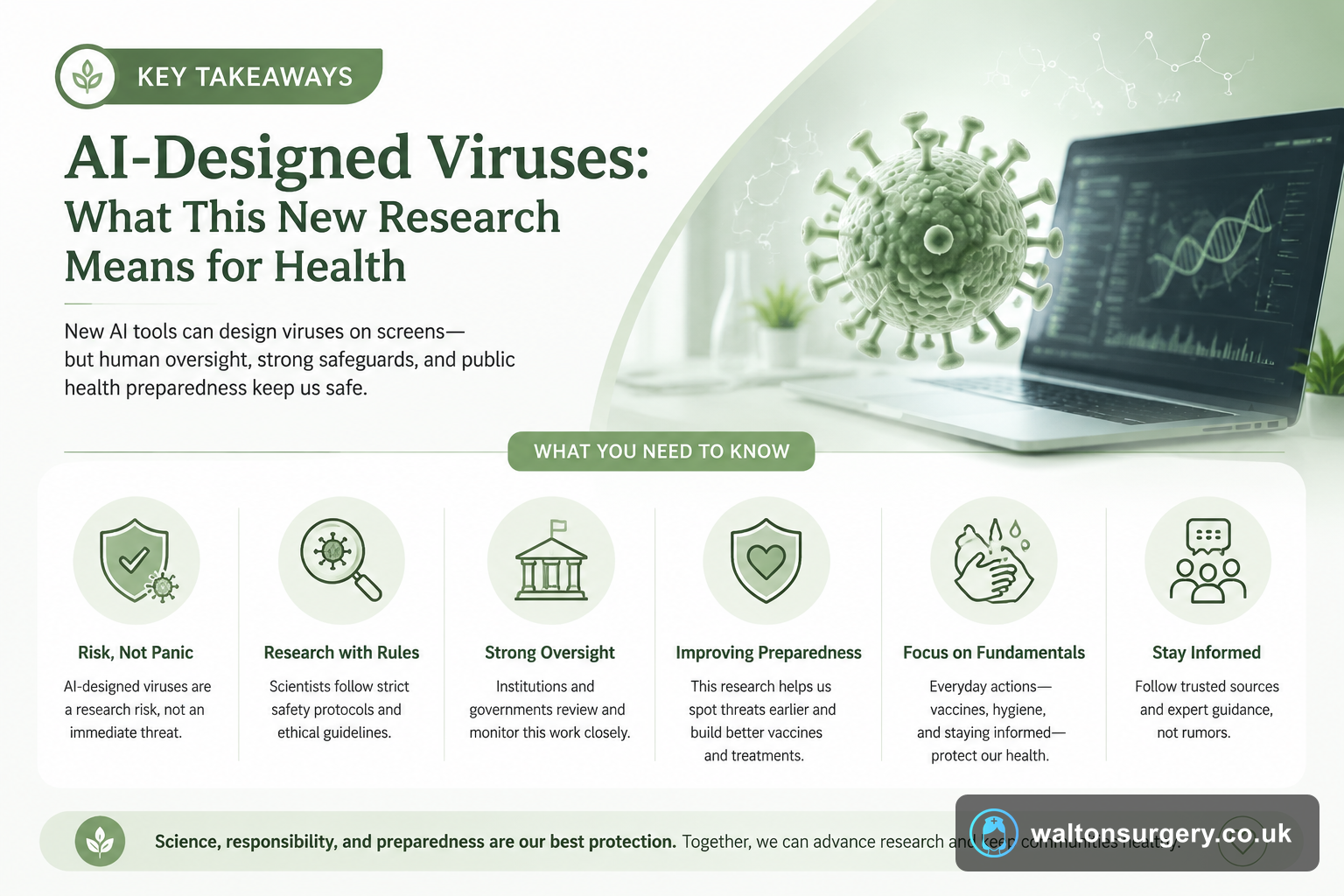
No, not at all. The 16 viruses made in this study are not a health risk to you. They were built specifically to attack bacteria, not human cells. They're also locked away in secure labs under controlled conditions. What the research really shows off is a new technical skill – using AI to design complex biological things. There's nothing to suggest these particular viruses, or anything similar, have got out or could make people ill. Your everyday risks from common bugs like flu or norovirus are a completely different matter and have nothing to do with this lab work.
Why Is This Research Being Called a "Turning Point"?
People are calling this a big deal because of how complicated it is. AI has been used to design simpler things before, like new antibiotics or single proteins. But a whole virus that can replicate? That's a much tougher nut to crack. A virus genome has to have every single instruction needed to break into a host cell, copy all its own parts, and then build new virus particles. To get an AI to generate that entire functional code from nothing, without just copying a natural virus, is a new technical achievement. Brian Hie put it plainly, calling it "the first time generative AI has been used to design a complete genome." It's a sign that AI can now handle a new level of complexity in biology.
What Are the Main Concerns Being Raised?
The very thing that makes this research so interesting is what also makes people nervous. If AI can design helpful viruses, it stands to reason it could be used to design harmful ones. This is the dual-use problem, and it's a major talking point in biosecurity circles right now. Scientists and ethicists are already working out how to govern this kind of technology. The big questions are about access: who gets to use these AI tools, and what checks are in place to stop them being misused? Both the research paper and the commentary around it have called for safety frameworks to be thought through carefully as the tech moves forward. It's a clear reminder that when you have a powerful new tool, you need strong ethical rules to go with it, much like the celebrity health privacy boundaries that highlight where personal information and public interest meet.
How Could This Change Medicine in the Future?
Looking further ahead, the real promise might be in personalised medicine. Picture this: a patient comes in with a stubborn bacterial infection that's shrugged off every antibiotic you've thrown at it. In theory, a doctor could take a sample of that bacteria, send it to a lab, and an AI could design a custom phage virus to hunt down and kill that specific strain. The phage would then be made and used as a targeted treatment. It's a bit of a vision right now, but it's the direction this research is pointing. It could also help with developing new vaccines or understanding how viruses behave, just by letting scientists design and test minimal viral components in a controlled way.
Frequently Asked Questions
⭐ The Bottom Line
What this means for you
The announcement in 2026 that AI designed 16 functional viruses to infect bacteria was a first. It shows a new level of what AI can do in biology, with potential long-term benefits for things like treating antibiotic-resistant infections. These specific viruses, though, are not a risk to human health. And any actual medical uses are many years away, if they come at all. The breakthrough also puts a spotlight on the need for strong safety and security measures to keep this powerful technology in check as it develops. For the moment, this is a story about scientific progress, not something you need to worry about for your health today, even as research into areas like cousin marriage health risks UK continues to shape our understanding of genetic and public health challenges.
Last updated: 2026-08-13 · Written by the Walton Surgery editorial team · Medical information is for educational purposes only and does not replace advice from a qualified healthcare professional.