NHS Health Check: What to Expect Before and During
PART C — HTML BODY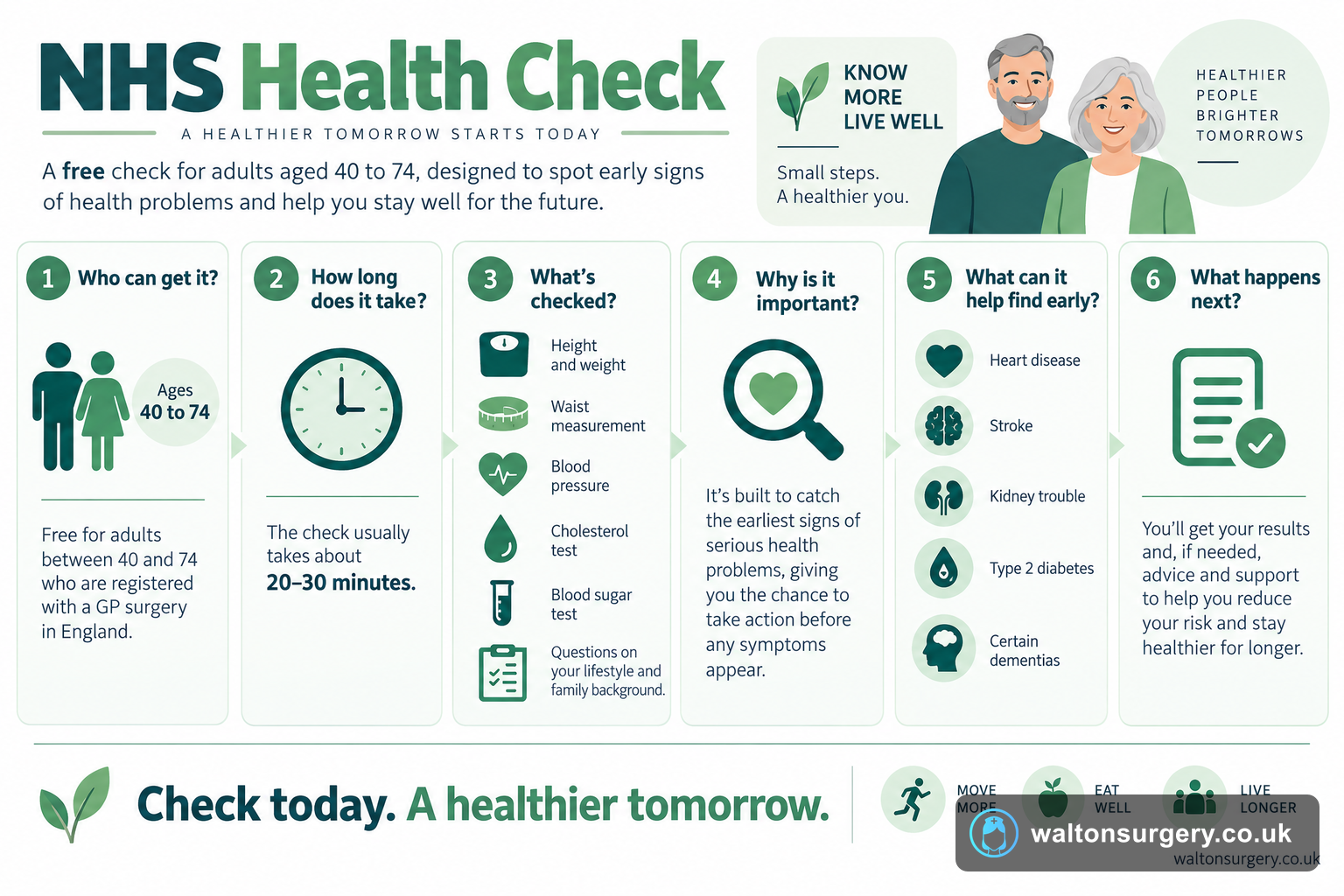
⚡ Quick Answer
Free for adults between 40 and 74, the NHS Health Check runs to about 20–30 minutes and covers your height, weight, waist measurement and blood pressure, alongside cholesterol and blood sugar tests plus questions on lifestyle and family background. It's built to catch the earliest signs of heart disease, stroke, kidney trouble, type 2 diabetes and certain dementias, giving you room to act before anything actually shows up.
If you're in England and between 40 and 74, there's a decent chance you've been sent — or will soon be sent — an invitation to an NHS Health Check. It costs nothing and it lasts around twenty to half an hour. What it does is quietly hunt for the beginnings of problems like heart disease, stroke, kidney disease, type 2 diabetes and some forms of dementia. Those conditions tend to make no noise at all in the early years. That's precisely why somebody invented the check. We cover this in more depth in what is gogglebox celebrity health. We cover this in more depth in what to stream health benefits this week.
It isn't routine care and it's not treatment either. Think of it as a risk briefing: you find out where you stand on certain conditions, and you get told what's actually within your power to change. Most people walk out of the appointment knowing their risk level on the spot and holding a short list of things to do about it. For anything that's specific to you personally, you'll want to sit down with your GP, pharmacist or practice nurse.
What Is the NHS Health Check and Who Is It For?
Based on NHS information summarised in current Google search results, this is a free midlife MOT for adults aged 40 to 74 who don't already have certain conditions being managed elsewhere. It exists to weigh up your odds of developing heart disease, type 2 diabetes, kidney disease and stroke, and to catch the earliest hints of some kinds of dementia.
Nobody's diagnosing anything on the spot here. The real purpose is to hand you a clearer read on where your health actually sits and what's pushing the numbers in the wrong direction — so you can adjust things or start treatment sooner rather than later. NHS Health Checks aren't stand-ins for your regular GP appointments. They're there to flag risk to people who don't yet know they carry it.
Who runs the thing depends on where you live. The sources pulled together for this piece describe it being delivered by a GP, practice nurse, or another trained healthcare professional — in some places a nurse or healthcare assistant handles it. Wherever you sit down for it, you won't pay anything at the point of access; it comes through NHS services.
Falls outside that 40–74 window? Already got something being looked after by your GP? Then the check probably isn't the right fit for you. Your GP practice or a pharmacist is best placed to say what does apply to your case. Related schemes aimed at specific groups are worth knowing about too — recent national headlines on nhs menopause health check 2026 routine 5 million women show how quickly the screening landscape shifts.
What Does an NHS Health Check Test For?
There's a mixture going on here — physical measurements, blood work, and a fair few lifestyle questions. Put together, they produce a rough outline of your heart-related risk.
What exactly gets checked, going off descriptions published by the NHS and summarised in current search listings, includes:
- Height and weight (which is used to work out your BMI)
- Waist measurement
- Blood pressure
- Cholesterol (a blood test)
- Blood sugar / blood glucose (a blood test)
- Questions about your family history
- Questions about exercise and physical activity
- Questions about alcohol use
- Questions about smoking
- Questions about diet, sleep and stress levels
The list of conditions the check is hunting for reads: heart disease, stroke, heart attack, kidney disease, type 2 diabetes, plus some types of dementia. What links them is that early on, they can all slip by unnoticed. Taking measurements while you feel fine is the smarter move than sitting around waiting for something to go wrong.
🔬 Key Facts
What the NHS Health Check actually measures
- → Height, weight and waist measurement — used to work out your BMI and see how weight is distributed
- → Blood pressure, plus cholesterol and blood sugar via blood tests
- → Lifestyle and family history questions — exercise, alcohol, smoking, diet, sleep and stress
- → Targets: heart disease, stroke, heart attack, kidney disease, type 2 diabetes and some dementias
How Long Does It Take and What Happens During the Appointment?
Most people care about the mechanics more than anything else, so let's walk it through properly. Different sources put the length at around 30 minutes, less than 30 minutes, or roughly 20 to 30. Call it half an hour, give or take.
No fancy prep is described in NHS guidance summarised in current search listings. That said, if whoever's running your check hands you instructions — eat beforehand, don't eat beforehand, bring your medicine list — do what they tell you.
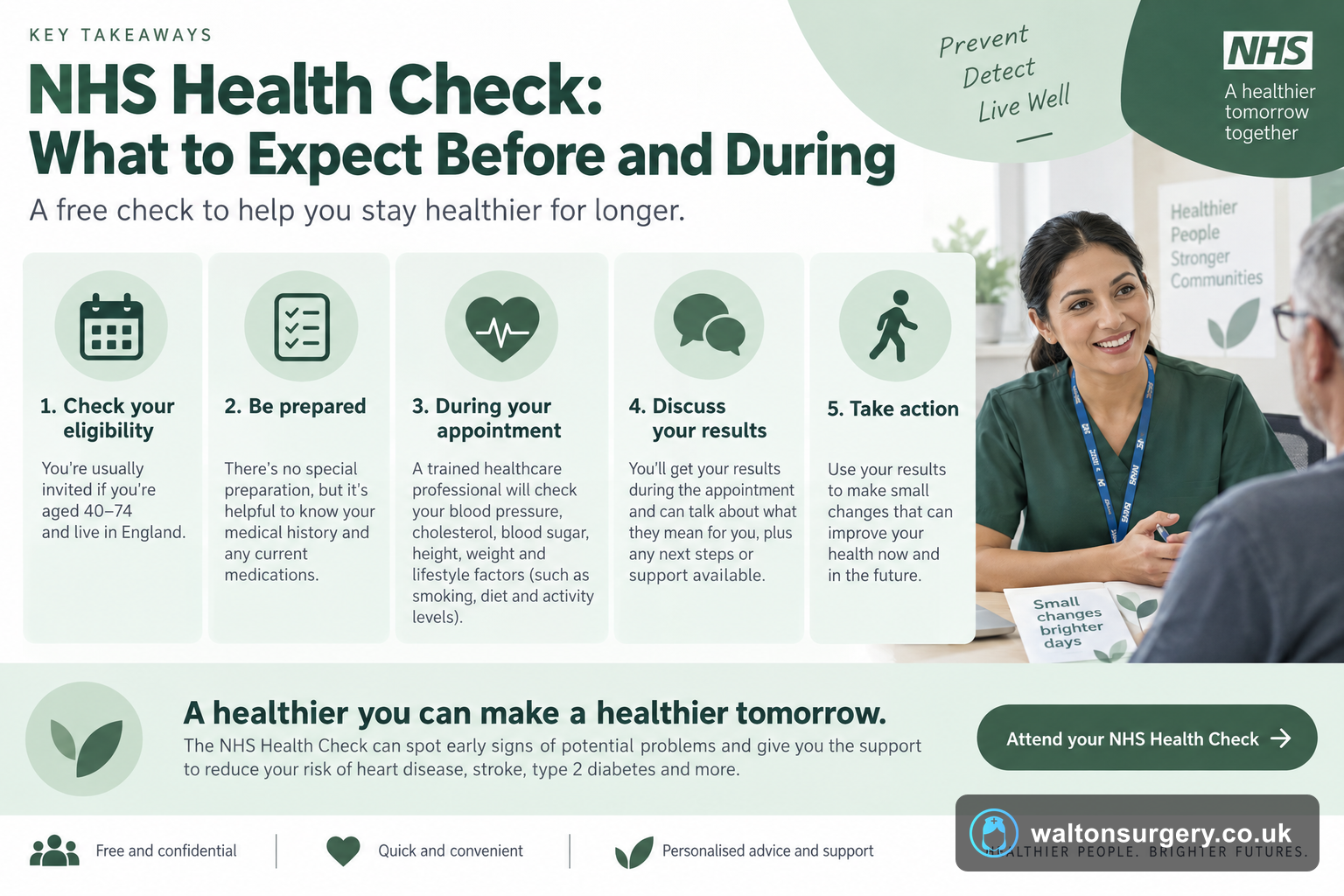
In the room, a health professional will typically:
- Measure your height, weight and waist. These are used to work out your BMI and to look at how your weight is distributed.
- Check your blood pressure. This is done with a cuff on your arm and takes under a minute.
- Take a blood sample or finger-prick sample to test your cholesterol and blood sugar. These are the two blood measurements referenced across the NHS Health Check descriptions reviewed for this article.
- Ask you questions about your family history of certain conditions, and about your exercise habits, alcohol use, smoking, diet, sleep and stress levels.
- Discuss your results with you. You will then usually be told your risk of developing the conditions the check looks at, and what you can do to lower it.
- Talk through next steps. Depending on your results, this might mean lifestyle changes, further tests, or a referral to another service or to your GP for follow-up.
The chat at the end carries as much weight as the measurements do — early action being the whole point. Fire off questions about anything that went over your head. Mention the thing that's been nagging at you. If it's outside the scope of the appointment, the person doing the check can point you somewhere better suited.
What Your Results Mean Afterwards
Risk gets communicated to you during the appointment itself. What you make of it comes down to what the numbers actually looked like.
Everything came back in a healthy range? Then the usual advice is to keep on as you are and re-up when the next invitation lands. Honestly, it's a decent excuse to cement whatever you're already doing right.
Something sat higher than you'd like — blood pressure, cholesterol, blood sugar, say — and the professional will walk through your options with you. Could mean diet tweaks, cutting back on the drinking, getting more movement in, stopping smoking. Could also mean extra tests or treatment routed through your GP.
Worth being plain about this: the NHS Health Check is a risk assessment and nothing more. It is not a diagnosis. What it does is estimate how likely you are to end up with certain conditions, based on the measurements and answers you gave on the day. Only a qualified healthcare professional, weighing up your individual circumstances, can tell you what any specific number means for you and whether follow-up is needed. If a figure is keeping you up at night, get in touch with your GP or practice nurse.
Why Early Detection Matters
Heart disease, stroke, type 2 diabetes and kidney disease — all four can run silent for years. You might feel entirely fine while the underlying risk factors quietly stack up behind the scenes.
That is the argument for doing this in midlife instead of twiddling your thumbs until something breaks. Checking blood pressure, cholesterol and blood sugar while you're still symptom-free opens a window for you to make changes while they're still relatively simple to make. Some dementias get folded in too, since vascular risk factors in midlife have a habit of showing up in brain health decades down the line.
Don't treat any of this as a guarantee though. A clean bill on the day won't buy you immunity forever. A raised reading doesn't mean you've got a condition either. It's a photograph of right now, and a nudge to do something about the bits you can actually influence.
NHS Health Check vs a Private Health Check
Some people would rather skip the queue and just pay. Private and NHS checks aren't interchangeable, so it pays to understand how they differ before you part with any money.
Free at the point of use, aimed at 40–74 year olds, and laser-focused on heart disease, stroke, kidney disease, type 2 diabetes and certain dementias — that's the NHS version in a nutshell. A fixed menu of measurements and blood tests underpins it.
Private checks, on the other hand, tend to run wider. Descriptions reviewed for this piece list cholesterol, blood sugar, liver, kidneys and hormones among the things tested, and they fold in questions on diet, exercise, smoking, alcohol use, sleep and stress levels as part of the review. What you get and what it sets you back vary a lot between providers.
Neither one wins outright. The NHS Health Check costs nothing and is pointed squarely at the early conditions named above in the right age bracket. A private option might cast a broader net over your bloods, but it's coming out of your pocket and you still need somebody qualified to sit down and read the results back to you. If you're on the fence, run it past your GP or pharmacist first.
Frequently Asked Questions
When to See Your GP, Call NHS 111 or Call 999
A health check is planned and routine. Some situations need you to move faster than that.
Ongoing worries about blood pressure, cholesterol, blood sugar, weight, how much you're drinking or smoking — book in with your GP. Also true if a health check result has left you rattled. GPs can order more tests, look over your medicines, and refer onwards when it's warranted. A pharmacist is another option for questions about medicines, blood pressure and everyday health.
Ring NHS 111 when you need advice or treatment urgently but it's not life-threatening. Picture the gap: you feel properly unwell, the GP can't see you in time, and yet it doesn't feel like an ambulance job.
999 is for emergencies, full stop. Signs of a heart attack or stroke fall squarely into that category. Don't sit around waiting for a health check slot or try to talk yourself out of symptoms — dial 999 straight away.
The Bottom Line
⭐ The Bottom Line
What this means for you
Free, roughly half an hour, aimed at anyone aged 40 to 74 — the NHS Health Check takes your height, weight, waist measurement, blood pressure, cholesterol and blood sugar, then quizzes you on lifestyle and family history. What it's hunting for is early risk of heart disease, stroke, kidney disease, type 2 diabetes and some types of dementia, while everything is still pre-symptom. Got questions about your own numbers? Take them to your GP, pharmacist or practice nurse.
Last updated: 2026-11-21 · Written by the Walton Editorial Team · Walton Health News is an independent health information site, not a GP practice. Information is for educational purposes only and does not replace advice from your own GP, pharmacist or NHS 111.