How to Get Rid of Mouth Ulcers: Fast, Evidence-Based Relief
PART C — HTML BODY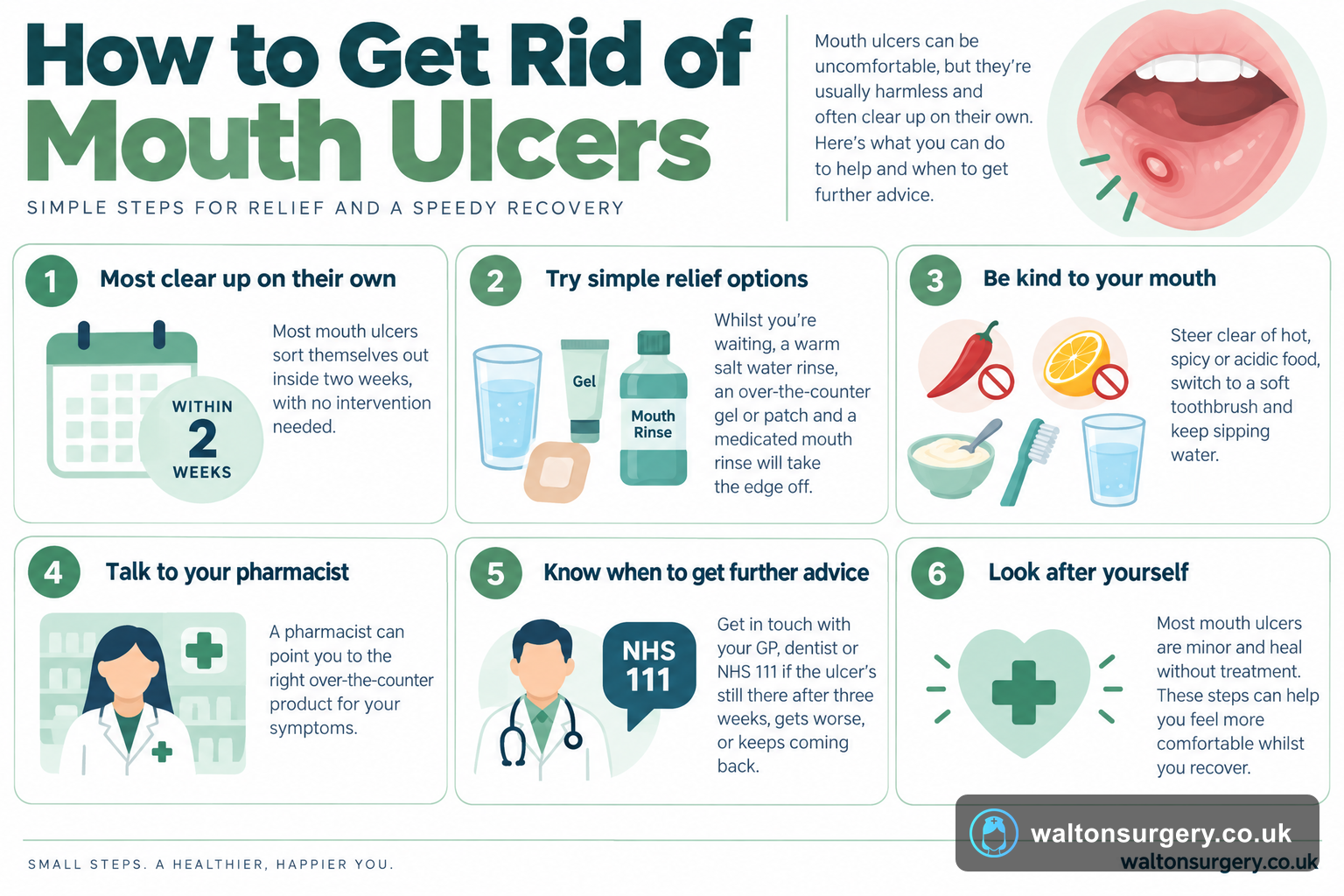
⚡ Quick Answer
Most mouth ulcers sort themselves out inside two weeks, no intervention needed. Whilst you're waiting, a warm salt water rinse, an over-the-counter gel or patch and a medicated mouth rinse will take the edge off. Steer clear of hot, spicy or acidic food, switch to a soft toothbrush and keep sipping water. A pharmacist can point you to the right product. Get in touch with your GP, dentist or NHS 111 if the ulcer's still there after three weeks, gets worse, or keeps coming back.
They're small, they're sore, and they always seem to arrive at the worst possible moment. Mouth ulcers show up on the inside of your cheeks, your lips, your tongue or your gums, and most of us have had one at some point. In the health information on canker sores that surfaces through Google's search results (Canker Sore: Symptoms, Causes & Treatment, 18 September 2025), these sores are described as clearing up within about two weeks even if you do absolutely nothing about them. So treatment, really, is about keeping the pain manageable and the area clean while nature gets on with it.
What follows is a look at the methods that come up time and again across UK health information for getting rid of mouth ulcers: salt water rinses, medicated gels and patches, mouth rinses, and a few straightforward tweaks to how you eat and clean your teeth. It also covers what sets ulcers off in the first place, the warning signs worth taking seriously, and where to go for help — a pharmacist, your GP, your dentist, NHS 111, or 999.
What are mouth ulcers and how long do they last?
Think of them as tiny craters. Mouth ulcers are round or oval sores that sit inside the mouth, often white, grey or yellow in the middle with a red rim around them, and they tend to sting quite badly when you eat or drink or brush. Some people get one and that's it. Others get several at once. The term "canker sore", used in a lot of the health information out there, means exactly the same thing.
Time-wise, you don't have to be patient for long. Google's canker sore summary (18 September 2025) puts the natural timeline at roughly two weeks, untreated. A second canker sore summary is a bit more granular — the pain should start fading within a few days, and everything else settles by around 10 to 14 days.
That window is worth holding onto, because it tells you what's normal and what isn't. If an ulcer is still hanging around after three weeks, someone qualified needs to look at it. The mouth ulcer overview (Google search result, "Mouth Ulcers - What Causes Them and How to Treat") says it plainly: contact your dentist or doctor if an ulcer is still present past three weeks or gets worse, meaning it grows, gets more painful, or multiplies.
What triggers mouth ulcers?
No single villain here. Ulcers get set off by all sorts of things people run into without thinking — chomping down on the inside of your own cheek, a chipped tooth or a denture that rubs the same patch raw, scrubbing at your teeth with a brush that's far too stiff, or food that riles up the lining of your mouth. Stress and tiredness come up in conversation constantly as culprits too, although it's hard to prove cause and effect.
People obviously want to know what's behind them, judging by how often "what causes mouth ulcers" pops up in related searches. The practical advice that runs through UK health content (How Do You Get Rid of Mouth Ulcers Fast?, 20 July 2026) is pretty mundane when you get down to it: use a soft toothbrush, drink plenty of water, and avoid food that's really hot. Each of those cuts down on the friction and irritation that kicks a sore off in the first place. It's the same instinct behind wider self-care habits people look up alongside sore mouths — for instance, readers researching overnight breathing and dry mouth sometimes land on Mouth taping for sleep — UK evidence and safety before circling back to ulcer causes. There's more on this in our ai in social care guidance uk explainer.
Of course, sometimes there's nothing obvious to blame at all. If you're getting ulcers on repeat and drawing a blank on why, try keeping a short log — when they flare up, what you ate that day, what you were doing. Bring it to your GP or your pharmacist. Honestly, it gives them something concrete to work with instead of guesswork.
How to get rid of mouth ulcers at home
Here's the bit you scrolled for. These are the home measures that show up again and again in UK health information, and none of them replace a chat with your own GP, dentist or pharmacist — they're general self-care, nothing more.
Salt water rinses
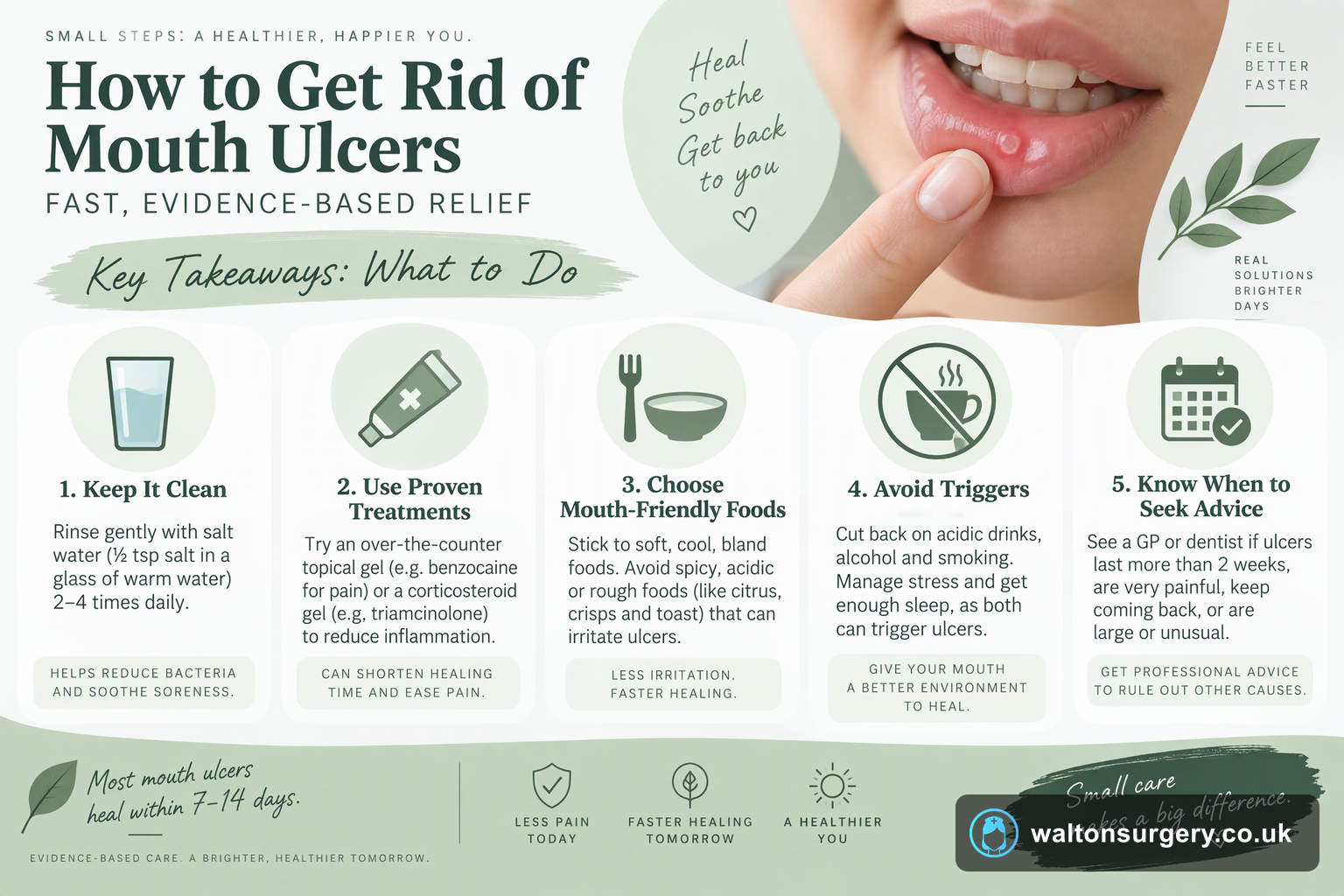
If you only do one thing, do this. Salt water rinses get mentioned more than any other home remedy, and the recipe is dead simple. A mouth ulcer treatment piece (Google search result, "Mouth Ulcers: How to get rid of them") lays it out: a teaspoon of salt, half a pint of warm water, stir until it's dissolved, swish, spit into the sink. Do not swallow.
Plenty of other UK sources say the same thing, more or less. "How to Get Rid of Mouth Ulcers" (14 July 2026) describes it as "one of the simplest" approaches available and advises swishing gently rather than aggressively. "How Do You Get Rid of Mouth Ulcers Fast?" (20 July 2026) suggests doing it a couple of times a day with warm salt water. And "Does rubbing salt on mouth ulcers work?" (15 February 2023) makes a specific point about gargling with warm salt water when you have an outbreak rather than going anywhere near the ulcer with dry salt, on the grounds that it helps "neutralise the oral environment".
Should you put salt directly on an ulcer?
Searches for "putting salt directly on mouth ulcer" are surprisingly common, and the answer from UK health information is no, don't. The "Does rubbing salt on mouth ulcers work?" article (15 February 2023) comes down firmly on rinsing or gargling with warm salt water instead of rubbing salt onto the sore. Dry salt on an open ulcer is genuinely agonising and it'll irritate the tissue further. A dissolved rinse gets salt in contact with the whole mouth and does the job without the punishment.
Medicated gels and patches
Walk into any pharmacy and you'll see shelves of these. UK health information on mouth ulcer causes and solutions (4 September 2020 and 4 June 2020) describes medicated gels as something you dab onto the affected spot. They numb it for relief and, just as usefully, lay down a protective layer that shields the ulcer from further knocks and irritation while it heals. A canker sore remedies round-up ("Remedies for canker sores: 9 options", 10 December 2019) places over-the-counter gels and patches right at the top of the home options list.
Not sure which one to grab? Just ask the pharmacist. They'll know what's appropriate for you, or for your child if that's who's suffering, and they can check it plays nicely with any other medicines in the mix. Anything sold in the UK ships with a patient information leaflet, and it's genuinely worth reading before you use the thing — particularly if you're buying for a kid.
Does Bonjela work on mouth ulcers?
A huge number of people in the UK type this exact question into search engines, so it's worth addressing head-on. Bonjela is a branded mouth ulcer gel range you'll find in UK pharmacies and supermarkets. The wider category, medicated mouth ulcer gels, is what UK health information recommends for numbing and protecting the sore (mouth ulcer causes and solutions, 4 June 2020). As for whether one specific product fits your situation or your child's — that's a pharmacist's call. Products in this space differ in what they contain and in the ages they're cleared for, so give the packaging a read before you commit.
Mouth rinses and other soothers
Alongside gels, mouth rinses are considered a first-line option ("Remedies for canker sores: 9 options", 10 December 2019). Over-the-counter and prescription ointments and rinses are listed among canker sore treatments too (Canker Sore: Symptoms, Causes & Treatment, 18 September 2025). Now, for ulcers that are genuinely miserable, a separate UK article ("Soothing the pain of mouth ulcers", 24 July 2018) floats the idea of gargling with soluble aspirin and keeping well away from anything that stokes up the inflammation. But — and this matters — aspirin is not for everyone, especially children or anyone with certain health conditions, so run it past a pharmacist before you go that route.
What to eat, drink and avoid while an ulcer heals
What you put in your mouth has a direct bearing on how much an ulcer hurts. The guidance in "How to Heal Mouth Ulcers Without Making Them Worse" (16 July 2026) is unambiguous: leave out food that stings, which basically means anything very spicy or sharply acidic, for a couple of days. Soft food goes down easier. Cool food is soothing.
"Soothing the pain of mouth ulcers" (24 July 2018) takes a similar line, telling you to avoid hot, spicy or acidic foods that might inflame the ulcers. "How Do You Get Rid of Mouth Ulcers Fast?" (20 July 2026) layers on a few more habits — don't eat really hot food, swap in a soft toothbrush, drink enough water through the day.
It's about technique as much as ingredients. Cut food small. Take modest bites. Chew on the side of your mouth that isn't currently hosting an ulcer. All of it lowers the odds of you bashing the sore by accident. For a child with an ulcer, something cool and soft — yoghurt, mashed potato — tends to make mealtimes less of a battle.
Mouth ulcer treatment options beyond home care
Sometimes home remedies just aren't cutting it, and at that point it makes sense to widen the net.
Pharmacy treatments
Canker sore health information (18 September 2025) names over-the-counter ointments and rinses as standard treatments and notes prescription alternatives exist. You'll generally see two families of product in the shop: gels or patches that sit on top of the sore, and rinse products ("Remedies for canker sores: 9 options", 10 December 2019). A pharmacist will talk you through the difference and tell you honestly if what you actually need is a GP or dentist instead.
Prescription treatments
These do exist (Canker Sore: Symptoms, Causes & Treatment, 18 September 2025) — ointments and rinses that you won't find on a shelf. They get prescribed by a GP, dentist or another prescriber after someone has looked at your mouth and asked a few questions. If your ulcers are turning up constantly, are unusually large or painful, or simply won't settle, that is a fair enough reason to request a review.
Mouth ulcer tablets
Plenty of people search "how to cure mouth ulcers tablets", hoping for a magic pill. Whether tablets are right for you isn't a self-diagnosis job. It's a clinical decision. Speak to your GP, dentist or pharmacist about it. Where ulcers keep recurring, some people get advised to look into nutritional deficiencies or other underlying conditions, and a blood test can form part of that — but again, your GP is the one who'd arrange it.
How to cure mouth ulcer in one day — is it possible?
"how to cure mouth ulcer in one day", "how to get rid of mouth ulcers fast" — both are searched constantly. The straight answer is that mouth ulcers don't operate on that kind of schedule. What the health information tells us is that canker sores typically run to about two weeks before they go (Canker Sore: Symptoms, Causes & Treatment, 18 September 2025), and that symptoms other than the pain generally clear up in 10 to 14 days (Canker Sore summary).
🔬 Key Facts
The healing timeline, in numbers
- → ~2 weeks is the natural timeline for canker sores to clear, untreated (Canker Sore summary, 18 September 2025)
- → A few days is when the pain should start fading (second canker sore summary)
- → 10 to 14 days is when everything other than the pain settles
- → 3 weeks is the cut-off — an ulcer still present past that, worsening, or multiplying needs a dentist or doctor
What you can meaningfully do is pull the suffering forward a bit, not the healing. Gels and rinses take the sting down so that eating and talking don't feel like an ordeal. Salt water rinses keep the area clean. Avoiding irritating food stops you knocking the thing back to square one. Those small wins make a real difference to how the next fortnight feels. If you want the fuller picture, our guide to how to stop diarrhoea goes further.
And if one does vanish in a couple of days? It was probably tiny, or barely formed in the first place. That's ordinary behaviour for a minor sore and it doesn't prove that any particular hack worked.
When to see your GP, dentist, NHS 111 or 999
Mostly, mouth ulcers are a nuisance that resolve without fuss. There are exceptions, though. The mouth ulcer overview ("Mouth Ulcers - What Causes Them and How to Treat") states that you should get in touch with your dentist or doctor if an ulcer outlasts three weeks or deteriorates — so if it grows, hurts more, or turns from one sore into several.
Worth seeking help for:
• Ulcers arriving in clusters over and over, or ones that never properly heal up.
• Trouble swallowing, drinking, or opening your mouth.
• A temperature, feeling rubbish in general, or a rash appearing alongside the ulcer.
• A child who's refusing food and drink because of an ulcer — dehydration in kids can get serious fast.
How to Get Rid of Mouth Ulcers: what it means for you.
Where to go in the UK:
• Pharmacist: your first port of call for advice about gels, patches, rinses and whether something's right for you or your child. Walk in, no appointment.
• Your GP or dentist: for anything lasting beyond three weeks, worsening, or recurring. They can rule out other causes and think about prescription treatment.
• NHS 111: if you need advice and it's urgent but not an emergency — say, pain that's preventing you drinking and your GP surgery is shut.
• 999: for a proper medical emergency, like severe trouble breathing or swallowing, swelling that's affecting your breathing, or signs of a serious allergic reaction.
Walton Health News is an independent UK health information site. We don't see or treat patients. Always speak to your own GP, dentist, pharmacist or NHS 111 for advice tailored to you.
Frequently Asked Questions
⭐ The Bottom Line
What this means for you
Very common, and usually gone within two weeks without any help at all. While you're stuck with one, salt water rinses, a gel or patch from the pharmacy, and giving hot, spicy and acidic food a miss will make things noticeably easier. A pharmacist is the person to ask about which product to pick. Anything still around at three weeks, getting worse, or returning again and again, goes to your GP or dentist. NHS 111 handles urgent advice; 999 is for emergencies.
Last updated: 2026-11-28 · Written by the Walton Editorial Team · Walton Health News is an independent health information site, not a GP practice. Information is for educational purposes only and does not replace advice from your own GP, pharmacist or NHS 111.