What Does Being 'Cancer-Free' Really Mean?
PART C — HTML BODY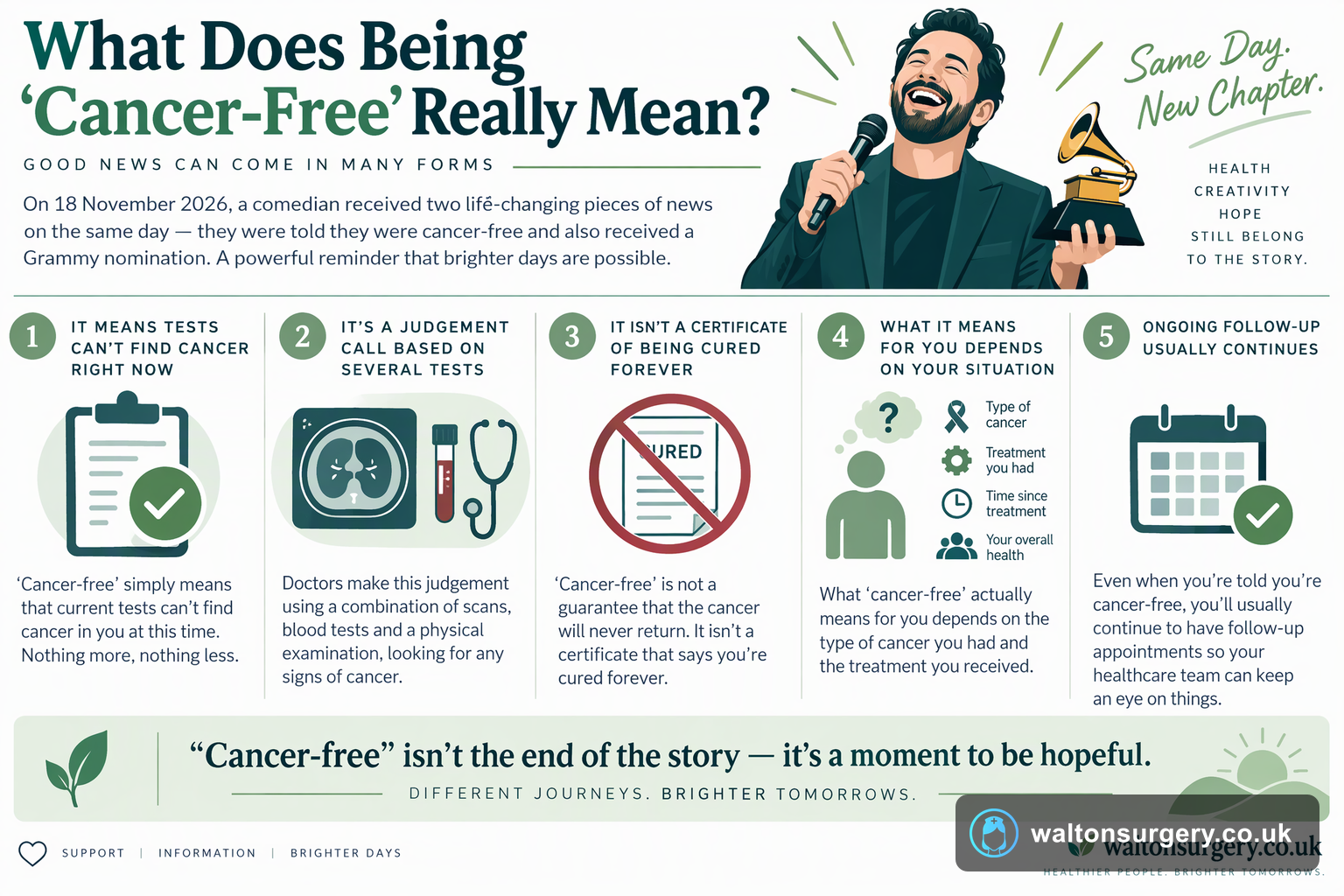
⚡ Quick Answer
A comedian heard he was cancer-free and Grammy-nominated on 18 November 2026, same day. "Cancer-free" simply means tests can't find cancer in you right now, nothing more. It's a judgement call built from scans, bloods and a physical exam, and it isn't a certificate that says cured forever. What it actually means for you depends on the cancer you had and the treatment you got.
Sometimes the phone rings and it's better news than you dared imagine. On 18 November 2026 a comedian picked up to find out he was cancer-free, and, as EntertainmentNow reported, Grammy-nominated too, on the very same day. Wild coincidence, and it got people talking. But under the headline sits a question people actually want answered: what does "cancer-free" mean when a doctor says it?
It isn't a prophecy. What it actually means is that no cancer can be picked up by the tests we have available today, after treatment. Not quite the same thing as a permanent cure, and the gap between those two ideas matters a lot. So if you saw that story and thought "wait, what does this promise me?", you're in good company. The real answer is messier than the headline. We've covered similar news before, including the jessie j cancer free breast cancer mastectomy update 2026, and the same careful reading applies.
What happened when the comedian found out he was cancer-free and Grammy-nominated?
Both pieces of news landed together, as EntertainmentNow reported. That alone is headline material almost anywhere in the world. Usually a cancer-free result comes after a long stretch — months, sometimes years — of treatment and appointments and just waiting. Meanwhile a Grammy nomination comes from voting members of the Recording Academy, a completely separate thing. For both to land on the same day feels a bit like the universe is playing at being a screenwriter.
What's actually useful about the story isn't the coincidence though. It's that "cancer-free" is a phrase you'll hear bandied about in normal life, often at second hand. It shows up in news banners and on social media, and nobody stops to define it properly. Which is what we're doing here.
What does "cancer-free" actually mean in clinical terms?
Ask a UK lawyer or search an NHS policy document and you won't find a statutory definition of "cancer-free" — there isn't one. What it means in practice: a scan, a blood test, a physical exam or some other investigation has turned up no evidence of cancer in the body at the moment of testing. Oncology teams often say "no evidence of disease" instead, or describe a patient as being "in remission".
Every last cell being gone isn't what it means either. Tests come with limits — a scan simply cannot see a tumour below a certain size, full stop. That's a big part of why oncologists are so careful about the words they choose. Think of the phrase as a photograph of one moment. It says nothing about tomorrow.
🔬 Key Facts
What "cancer-free" really means
- → No statutory definition exists in the UK — it is a lay phrase, not a legal or clinical term.
- → It means tests found no evidence of cancer at the moment of testing — scans, bloods, biopsies or examination.
- → Tests have detection thresholds, so it does not mean every last cancer cell is gone.
- → Oncologists say "no evidence of disease" or "remission", because those terms match what the tests actually show.
Why "cancer-free" isn't the same as "cured"
Remission versus cure
Remission is really just an observation tied to time. Cure is a judgement that takes a lot longer to make. In oncology you'll only normally hear the word cure after a long stretch with no recurrence, and that's typically five years or more, although the timeframe shifts depending on the cancer type. Before that point, the right word is remission.
That isn't gloom talking, it's just precision. Plenty of people who hit remission go on to live decades, healthy as anything. Still, a doctor who uses the word "cured" after one clear scan is stepping outside how the profession normally describes outcomes, and it's worth knowing that.
Why the language matters to patients
"Cancer-free" lands like a finishing tape. "Remission" lands like a caution. People feel both of those things, and neither reaction is wrong. If you've had either piece of news and you're fuzzy on what it means going forward for your own care plan, just ask your oncology team straight out. They can talk you through what your specific results say and what the follow-up looks like. Support can help too — there is free counselling for blood cancer patients if the uncertainty is weighing on you.
How do doctors confirm that someone is cancer-free?
Which tests get used depends on the cancer in question. The usual toolkit includes CT scans, MRI scans, PET scans, blood tests that look for tumour markers, biopsies and physical examination. Your hospital team picks the mix that suits your diagnosis.
No single test is watertight. Scans have detection thresholds that stop them seeing very small things. Blood markers go up and down for reasons that have nothing to do with cancer at all. Doctors put the whole picture together, usually across several points in time, rather than hanging everything on one result. And if your results do come back clear, the team will tell you what the follow-up schedule looks like for you specifically.
Should you change how you live after being told you're cancer-free?
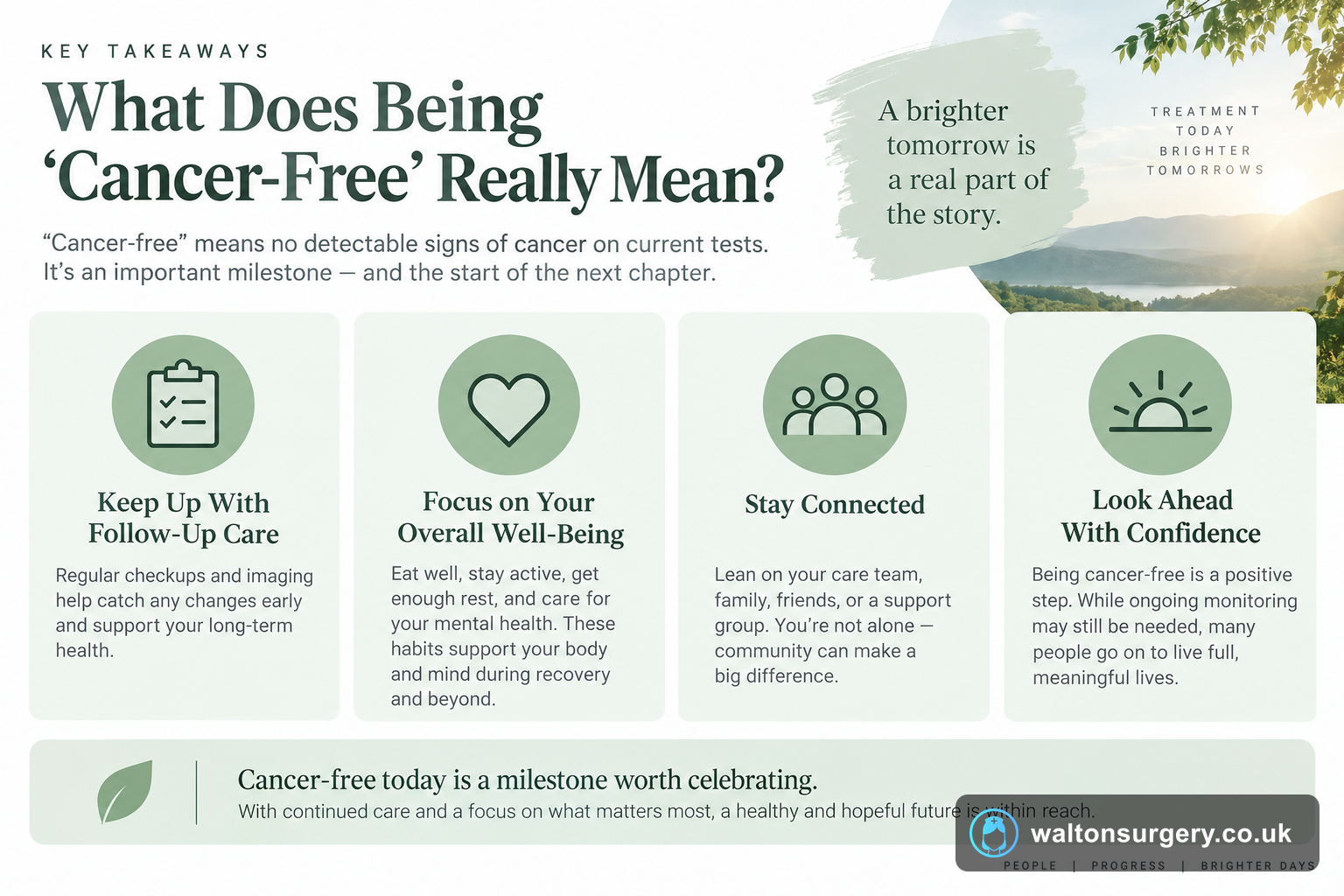
No universal prescription exists here, and anyone telling you otherwise is overreaching. It turns on your diagnosis, your treatment, how healthy you are generally. As a baseline though, the standard NHS lifestyle advice that lowers risk for a whole pile of conditions still counts: don't smoke, stay active, eat a balanced diet, go easy on the alcohol, and keep up with screening programmes where you're eligible. Risk reduction matters across the board — the rules on sunbed cancer risk uk advertising are one example of how prevention is being pushed upstream.
The practical takeaway: a clear result is not permission to bin the healthy habits or skip follow-ups. Your oncology team will book scans, blood tests, appointments, all based on your individual risk. Turning up to those matters more than anything you'll read on a wellness blog. Including this one, for the record.
Frequently Asked Questions
⭐ The Bottom Line
What this means for you
Getting a cancer-free result is good news, and the comedian's double announcement on 18 November 2026 is the kind of thing worth marking. Still, the phrase describes a clinical snapshot. It is not a permanent guarantee. Tests have their limits, and follow-up appointments aren't decoration. Should you find yourself with similar news and feeling unsure what it means in your case, ask your oncology team or your GP — they know the specifics of your case, and this article is not a substitute for their advice.
Last updated: 2026-11-18 · Written by the Walton Surgery editorial team · Medical information is for educational purposes only and does not replace advice from a qualified healthcare professional.