Sunbed cancer risk: what UK advertising rules require firms to say
PART C — HTML BODY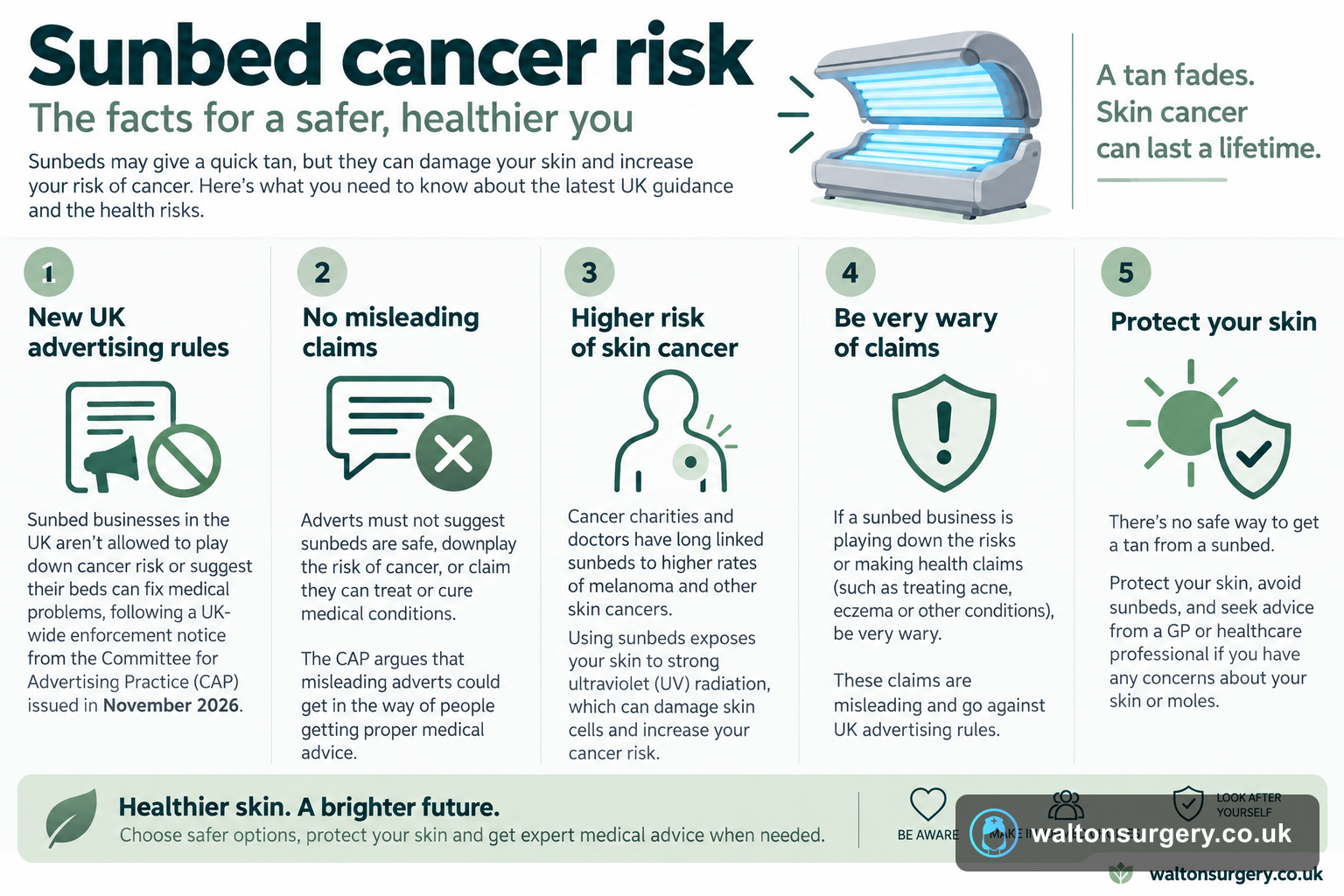
⚡ Quick Answer
Sunbed businesses in the UK aren't allowed to play down cancer risk or suggest their beds fix medical problems, on the back of a UK-wide enforcement notice from the Committee for Advertising Practice (CAP) issued in November 2026. Misleading adverts, the CAP argues, could get in the way of people getting proper medical advice. Cancer charities and doctors have long linked sunbeds to higher rates of melanoma and other skin cancers, so if a firm is playing any of this down, be very wary.
Using a sunbed raises your risk of skin cancer, and that risk is serious. That, in short, is the message the Committee for Advertising Practice (CAP) is now requiring tanning firms in the UK to respect. On 12 November 2026 the CAP issued a UK-wide enforcement notice telling advertisers they must not downplay the risks of sunbed use, must not call their beds safe, and must not claim beds can treat medical conditions.
If a session on a bed has crossed your mind recently, the crackdown changes what firms are legally allowed to put in front of you. Below: what the rules actually mean day to day, the sort of claims that have been doing the rounds on social media, and where you go if you've got a skin concern that needs a proper medical opinion rather than a tanning salon's say-so.
What did the advertising watchdog actually announce?
Back on 12 November 2026, the body that writes the UK's advertising rules — the Committee for Advertising Practice (CAP) — issued a UK-wide enforcement notice aimed squarely at the sunbed industry. According to the CAP's compliance executive, the move was designed "to send a clear message to the industry that advertisers must not downplay the risks associated with sunbed use".
Risk language wasn't the only thing addressed. Firms were also warned off describing their beds as safe, and off claiming beds treat medical conditions. The watchdog's stated concern: some of the claims being made by companies were potentially harmful, because they could discourage customers from seeking appropriate medical treatment or advice. Which is not a soft guideline. It's a formal enforcement notice, and it covers the whole of the UK.
🔬 Key Facts
The CAP enforcement notice, 12 November 2026
- → UK-wide enforcement notice issued by the Committee for Advertising Practice on 12 November 2026
- → Firms must not downplay the risks associated with sunbed use, must not describe beds as safe
- → No medical treatment claims — beds must not be said to treat skin conditions, mental health problems or other conditions
- → Claimed harm: misleading adverts could discourage customers from seeking appropriate medical treatment or advice
What kinds of sunbed claims have been getting people in trouble?
Earlier in 2026 the BBC turned up hundreds of social media videos claiming sunbeds boost energy, treat skin conditions, or improve mental health problems. Those are precisely the sorts of claims the CAP has in its sights. The shape of it is consistent every time — a recreational tanning service gets reframed as a health intervention, and that's what makes the claim misleading and potentially damaging. Health messaging gets reshaped into marketing in much the same way celebrity lifestyle stories can blur the line between viral interest and genuine medical risk, as we've seen with coverage of kim kardashian psoriasis cancer risk.
Why health claims about sunbeds are treated so seriously
What worries the CAP is not tone or branding. It's what happens next. Someone who believes a sunbed will sort out a skin condition or lift their mood is someone who may put off seeing their GP or pharmacist for the same problem. That delay is the harm the watchdog is trying to head off. Do bear in mind this article is general information and not personalised medical advice — if there's something you're personally worried about, speak to your GP or pharmacist.
What does the tanning industry say?
Around half the UK's tanning salons are represented by the Sunbed Association, and the Association said it fully supported action against misleading adverts. At the same time, it said businesses must still be allowed to show they operate responsibly.
There's a tension sitting inside that statement. Backing action against misleading adverts is one thing; accepting limits on how firms describe their product is another thing entirely. The CAP's enforcement notice sets the boundary — whatever a salon does "responsibly" in how it runs, its advertising still isn't allowed to downplay cancer risk or claim medical benefits.
What is the sunbed cancer risk UK customers should take seriously?
Weighing up a session? This is the part that actually counts. Cancer charities and doctors say sunbeds are linked to higher rates of melanoma and other skin cancers, and that's the health position the CAP is anchoring its enforcement notice to. It's also the claim firms are now barred from softening. For context on how inherited factors can also shape cancer risk, our guide to hereditary cancer risk genetic testing covers what family history adds to the picture.
The CAP's own wording is direct: "Sunbeds carry serious health risks, including an increased risk of skin cancer." Worth sitting with that framing for a moment — it's stated as a risk, an increased likelihood, not a guarantee that one session does you damage. An increased risk is still exactly the sort of fact you'd want in front of you before deciding anything. And it's the sort of fact misleading adverts have been working hard to sidestep.
What this does and doesn't tell you
Be straight about the limits. What the facts above show you is that cancer charities and doctors link sunbeds to higher rates of melanoma and other skin cancers, and that the CAP treats that as a serious risk. What they don't show you is a personalised risk number — for your skin type, your age, or how often you'd actually use a bed. Those are questions for a GP or a dermatologist, not for a tanning salon's marketing department.
Why the CAP says misleading adverts can cause real harm
The reasoning the CAP gives runs like this: misleading claims about sunbeds are "potentially harmful" in a fairly specific way, namely that they could discourage customers from seeking appropriate medical treatment or advice. That is the argument underpinning the crackdown, and it covers both claims that downplay risk (calling a bed "safe") and claims that inflate benefit (saying it treats skin conditions or mental health problems).
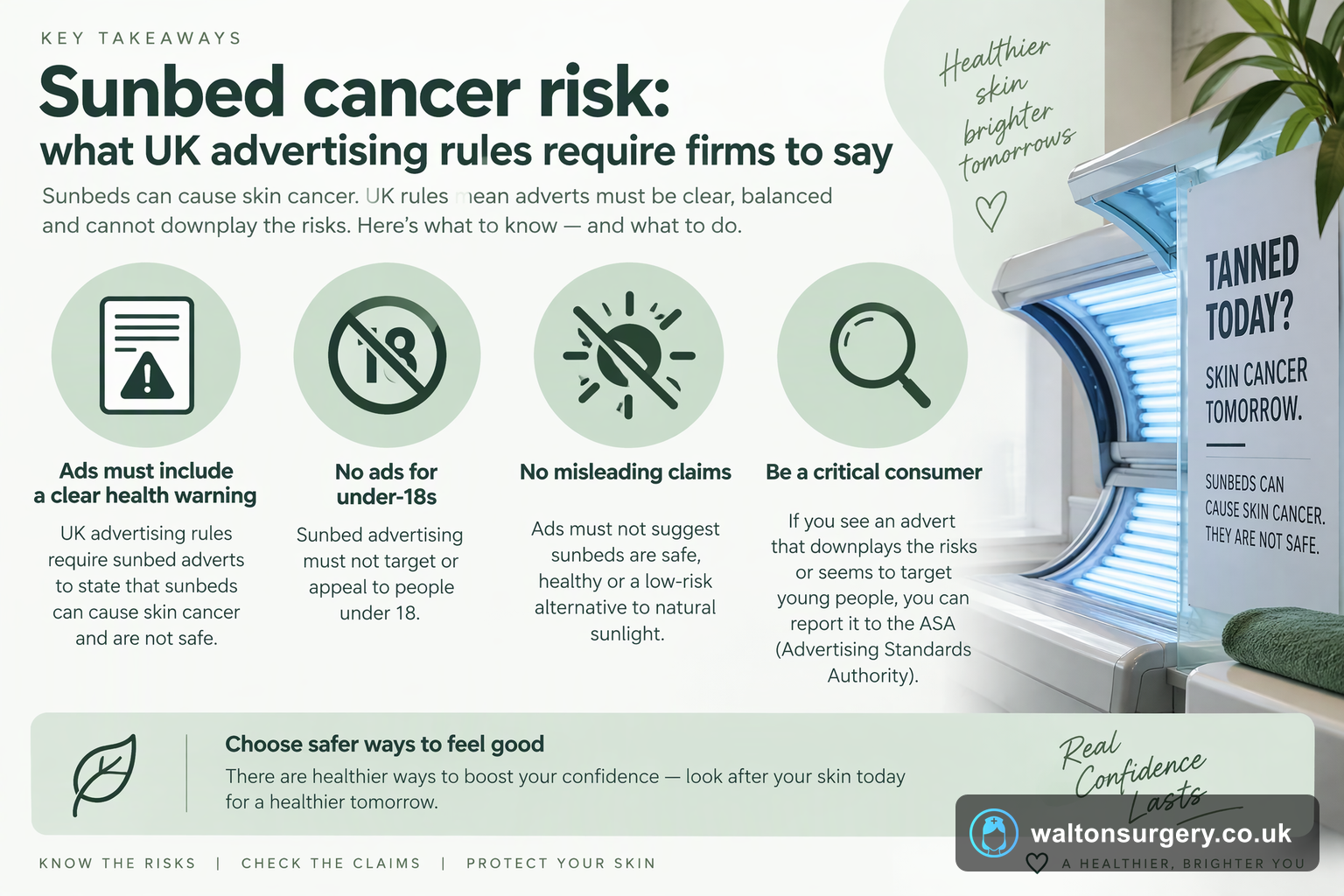
Picture how it plays out in practice. A persistent skin complaint. A social media video promising a sunbed will fix it. A booking instead of a GP appointment. The underlying issue goes untreated. This is the chain of harm the CAP is trying to break with the notice — not simply policing how adverts sound, but keeping people from being steered away from proper care. When a serious diagnosis does land, patients deserve a straight account of treatment and recovery rather than speculation, as in our report on jessie j cancer free breast cancer mastectomy update 2026.
How to check what a sunbed firm is allowed to claim
Treat the CAP's rules as a checklist before you book anything. Adverts, social media posts, in-salon signage — if any of the following turn up there, the firm has crossed the line the watchdog drew.
Claims that should trigger caution
One: any suggestion that a bed is "safe", or that it carries no health risks. The CAP has been explicit that firms must not claim their beds are safe. Two: any claim the bed treats a skin condition, a mental health problem, or some other medical condition — specifically flagged by the CAP as not acceptable. Three: any framing that plays down the link between sunbeds and skin cancer.
Turn up any of those in what you're reading and you're looking at exactly the kind of advertising the enforcement notice is aimed at. Panic isn't the response. Thinking twice about who you're trusting with your health, though, that absolutely is.
Frequently Asked Questions
⭐ The Bottom Line
What this means for you
Sunbed cancer risk now sits front and centre in UK advertising rules. Under the CAP's November 2026 enforcement notice, firms are not permitted to call beds safe, to downplay cancer risk, or to claim beds treat skin conditions or mental health problems. Cancer charities and doctors link sunbeds to higher rates of melanoma and other skin cancers. Anything personal to your health: talk to your GP or pharmacist.
Last updated: 2026-11-14 · Written by the Walton Surgery editorial team · Medical information is for educational purposes only and does not replace advice from a qualified healthcare professional.