Understanding Facial Lesions and Why They May Be Removed
PART C — HTML body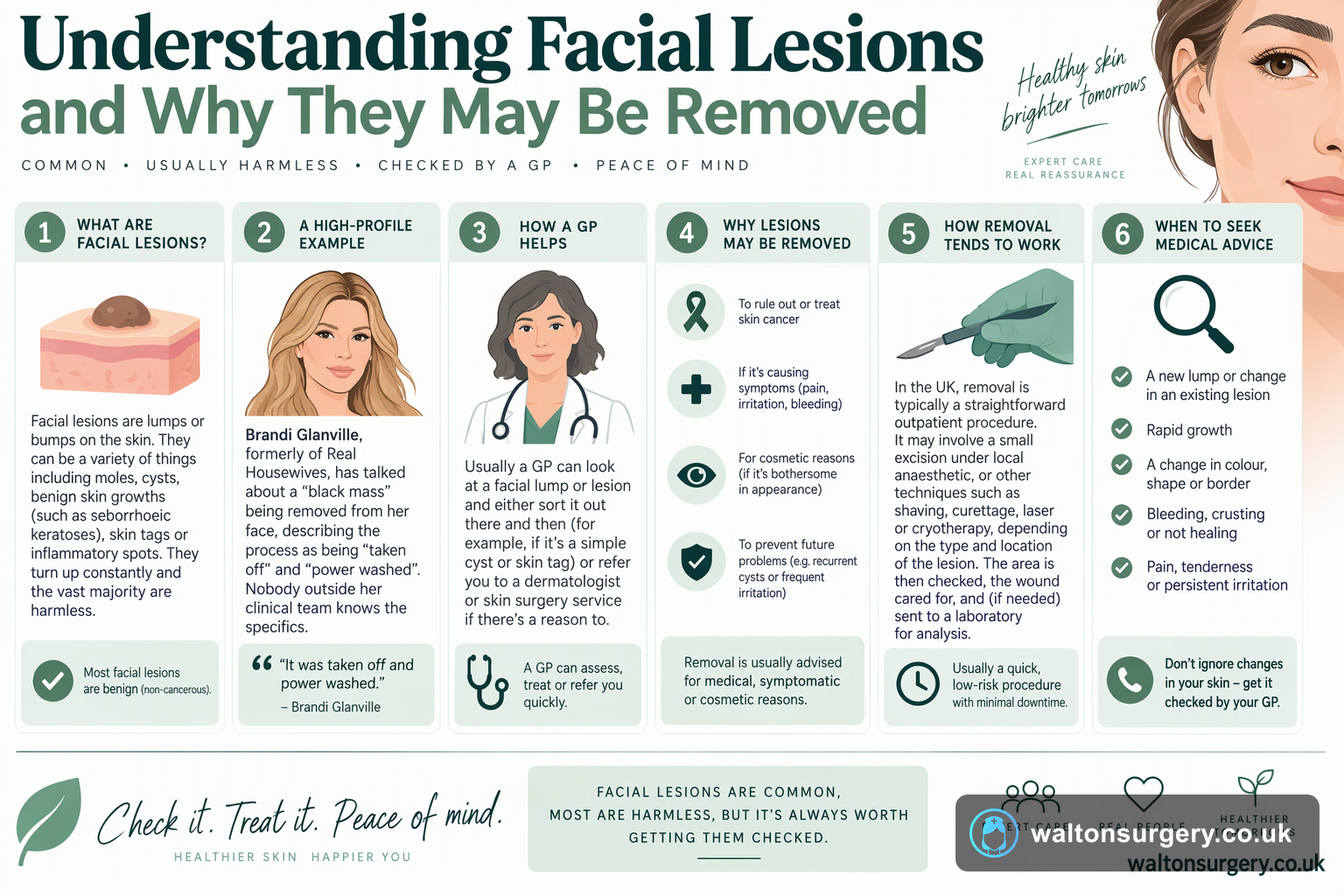
⚡ Quick Answer
Brandi Glanville, formerly of Real Housewives, has talked about a "black mass" being removed from her face, describing the process as being "taken off" and "power washed". Nobody outside her clinical team knows the specifics, but facial lumps and lesions turn up constantly and the vast majority are harmless. Usually a GP can look at one and either sort it out there and then or refer you on if there's a reason to. What follows is a plain guide to what facial lesions actually are, how removal tends to work in the UK, and the point at which you should stop ignoring something — with no attempt whatsoever to diagnose anyone's individual case.
Brandi Glanville told her followers that a "black mass" was removed from her face after being "taken off" and "power washed" — those are her words, taken from her own social media posts. It got people thinking: what sorts of lumps and dark spots show up on the face in the first place, and at what point should you actually see someone about one?
Truth is, lesions on the face are one of the most common things a GP ends up looking at, or one of the reasons people ask to be referred to a dermatologist or plastic surgeon. Benign ones are the norm and tend to be easily dealt with. A fair few get removed because they're uncomfortable or someone dislikes how they look. A much smaller group gets removed because there's a chance they could be cancerous. Here is how UK doctors normally go about thinking these through.
What is a facial lesion?
Any abnormal patch of skin on your face counts as a facial lesion. So that's the lumps that sit underneath, the bumps that stand out, flat marks that just don't match the rest of your skin tone, scabs which refuse to heal, moles that shift shape over time, and the odd cyst that flares up and then settles back down again. Colour varies too — skin-coloured, red, brown, yellow, or dark and black like what Glanville was describing.
The NHS groups them into three broad categories: benign, which means harmless, pre-cancerous, and cancerous. When someone notices a lump on their face, it is almost always benign — cysts, lipomas (those soft fatty lumps), skin tags, warts, unremarkable moles. Then there are actinic keratoses, which are rough patches from years of sun damage and can now and then turn into skin cancer if you leave them. As for skin cancers themselves, the main types are basal cell carcinoma, squamous cell carcinoma, and melanoma.
Not one of those can be identified from a photograph or a description over the phone. Which is precisely why getting someone to examine it in person makes all the difference.
Why did Brandi Glanville's "black mass" make headlines?
Reports circulated around mid-November 2026 that Glanville had posted about a "black mass" being removed from her face. She phrased it oddly, talking about the area being "taken off" and "power washed", and that sent plenty of readers searching for what a "black mass" on a face could even mean.
Straight answer: Glanville hasn't put out a confirmed diagnosis and her medical team hasn't said anything publicly about the clinical detail. Any outlet claiming to know what her lesion actually was is guessing, and this article isn't going to add to the pile. What we can tell you is that the range of dark or black things on a face is enormous — it could be clotted blood beneath a scab, it could be a dilated pore, and yes it could be certain types of skin cancer including melanoma.
Spotting something dark or changing on your own face, then, the last thing you should do is hold it up against a celebrity's and see if it matches. Get a GP or a dermatologist to look at it. Skin symptoms can point in unexpected directions too — a separate piece on our site looks at can you tell ferritin levels from your face, which shows just how much the face can hint at what's happening elsewhere in the body.
What kinds of dark or black lesions can appear on the face?
Clotted blood or a scab that won't lift
Now and then a tiny vessel will leak under the skin and what you see on the surface is black or a dark purple sort of colour. These typically sort themselves out, or at worst just need straightforward wound care.
Dilated pores and blackheads
A pore that's clogged and stretched wide can read as a little black hole or plug sitting in the skin. Nose and cheeks are the usual spots. People often handle them cosmetically or simply don't bother with them at all.
Seborrhoeic keratoses
Waxy, brown-to-black growths with a raised profile and a "stuck on" sort of appearance. They're benign, they're common as you get older, and generally the only reason anyone takes one off is that it snags on clothing or just bugs the person wearing it.
Pigmented basal cell carcinoma
Of all the skin cancers running around the UK, basal cell carcinoma is the one you'll see most often. It can show up as a pearly or pigmented or outright dark patch, it grows slowly, and it doesn't heal over. Metastasis is rare with it, but you do still have to treat it.
Melanoma
Less common and considerably more serious. The NHS tells you to run moles through the ABCDE check: Asymmetry, Border irregularity, Colour variation, Diameter over 6mm, and Evolving over time. A dark lesion appearing fresh on your face, or one that's shifting, is worth having looked at promptly.
Blood blisters or haemangiomas
Growth of blood vessels can come out dark red or so close to black you'd swear otherwise. Harmless most of the time. Still, if one starts behaving differently, get it checked.
What actually happens during facial lesion removal in the UK?
Most readers want the nuts and bolts here, so it is probably worth walking through this properly.
Step 1 — GP assessment
Normally the GP is your starting point. They'll eyeball the lesion, ask you roughly how long it's been hanging around, whether it's altered in appearance, if it bleeds or itches, and whether you've dealt with sun damage or skin cancer in the past. Straightforward benign ones, the GP can often just reassure you about or treat right there in the practice. Anything looking suspicious, or any request for removal purely on cosmetic grounds, gets sent onward — usually to dermatology, or sometimes a minor surgery clinic.
Step 2 — Choosing the removal method
What gets used depends on the lesion itself: what it is, how big, where it sits, and why you want it gone. In NHS and private practice you'll come across these:
- Excision: the lesion is cut out under local anaesthetic and the wound closed with stitches. Standard route for moles, small cysts, and anything that has to go off to the lab for a biopsy.
- Curettage and cautery: the lesion is scraped away, the base sealed with heat. Quite often the choice for benign raised lesions.
- Cryotherapy: the lesion is frozen with liquid nitrogen. Used on warts, sun-damaged patches, and some benign growths.
- Laser or light-based treatments: sometimes used, for vascular lesions or cosmetic concerns.
- Shave excision: a raised lesion gets taken off flush with the surrounding skin. Seborrhoeic keratoses and small raised moles are the common candidates.
Step 3 — The appointment itself
Nearly all facial lesion removals happen under local anaesthetic, so you stay awake but the area goes numb. A fine needle delivers the anaesthetic and there's a brief sting before the numbness settles in. Once you're numb the procedure itself normally runs between 15 and 45 minutes, though it depends entirely on the lesion.
Afterwards you'll get instructions on wound care — typically keep it clean and dry, use whatever ointment they've given you, and don't pick at any scab that forms. Facial skin heals well, thanks to how much blood it gets, but it does need treating gently.
Step 4 — Aftercare and results
Where tissue went off to the lab, results tend to come back over the following weeks via your GP or the hospital team. They'll tell you what the lesion actually was, and whether anything further needs doing. Follow-up then hinges on that diagnosis.
"Power washed", Glanville's phrase, has been quoted all over the place but it isn't clinical terminology. In UK practice debridement, the thorough cleaning of a wound, is a recognised step in some procedures. That said it doesn't replace proper surgical removal, and shouldn't be confused with it.
🔬 Key Facts
Facial lesion removal in the UK at a glance
- → Nearly all facial lesion removals happen under local anaesthetic — you stay awake but the area goes numb.
- → The procedure itself normally runs between 15 and 45 minutes, though it depends entirely on the lesion.
- → Five main methods are used in NHS and private practice — excision, curettage and cautery, cryotherapy, laser or light-based treatments, and shave excision.
- → Facial skin heals well, thanks to how much blood it gets, but it does need treating gently.
When should you see a GP about a facial lump or lesion?
The NHS lists the following as reasons to book in with a GP:
- A mole or lesion that has changed in size, shape, or colour.
- A sore or scab that hasn't healed after three to four weeks.
- A lump that's growing, bleeding, or painful.
- A new dark or pigmented patch that wasn't there before.
- Any lesion you're worried about, even if you can't say exactly why.
On top of that: get seen if a lump popped up after some kind of injury, if there's numbness or weakness in the face alongside it, or if skin cancer runs in your family or you've had it yourself before.
NHS 111 will talk things through for anything urgent. If it's an emergency, say rapid swelling that's interfering with your breathing or your vision, then it's 999.
What are the risks of leaving a facial lesion alone?
For anything that's genuinely benign, walking away from it is normally fine. Loads of people spend decades with harmless moles, skin tags and cysts and never have a moment's trouble.
Trouble arrives when the thing you've written off turns out to be an unspotted skin cancer. Basal cell carcinomas creep along slowly but can eat into tissue nearby if you leave them be — and on the face that means the nose, the eyelids, the lips. Squamous cell carcinomas move quicker. Melanomas, left late, can go on to spread through the body.
It is one of the reasons the NHS pushes you toward early assessment instead of watchful waiting whenever something is changing or new. Taking off a lesion you don't want is generally straightforward. Getting on top of an advanced skin cancer, by contrast, is a much bigger job. And medical worries are rarely confined to one body part — plenty of people wonder about entirely different symptoms, from does salmonella come from salmon to other everyday health questions, so it pays to ask rather than assume.
Frequently Asked Questions
⭐ The Bottom Line
What this means for you
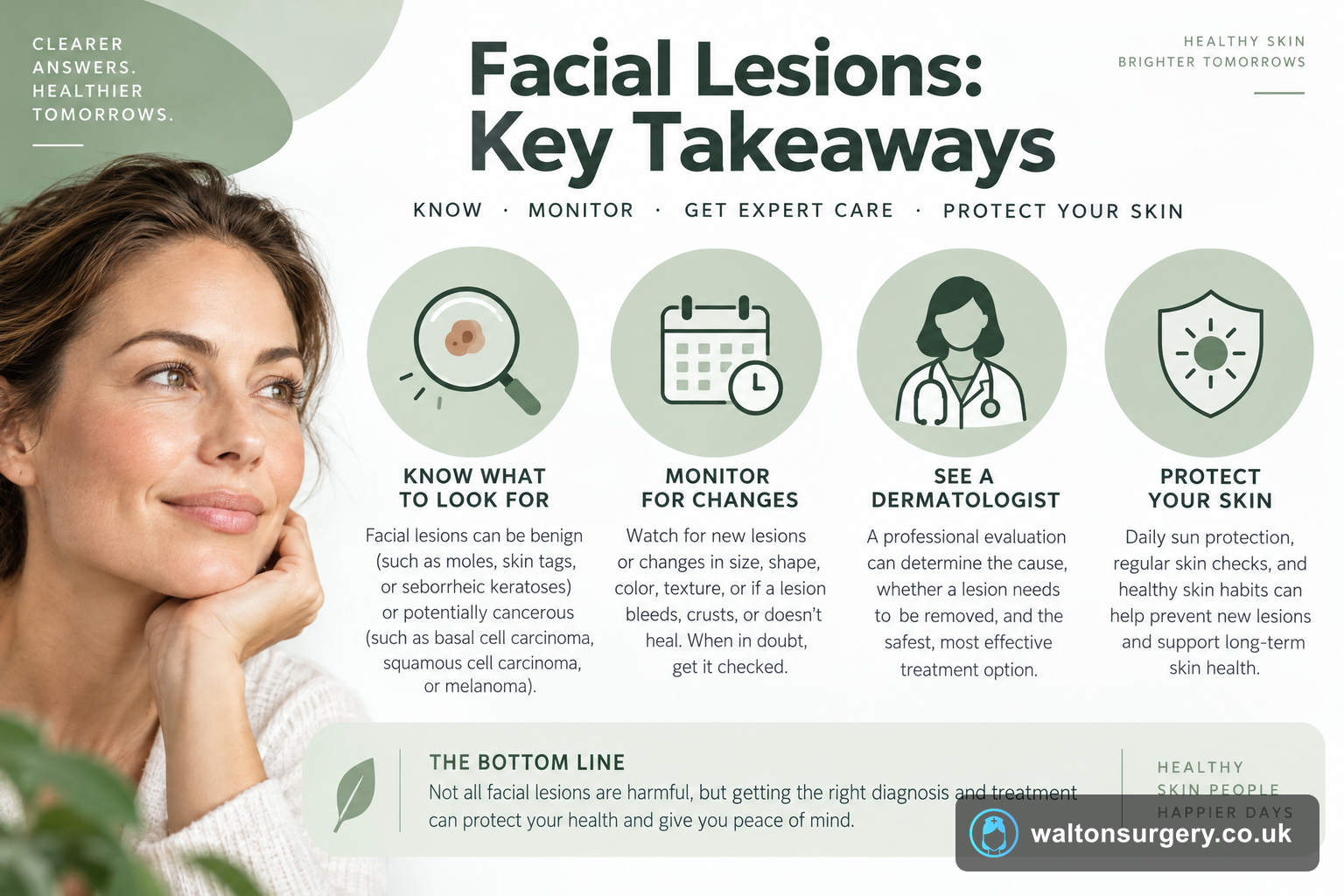
Brandi Glanville's story is a nudge that facial lesions are ordinary and worth paying attention to, however they happen to look. Mostly they're benign and a GP or dermatologist can deal with them in a short appointment under local anaesthetic. If you've spotted a lump, a dark patch, or a mole that's changing shape on your face, don't sit around waiting to see if it sorts itself out. Book with your GP and get it properly assessed. General information only this article — not personal medical advice for you.
Health questions come in all shapes and sizes, and not every one of them involves a visit to the surgery — some people are simply looking for practical reassurance at home, whether that's how to remove gas from stomach instantly home remedies uk or guidance on a facial lump like the ones discussed above.
Last updated: 2026-11-15 · Written by the Walton Surgery editorial team · Medical information is for educational purposes only and does not replace advice from a qualified healthcare professional.