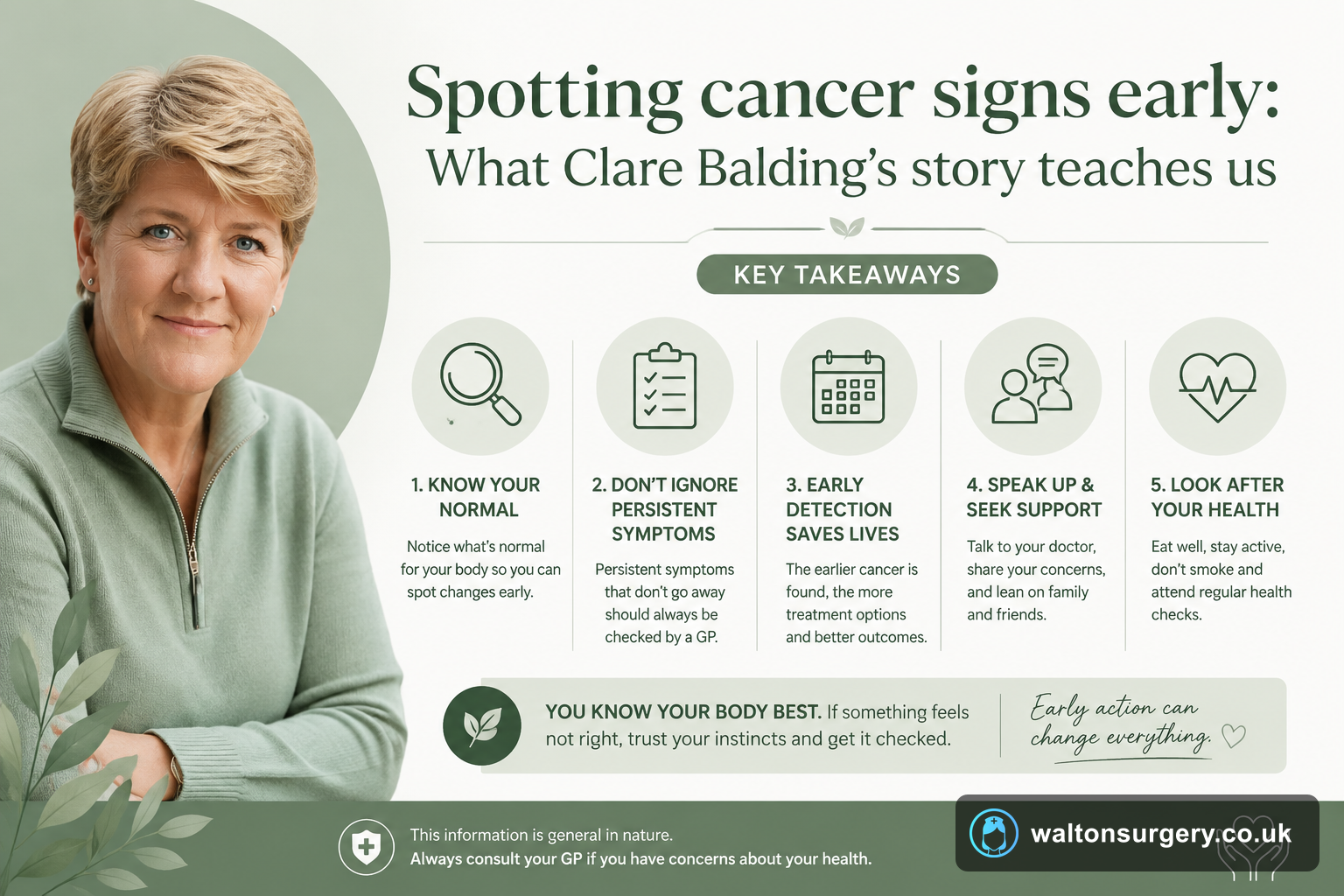
Spotting cancer signs early: What Clare Balding's story teaches us
PART C
⚡ Quick Answer
It came out in July 2026 that Clare Balding had received a cancer diagnosis after she noticed a physical change while watching herself present on BBC television. Her case really underlines that catching things early so often begins with clocking small shifts in your own body. The NHS says you should see your GP if anything feels off and won't go away. Keeping an eye out for things like unexplained weight fluctuations, being constantly knackered, new lumps, or shifts in your skin or bowel habits could make all the difference, as treatment tends to be far more effective when cancer is found at the start.
Back in July 2026, it was reported that Clare Balding got her cancer diagnosis after she spotted a visible change in herself while reviewing footage from her BBC presenting work. Her experience really drives home that symptoms can show up in ways you'd never anticipate. For a lot of people, cancer doesn't announce itself with a sudden collapse or sharp pain — it's more often these small, persistent shifts where you just get a feeling that something isn't quite right.
The NHS position is that you ought to go and see your GP if you notice anything about your body that's unusual and doesn't resolve. There's genuinely no need to hold out until a symptom feels severe. Catching things early is still one of the most effective ways we have for improving outcomes, and that all starts with getting to grips with what you're actually looking for.
How Clare Balding Spotted Her Cancer
While looking back over BBC presenting footage of herself, Clare Balding saw a visible physical change. That prompted her to go and get it checked out, which is what led to her diagnosis. The detail that came out on 27 July 2026 is pretty striking, because it really does show that being tuned in to your own body can sometimes come from the most unexpected places.
For Balding it was literally watching herself on screen. For you, it could be spotting something different in the mirror, feeling a lump that wasn't there before, or just noticing your energy's dipped without any obvious explanation. The takeaway here has got nothing to do with television presenting — it's about paying attention. The NHS says that any unexplained change which sticks around for more than a few weeks warrants going to have a chat with your GP.
What the NHS Says About Recognising Cancer Symptoms
There's a list of symptoms the NHS says should prompt a trip to your doctor. It's worth remembering that these symptoms aren't unique to cancer, and having one of them absolutely does not mean you've got cancer. They are, however, changes that are worth getting checked out without too much delay.
Weight loss or gain that you can't put down to diet or exercise shifts is one flag. A new lump or swelling, wherever it appears on your body, is another. Tiredness that doesn't let up even with proper rest, bowel habit changes that linger for more than a few weeks, blood in your urine or stool, and a cough that just won't quit are also on the NHS's radar. Understanding the early breast cancer diagnosis symptoms uk can help with prompt action.
Changes to moles or other skin lesions get a mention too, alongside unexplained pain that won't settle, trouble swallowing, and any unusual bleeding — things like bleeding between periods or after the menopause. The common thread running through all of these is that they're unexplained and they're persistent. A one-off headache after a stressful week at work isn't really comparable to a headache that comes back every single day for three weeks. Context is everything, and your GP is trained to help you figure out what's going on.
The Most Important Thing: Don't Wait
Probably the single most useful bit of advice the NHS offers is pretty simple: don't hang about if you spot something unusual, just go and see your GP. Loads of people put it off because they feel awkward, or they convince themselves it's nothing, or they worry they'll be wasting the doctor's time. Clare Balding's situation really illustrates why that hesitation can end up costing you.
GPs see patients with potential cancer symptoms all the time. It's a completely routine part of what they do. You won't be wasting anyone's time. If your symptom turns out to be benign, that's a great result. If it does need looking into further, catching it early gives you more treatment options and generally a better prognosis. The NHS runs cancer screening programmes for breast, cervical, and bowel cancer precisely because finding it early saves lives. If you are diagnosed, it is also important to manage your diet and watch out for issues like malnutrition after cancer diagnosis.
How to Stay Aware of Your Own Body
You don't need a medical degree to spot changes in your own body. What you do need is a sense of what's normal for you. That's something only you can really establish.
Start by just paying attention to your body's regular patterns. What's your energy usually like on a normal day? How does your skin typically look? How often do you normally need the loo? What's your usual weight range? Once you've got a handle on what "normal" looks and feels like for you personally, you're in a much better position to notice when something's off.
The NHS recommends checking your breasts or chest and your testicles regularly so you get familiar with how they usually feel. You can also keep an eye on your skin, especially any moles. If a mole shifts in size, shape, or colour, or it starts to itch or bleed, report it to your GP. The NHS ABCDE checklist for moles — Asymmetry, Border irregularity, Colour variation, Diameter over 6mm, and Evolving shape — is a really handy tool for gauging changes.
There's no need to become obsessed with this stuff. A few minutes of awareness each month is plenty. The idea isn't that you diagnose yourself — it's about noticing enough to know when something warrants getting a professional involved.
Why Early Detection Changes Outcomes
🔬 Key Facts
NHS Screening Programmes
- → Breast screening invites women aged 50 to 71 for mammograms every three years.
- → The cervical screening programme covers women and people with a cervix aged 25 to 64.
- → Bowel cancer screening sends home testing kits to people aged 60 to 74 across England.
The reason the NHS, Cancer Research UK, and the wider medical community bang on about early detection so much is straightforward: cancer that's found at an earlier stage is generally much easier to treat. When a cancer is localised and hasn't started spreading to other bits of the body, treatment options tend to be wider and survival rates are typically better.
The NHS screening programmes are built entirely around this logic. Breast screening invites women aged 50 to 71 for mammograms every three years. The cervical screening programme covers women and people with a cervix aged 25 to 64. Bowel cancer screening sends home testing kits to people aged 60 to 74 across England. These programmes exist because catching cancer before any symptoms crop up — or at the very earliest hint of them — can be the difference between a relatively straightforward treatment path and something far more complicated.
It's also worth bearing in mind that some cancers produce very few symptoms right at the beginning. That's precisely why screening programmes are there and why it really does matter to attend your appointments. Clare Balding's cancer was visible enough to spot on camera, but a lot of cancers won't be obvious until they've had time to grow. Screening can catch things you simply can't see or feel yourself.
Common Misconceptions About Cancer Symptoms
One of the most stubborn misconceptions out there is that cancer always comes with pain. Plenty of early-stage cancers are actually painless. A painless lump, a painless change in a mole, or painless blood in your stool are all reasons to get yourself to the GP, even if nothing's actually hurting.
There's also a widespread belief that cancer is only something older people need to worry about. While it's true that risk does go up with age, cancer can hit at any age. The NHS screening programmes kick in at specific ages based on population-level risk data, but if you've got symptoms at any age you should be seeing your GP, regardless of whether you fall inside a screening age bracket. Even recent celebrity cases, such as the nivea singer cancer diagnosis uk, have highlighted how awareness is for everyone.
Another one: the idea that if your symptoms come and go, they can't possibly be cancer. Symptoms that are intermittent rather than constant can still be linked to cancer. Bowel habit changes that keep cropping up, bleeding that comes and goes, or a lump that seems to shrink and then grow again — all of these are worth reporting to your doctor.
And then there's the assumption that because a family member had cancer, you're definitely going to get it too. A family history of certain cancers can raise your risk, for sure, but most cancers aren't caused by inherited genetic mutations. The NHS and Cancer Research UK both offer guidance on hereditary cancer risk, and your GP can put you forward for genetic counselling services if your family history warrants looking into it.
How to Talk to Your GP About Cancer Concerns
Booking a GP appointment about a potential cancer symptom can feel pretty daunting. A bit of preparation beforehand can help you get the most out of that consultation.
Jot down your symptom, when you first clocked it, whether it's changed since then, and how often it happens. If you've noticed a lump, note its size and whether it's shifted at all. If it's a bowel habit change, keep a brief record for a week or two beforehand. This kind of information helps your GP get a clearer picture of what's going on.
Be straight about your concerns. If you're worried it could be cancer, just say so. GPs appreciate that kind of directness and it helps them figure out the right next steps. Ask what happens next, whether you need any tests, and roughly what the timeline looks like. If you get referred for further investigation, the NHS two-week wait pathway means you should be seen by a specialist within two weeks of referral for suspected cancer. That's a real safety net built into the system.
If you feel like your concerns aren't being taken seriously, you're absolutely entitled to seek a second opinion. Your health is your responsibility, and being your own advocate is a big part of that.
Frequently Asked Questions
⭐ The Bottom Line
What this means for you
Clare Balding's cancer diagnosis — which she clocked while watching herself on television — is a powerful reminder that being aware of your own body really does matter. You don't need any specialist knowledge to do this. You just need a sense of what's normal for you, and the willingness to act when something changes. The NHS is unambiguous on this: if you spot an unexplained, persistent change, go and see your GP. Most symptoms won't turn out to be cancer, but checking promptly gives you the best possible chance if something is wrong. Don't put it off, don't try to diagnose yourself, and don't let embarrassment stop you from picking up the phone and booking that appointment.
Last updated: 2026-07-27 · Written by the Walton Surgery editorial team · Medical information is for educational purposes only and does not replace advice from a qualified healthcare professional.