Jax Taylor's Tumour Surgery: What Cancerous Tumours Involve
PART C — HTML BODY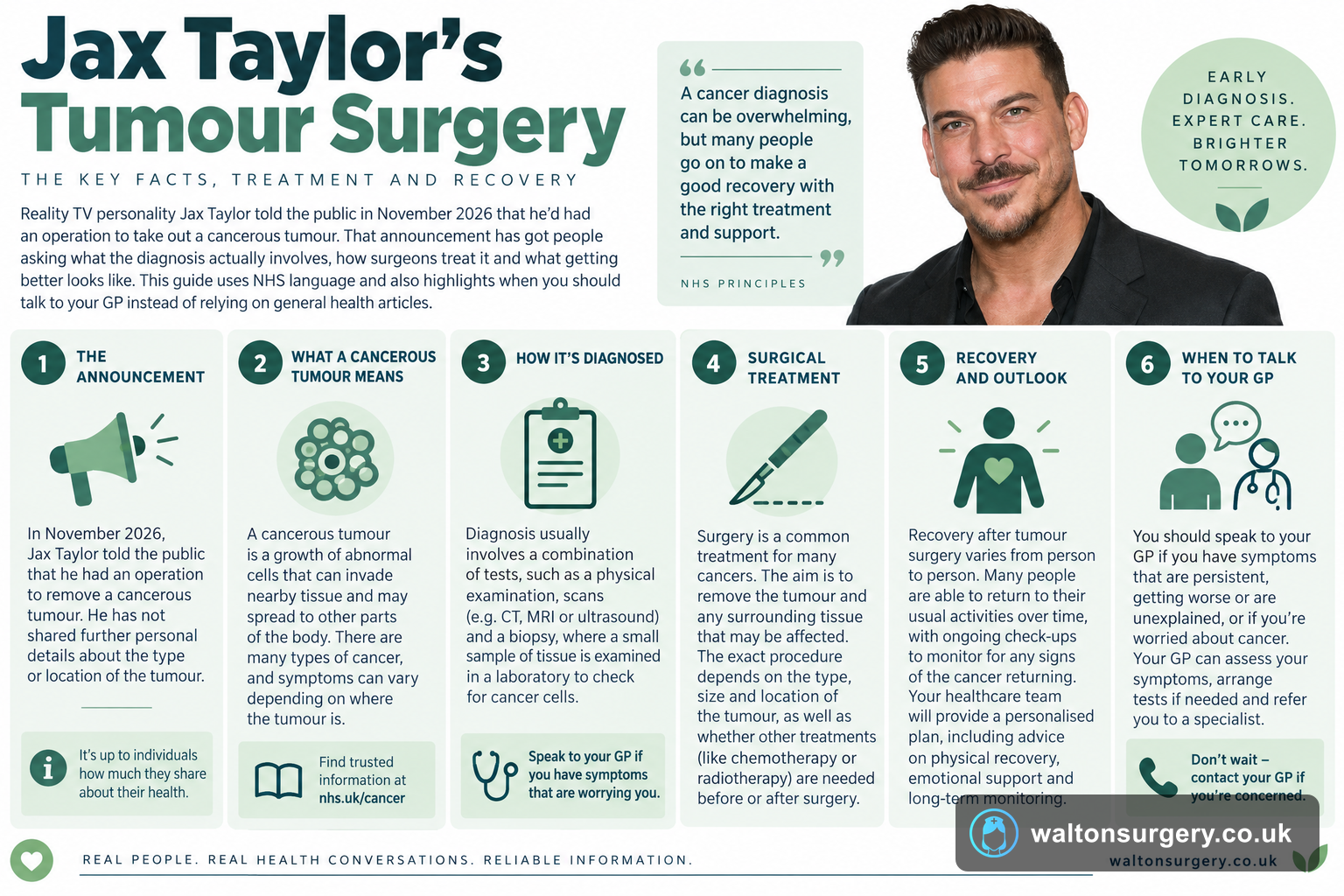
⚡ Quick Answer
Reality TV personality Jax Taylor told the public in November 2026 that he'd had an operation to take out a cancerous tumour. That announcement has got people asking what the diagnosis actually involves, how surgeons treat it and what getting better looks like. What follows walks through each of those stages using NHS language, and flags the points where you ought to be talking to your GP instead of reading general health articles.
According to The Cut, Jax Taylor — the reality TV personality — has gone public about undergoing surgery to remove a cancerous tumour. Since then there's been a spike in people searching for the medical basics: what does "cancerous" actually mean, how do surgeons use an operation to treat it, and what does the whole process look like once you have a diagnosis? Celebrities making health announcements often trigger the same wave of curiosity — we saw it with the kim kardashian worrisome diagnosis before surgery story, and the pattern repeats each time.
Every year the NHS performs a very large number of tumour removals, and for many cancer types surgery is still a mainstay of treatment. What happens in practice, though, shifts a lot based on where the tumour is sitting, how big it's grown and whether it's been caught early. Below is a straight breakdown of the process, framed around the language and pathways the NHS uses.
What does "cancerous tumour" actually mean?
Put simply, a tumour is a growth of tissue that shouldn't be there. Plenty of them aren't cancer at all. Under a microscope, cells in a "benign" tumour look normal and they expand slowly without wandering off to other parts of the body. A "malignant" tumour — the cancerous kind — has abnormal cells that can push into nearby tissue or hitch a ride through the blood or lymph system to end up elsewhere.
Don't think of cancer as one illness. There are over 200 different types, and each one gets its name from the organ or cell type where it started. When a headline says "cancerous tumour", you know the growth was malignant, but that's about all you know — which type of cancer it was typically stays between patient and doctor, and in Taylor's case it hasn't been made public.
Why does that distinction matter so much? Because treatment hinges on it. Benign ones tend to come out only if they're causing bother, say by pressing on something nearby. Cancerous tumours generally do need treatment, and the reason is their capacity to spread.
How is a cancerous tumour diagnosed?
Imaging is usually the first port of call. Depending on where the suspected growth sits, that might mean an ultrasound, a CT scan, an MRI or a PET scan. Those pictures give clinicians a sense of the size, shape and position of the thing — but imaging alone can't always say for certain whether cells are cancer.
Confirmation arrives through a biopsy. What happens there is a small chunk of tissue gets taken from the tumour, normally under local anaesthetic, and shipped off to a lab where a pathologist studies the cells down a microscope. That's the moment your team learns whether the cells are benign or cancerous, and possibly which type of cancer is involved.
A positive biopsy then usually triggers staging tests. These are designed to work out whether the cancer has spread, and how far, since that shapes the treatment plan ahead. Ask your GP to walk you through what each scan is for — NHS guidance actively wants patients firing off questions at any stage of the process.
What does surgery for a cancerous tumour involve?
For cancer, surgery is one of the most frequently used treatments there is. The NHS puts the aim bluntly: cut out the cancerous tissue completely, and where you can, take a thin margin of healthy tissue around it too, to lower the odds that any abnormal cells get left behind.
How big a job the operation turns out to be depends on the tumour's site and its size. Some cancerous growths come out through tiny incisions or keyhole methods. Others demand open surgery, particularly when they're bulky or they're sitting next to important organs. Your surgical team picks the anaesthetic — local, regional or general — based on the procedure and on your overall health.
🔬 Key Facts
Surgery for a cancerous tumour: the essentials
- → Aim: cut out the cancerous tissue completely, plus a thin margin of healthy tissue to lower the odds of abnormal cells being left behind
- → Technique: keyhole or tiny incisions for some growths; open surgery for bulky tumours or those sitting next to important organs
- → Anaesthetic: local, regional or general — chosen based on the procedure and on your overall health
- → Position in the plan: surgery may stand alone, run alongside other treatments, or come before or after radiotherapy and chemotherapy
Sometimes surgery happens on its own. Sometimes it's slotted in alongside other treatments. Occasionally it goes first, to strip out the bulk of the tumour before radiotherapy or chemo. Sometimes it comes afterwards, to take away whatever's left. And if an operation isn't on the cards at all, other routes get used instead. Your medical team should be explaining which one applies in your case.
What happens immediately after surgery?
How you bounce back from cancer surgery is not a fixed thing — it hinges on the operation itself and on you as a person. Lots of people are in hospital only briefly afterwards, maybe just the night, maybe a handful of days, while staff keep an eye on healing and keep pain under control.
Your surgical team will hand you specific instructions covering wound care, pain relief, how much you should be moving, and what warning signs to look out for. Following those instructions really does matter, because something like an infection can put a serious dent in your recovery. If you've had cancer surgery and something's off — pain getting worse, a temperature, a wound that looks angry — get in touch with your medical team or call NHS 111 promptly.
Whatever tissue they removed gets sent to a pathology lab without exception. Results take a few days to come through, and what they show is whether the tissue margins around the tumour were clear. That information feeds directly into whether more treatment is recommended. Wound care is one area where patients often seek reassurance afterwards — some even explore the option to tattoo to cover surgery scars once healing is complete.
Which treatments are used alongside surgery?
Cancer surgery rarely stands on its own. Depending on type and stage, your team might suggest additional treatment before or after the operation. NHS material highlights three common companions to an operation.
Chemotherapy
Chemotherapy works by hitting cancer cells with drugs that kill them or stop them dividing. It can be used before surgery to shrink a tumour down, or afterwards to cut the chance of the cancer coming back. Side effects happen a lot and they shift depending on which drug you're on.
Radiotherapy
Radiotherapy aims high-energy radiation at cancer cells in one specific region of the body. It's frequently used post-surgery if there's some worry that abnormal cells are still hanging around.
Targeted therapies and hormone therapies
Targeted therapies and hormone therapies cover certain cancers too, and they work in a way that's different from chemo. Your oncologist is the one to explain which, if any, of these applies to you and the reasoning behind it.
Should I be concerned about a lump or growth?
A new lump is unsettling. Most of them turn out not to be cancer, though. Even so, NHS guidance stays consistent on this: a lump that's still there after a few weeks, one that's growing, one that's painless and hard, or one that's arrived alongside other changes in your body — any of those warrant a trip to your GP to get it looked at.
Typically your GP examines you first and might refer you on to hospital for extra tests. Where cancer is suspected on the NHS, you get put on an urgent pathway meant to deliver answers fast, usually within two weeks of the referral.
There's no need to sit there self-diagnosing or to wait until symptoms become impossible to ignore. A good number of tumours get picked up early purely because somebody spotted that something had changed and asked their GP about it. Tumour surgery isn't limited to human patients either — techniques have even advanced in snake cancer surgery veterinary research for exotic pets. Not sure whether it needs checking? Just ask.
Frequently Asked Questions
⭐ The Bottom Line
What this means for you
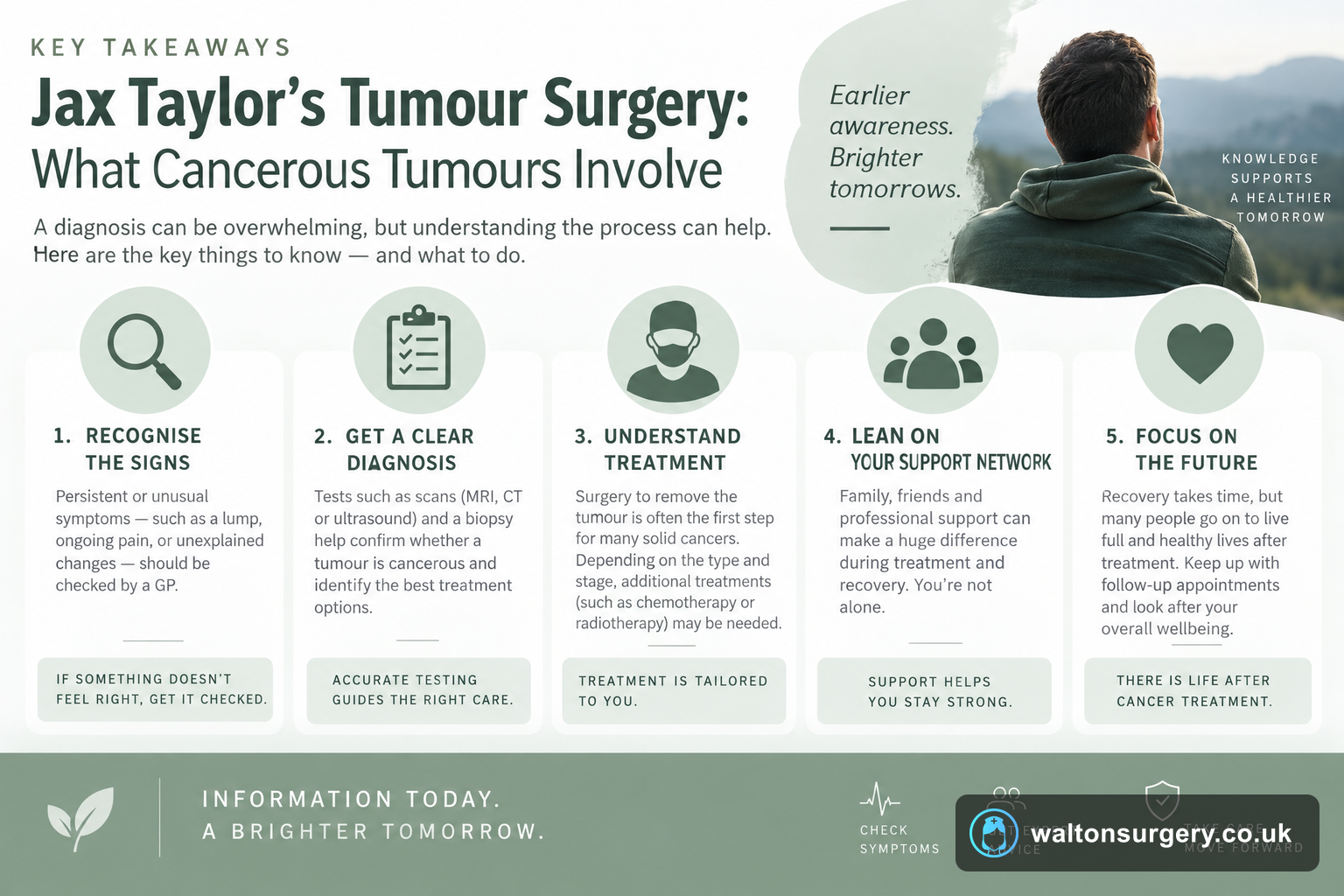
Taylor going public has shone a light on cancerous tumour surgery, but the actual medical specifics behind a diagnosis like that remain personal. What can be stated plainly is that surgery, when it's the chosen route, sits within a wider set of treatments that includes chemotherapy and radiotherapy. If you notice a lump or something's worrying you symptom-wise, go see your GP rather than diagnosing yourself. What you're reading here is general health information, not personalised medical advice.
Last updated: 2026-11-19 · Written by the Walton Surgery editorial team · Medical information is for educational purposes only and does not replace advice from a qualified healthcare professional.