Dental implants: What to know from Martin Clunes' story
PART C — HTML Body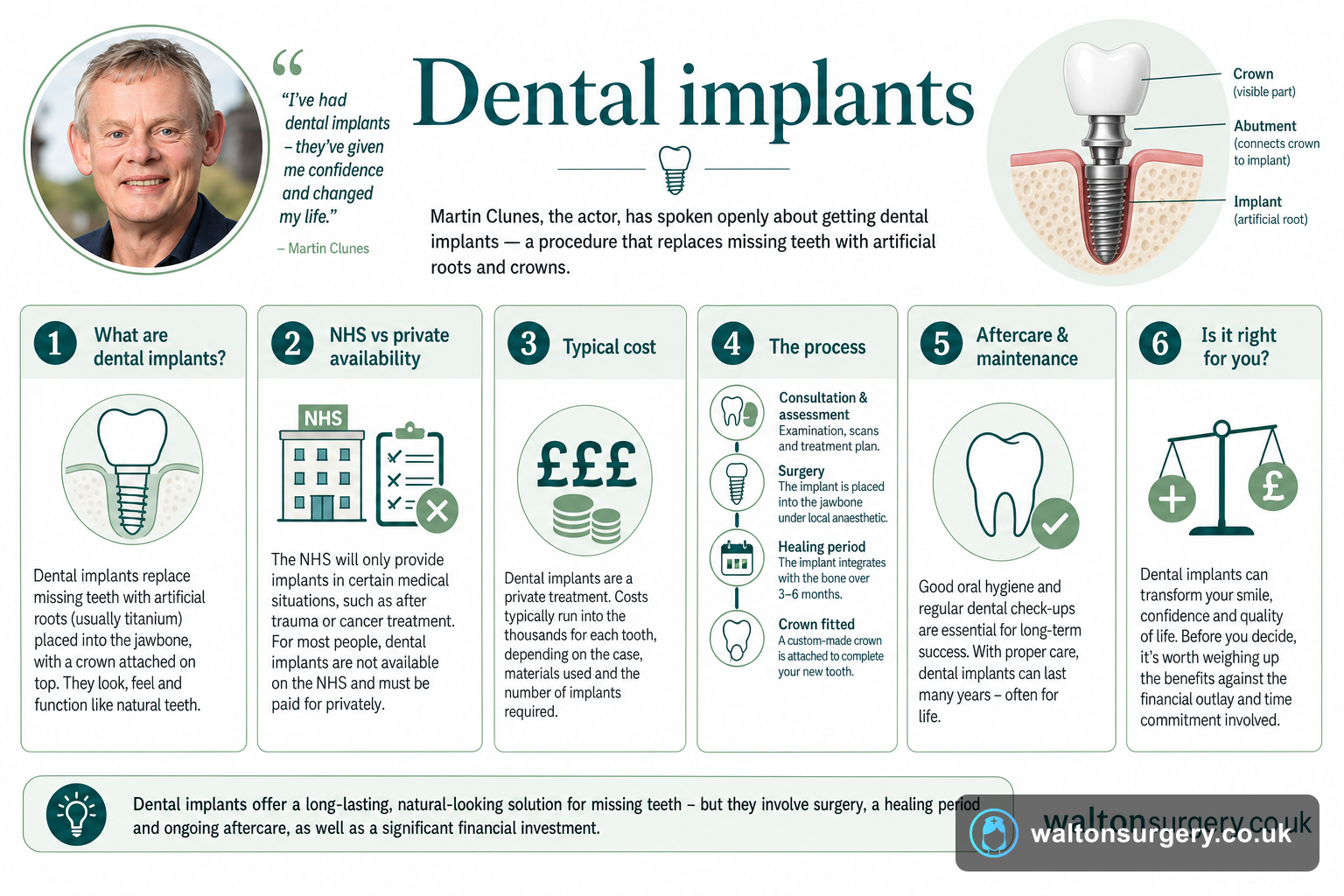
⚡ Quick Answer
Martin Clunes, the actor, has spoken openly about getting dental implants — a procedure that replaces missing teeth with artificial roots and crowns. The NHS will only provide implants in certain medical situations, so most people end up going private. You're looking at costs that typically run into the thousands for each tooth. The whole thing involves surgery, a healing period, and ongoing aftercare. Before you decide, it's worth weighing up the benefits against the financial outlay and time commitment.
Martin Clunes — you'll know him from Doc Martin or Men Behaving Badly — has been pretty open about his dental implant journey. That willingness to talk has got a lot of people thinking about whether the treatment could work for them too. In simple terms, dental implants involve a surgeon placing a titanium post into your jawbone, which then anchors a replacement tooth or bridge in place. It's a well-established procedure that trained dental professionals across the UK carry out regularly.
If you've caught Clunes discussing his implants and found yourself wondering whether this might be something for you, hopefully this article helps. We'll cover how implants actually function, what they'll set you back on the NHS versus privately, who's eligible, and what recovery looks like. This is general information only, mind — not a substitute for personal medical advice. Always have a chat with your own dentist or GP about your specific situation.
How dental implants actually work
There are three main components to a dental implant. First, there's a small titanium screw that gets placed into your jawbone during an operation. Think of it as an artificial tooth root. Over several months, your bone gradually grows around the screw in something called osseointegration, which basically locks it in place.
Once the implant has bonded properly with the bone, an abutment gets attached on top — it's a small connector piece that protrudes through the gum line. Then finally, a crown goes on. That's the visible bit, the part that looks like a real tooth. Some people just need a single crown, though others might have a bridge or denture held up by several implants instead.
The titanium itself is biocompatible, which basically means your body tends to accept it without any rejection issues. The NHS says implants can last many years if you look after them properly, though the crown portion may need swapping out after somewhere around 10 to 15 years just through normal wear and tear.
🔬 Key Facts
The Three Parts of an Implant
- → Titanium screw: Acts as an artificial root, placed into the jawbone during surgery.
- → Abutment: A connector fitted above the gum line once the screw has bonded with the bone.
- → Crown: The visible replacement tooth, typically needing replacement after 10–15 years.
- → Osseointegration: The months-long process where bone grows around the screw to lock it in.
What Martin Clunes has shared about his experience
Clunes has been vocal in interviews about having dental implant treatment done. His willingness to talk openly has helped make a procedure that many people feel awkward or embarrassed about seem more normal. Missing teeth can knock your confidence, affect how you speak, and make eating harder than it should be — and the fact that he's been honest about his own dental work has given other people the nudge to look into their options. It brings to mind discussions around celebrity health privacy boundaries, reminding us that while sharing can help others, it's always a personal choice.
That said, everybody's mouth is different. The number of implants Clunes needed, the timescale involved, the particular clinical approach taken — none of that will map directly onto what you'd go through. His experience is a handy jumping-off point for a conversation with your dentist, but your own treatment plan would be shaped by your oral health, bone density, and what you're hoping to achieve.
Who can get dental implants on the NHS
Implants are available through the NHS, but only in pretty narrow circumstances. You won't usually get them under standard NHS dental care just because you want a nicer smile. Instead, the NHS might fund implants when there's a definite clinical reason — say, you've lost teeth because of mouth cancer, a serious facial injury, or a congenital condition affecting how your jaw developed.
To get NHS-funded implants, you'd normally need your dentist to refer you to a hospital-based specialist. NHS dental charges do apply and they're sorted into bands. Band 3 treatment — the top tier covering complex work like crowns and dentures — carries a set fee, though implants themselves frequently fall outside what the NHS routinely provides. The health service is focused on wider priorities like the nhs staff wellbeing movement exercise initiatives, so cosmetic requests are rarely covered.
Should your dentist decide you don't meet the criteria for NHS implants, they can point you towards a private clinic. Most people in the UK who end up with dental implants pay for them privately.
The cost of dental implants in the UK
Going private for dental implants in the UK will generally cost somewhere between £1,500 and £3,500 per tooth, though this figure shifts depending on where you live, how complicated your case is, and what materials are used. Clinics in London and the South East tend to charge a fair bit more than elsewhere. Some places advertise suspiciously low prices, so do check what's actually included — a proper quote should cover the implant, abutment, crown, and follow-up visits.
If your jawbone has thinned since you lost the tooth, you might need bone grafting before an implant can go in, and that's an added expense. A sinus lift might also be necessary in some cases, pushing costs up further still. Your dentist should provide you with a full written plan and cost breakdown before you sign up for anything.
A lot of private practices offer payment plans and finance options. Some people try to use dental insurance, though plenty of UK policies have annual caps that won't stretch to cover the full cost of implants. Worth checking your policy thoroughly before counting on it.
What the procedure involves step by step
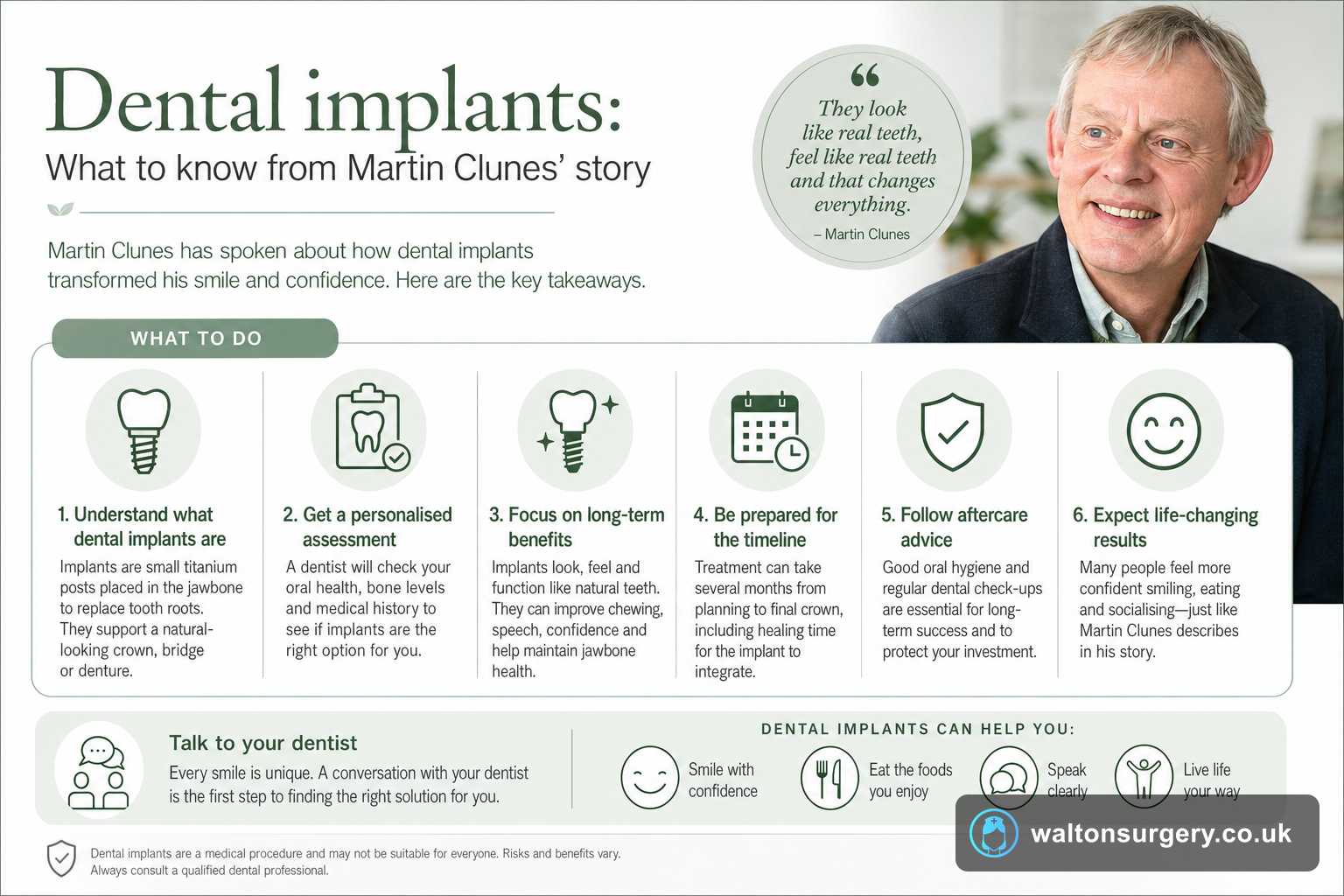
Getting implants is a multi-month process with several appointments along the way. Here's roughly what to expect:
Your dentist will start by examining your mouth with X-rays and possibly a CT scan to assess bone density and map out where the implant should go. If there isn't enough bone to work with, a graft might be needed first — and that tacks on extra months to the whole timeline.
Then comes the surgical bit where the titanium screw goes in. This is typically done under local anaesthetic, though sedation is an option if dental anxiety is an issue for you. The operation itself usually takes around one to two hours per implant. You'll head home with stitches and aftercare instructions for looking after the site while it heals.
Healing and osseointegration take roughly three to six months. Your bone is growing around the implant during this period. You might get a temporary crown or denture to wear so there's no obvious gap on show.
Once everything's healed, the abutment goes on and impressions get taken for your permanent crown. The crown is then fitted at a later appointment. Some dentists do offer same-day implant systems, but the traditional staged method is still more widely used and has a solid track record.
Risks and complications to be aware of
Implant surgery has a high success rate — the NHS describes it as generally safe — but any surgical procedure carries some risk. Infection at the implant site is one of the more common problems. You can cut down on this risk by sticking to your dentist's aftercare advice and keeping up good oral hygiene.
Nerve damage is uncommon but serious if it happens. It can leave you with pain, numbness, or tingling in your teeth, gums, lips, or chin. This is more of a concern when an implant ends up placed close to a nerve, which is one of the reasons detailed imaging beforehand really matters.
Sometimes an implant simply doesn't integrate with the bone properly and works itself loose — that's implant failure. Smoking is a big risk factor there. If you're a smoker, your dentist will almost certainly tell you to quit before going ahead with treatment. The NHS notes that smokers experience higher rates of implant failure than non-smokers, the figures are pretty clear on that.
Upper jaw implants can occasionally cause sinus issues if they protrude into the sinus cavity. Careful planning and placement by your dentist should avoid this, but it's something to be aware of.
Looking after your implants long term
Once your implants are settled in, they need the same basic care as natural teeth — arguably a bit more vigilance, in fact. Brush twice a day with a soft-bristled toothbrush, floss regularly, and use interdental brushes to get around the implant posts properly. Your dentist or hygienist can demonstrate the right technique if you're unsure.
Keep up with regular dental check-ups. The NHS suggests visiting your dentist at whatever interval they recommend — for some folk that's every six months, for others it could be more or less often. At these visits, your dentist will examine the implant, the gum around it, and your general oral health.
Try not to bite down on hard things like ice cubes or pen caps — that can crack or damage the crown. If you're someone who grinds their teeth at night, ask about getting a mouthguard to shield your implants. With decent care, implants can genuinely last decades. But if you neglect them, you're raising the risk of peri-implantitis, a condition quite similar to gum disease that can lead to bone loss around the implant site.
Alternatives to dental implants
If implants aren't the right fit for you — whether that's down to cost, medical reasons, or just personal preference — there are other routes. Dentures are the most widely used alternative. They're removable replacements for missing teeth, usually made from acrylic or metal. The NHS provides dentures as part of its standard dental treatment offering.
A dental bridge is another possibility. This one involves fixing a false tooth to the teeth either side of the gap. Bridges don't need surgery, and they can be fitted more quickly than implants. The trade-off is that they depend on the health of the neighbouring teeth, which may have to be filed down to act as supports.
Your dentist will talk through the advantages and drawbacks of each option in the context of your own situation. Implants tend to be seen as the most durable and natural-feeling choice, but they're not always the best option for everybody.
Frequently Asked Questions
The Bottom Line
⭐ The Bottom Line
What this means for you
Martin Clunes' openness about dental implants has pushed a lot of people to start thinking properly about replacing missing teeth. Implants are well-established, safe, and can genuinely restore both function and confidence — but they come with a substantial price tag and a process that stretches over months. If you're thinking about them, book a consultation with your dentist to talk through whether you're a suitable candidate. This article is general information only and doesn't replace professional dental advice specific to your own health. You might also want to stand up to cancer bake off events highlight how public figures can raise awareness for health causes.
Last updated: 2026-08-09 · Written by the Walton Surgery editorial team · Medical information is for educational purposes only and does not replace advice from a qualified healthcare professional.