Why Movement Matters for NHS Staff Wellbeing and Your Health
PART C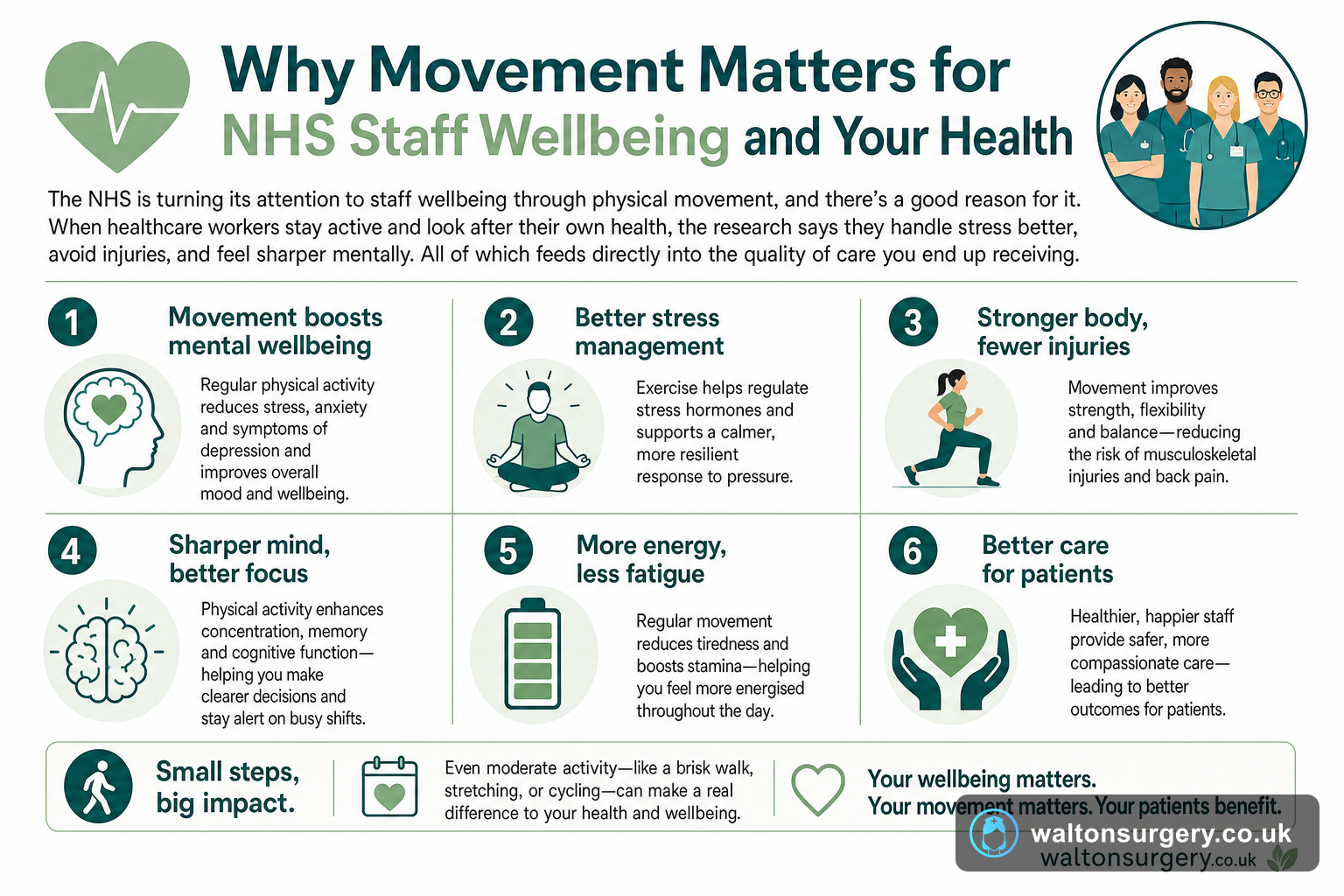
⚡ Quick Answer
The NHS is turning its attention to staff wellbeing through physical movement, and there's a good reason for it. When healthcare workers stay active and look after their own health, the research says they handle stress better, avoid injuries, and feel sharper mentally. All of which feeds directly into the quality of care you end up receiving.
There's a real push happening across the NHS right now around getting healthcare staff moving more — not just for their sake, but yours too. A 2026 report from Practice Business laid out why physical activity matters so much in this context, and the core idea is pretty simple: when staff feel better in themselves, they do their jobs better.
For anyone who uses NHS services, and that's most of us at some point, the connection between a nurse's physical health and the care they give you isn't abstract. Healthier, more resilient staff tend to be more present, more careful, and more patient. The NHS is putting money and effort into workforce activity programmes because the evidence points clearly in that direction.
What Is the NHS Staff Wellbeing Movement?
Think of it as the health service recognising that its own workers take a beating, physically and mentally, from the job. Shifts that stretch for twelve hours, constant lifting and moving of patients or equipment, standing in one spot during long procedures, plus the emotional weight of what they see every day — it all adds up. This movement is about building structured and informal activity into the working day as one way of tackling that toll.
What makes it different from a generic corporate wellness scheme is the framing. It doesn't treat staff wellbeing as some separate, optional extra bolted onto the edges of clinical work. Instead it argues, quite sensibly, that people who take care of their own bodies and minds are better placed to take care of yours.
Why Does Physical Activity Matter for Healthcare Workers?
The physical demands of NHS work are not subtle. Nurses routinely clock up several miles walking during a single shift. Porters spend their days hoisting and pushing heavy loads. Surgeons can stand for four, five, six hours straight in theatre without much chance to sit down. If none of that is counterbalanced with movement outside work — or even during breaks — the body starts filing complaints: musculoskeletal injuries, deep tiredness, and eventually burnout.
The International Society of Sports Nutrition (ISSN) has long made the case that regular physical activity builds both physical resilience and psychological wellbeing. For NHS staff, that translates into something practical. Moving your body regularly can help offset the physical punishment of the job while also dialling down stress and improving how well you sleep at night. Those aren't small things when you work in healthcare.
The Mental Health Connection
Healthcare workers carry a particular kind of psychological weight. They're present at the worst moments of people's lives, they make decisions that carry life-or-death consequences, and they often do all of it against a backdrop of understaffing and time pressure — a situation worsened by the nhs outsourcing staff shortage effect. Physical activity triggers endorphin release and helps bring cortisol — that's the stress hormone — back under control, which can ease both anxiety and low mood. When staff manage their mental health in this proactive way, it shows up in their work. They're calmer, more focused, and more emotionally available to the patients in front of them.
How Does Staff Movement Affect Your Care?
You'd be right to ask why any of this should matter to you as a patient. The link is actually quite direct. Staff who are physically well and mentally steady make fewer mistakes, communicate with you more clearly, and show up with more empathy. A nurse who slept properly because they exercise regularly, for instance, is noticeably sharper during your appointment.
The research backs this up consistently — worker wellbeing in healthcare maps onto patient satisfaction and safety outcomes in ways that are hard to ignore. So when the NHS puts resources into staff movement programmes, what it's really doing is investing in the standard of care that reaches you.
What Does the NHS Recommend?
The guidance for NHS staff mirrors what the UK Chief Medical Officers say for every adult in the country: at least 150 minutes of moderate-intensity activity per week, or 75 minutes if you're going at a more vigorous pace. That's the baseline. Strength work on two or more days per week is also recommended, though plenty of people skip that bit.
Some NHS trusts have gone further and rolled out their own programmes — walking groups, on-site gyms, initiatives that nudge people into taking active breaks. None of these are indulgences. They're grounded in the straightforward reality that a workforce which sits or stands still all day is more likely to develop the same chronic conditions the NHS spends billions treating in the wider population.
Practical Examples from NHS Settings
A number of trusts have appointed what they call "movement champions" — staff members whose role partly involves encouraging colleagues to step away from their desks or stations and actually move during the day. Others have rethought their break rooms, adding space for stretching or places to stand rather than just sit. Smaller tweaks are cropping up too: walking meetings instead of sitting in a conference room, standing desks appearing in admin offices. The whole point is making movement something you can do without it requiring a huge effort or change to your routine — for example, movements like the farmers carry exercise benefits can be practised almost anywhere with minimal equipment.
🔬 Key Facts
The Physical Toll of NHS Work
- → Shifts that stretch for twelve hours with constant lifting, moving, and standing take a heavy toll on the body.
- → 150 minutes of moderate-intensity activity per week is the baseline recommended by UK Chief Medical Officers.
- → Musculoskeletal injuries, deep tiredness, and burnout are the common complaints when activity is not counterbalanced.
- → Regular movement builds physical resilience and psychological wellbeing according to the International Society of Sports Nutrition (ISSN).
What Are the Barriers to NHS Staff Exercise?
This bit matters, because if you design a wellbeing programme without thinking about why people struggle to exercise in the first place, you're wasting everyone's time. Shift patterns are an obvious problem — if your hours change week to week, turning up to a regular fitness class is nearly impossible. Then there's the exhaustion factor. After a physically gruelling shift, the last thing most people want to do is head to the gym. And some NHS sites don't even have decent changing or shower facilities for staff who might fancy exercising before or after work.
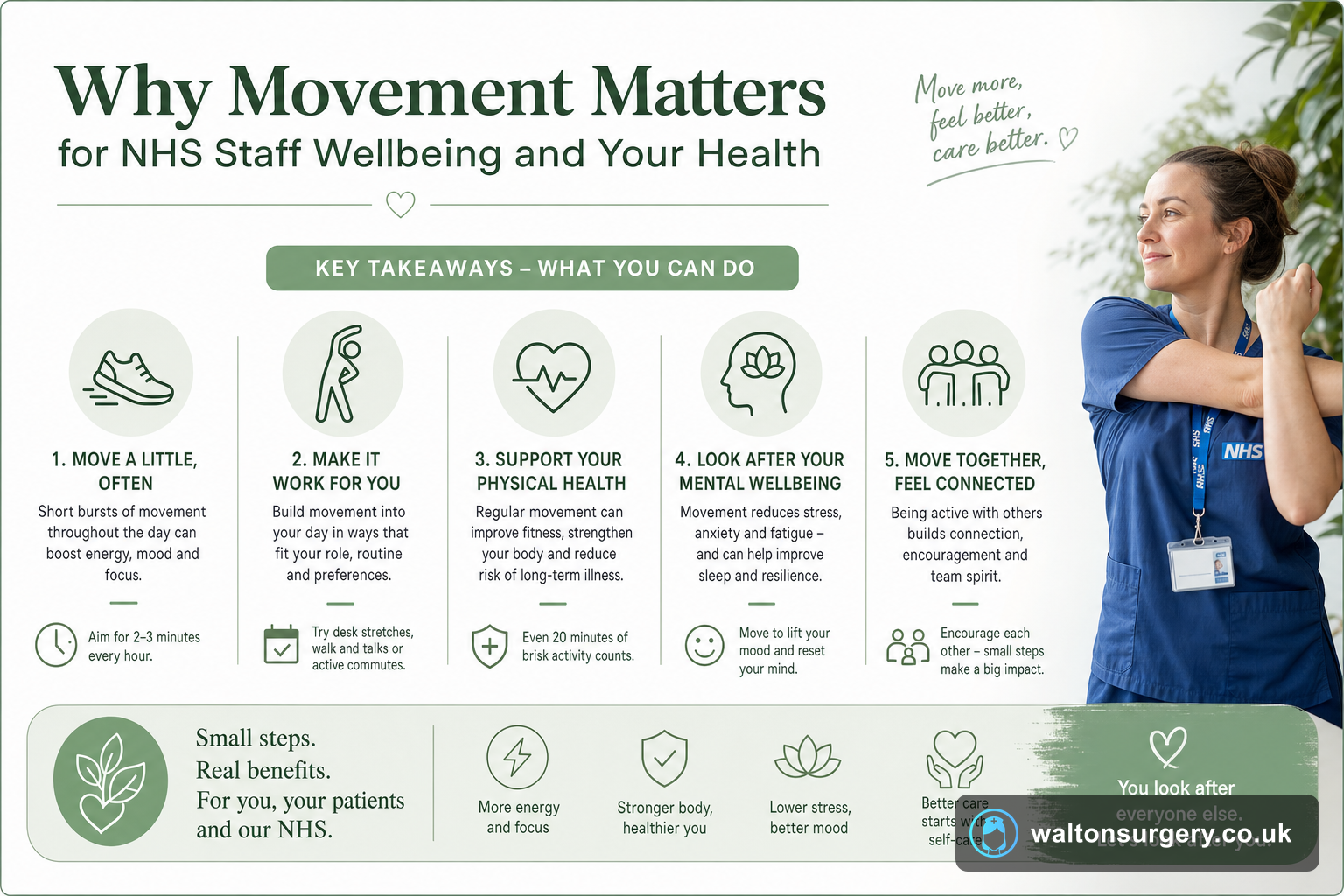
Time is probably the biggest hurdle of all, though. When you're already doing unpaid overtime on a regular basis, carving out 30 minutes for a walk or a session feels like a fantasy. The wellbeing movement has started to acknowledge this, which is why there's more emphasis now on small, incidental bits of movement woven through the day rather than expecting everyone to commit to structured exercise routines — even knowing the skull crusher exercise uk technique benefits triceps guide can be helpful for staff who manage to fit in targeted strength work during breaks.
Frequently Asked Questions
⭐ The Bottom Line
What this means for you
The NHS staff wellbeing movement boils down to a fairly simple idea: physically active workers are healthier, more resilient, and better at their jobs. For patients, that translates into care from people who have the energy and the headspace to do things properly. The barriers are real — shift patterns, fatigue, understaffing — and nobody's pretending they'll disappear overnight. But the direction things are heading is positive. If you work in the NHS yourself, even tiny increases in how much you move during a day can add up, for your own health and for the people you look after.
Last updated: 2026-08-08 · Written by the Walton Surgery editorial team · Medical information is for educational purposes only and does not replace advice from a qualified healthcare professional.