NHS Outsourcing Fears: How Staff Shortages May Affect Your Care
PART C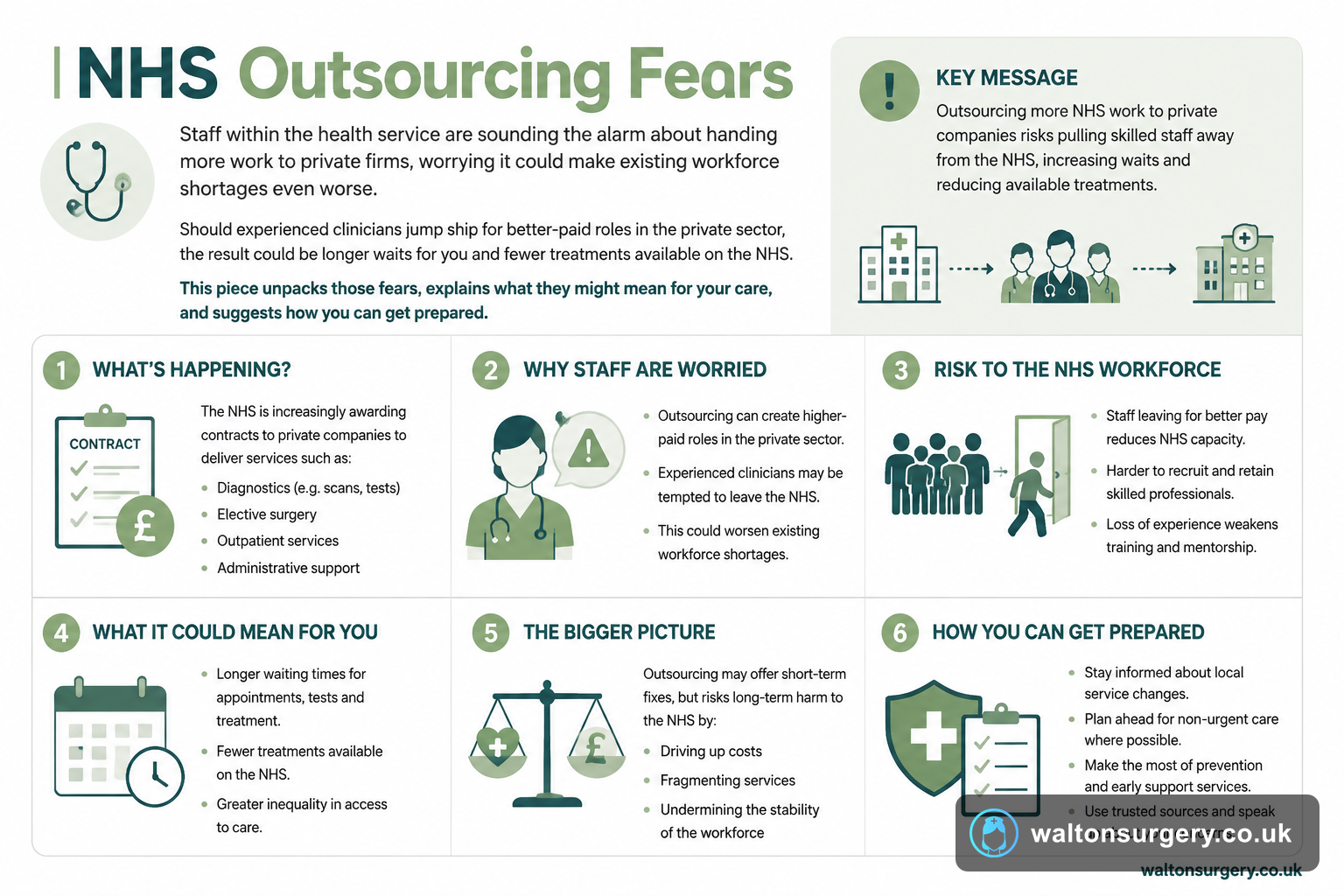
⚡ Quick Answer
Staff within the health service are sounding the alarm about handing more work to private firms, worrying it could make existing workforce shortages even worse. Should experienced clinicians jump ship for better-paid roles in the private sector, the result could be longer waits for you and fewer treatments available on the NHS. This piece unpacks those fears, explains what they might mean for your care, and suggests how you can get prepared.
The mood among NHS staff right now isn't great. A recent report shows real anxiety inside the service about what happens when private companies get handed more NHS work — the fear being that these firms will lure away staff the NHS can't afford to lose. This isn't some overnight corporate takeover, but it is a pattern. Outsourced procedures and services tend to come with slicker contracts or better conditions, and that makes the already-dire recruitment and retention challenge in the public sector even tougher.
For anyone depending on the NHS — which is most of us — these internal staffing dramas aren't abstract policy talk. They translate into real-world consequences at the point of care. The big question people are asking is whether outsourcing, supposedly brought in to slash those infamous waiting lists, might actually end up hollowing out the very workforce that delivers the majority of everyday NHS care. We're going to dig into those specific worries here and consider what they could mean when you next book a GP appointment or turn up at hospital. From increasingly sophisticated attempts to defraud patients to reports of a fake nhs manager scam, staying informed about who you're dealing with is part of protecting your own health journey.
What Is NHS Outsourcing and Why Is It Happening?
Put simply, outsourcing means the NHS pays a private company — or some other organisation — to carry out particular treatments or services on its behalf. That covers a pretty wide range of things: routine hip replacements, cataract surgery, diagnostic imaging, even physiotherapy in some areas. The practice isn't new; the NHS has been doing this in various forms for decades. What's changed is the scale. As waiting lists have ballooned, outsourcing has expanded with them.
Capacity is the main driver behind it. When NHS hospitals and clinics are packed to the rafters, farming out work to private providers is one lever available to treat more people and drag waiting times down. The NHS picks up the bill, so patients still get their care free at the point of use. The catch is that the staff and the facility doing the work aren't part of the NHS payroll.
Why Are NHS Staff Worried About Outsourcing?
What has NHS workers spooked, according to the reporting, is the idea that outsourcing acts as a magnet — a "pull factor" that deepens staff shortages. The NHS happens to be the biggest employer in the UK, but it's riddled with tens of thousands of vacancies, nursing and specialist medical roles being especially hard to fill. The logic is painfully straightforward: if a private provider offers the same kind of work with better pay packets or more flexible shifts, experienced staff are going to be tempted.
And then the wheel starts turning. Each time the NHS bleeds staff to these outsourced positions, its own capacity to deliver care shrinks a little. That growing pressure pushes the system to outsource even more work to paper over the cracks, which then pulls still more people out of the public sector. From the NHS workforce's perspective, this cycle threatens to hollow out the service's ability to function on its own terms over time. It is a structural issue that runs parallel to other persistent gaps, including what steps to take in the event of a cancer misdiagnosis UK what to do scenario where time and expertise are critical.
How Could This Affect Your Access to Care?
Waiting times are the thing most people will feel first, but it's messier than just standing in a longer queue. Should the NHS lose experienced consultants, surgeons, or specialist nurses to private outfits, the teams left behind are carrying the same workload with less know-how. That kind of drain slows the whole machine down.
Here's how it plays out in practice. Say you're waiting for a joint replacement — the private company handling outsourced operations might get you in quickly. But your ongoing follow-up, your chronic condition management, your emergency care — all of that sits within the NHS, and if the key people have gone, those parts of your care could suffer. What really matters is the potential workforce shift. The NHS needs its most skilled clinicians to train the next generation, wrestle with complex cases, and staff services around the clock.
What Does This Mean for Specific Services and Waitlists?
🔬 Key Facts
Impact on Routine vs Complex Care
- → Routine surgeries like knee ops and cataracts may see shorter waits due to high-volume outsourcing.
- → Complex and urgent NHS surgery queues could stretch as specialist expertise is diluted.
- → Diagnostic services (MRIs/CTs) face a squeeze if radiographers move to private imaging centres.
The impact won't be uniform across every service. Routine, high-volume surgeries — think straightforward knee ops or cataract removals — are the bread and butter of outsourcing. For patients needing those procedures, a shorter wait is a real possibility. The trouble starts when NHS surgical teams themselves get hollowed out because the surgeons and theatre staff have decamped to do that same routine work privately.
An imbalance can creep in. Your wait for a common knee operation might actually shrink, yet the queue for more complex or urgent surgery inside the NHS could stretch if specialist expertise gets diluted. Diagnostic services face a similar squeeze. If radiographers start moving over to private imaging centres, NHS waits for MRIs and CT scans could climb, and that delays diagnoses for a whole spread of conditions. The pressure is such that even when high-profile figures like saira khan health condition concerns capture public attention, the fundamental wait for diagnosis remains the core struggle for the average patient.
Are There Any Potential Benefits for Patients?
A bit of balance is needed here. Outsourcing is meant to be a tool for expanding overall treatment capacity. In principle, more total capacity across both the NHS and private sectors means more patients get seen. Done properly — with fair staff terms and decent coordination between providers — it can help chew through backlogs.
The benefit for you as a patient is pretty direct: you get your operation or scan sooner than you would waiting purely for an NHS slot. Where the controversy really lies isn't in that short-term gain for some individuals. It's in whether the NHS model can sustain itself long-term if its workforce keeps being drained by the very system that's trying to fix the backlog.
What Can You Do as a Patient?
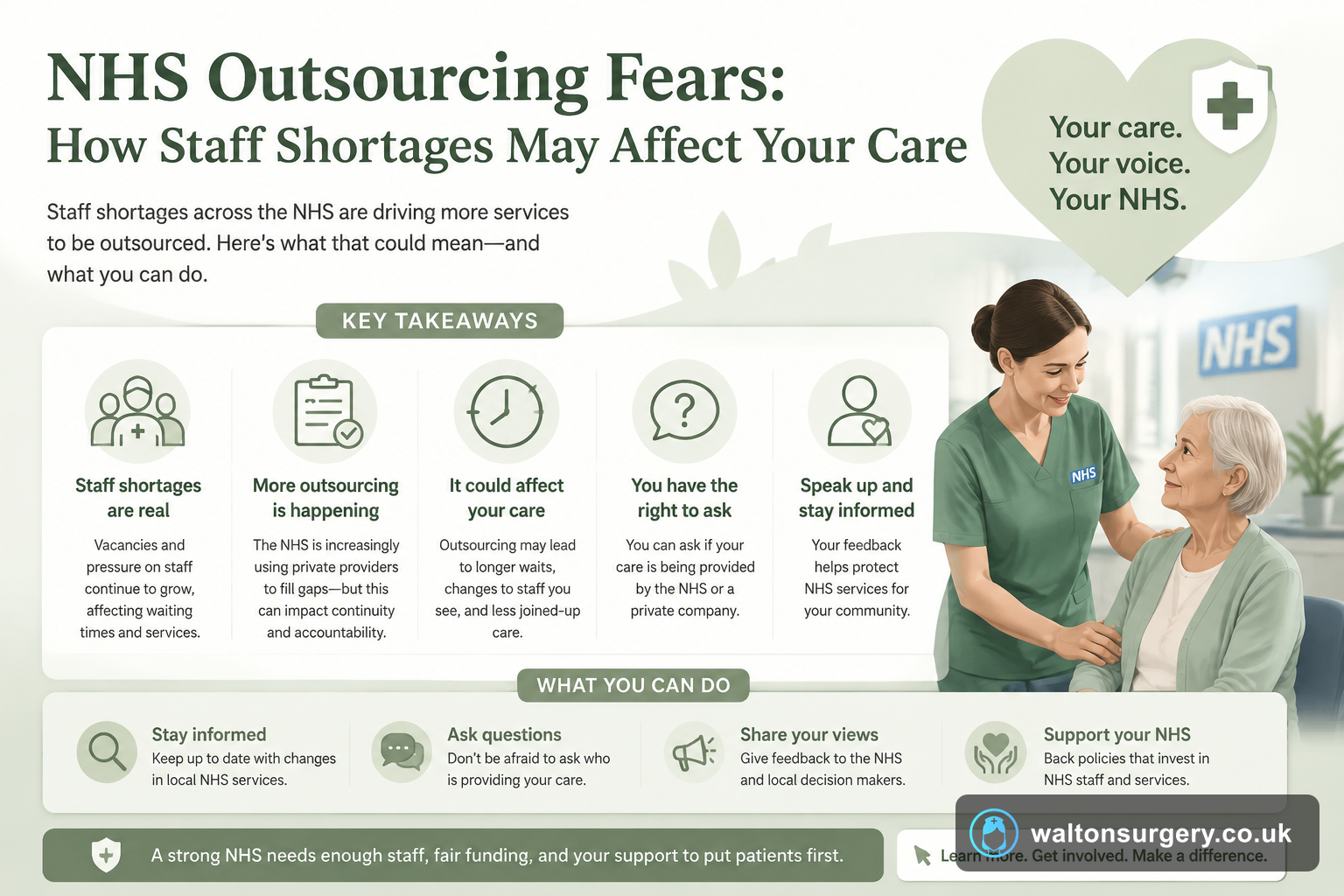
You can't single-handedly fix national staffing policy, but there are practical moves you can make. First off, talk to your GP about your specific wait. They sometimes know if you're eligible for treatment in a different setting — NHS-run diagnostic hubs, say, or clinics run by charities, which aren't the same as private outsourcing.
Second thing: use the NHS e-Referral Service, assuming you've got a referral, to check where you sit on the waiting list and in some cases choose a provider. Be mindful that picking a private provider might get you seen faster, but the aftercare pathway could look quite different from what your local NHS hospital would offer. Always ask about continuity of care — where will your follow-up happen, and who's actually in charge of it?
Frequently Asked Questions
⭐ The Bottom Line
What this means for you
The concerns NHS staff have raised come down to protecting the health service's core capacity to deliver care. While outsourcing might offer you a quicker route to certain treatments, the workforce pressures underneath it all could narrow broader access to NHS care as time goes on. Your strongest move is keeping communication with your GP clear, understanding the choices available to you within the system, and making sure your care is coordinated — regardless of whether it happens in an NHS hospital or a private facility. This whole debate really reflects a system buckling under demand it can't quite meet with the resources it has.
Last updated: 2026-07-29 · Written by the Walton Surgery editorial team · Medical information is for educational purposes only and does not replace advice from a qualified healthcare professional.