Amy Dowden's Crohn's: How Chronic Illness Can Test Friendships
⚡ Quick Answer
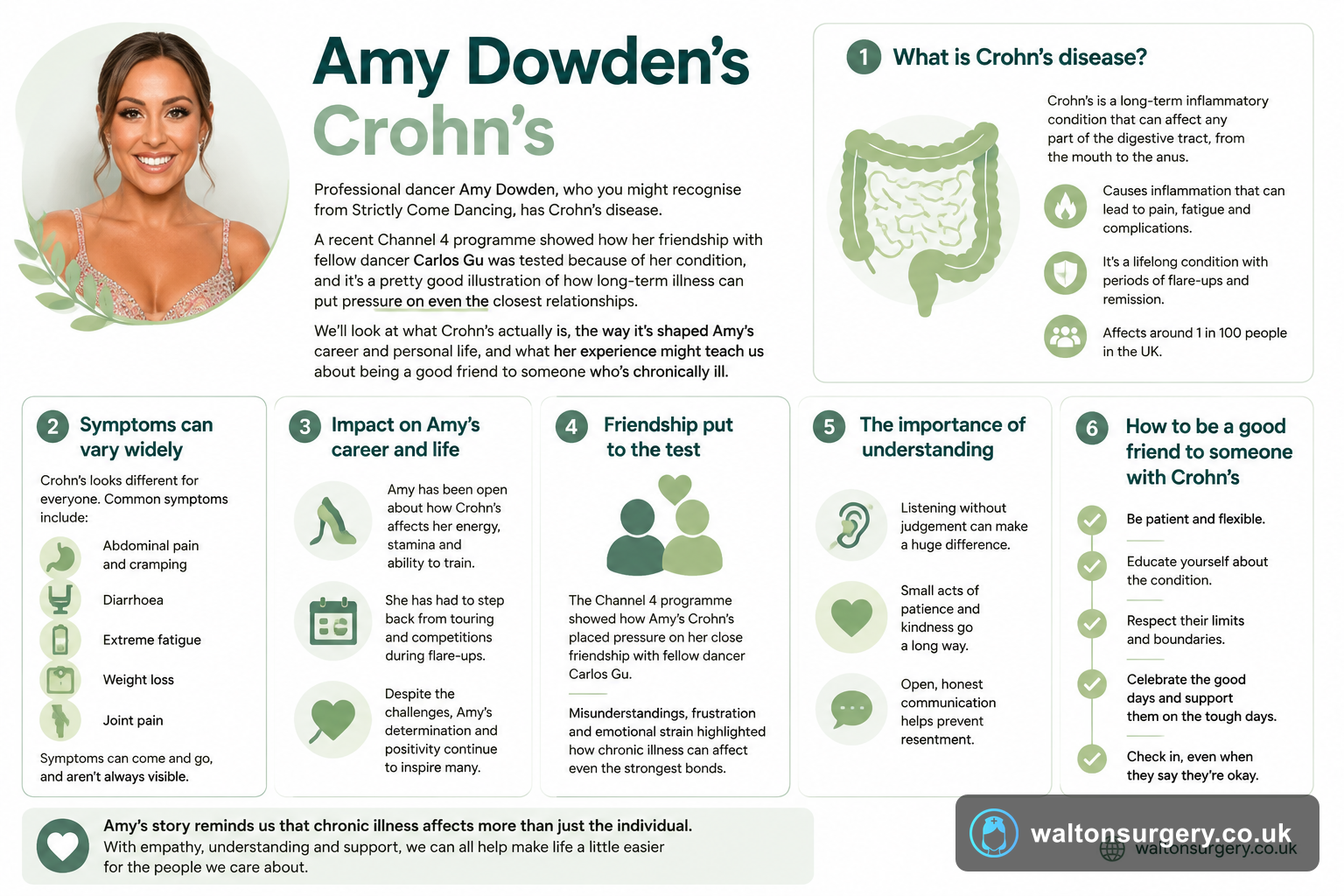
Professional dancer Amy Dowden, who you might recognise from Strictly Come Dancing, has Crohn's disease. A recent Channel 4 programme showed how her friendship with fellow dancer Carlos Gu was tested because of her condition, and it's a pretty good illustration of how long-term illness can put pressure on even the closest relationships. We'll look at what Crohn's actually is, the way it's shaped Amy's career and personal life, and what her experience might teach us about being a good friend to someone who's chronically ill.
Amy Dowden has talked pretty openly about living with Crohn's disease — that's a condition where the digestive system gets inflamed, and it can be really rough. Her friendship with Carlos Gu went through a difficult patch during a Channel 4 show, and that whole situation really underlines how a chronic illness doesn't just affect the person who has it, it ripples out into their relationships too. What happened between them gives us a real, honest look at the kind of challenges that loads of people with long-term conditions deal with in their friendships and personal lives.
Before you can properly support someone with this condition, you need to understand what it actually involves. Crohn's brings symptoms that are pretty much impossible to predict, and they can throw a spanner in the works of daily life, your job, and any social plans you might have. Amy choosing to be so open about her experience is helping to raise awareness, and honestly, that probably means a lot to other people going through something similar — much like public figures discussing parkinson's disease symptoms and treatment have done for neurological conditions.
What Is Crohn's Disease?
So Crohn's disease falls under the umbrella of inflammatory bowel disease, or IBD. What it does is cause long-term inflammation in the gastrointestinal tract, and that can lead to all sorts of different symptoms. The NHS makes clear that the condition can strike anywhere along the gut — from your mouth all the way down to the anus. More often than not, the inflammation settles in the small intestine and the start of the colon. People with Crohn's tend to go through phases: remission, where symptoms ease off or disappear altogether, and flare-ups, where things get noticeably worse. There's no cure for it at the moment, which is a hard fact, but treatments are available that can keep symptoms under control and help maintain those remission periods.
What actually causes Crohn's is still not completely nailed down. The NHS suggests it probably involves a mix of genetic factors, things in the environment that act as triggers, and an immune response that's gone into overdrive. Basically, the immune system ends up attacking the harmless bacteria in the gut, and that's what sparks the inflammation. It can show up at any age, though it's most commonly picked up in people between 15 and 30.
How Does Crohn's Disease Affect Daily Life?
When you've got Crohn's, you're often dealing with symptoms that don't follow any predictable pattern. The usual ones include persistent diarrhoea, stomach pain and cramping, tiredness, and losing weight without meaning to. The NHS also points out that some people get mouth ulcers, develop anaemia, or just feel generally rubbish. Flare-ups can be set off by stress, particular foods, infections, or tweaks to medication. The fact that these episodes can strike without warning makes it genuinely difficult to commit to social plans, travel, or hold down a steady work routine.
🔬 Key Facts
Crohn's and Daily Life
- → Symptoms include persistent diarrhoea, stomach pain, cramping, tiredness, and unintended weight loss
- → Flare-ups can be triggered by stress, certain foods, infections, or changes to medication
- → Unpredictable episodes make it difficult to commit to social plans, travel, or a steady work routine
- → Amy Dowden's career as a professional dancer is physically demanding while managing her condition
For Amy Dowden, this has meant trying to keep up with a physically demanding career in professional dance while her body is fighting her at the same time. The physical toll is real — fatigue and pain chip away at your energy and your ability to perform. But there's an emotional side to it as well, and people don't always talk about that bit. Not knowing when the next flare-up will hit creates anxiety, and it can make you feel like you've lost control over your own body. When you're carrying both that physical and emotional weight, it's bound to affect how you relate to the people around you, friends and family included.
How Did Crohn's Disease Test Amy Dowden's Friendship with Carlos Gu?
A Channel 4 programme recently gave viewers a pretty clear example of how chronic illness can put friendships under strain. Amy Dowden and Carlos Gu both talked about how their friendship was tested while they were filming. The pressures of the show, layered on top of Amy having to manage her Crohn's, created a situation where both of them needed to show understanding, patience, and be willing to talk things through. The specific details of what actually happened between them are their business, but the fact they spoke about it publicly says something. It's a situation a lot of people with chronic conditions will recognise.
And that's really the bigger picture here. When a friend has a long-term illness, plans might get cancelled at the last second, or they might need more support than you'd expected. The healthy friend has to be flexible and put themselves in the other person's shoes. The person who's ill, on the other hand, has to be honest about what they need. The fact that Amy and Carlos were comfortable enough to talk about this openly — that probably means the challenge actually made their friendship stronger, rather than tearing it apart.
What Does This Teach Us About Friendship and Chronic Illness?
There are some practical takeaways from what Amy Dowden and Carlos Gu shared, and they apply to anyone in a similar boat. Being friends with someone who has a chronic illness isn't about making big, dramatic gestures. It's the small, steady things that matter — checking in without being overbearing, being willing to change plans, and not taking it personally when they have to cancel. For the person with the condition, it means trying to be upfront about what they can and can't do, without carrying guilt around for it. This principle applies broadly, whether someone is dealing with Crohn's, researching a bryan johnson incurable disease diagnosis, or managing any other long-term health challenge.
The NHS makes the point that support from friends and family is a pretty important part of managing any long-term illness. That support can look like practical help — picking up prescriptions, running errands during a flare-up — or it can just be sitting and listening. At the same time, it matters that the person with the illness doesn't let their whole identity get swallowed up by it. Friendships should be about the things you enjoy together, not just about managing symptoms.
How Can You Support a Friend with Crohn's Disease?
If you want to support a friend who has Crohn's, the starting point is learning a bit about the condition and having some empathy. Crohn's & Colitis UK, the charity, has solid information you can look at. Then — and this sounds obvious but people forget — actually listen to them. Ask what kind of help they want, because it changes depending on the person and honestly depending on the day. Don't assume you know what they can or can't do, and definitely don't start recommending miracle cures or diets you read about online.
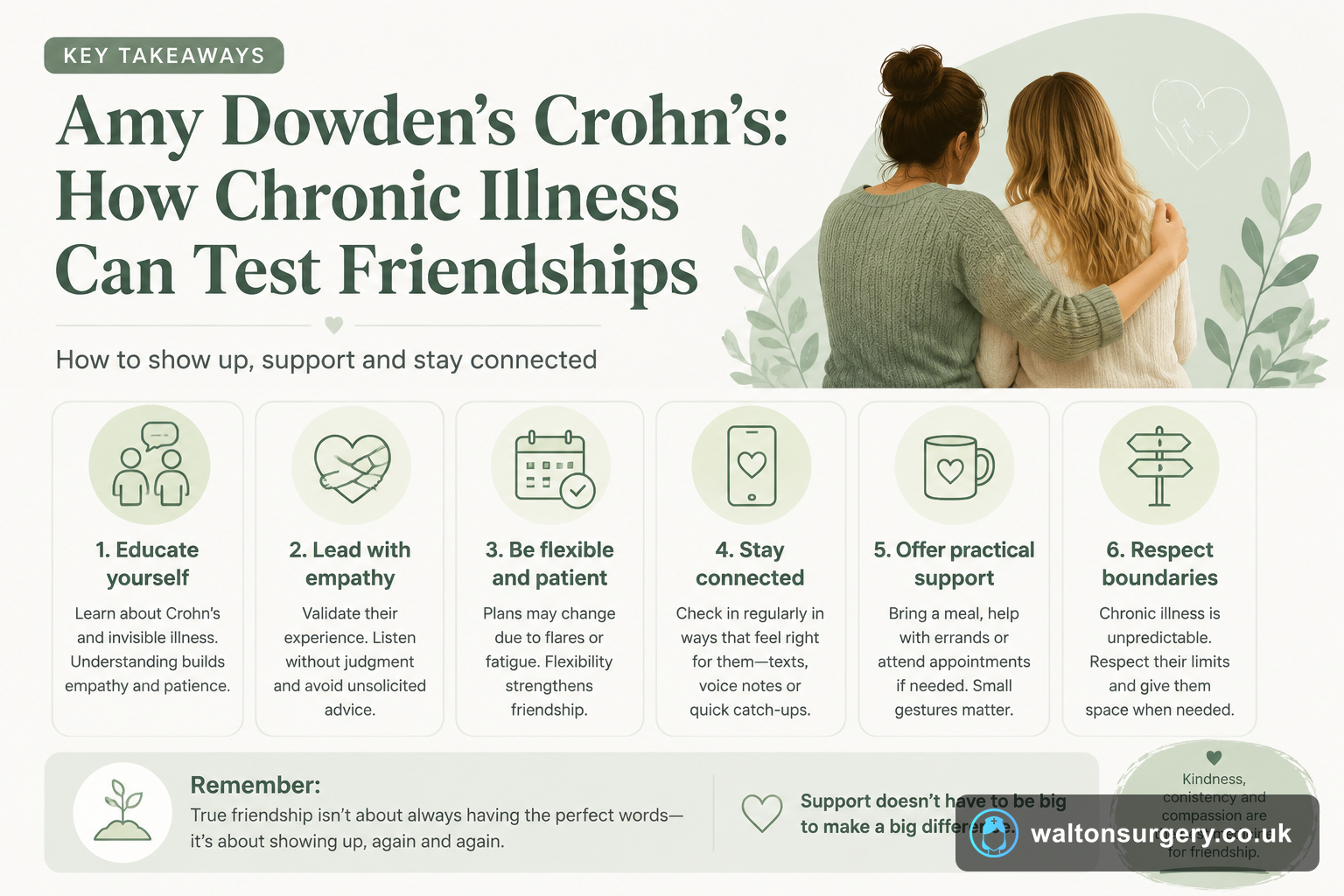
Practical support goes a long way. That might look like picking a restaurant where you know the toilets are decent, or being completely fine with it if they need to duck out of an event early. Sometimes it's just being there without any pressure to do anything or talk about anything in particular. It also helps to gently encourage them to stick with their treatment plan, without becoming a nag about it. Really, the main thing is to see them as a whole person — not just as someone who happens to have a disease — just as public awareness around conditions like lyme disease uk 2026 nhs tick bite season june what to do helps people understand what patients actually experience day-to-day.
Frequently Asked Questions
⭐ The Bottom Line
What this means for you
By being so open about her Crohn's disease, Amy Dowden has given people a genuine look at what living with a chronic condition actually involves. Her friendship with Carlos Gu is a good reminder that illness can put relationships to the test, but that with honesty and a willingness to understand each other, friendships can adjust and carry on. If you or someone you care about is dealing with Crohn's, the NHS and charities like Crohn's & Colitis UK are solid places to find reliable information. For a diagnosis and advice tailored to your situation, always talk to your GP.
Last updated: 2026-07-31 · Written by the Walton Surgery editorial team · Medical information is for educational purposes only and does not replace advice from a qualified healthcare professional.