What Is an Incidental Finding? How Routine Checks Can Spot Cancer
PART C — HTML Body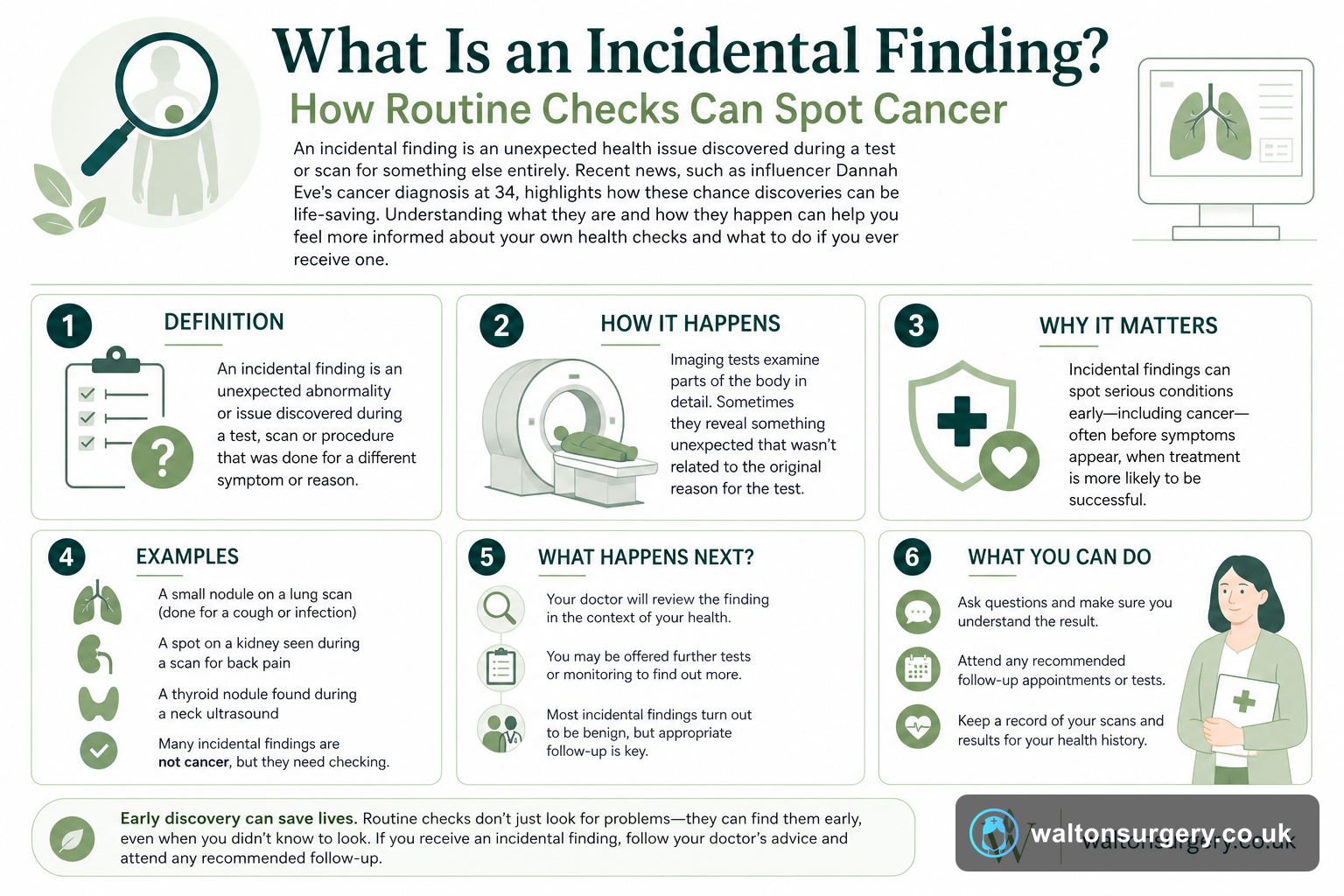
⚡ Quick Answer
An incidental finding is an unexpected health issue discovered during a test or scan for something else entirely. Recent news, such as influencer Dannah Eve's cancer diagnosis at 34, highlights how these chance discoveries can be life-saving. Understanding what they are and how they happen can help you feel more informed about your own health checks and what to do if you ever receive one. There's more on this in our what was mums only symptom before cancer diagnosis explainer.
Sometimes a medical test turns up something nobody was looking for. You go in for one thing, and the scan or examination reveals a completely different issue hiding in the background. That's what doctors call an incidental finding — a discovery made by accident, not by design. It happens more often than you might think across the NHS and other healthcare settings.
Influencer Dannah Eve brought the concept into sharp public focus when she shared her cancer diagnosis at 34. A follower had spotted something unusual in her content and urged her to get checked. Her story is a striking reminder that routine investigations for one problem can sometimes uncover something else entirely, occasionally something quite serious. Here's what you need to know about incidental findings and what they mean for your own health.
What Exactly Is an Incidental Finding?
Think of it as a medical surprise. Say your doctor orders a chest X-ray because you've had a cough that won't shift. The X-ray comes back showing your lungs are fine, but there's a small shadow on one of your rib bones that nobody expected. That shadow — that's the incidental finding. It wasn't what anyone was hunting for, but it showed up anyway.
The range of what these findings can be is wide. Some turn out to be completely harmless, like a benign cyst that needs no treatment. Others might point to something more serious, including early-stage cancer. The term itself doesn't carry a value judgement; it simply describes how the discovery happened. Within the NHS, these findings crop up regularly, and there are well-established pathways for working out what to do next.
How Do Incidental Findings Happen?
Modern imaging technology captures a remarkable amount of detail. A CT scan done to investigate kidney stones, for instance, doesn't just photograph your kidneys. It picks up images of your liver, spleen, pancreas, and surrounding structures at the same time. The radiologist examining those images is expected to look at everything visible, not just the area connected to your original complaint.
If something looks out of place in an organ that wasn't the focus of the scan, the radiologist has a professional obligation to flag it. That's how a test meant to answer one question can end up raising another. It functions as a kind of built-in safety net within diagnostic imaging. Once the finding is noted, it gets passed to your GP, who takes things from there and decides what follow-up, if any, is needed.
Why Is This in the News Now?
August 2026 was when the phrase really entered public conversation. Dannah Eve, an influencer aged 34, went public with her cancer diagnosis. What made her case unusual was how it started: a follower who happened to work in medicine spotted something off in one of her social media posts and told her to get it looked at. Her experience echoes other public figures who have shared their journeys, such as Lucy Davis's cancer diagnosis, which also brought awareness to the importance of early detection.
That observation worked in much the same way as an incidental finding. It wasn't a formal diagnostic test, but it was an unexpected notice of something that didn't look right, and it prompted a proper medical investigation which led to a diagnosis. Eve's experience is a vivid, real-world illustration of why paying attention to changes in your body matters — and why listening when someone else raises a concern can make all the difference.
What Should You Do If You Get One?
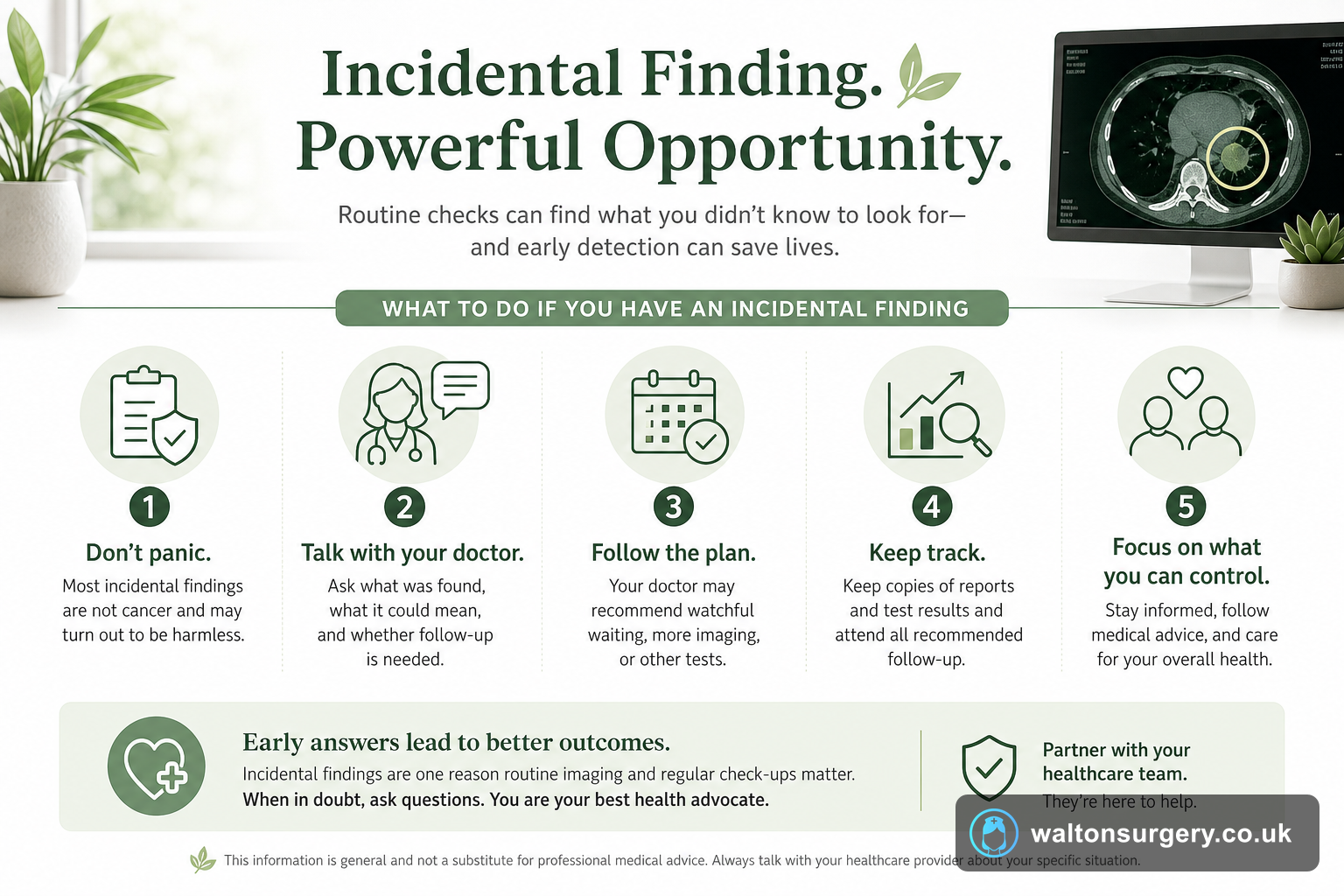
Getting a letter or phone call about an unexpected finding on a scan is unsettling. That reaction is completely normal. The first thing to hold onto is that many of these findings turn out to be nothing serious. Your GP will get in touch to go through the result and explain what it could mean.
From there, they'll talk you through what comes next. Typically that means further, more focused testing to pin down exactly what the finding is. It might be a different kind of scan, a blood test, or a referral to a specialist. The whole point is to arrive at a clear answer. Make sure you attend every follow-up appointment — they matter for your peace of mind as much as for your physical health.
Are All Incidental Findings Cancer?
No. And honestly, this is the point worth stressing most. The overwhelming majority of incidental findings are not cancer. They're frequently harmless anatomical quirks, benign cysts, old infections that have long since gone quiet, or other non-cancerous conditions. That said, because cancer remains a possibility, every finding does need proper investigation. Stories like Clea Shearer's breast cancer diagnosis show how vital it is to follow up on any unusual finding, even when the odds are in your favour.
The investigation process exists to rule out anything serious. It's systematic by design, making sure nothing slips through the cracks. Waiting for answers can be nerve-wracking, and that's understandable, but the process itself is necessary. The NHS follows clear guidelines on managing these findings so that patients get timely and appropriate care without unnecessary delays.
🔬 Key Facts
Incidental Findings: The Numbers
- → Over 40% of patients undergoing CT colonography scans have incidental findings.
- → Most are clinically insignificant, meaning they require no treatment or follow-up.
- → The NHS has established pathways for managing and investigating these findings.
- → Your GP has a legal duty to inform you of all test results, including incidental findings.
Frequently Asked Questions
⭐ The Bottom Line
What this means for you
Incidental findings are a common side effect of the detailed diagnostic tools modern medicine relies on. They're unexpected discoveries that deserve further investigation, but more often than not they turn out not to be serious. Dannah Eve's story is a useful prompt to pay attention to your body and to listen when people around you express concern. If something is worrying you, or if you receive a letter about an unexpected finding, your GP is the right place to start. They'll walk you through whatever comes next with the care and clarity you need.
Last updated: 2026-08-30 · Written by the Walton Surgery editorial team · Medical information is for educational purposes only and does not replace advice from a qualified healthcare professional.