AI Receptionists and Accents: Why Voice Tech Can Struggle
PART C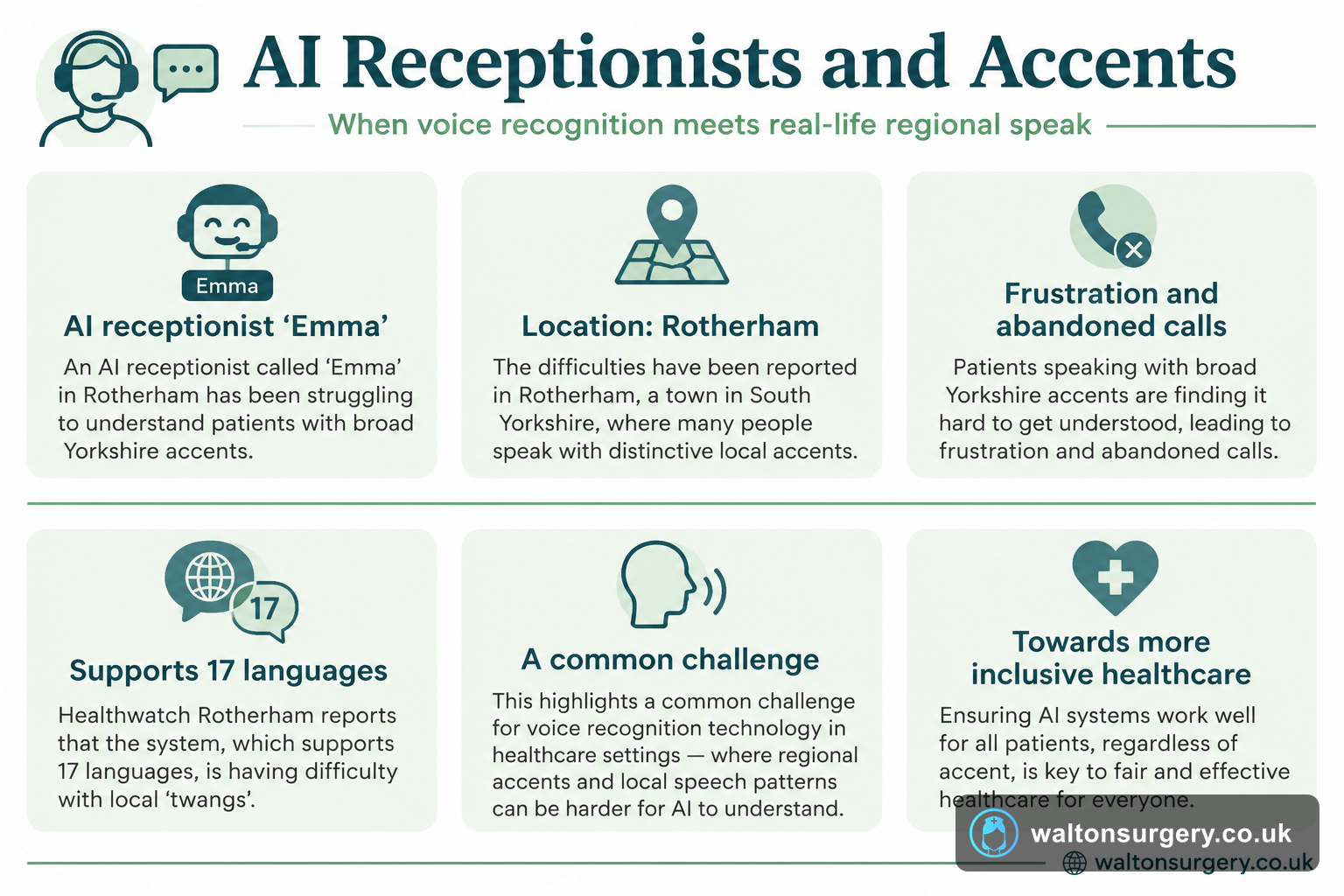
⚡ Quick Answer
An AI receptionist named 'Emma' in Rotherham has been struggling to understand patients with broad Yorkshire accents, leading to frustration and abandoned calls. Healthwatch Rotherham reports the system, which supports 17 languages, is having difficulty with local 'twangs'. This highlights a common challenge for voice recognition technology in healthcare settings.
Folks in South Yorkshire are putting the phone down on their GP surgery's automated line because the system just can't grasp what they're saying. Healthwatch Rotherham, the local watchdog, has flagged that the AI receptionist—called 'Emma'—is having a proper struggle with broad local dialects. People trying to book appointments or get through to services are getting wound up, and honestly, who can blame them. We cover this in more depth in snake cancer surgery veterinary.
This isn't just a Rotherham problem, though. It's a symptom of something bigger going on with voice recognition tech in the NHS and elsewhere. These systems might handle 17 languages no bother, but a strong regional British accent? That's apparently a different kettle of fish. If you've ever found yourself shouting at a robot on the phone, you'll know the feeling.
What's Happening in Rotherham?
There's an AI chatbot called 'Emma' that's been rolled out at GP surgeries in Rotherham, and it's not going well. Healthwatch Rotherham—the local health and social care watchdog—says patients are finding the system can't reliably pick up what they're saying. One patient put it bluntly to the watchdog: "I could never get it to understand me, I ended up just hanging up and not bothering to try and book an appointment."
The company behind the tech says 'Emma' works in 17 different languages. Fair enough. But Healthwatch Rotherham has flagged that the technology is "struggling with local 'twangs'". What that tells you is the software's training data probably didn't include enough examples of strong regional British accents. So the very community it's supposed to help is the one it's failing.
Why Do AI Systems Struggle with Accents?
Voice recognition works by taking the sound waves of your speech and matching them against patterns the system has already learned. If it was trained mostly on "standard" or "neutral" English accents, it's going to have a much harder time with anything else. Accents change vowel sounds, how consonants come out, the rhythm of speech, even the rise and fall of your voice.
For an AI receptionist, this can mean it hears something completely wrong when you say "appointment" or "doctor". Or it might just register the whole thing as noise. The fault isn't with the speaker—it's with what the software was trained on. The tech is only as good as the data it was fed, and that data often doesn't reflect the sheer variety of how people actually talk across Britain.
The Real-World Impact on Patients
When an automated system can't understand you, it's more than just a nuisance. For someone trying to get a GP appointment, it can mean missing out on care altogether. Repeating yourself over and over, slowing your speech down to something unnatural, getting misunderstood anyway—it's enough to make most people just give up.
That creates a barrier to access. You can't get past the automated gatekeeper, so you can't reach a human receptionist who might actually help. For elderly patients, anyone with hearing difficulties, or someone who's already feeling rough, this extra stress is the last thing they need. A simple phone call turns into a draining ordeal. Much like the challenges faced in what is postpartum psychosis care, where clear communication is vital, these technological failures can have serious consequences for vulnerable individuals.
What Can You Do If the AI Doesn't Understand You?
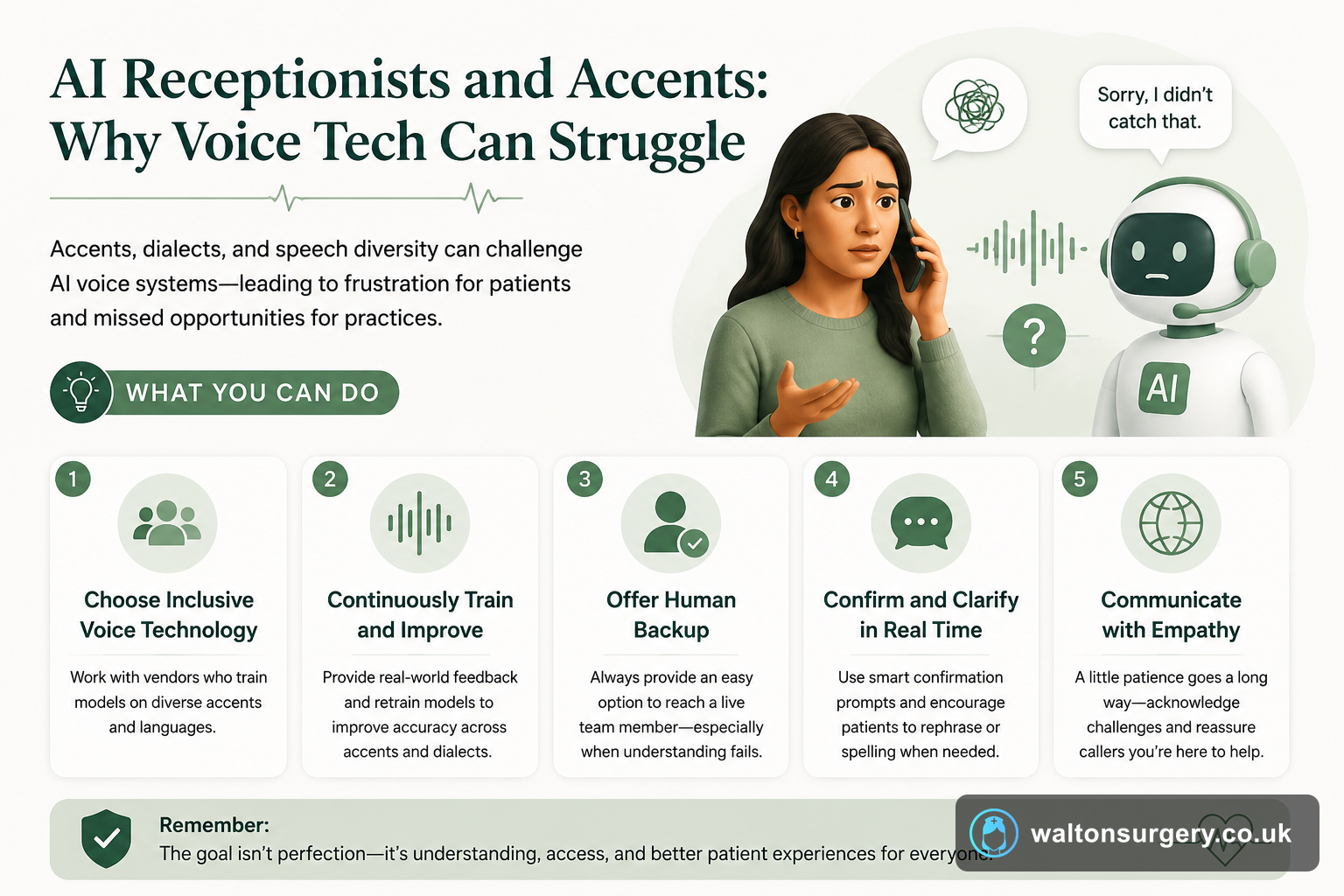
Stuck with an AI receptionist that can't make sense of your accent? You've got a few things you can try. Speaking more slowly and clearly is worth a go, but don't try to change your accent—just enunciate a bit more without shouting. Sometimes a small tweak in pace is all the software needs.
If that doesn't do it, most systems have a way to get through to a real person. Listen out for something like "press 0 to speak to a receptionist" or "say 'operator'". With voice-activated setups, try saying "human" or "receptionist" nice and clearly. Still stuck? Hanging up and ringing back might get you through to a different line or an actual person.
Is This a Problem Across the NHS?
AI and automated phone systems are popping up more and more across the NHS as a way to cope with massive call volumes. The Rotherham case, though, shows what happens when these systems get rolled out without proper testing on the local population. It's not a one-off, either—similar gripes have turned up in other parts of the country where people speak with strong accents.
🔬 Key Facts
The NHS AI Rollout Challenge
- → The 'Emma' system supports 17 languages but struggles with strong local accents.
- → Healthwatch Rotherham flagged the issue after patient complaints about abandoned calls.
- → The problem is widespread across the NHS, not isolated to one town.
- → Balancing efficiency and accessibility is the core challenge for health services.
The tricky bit for the NHS is balancing efficiency against accessibility. A system that works brilliantly for some but shuts others out isn't really efficient at all. Healthwatch organisations across the UK are keeping an eye on these rollouts to make sure they don't end up creating new barriers to care. Patient feedback—the kind coming out of Rotherham—is exactly what's needed to hold providers to account. This kind of scrutiny is essential, whether the topic is is instagram safe for teens or the reliability of a medical booking system.
Frequently Asked Questions
⭐ The Bottom Line
What this means for you
What's happening in Rotherham with the 'Emma' AI receptionist is a straightforward case of technology falling short of what patients actually need. Automated systems can bring real benefits, no question, but they've got to work for everyone. If you're dealing with an accent-unfriendly system, know that you have the right to speak to a human being. And your feedback—to your surgery, to your local Healthwatch—is one of the most effective tools you've got for pushing things in the right direction.
Last updated: 2026-08-21 · Written by the Walton Surgery editorial team · Medical information is for educational purposes only and does not replace advice from a qualified healthcare professional.