A&E Negligence: What Patients Need to Know About Their Rights
**PART C — HTML Body**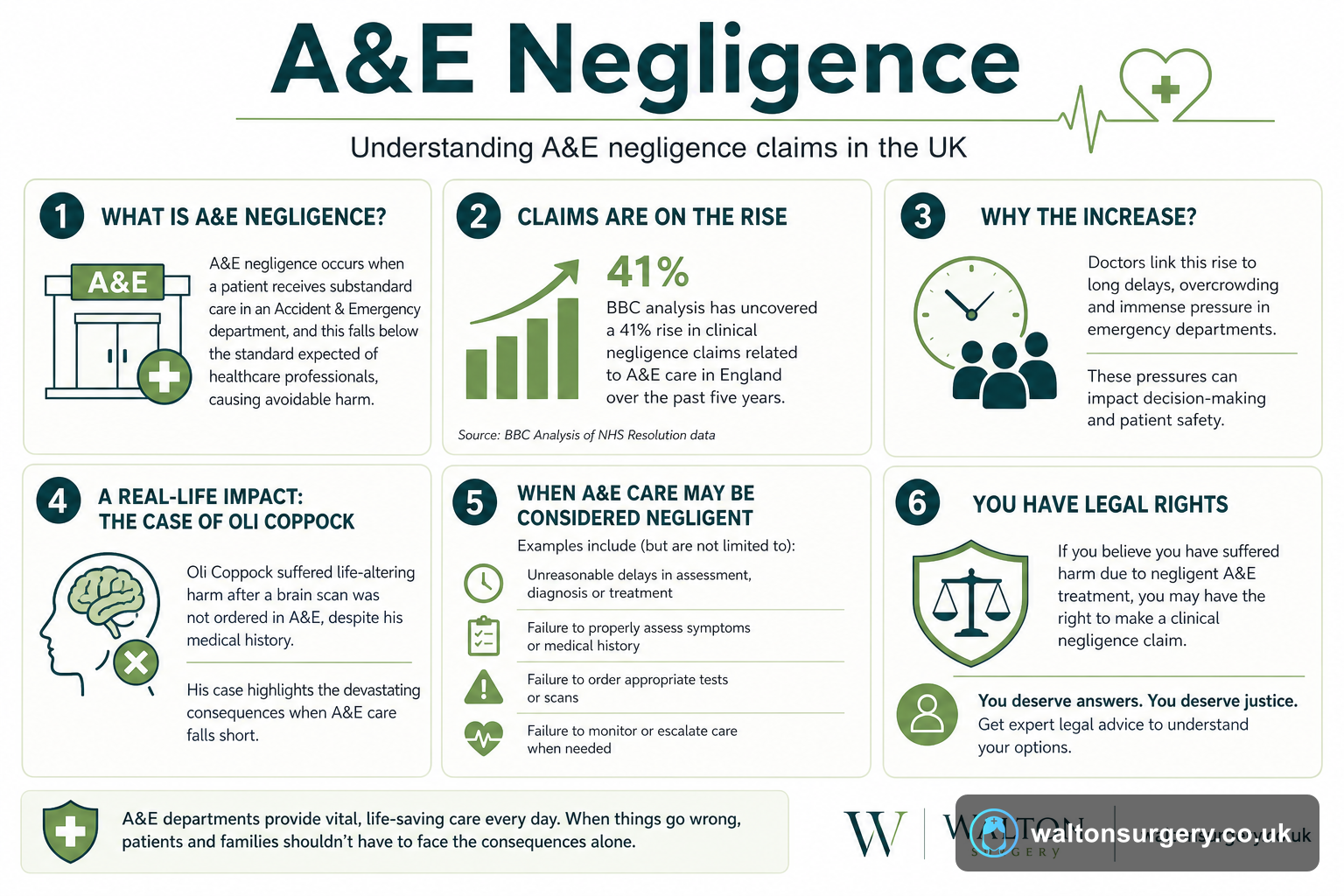
⚡ Quick Answer
BBC analysis has uncovered a 41% rise in clinical negligence claims related to A&E care in England over the past five years, with doctors linking this increase to long delays and pressure in emergency departments. The case of Oli Coppock, who suffered life-altering harm after a brain scan was not ordered despite his medical history, illustrates the devastating consequences when A&E care falls short. Patients have legal rights if they believe negligent A&E treatment has caused them harm.
Over the past five years, claims for clinical negligence linked to A&E care in England jumped by 41%, a BBC investigation found. Doctors themselves have pointed to the cause: the long waits and mounting pressures that emergency departments are struggling under. If substandard emergency care has harmed you or someone close to you, there may be grounds to pursue a claim.
The BBC's reporting on Oli Coppock gives a face to that statistic. Back in May 2024, the 32-year-old went to Warrington Hospital's emergency department suffering severe headaches and dizzy spells — this was months after he'd been treated for a brain tumour. Staff assessed him, then sent him home. No brain scan was performed. Within a week, fluid had accumulated on his brain, triggering a cardiac arrest. He now lives with almost complete paralysis. His father, Stephen Coppock, simply cannot fathom why a scan wasn't arranged given what his son had already been through medically. There's more on this in our US health report on gender identity explainer.
What Counts as A&E Negligence?
When we talk about clinical negligence in A&E, we mean a situation where the care you get doesn't reach the level a reasonably competent emergency medicine doctor would provide — and you come to harm because of it. A poor outcome on its own isn't enough. Medicine is complicated stuff, and sometimes things go badly without anyone being at fault.
To build a claim, there are usually three elements you'd need to demonstrate. First, that the medical staff owed you a duty of care — which kicks in automatically the moment you attend an NHS or private A&E department. Second, that the treatment you received fell short of that duty. Third, that the shortfall directly caused you an injury, or left you worse off than you would have been otherwise. Oli Coppock's situation raises a pretty stark question: does failing to order a brain scan for someone with a recent brain tumour and fresh neurological symptoms cross that line?
Why Are A&E Negligence Claims Rising?
A clear pattern emerges from the BBC's figures: A&E negligence claims are up 41% over five years. Doctors have put a name to the problem, pointing straight at the long delays and relentless pressure in emergency departments. When staff numbers are stretched, when patients are left waiting hours in corridors, when departments are heaving — the chance of things going wrong climbs.
That isn't to say every A&E visit is risky. It does mean, though, that wider problems within emergency care can land squarely on individual patients. The strain on A&E departments is something the NHS itself has documented extensively, with waiting time targets being missed again and again. For patients, knowing about these pressures isn't about blaming frontline staff. It's about understanding that if something goes sideways with your care, you're not without options.
🔬 Key Facts
The Rising Trend of Claims
- → 41% rise in clinical negligence claims linked to A&E care in England over the past five years.
- → Root cause identified as long delays and relentless pressure in emergency departments.
- → NHS documentation confirms missed waiting time targets, reflecting systemic strain.
- → Patient awareness of these pressures is crucial for understanding legal options.
How to Recognise if Your A&E Care Was Negligent
Right after a hospital visit, it can be genuinely hard to tell whether what happened was negligence or just an unfortunate outcome. That said, there are warning signs worth paying attention to.
Maybe your symptoms weren't properly looked into. Perhaps tests that ought to have been ordered simply weren't. You might have been discharged before you were ready, or there could have been a failure to take your medical history into account. In Oli Coppock's case, what stands out is this: a patient with a known brain tumour and a recent multiple sclerosis diagnosis turned up with headaches and dizziness, yet no brain scan was carried out. His father has said bluntly that A&E staff didn't get the basics right. If the care you received is worrying you, the first move is to ask the hospital for your full medical records. Those documents will spell out what assessments took place, which tests were done, and the reasoning behind the decisions that were made. We cover this in more depth in dave mustaine cancer diagnosis advice.
What to Do if You Suspect A&E Negligence
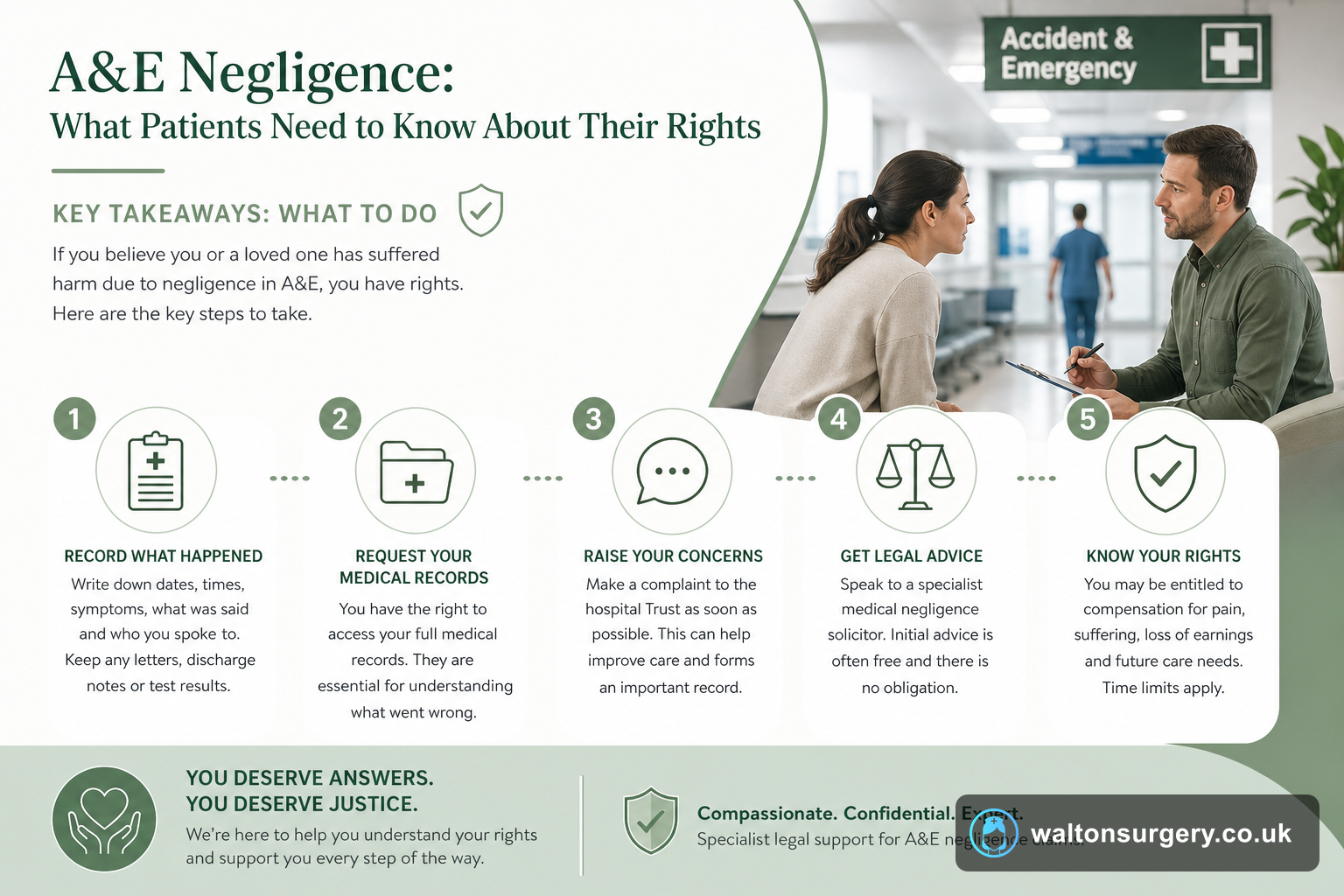
Acting quickly matters if you think your A&E treatment was negligent. Start by jotting down everything you can recall about the visit — your symptoms, who you spoke to, what investigations were carried out, what you were told at each stage. Next, request copies of your medical records from the hospital, since these will underpin any potential claim.
It's also worth talking to your GP about any health issues that have lingered since the incident. They can keep track of your condition and make sure it's properly documented. The other step, and it's an important one, is to get specialist legal advice from a solicitor experienced in clinical negligence. They'll be able to assess whether what you went through meets the legal test for a claim. Don't forget about time limits: in England, you generally get three years — counted either from the date of the negligence itself or from when you first realised the harm was connected to it — to begin legal proceedings.
Frequently Asked Questions
⭐ The Bottom Line
What this means for you
Claims for A&E negligence in England have climbed sharply — the BBC's analysis puts the rise at 41% over five years. Cases like Oli Coppock's, where straightforward steps such as a brain scan weren't taken even though his medical history clearly warranted one, bring home the human cost when emergency care misses the mark. If you suspect your A&E treatment was negligent, you do have a legal right to get answers. Talk to your GP, ask for your records, and sit down with a specialist solicitor to work out where you stand.
Last updated: 2026-09-08 · Written by the Walton Surgery editorial team · Medical information is for educational purposes only and does not replace advice from a qualified healthcare professional.