Abortion Pardons: Understanding UK Law and Your Care
PART C — HTML body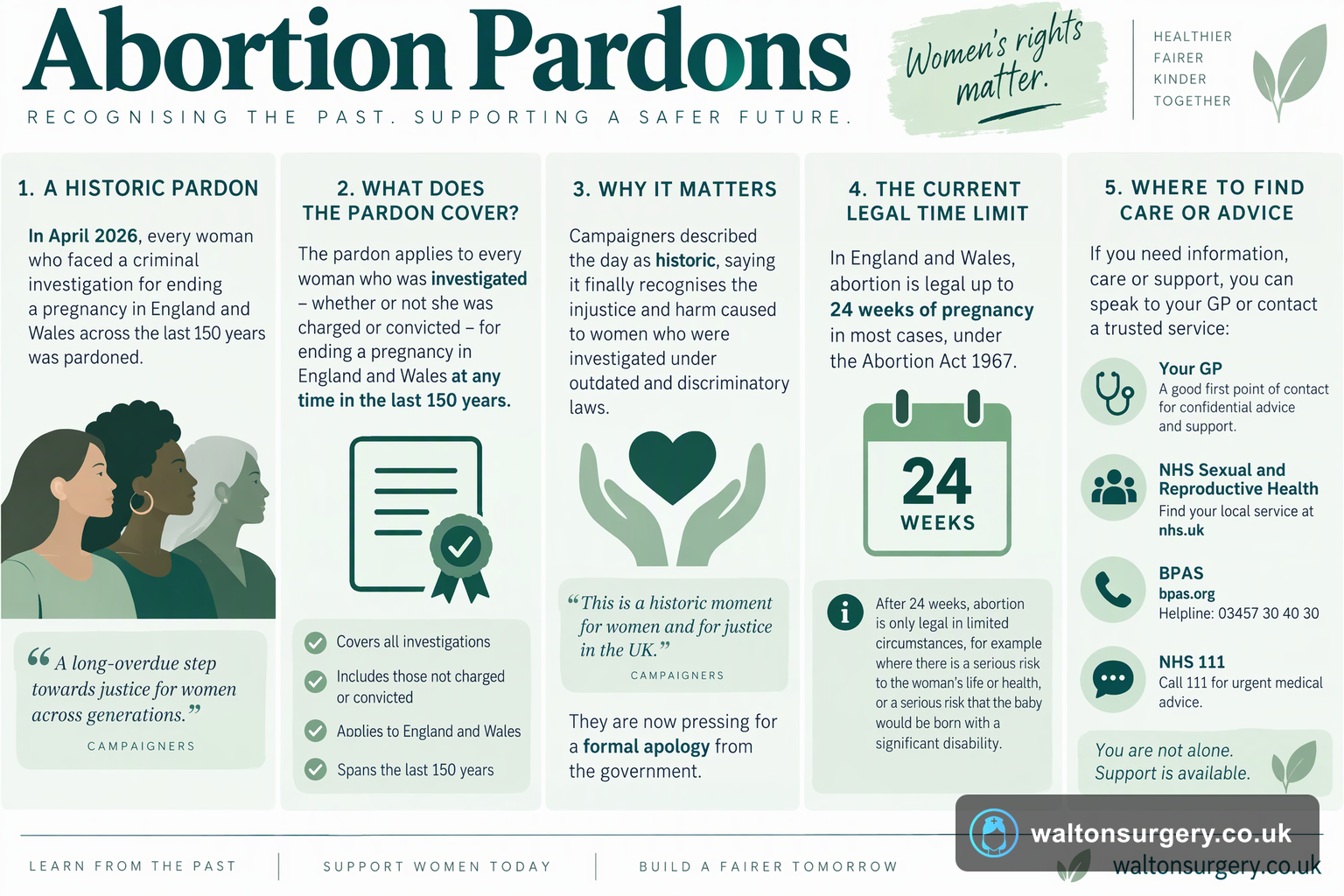
⚡ Quick Answer
Every woman who faced a criminal investigation for ending a pregnancy in England and Wales across the last 150 years was pardoned in April 2026. Campaigners described the day as historic and are now pressing for a formal apology from the government. Below we set out what the pardon actually covers, where the current legal time limit sits in England and Wales, and where to find care or advice.
Women who were prosecuted over abortions have called it a "historic day" after the pardon went through. It covers anyone who faced a criminal investigation for ending a pregnancy across the past 150 years. That's a very long window. The Guardian reported the story in April 2026, and both campaigners and women previously convicted of illegal abortions welcomed what happened.
There's now pressure building on the government to issue a formal apology to those who were investigated after ending pregnancies in England and Wales. But the law matters for you as well, not just for the people at the centre of this story. In England and Wales, abortion is permitted up to 24 weeks of pregnancy. Go past that limit and ending a pregnancy can bring a criminal investigation, which is exactly what a 2023 case showed. That steady build-up of public feeling is part of why women are getting angrier about how reproductive rights are handled.
What actually happened in April 2026?
On 17 April 2026, The Guardian reported that every woman who has faced a criminal investigation for ending a pregnancy during the last 150 years has been pardoned. Women previously convicted of illegal abortions called it a "historic day" and campaigners who stood beside them said much the same.
What the pardon covers is fairly specific. It's women in England and Wales, and it applies to the investigations themselves, not to men and not to medical professionals either. In practice this means that convictions linked to ending a pregnancy are now formally recognised as instances where the law wronged those women.
Campaigners aren't stopping here. What they want now is for the government to go one step further and issue a formal apology to those investigated after ending pregnancies in England and Wales. Whether that apology comes remains to be seen.
Why did campaigners call for a pardon?
The campaign grew out of particular cases — women who were investigated and prosecuted after ending pregnancies. Photographs from the Royal Courts of Justice in 2023 show campaigners demonstrating there after a 44-year-old woman was sentenced to more than two years in prison for inducing an abortion after the legal 24-week limit.
That case drew a lot of attention to the way criminal law deals with women who end pregnancies. Campaigners put forward the argument that prosecuting someone who has already gone through an unwanted pregnancy causes further harm, and that a pardon would at least acknowledge that. Their ask was straightforward: every woman who faced a criminal investigation for ending a pregnancy should be formally cleared. Research into women anger mental health shows how much an experience like a criminal investigation can weigh on a person long afterwards.
Honestly, the logic here isn't complicated. A prosecution on top of an unwanted pregnancy piles one painful experience onto another.
How long is the legal limit for abortion in England and Wales?
Current law in England and Wales allows abortion up to 24 weeks of pregnancy. That's the same legal limit referenced in the 2023 court case, where a 44-year-old woman was given more than two years after inducing an abortion past the 24-week threshold.
Past 24 weeks, ending a pregnancy can sit outside the legal framework entirely and a criminal investigation can follow. The 2026 pardon doesn't touch the time limit itself. It addresses how women who were investigated under that limit were treated.
Unsure where you stand in a pregnancy? Talk to your GP or a specialist abortion provider as early as you can. Timing has a big effect on the options open to you, and getting accurate dates from a clinical assessment is what tells you which timeframe applies.
🔬 Key Facts
The legal time limit and the 2023 case
- → Abortion is permitted up to 24 weeks of pregnancy in England and Wales under current law.
- → A 44-year-old woman was sentenced to more than two years in prison in 2023 for inducing an abortion past the 24-week limit.
- → The 2026 pardon does not change the time limit itself — it addresses how investigated women were treated.
- → Accurate dates from a clinical assessment determine which timeframe applies to you.
Who exactly does the pardon cover?
Every woman who faced a criminal investigation for ending a pregnancy during the last 150 years — that's who. It's a wide span, reaching back through generations of cases where women in England and Wales found themselves investigated after ending a pregnancy.
It doesn't extend to everyone touched by abortion-related cases. The reporting focuses specifically on women who were investigated after ending pregnancies. Campaigners have asked the government to issue a formal apology to those women too.
Think a family member might have been affected? Records from historic cases can be genuinely hard to unpick. A solicitor who works in criminal records is probably the best starting point, or one of the organisations that worked on the pardon campaign, for guidance on how the pardon applies to a specific case.
What does the pardon mean for your care today?
Nothing about the law governing your access to abortion care has changed. Not practically. Abortion remains permitted up to 24 weeks of pregnancy in England and Wales and the April 2026 decision didn't alter the rules on later abortions.
What has changed is the record. Women previously convicted of illegal abortions are now formally pardoned. For those individuals — and for anyone who's been living with the weight of a historic conviction on their file — that carries real meaning.
If you need an abortion, the process is exactly as it was. You can self-refer to an abortion provider or ask your GP. NHS-funded abortion care is available across England and Wales. Whatever you decide, get clinical advice early so you understand your options and the timeframe that applies to you. Wider discussion of abortion law changes uk gives useful context on how the framework has been evolving.
Where should you go for abortion care in England and Wales?
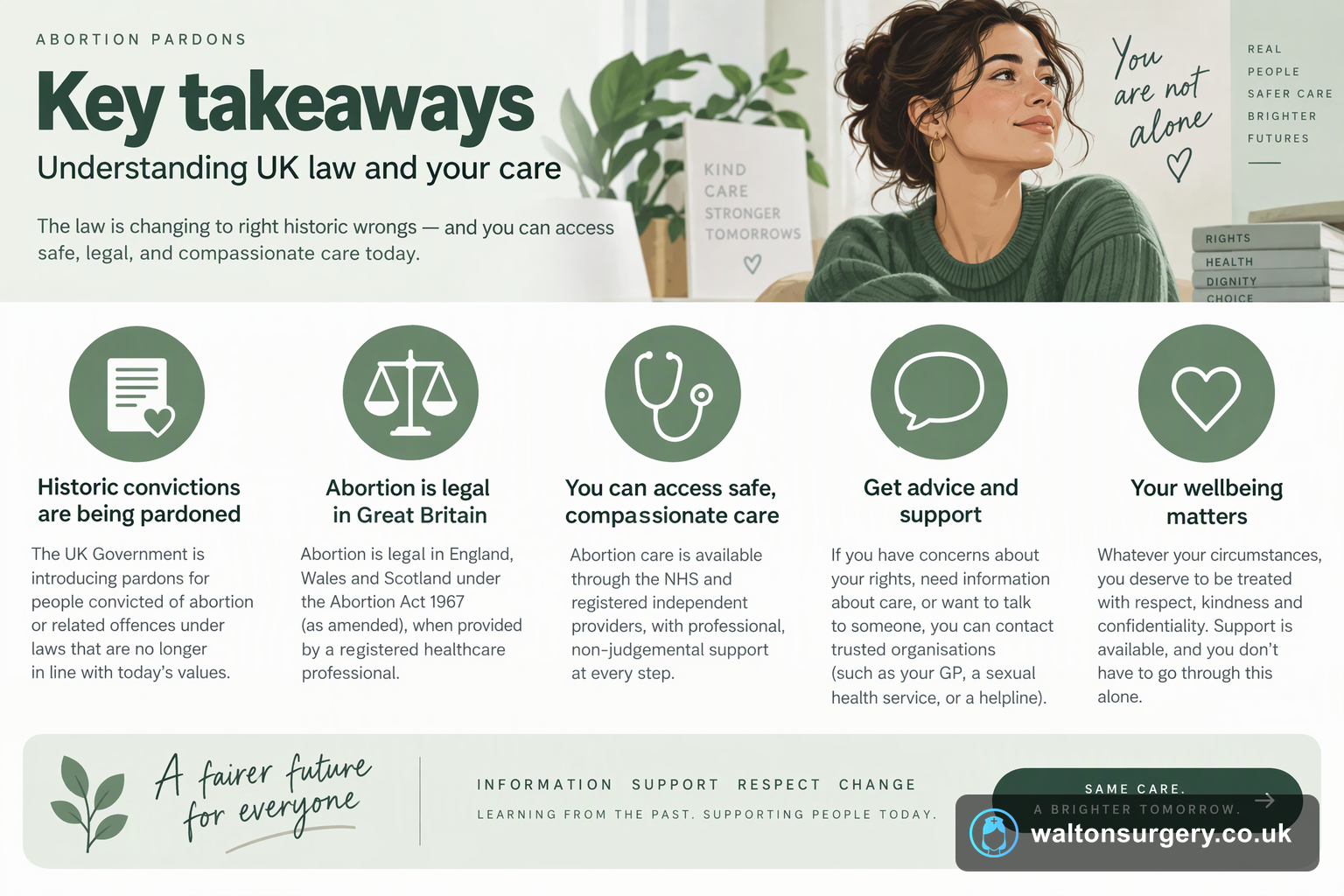
Care is available through the NHS and through independent sector providers that the NHS contracts. You don't need your GP's permission. You don't even need to see a GP first. Self-referral is possible directly to a service.
Your GP can also be useful if you'd prefer to talk something through before deciding. For early medical abortion, a pharmacist can advise where that service is offered. Neither one can tell you what to decide, that part is entirely yours, but both can explain the options, the timeframes, and what happens at each stage.
A quick practical note: ring the provider first if you're nervous about what the appointment will involve. They deal with these calls all day.
This article isn't personalised medical advice. If you have questions about your own pregnancy or health, speak to a GP, a pharmacist, or an abortion provider directly.
Frequently Asked Questions
The Bottom Line
⭐ The Bottom Line
What this means for you
Every woman who faced a criminal investigation for ending a pregnancy during the last 150 years has been pardoned, in a move hailed as a "historic day". A formal apology is what campaigners want next. For you, the legal position is unchanged: abortion remains permitted up to 24 weeks in England and Wales. Speak to a GP, a pharmacist, or an abortion provider about your own situation.
Last updated: 2026-11-16 · Written by the Walton Surgery editorial team · Medical information is for educational purposes only and does not replace advice from a qualified healthcare professional.