Luminal Breast Cancer: Types, Treatment and Outlook
PART C — HTML BODY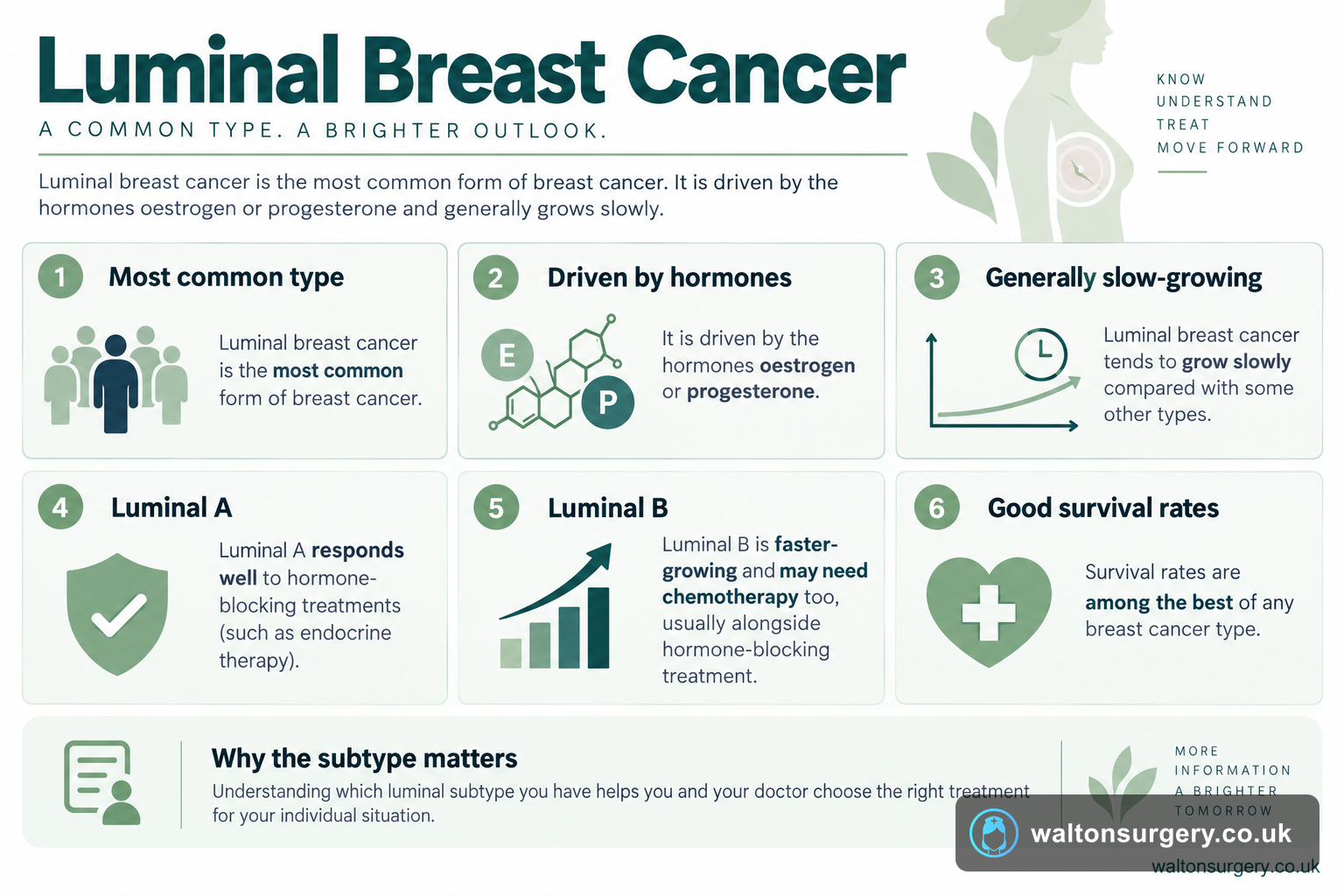
⚡ Quick Answer
Luminal breast cancer is the most common form of breast cancer. It's driven by the hormones oestrogen or progesterone and grows slowly. Luminal A responds well to hormone-blocking treatments. Luminal B is faster-growing and may need chemotherapy too. Survival rates are among the best of any breast cancer type. Understanding which subtype you have helps you and your doctor choose the right treatment.
Of all the breast cancer subtypes, luminal is the one you're statistically most likely to be dealing with. It's hormone-receptor-positive, meaning oestrogen or progesterone is fuelling the tumour's growth, and it begins in the milk-producing ducts or lobules. Hormone-receptor-positive cases make up roughly eight in ten breast cancers, so luminal types dominate the picture entirely. They're generally slower-growing than other forms, and they respond well to hormone-blocking drugs.
Two main luminal subtypes exist: luminal A and luminal B. Luminal A is the sluggish one, very slow-growing with an excellent outlook attached to it. Luminal B moves faster and is more likely to need chemotherapy in addition to hormone therapy. Your pathology report will tell you which subtype you're dealing with, and from there every subsequent treatment decision flows.
What Is Luminal Breast Cancer Exactly?
The name comes from the anatomy. Cells lining the milk ducts and lobules — the tubes carrying milk towards the nipple — are known as luminal cells. Turn those cells cancerous, give them hormone receptors on their surface, and you've got luminal breast cancer.
Think of the hormone receptors as locks, with oestrogen and progesterone serving as the keys. Once those hormones dock onto the receptors sitting on the cancer cells, growth signals fire off telling the cells to multiply. Take away the hormonal signal and the cancer's engine stalls, which is precisely the mechanism behind hormone therapy — the backbone of luminal breast cancer treatment.
Plenty of breast cancers don't carry hormone receptors at all. Some are HER2-positive, driven by a protein called HER2. Others fall into the "triple-negative" camp, lacking oestrogen receptors, progesterone receptors and HER2 simultaneously. Those types behave differently and require different approaches. The "luminal" label, in plain terms, just flags that hormones are running the show in your particular cancer — the same hormone-driven biology that made headlines when reports confirmed the jessie j cancer free breast cancer mastectomy update 2026.
How Do Luminal A and Luminal B Differ?
This section matters most, honestly. The subtype you're given dictates how intensive your treatment gets. On a mammogram luminal A and luminal B can look identical, but once a laboratory has examined the tumour tissue their behaviour splits apart.
Luminal A
Most luminal cancers are actually luminal A. The cells carry oestrogen receptors and usually progesterone receptors too, while HER2 protein levels stay low and the Ki-67 score — that's the pathologist's measure of how fast cells are dividing — comes out low. Slow division rate plus hormone dependence equals a tumour that grows slowly.
Treatment for luminal A typically involves hormone therapy alone once surgery is done. Chemotherapy often isn't required, though the tumour's size, grade and lymph node status all feed into that final call. Outlook-wise, luminal A sits at the favourable end of the spectrum.
Luminal B
Luminal B is the other luminal subtype. Hormone receptors are still present, so hormone therapy remains in the picture. What separates it is what else is happening: Ki-67 scores tend to be higher, meaning cells divide more rapidly, and some luminal B tumours additionally carry high levels of HER2 protein.
Faster growth and greater aggressiveness compared to luminal A mean your medical team is more likely to push for chemotherapy alongside hormone therapy. HER2-targeted medicines might join the mix too, where the tumour is HER2-positive. The outlook for luminal B is decent, just not quite as rosy as luminal A, and that's the reason treatment tends to be more intensive.
How Pathologists Tell Them Apart
Once a lump comes out or a core biopsy is taken, the tissue heads to a pathology lab. Testing there covers oestrogen receptors, progesterone receptors and HER2 protein, alongside a count of how many cells are actively dividing. Those findings get combined into a subtype on your pathology report.
Ask for a copy if you've been told it's luminal breast cancer but nobody's specified which subtype. Your breast care nurse or oncologist can provide one — it's your medical information and you're entitled to it. Once you understand it, you can take part in decisions about your own treatment rather than just nodding along.
🔬 Key Facts
Luminal A versus Luminal B at a glance
- → Most luminal cancers are actually luminal A — oestrogen and usually progesterone receptors present, low HER2, low Ki-67.
- → Luminal A treatment typically involves hormone therapy alone once surgery is done; chemotherapy often isn't required.
- → Luminal B has higher Ki-67 scores, meaning cells divide more rapidly, and some tumours additionally carry high levels of HER2 protein.
- → Pathology testing covers oestrogen receptors, progesterone receptors and HER2 plus a count of how many cells are actively dividing.
What Are the Signs and Symptoms?
There aren't unique symptoms that mark luminal breast cancer out from other types. The NHS list everyone's told to watch for applies here equally: a fresh lump or thickening in the breast or armpit, one breast changing in size or shape, skin dimpling or puckering, or a nipple turning inwards or leaking fluid when you're not breastfeeding.
Redness or a rash on the breast skin, plus persistent pain in the breast or armpit, also warrant getting checked. Most breast lumps turn out not to be cancer, but any new or unusual change still needs your GP's eye on it — and reporting those subtle changes matters, as case reports exploring what was mums only symptom before cancer diagnosis make clear. In England the NHS breast screening programme sends routine mammogram invitations to women aged 50 to 71, and those mammograms can catch cancers before any lump becomes palpable.
How Is Luminal Breast Cancer Diagnosed?
Imaging comes first. Found a lump, or had a screening mammogram flag something? You'll typically land at a one-stop breast clinic where a mammogram and an ultrasound scan happen. If the images look suspicious, a doctor takes a biopsy — pulling a small tissue sample from the abnormal area — using a fine needle.
That biopsy sample is the crucial part. Lab testing covers hormone receptors and HER2, and grading assesses how abnormal the cells appear plus how fast they're splitting. Together those results tell you whether you're looking at luminal A or luminal B, triple-negative or HER2-positive.
Scanning may go further — CT, MRI or a bone scan — to check whether the cancer has escaped the breast. Staging (how far it's reached) and grading (how aggressive the cells look) feed into your treatment plan alongside the subtype. Ask your team to walk you through each bit of the report; good communication makes the whole thing far easier to sit with.

How Is Luminal Breast Cancer Treated?
Surgery usually kicks things off. Depending on the tumour's size and position, that might be a wide local excision (lumpectomy) — just the tumour plus a margin of healthy tissue — or a mastectomy removing the entire breast. Breast reconstruction can happen at the same time or later. Lymph nodes in the armpit may get sampled or taken out to check for spread.
Hormone Therapy
For luminal breast cancers, hormone therapy is the mainstay. The strategy either blocks oestrogen from reaching cancer cells or cuts oestrogen production altogether. Tamoxifen blocks the receptor itself; aromatase inhibitors like anastrozole or letrozole dial down oestrogen production in post-menopausal women. Pre-menopausal women might get ovarian suppression injections to shut the ovaries' hormone output off.
Treatment duration is typically several years post-surgery. Hot flushes, joint stiffness and mood changes are all on the side effect list, so flag it to your doctor or pharmacist if things are rough — management options usually exist. Never stop hormone therapy without speaking to your treatment team first, even if you feel completely fine.
Chemotherapy
Chemotherapy works by killing fast-dividing cells. With luminal A, the tumour divides so slowly that chemo often isn't needed. Luminal B, on the other hand, commonly warrants chemotherapy, since a faster cell division rate raises the odds that stray cancer cells could bounce back.
Tumour size, grade, lymph node status and the receptor test results all weigh into the chemo decision. Some hospitals also run genomic tests — Oncotype DX or MammaPrint, for instance — on tumour tissue to gauge whether chemotherapy would actually add benefit. Worth asking your oncologist whether such a test suits your case.
Radiotherapy
High-energy X-rays are used to mop up any cancer cells left after breast-conserving surgery. Typically it runs daily over a few weeks and is standard after a lumpectomy to lower the chance of the cancer returning in the breast. Your oncology team will lay out the schedule and any skin side effects.
Targeted Therapy
Where a luminal B tumour also carries high HER2 protein levels, targeted drugs like trastuzumab (Herceptin) can be added. These medicines zero in on the HER2 protein sitting on cancer cells and can improve outcomes in HER2-positive cases. CDK4/6 inhibitors are another targeted option occasionally used for advanced luminal breast cancer. Which options apply to you is something your oncologist will explain.
What Is the Outlook for Luminal Breast Cancer?
Of the four main breast cancer subtypes, luminal carries the most favourable prognosis. Slow growth plus strong hormone therapy response means the odds of successful treatment run high, particularly where the cancer gets caught early — which is exactly why continued investment in breast cancer screening UK matters so much.
Luminal A tops the list for outlook. Luminal B still has a good one, just slightly less favourable than luminal A given its faster growth and marginally higher recurrence risk. Lymph node involvement, tumour size and grade all shift the picture as well.
Long-term but manageable is how treatment plays out for most people with luminal breast cancer. Many women take hormone therapy for five to ten years post-surgery and radiotherapy and carry on living full, active lives. Anxious about recurrence? Talk to your breast care nurse. Worrying silently helps nobody, but shared information often does.
Frequently Asked Questions
⭐ The Bottom Line
What this means for you
Luminal breast cancer, driven by oestrogen or progesterone, is the commonest form of breast cancer out there. Luminal A grows slowly and responds well to hormone therapy alone. Luminal B moves faster and more often needs chemotherapy added on. Outcomes rank among the best of any breast cancer type. Speak to your GP or oncology team about your specific subtype and treatment plan — this article is general information, not personalised medical advice.
Last updated: 2026-10-22 · Written by the Walton Surgery editorial team · Medical information is for educational purposes only and does not replace advice from a qualified healthcare professional.