What to Know About Recurrent Cancer After Katherine Ryan's Diagnosis
PART C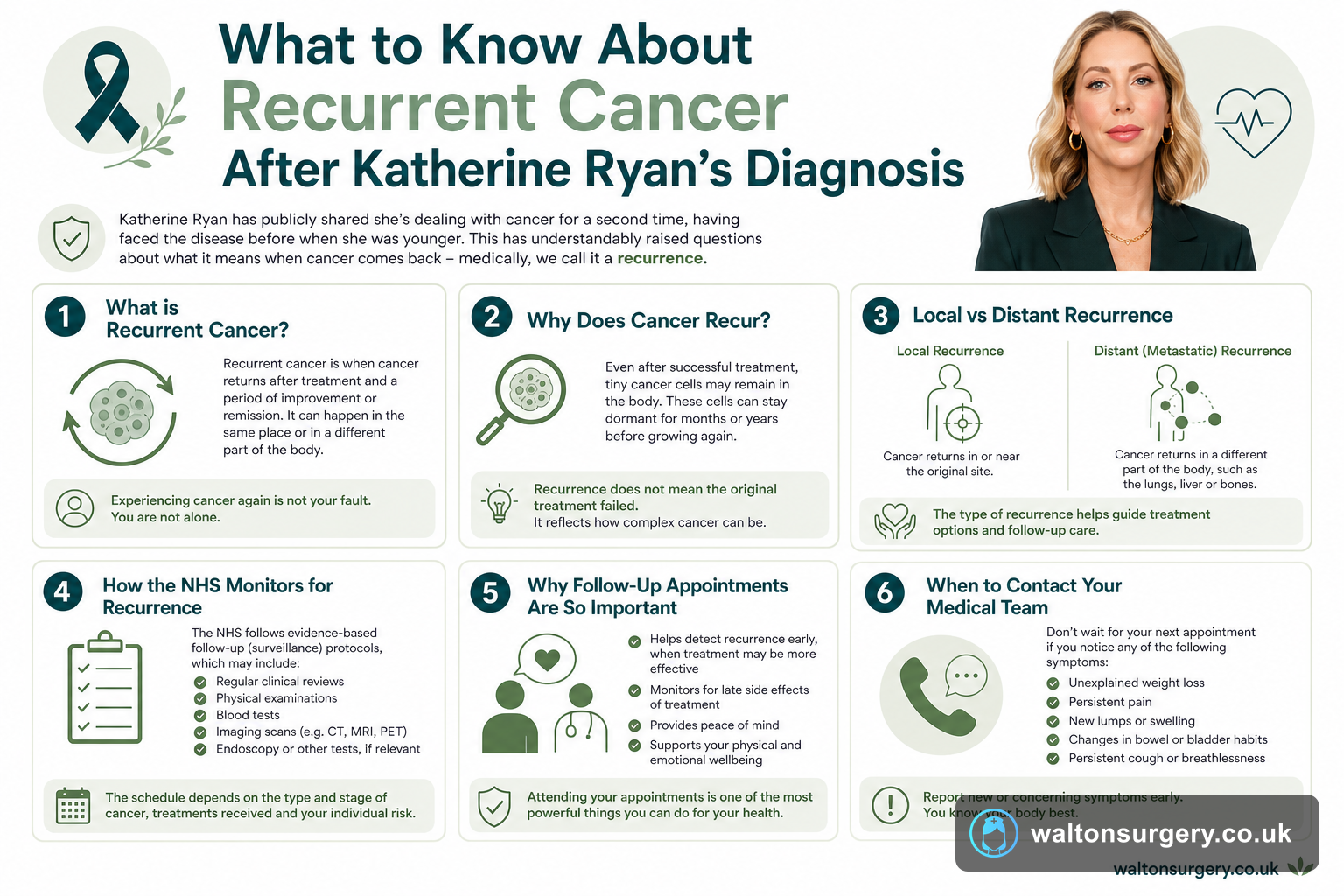
⚡ Quick Answer
Katherine Ryan has publicly shared she's dealing with cancer for a second time, having faced the disease before when she was younger. This has understandably raised questions about what it means when cancer comes back – medically, we call it a recurrence. Grasping the difference between a local and distant recurrence, knowing the standard monitoring protocols the NHS follows, and understanding why you absolutely must attend your follow-up appointments matters a great deal for anyone worried about their long-term health after a previous cancer.
On 28 September 2026, Katherine Ryan announced she had been diagnosed with cancer for a second time. That news has naturally resonated with a lot of people across the UK who live with the nagging worry that their own cancer might come back one day. For anyone who has finished treatment, hearing about recurrence can set off real anxiety about what's going to happen next.
This piece sets out the facts about cancer recurrence, drawing on what Katherine Ryan has shared and established guidance from UK health bodies, particularly the NHS. It looks at what a secondary diagnosis actually means, how monitoring works once treatment wraps up, and what practical steps you can take to manage your health and wellbeing going forward. It is not personalised medical advice – but it should help you have more informed conversations with your GP.
What Happened With Katherine Ryan?
Katherine Ryan, the comedian and television personality most people will know, revealed on 28 September 2026 that she has been diagnosed with cancer a second time. She'd dealt with cancer earlier in her life already. This recurrence means the cancer she previously had was treated successfully, it went into remission, but now it's been picked up again.
A diagnosis of cancer after a period of being cancer-free is what doctors call a recurrent cancer. It's different from a brand new, unrelated primary cancer. The specifics of Ryan's diagnosis – the type, the stage – haven't been made public, which is entirely her right. What her announcement does accomplish is bringing the topic of cancer recurrence out into the open, prompting very valid questions from others who have walked a similar path.
Understanding Recurrent Cancer: What Does It Mean?
When we say a cancer diagnosis is recurrent, we mean the cancer has been found again after a stretch of time during which it simply couldn't be detected. That gap could be months. It could be years after the initial treatment finished. Cancer Research UK points out that original cancer cells sometimes stick around in the body without being detected post-treatment. Those cells may then start to grow again later on.
One thing to grasp clearly: a recurrence is not the same as picking up a new cancer. It is the return of the same type of cancer you had before. The cancer cells are typically the same type as the original tumour. This is precisely why your medical history carries so much weight when a new finding needs assessing.
There are three main categories of recurrence, and they're classified by where the cancer shows up again:
- A local recurrence means the cancer has come back in the same part of the body where it originally started.
- A regional recurrence is when it returns in the lymph nodes or tissues near the original site.
- A distant recurrence, sometimes called metastatic cancer, is when the cancer has spread to another part of the body altogether – the bones, the liver, or the lungs, for instance.
Which type of recurrence someone might experience depends heavily on the kind of cancer they had to begin with. Your consultant or specialist nurse is the person to explain what your personal risk profile actually looks like, based on your initial diagnosis and the treatment you had.
Why Does Cancer Come Back?
Why cancer returns is one of the most difficult aspects of the whole disease, honestly. There isn't a single clean answer – it's a complex biological process. That said, there are known factors that can influence the risk.
The main reason is that some cancer cells survive the initial treatment. Surgery tries to physically remove the tumour, and chemotherapy and radiotherapy aim to kill cancer cells. But these treatments are not always 100 per cent effective at eliminating every last cancer cell from the body. Some cells might be left behind, even in quantities too tiny to show up on a scan. Doctors often refer to these as micrometastases.
If those surviving cells aren't destroyed by the body's immune system, they can later multiply and form a new tumour. The risk of this happening varies quite a bit. For certain cancers – some types of breast cancer, for example – the risk is highest in the first few years following treatment. For other types, the danger period might come later.
Your oncology team can tell you what the typical risk pattern looks like for your specific cancer type and stage. They base this on clinical trial data and large population studies. Understanding your own risk doesn't make the worry disappear, but it can help you and your GP shape your follow-up care plan appropriately.
How Does the NHS Monitor People After Treatment?
Once your cancer treatment ends, you are not simply discharged and left to get on with things. You'll enter a structured follow-up period – this is standard NHS cancer care. The whole point of this follow-up is to keep an eye on your health, watch for any signs of recurrence, and deal with any long-term side effects from your treatment.
Your hospital team, often a clinical nurse specialist or consultant, will put together your follow-up plan. It'll spell out how often you need to come in for appointments and what tests you might need. The schedule isn't the same for everybody. It depends on the type of cancer you had, the treatment you received, and how likely it is the cancer might return.
🔬 Key Facts
The Typical NHS Follow-up Schedule
- → Appointments typically start at every three months during the first year
- → Frequency usually drops to every six months for the next few years
- → Eventually, appointments may become annual check-ups
- → Each appointment includes a physical exam and a discussion about your health
Attending these appointments is absolutely essential. They are your main safeguard. And if you notice anything worrying between scheduled visits, don't sit tight until the next one comes around. Contact your GP or your hospital team. You have every right to seek advice when you feel you need it.
What Are the Signs of a Recurrence You Should Know?
Knowing what to watch for is a practical step you can actually take. The signs of recurrence vary a great deal depending on where the cancer comes back. They're often similar to the symptoms you experienced the first time around – but not always.
Listing every possible symptom is impossible, really, since they differ so much depending on cancer type. Still, there are some general changes you should report to your doctor straight away. These include:
- A new lump or swelling anywhere on your body.
- Unexplained weight loss or a loss of appetite.
- Persistent, unexplained pain that simply won't go away.
- Extreme tiredness that doesn't match your usual activity levels.
- Any bleeding that isn't normal for you.
- A persistent cough or breathlessness.
The most important thing is knowing your own body. You are the best judge of what's normal for you. If something feels off, get it checked. Don't dismiss symptoms because you worry you're "overreacting." Your GP would far rather see you and put your mind at ease than have you hold off until a problem has become more serious.
Living with the Fear of Recurrence
A cancer diagnosis shifts your relationship with your body and with the future. The stretch of time after treatment can be especially hard. While you're physically recovering, you might also be wrestling with the psychological weight of wondering whether the cancer will come back. This is a completely normal experience, and it's incredibly common.
There's actually a name for it: "fear of recurrence." It's a recognised form of anxiety that can affect anyone who has had cancer. It can be set off by things like upcoming follow-up appointments, medical news stories, or even just a random twinge somewhere in your body. The severity ranges from a mild background hum of worry to something much more intense that gets in the way of daily life.
If you're struggling with this fear, you're not alone – and support is out there. You don't have to manage it by yourself. Some steps worth taking:
- Talk to your GP. They can refer you to psychological support services, including counselling or cognitive behavioural therapy (CBT), which are often available on the NHS.
- Speak to your clinical nurse specialist. They've got a wealth of experience supporting people in exactly your situation and can offer practical advice alongside reassurance.
- Connect with others. Organisations like Macmillan Cancer Support and Cancer Research UK run support groups, online communities, and helplines where you can talk to people who truly understand what you're going through.
Managing this fear is part of your ongoing care. It's not a sign of weakness. It is a sign that you're human, and it deserves the same attention as any physical symptom.
Frequently Asked Questions
⭐ The Bottom Line
What this means for you
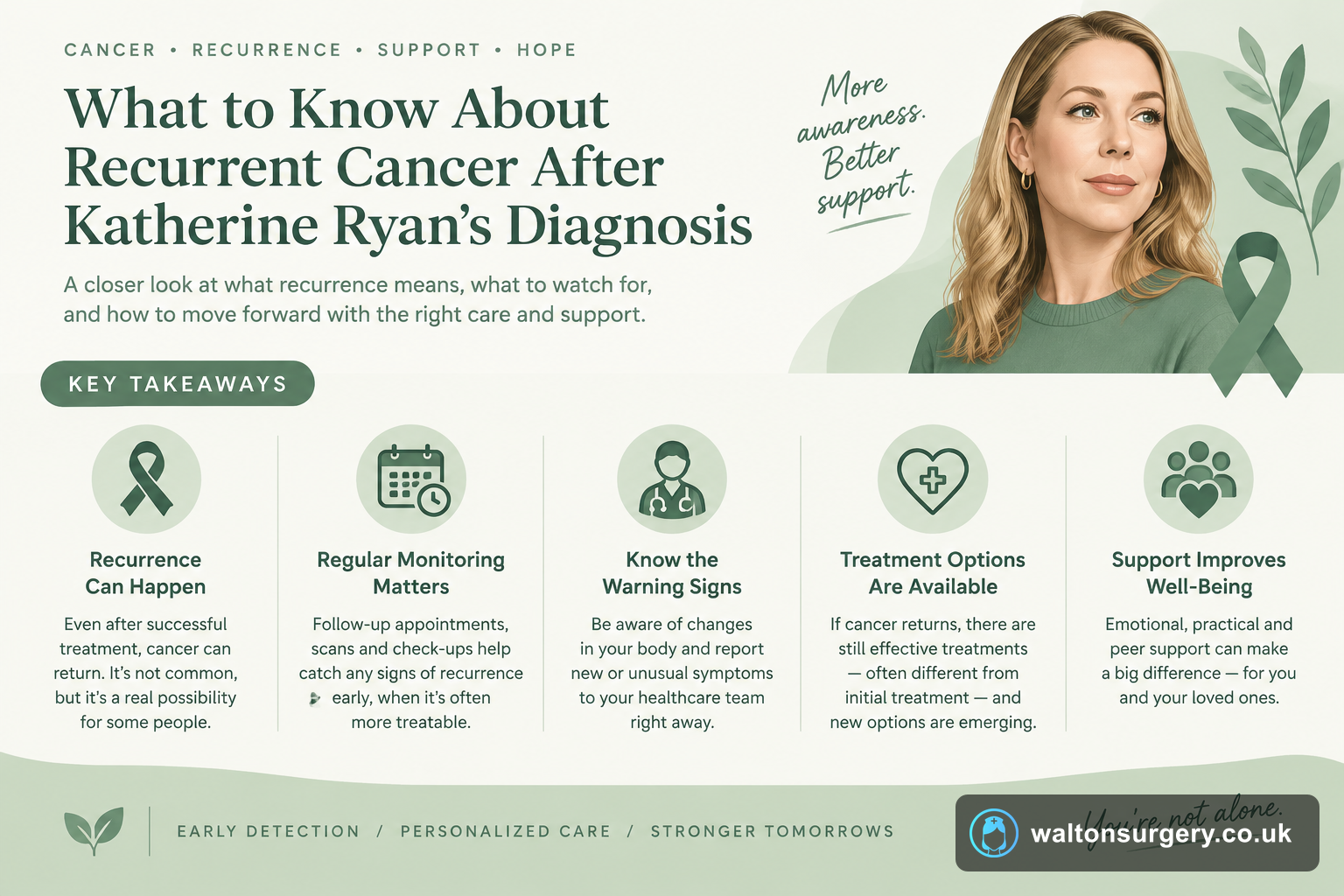
Katherine Ryan's news about her second cancer diagnosis has, understandably, pushed the subject of recurrence into the spotlight. If you have a history of cancer, it is natural to feel concerned. The most important thing you can do is stay engaged with your scheduled NHS follow-up care. Go to your appointments. Report any new or unusual symptoms to your GP promptly. And seek support for the emotional side of living with uncertainty. You are not defined by your diagnosis, but you are empowered by being informed and proactive about your health.
Last updated: 2026-09-28 · Written by the Walton Surgery editorial team · Medical information is for educational purposes only and does not replace advice from a qualified healthcare professional.