Breast Implant Illness: What You Need to Know
PART C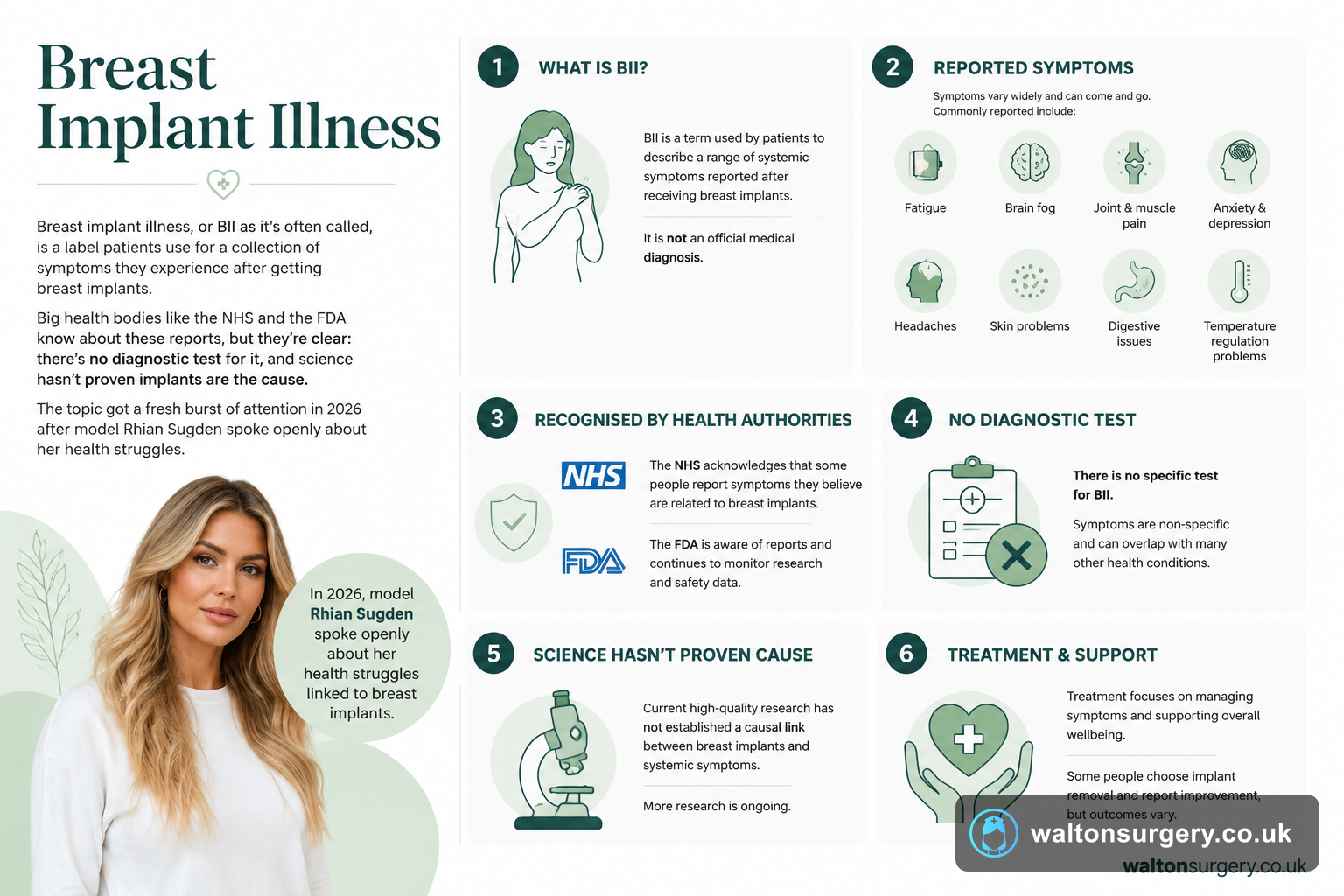
⚡ Quick Answer
Breast implant illness, or BII as it's often called, is a label patients use for a collection of symptoms they experience after getting breast implants. Big health bodies like the NHS and the FDA know about these reports, but they're clear: there's no diagnostic test for it, and science hasn't proven implants are the cause. The topic got a fresh burst of attention in 2026 after model Rhian Sugden spoke openly about her health struggles.
So what is breast implant illness? Well, it's not something you'll find in a medical textbook as a formal diagnosis. Instead, it's a term people use themselves to describe various symptoms they're convinced are linked to their implants. We're talking things like constant tiredness, aching joints, that fuzzy-headed feeling where you can't think straight, and skin problems. Health authorities on both sides of the Atlantic—the NHS here in the UK and the FDA in the US—have taken note of these patient accounts. But their official line is pretty much the same: the evidence we have so far doesn't show a clear cause-and-effect between silicone or saline implants and these illnesses.
It's been back in the news because of Rhian Sugden. In July 2026, the model was speaking about her own health experiences, which naturally brought the whole BII conversation back into the spotlight. What we're doing here is laying out the facts as they stand—what the condition is, what the doctors and regulators actually say, and what you can practically do if you're worried.
What Exactly Is Breast Implant Illness?
The first thing to grasp is that BII is a term coined by patients themselves. You won't find a doctor diagnosing "breast implant illness" in the way they'd diagnose, say, diabetes. It's a label for a broad range of symptoms that people with implants feel are connected to having those implants. And these aren't just local chest-area issues; they're systemic, meaning they seem to affect your whole body.
What symptoms are people actually reporting? The list is long and varied:
- Feeling wiped out all the time, with muscle weakness
- Pain in your joints and muscles
- Brain fog, trouble remembering things, difficulty focusing
- Your skin acting up—rashes, excessive dryness
- Losing more hair than normal
- Frequent headaches
- Struggling with anxiety or feeling low
- Not sleeping properly
- Hormones feeling out of balance
Here's the complication, though. Most of these symptoms are incredibly common. Loads of people who've never been near a breast implant deal with fatigue or joint pain. They could point to autoimmune conditions, thyroid issues, or a dozen other things. This massive overlap is what makes it so tricky for doctors to pin the blame solely on implants. Honestly, untangling the cause is a real headache.
Where Do Health Authorities Stand?
All the major health bodies are singing from roughly the same hymn sheet: they hear the patients, but they need more proof.
Take the NHS. Their guidance says that while some women do report these kinds of symptoms, "there is no clinical evidence to suggest that silicone implants cause these types of illnesses." Their advice? If you're worried, go see your GP. They'll help you look for other explanations first.
Over in the US, the FDA has been listening too. Back in 2019, they even held a big advisory committee meeting just to talk about BII. They stopped short of saying silicone gel implants cause these systemic problems, but they did stress that patients need to be fully aware of the potential issues. They also tightened up the rules for how manufacturers have to monitor their products after they're sold.
The bottom line from official sources is one of careful, cautious listening. They take the concerns seriously, but they're holding out for more solid, peer-reviewed research that can point to a specific biological reason why this might be happening. Until then, the position is one of acknowledgement without confirmed causation.
🔬 Key Facts
Understanding the Diagnostic Challenge
- → No Definitive Test: There is no blood test or scan that can diagnose BII; it is a diagnosis of exclusion after ruling out other conditions.
- → Symptom Overlap: Reported symptoms like fatigue and joint pain are extremely common and linked to many other medical issues.
- → Causation Not Proven: Major health bodies (NHS, FDA) acknowledge patient reports but state that scientific evidence has not confirmed implants as the direct cause.
- → Varied Research Results: Large population studies have not consistently shown a clear-cut difference in these symptom rates between women with and without implants.
Why Is It So Hard to Get a Clear Answer?
Figuring out whether implants are actually behind these symptoms is proving to be a tough nut to crack for a few reasons.
For a start, the symptoms themselves are vague. Fatigue and joint pain affect millions of people who've never had cosmetic surgery. That makes it really difficult to set up a fair comparison. Scientists need to see if women with implants get these problems more often than a similar group without them, and the large studies done so far haven't shown a consistent, clear-cut difference. The data is messy.
Then there's the problem of not having a specific test. With an infection, you can often find the exact germ causing it. With BII, there's no blood test or scan that can point at your implants and say, "That's the culprit." So doctors have to go through a process of elimination, checking for everything else first. It's a diagnosis of exclusion, which is frustrating for everyone involved.
And don't forget, implants and how they're put in have changed a lot over the years. That makes long-term studies on whole populations quite complex. Researchers are trying to separate all these variables, but getting definitive answers just takes a long time and very careful work.
What Are the Documented Risks of Breast Implants?
While the BII debate continues, there are other well-established risks with breast implants that the NHS and other bodies are very clear about. Any surgery has risks, and implants come with their own set of known complications. These documented risks include:
- Capsular contracture: This is the most frequent problem. Your body naturally forms scar tissue around the implant, but sometimes it tightens up too much, going hard and causing pain or making the breast look misshapen.
- Implant rupture or deflation: The shell can break. If it's silicone, the gel might leak out; if it's saline, the breast will just go flat.
- Breast Implant-Associated Anaplastic Large Cell Lymphoma (BIA-ALCL): Now, this is a rare cancer of the immune system that's been specifically linked to textured implants. It's important to note this is a different thing from BII. The risk is very low, but it's serious, and there's clear guidance from health bodies on what to look for.
- Surgical complications: Infection, bleeding, and scars that don't heal well are always possibilities with any operation.
- Rippling or wrinkling: Sometimes you can see or feel ripples under the skin.
- Not liking the result: Unhappiness with how things look can lead to more corrective surgeries.
These are the things surgeons are obliged—both ethically and by law—to go over with you in detail during the consent process before you ever go under the knife. It's a critical conversation.
Navigating Your Concerns: A Practical Guide
If you have implants and something feels off, here’s a grounded, step-by-step approach to take.
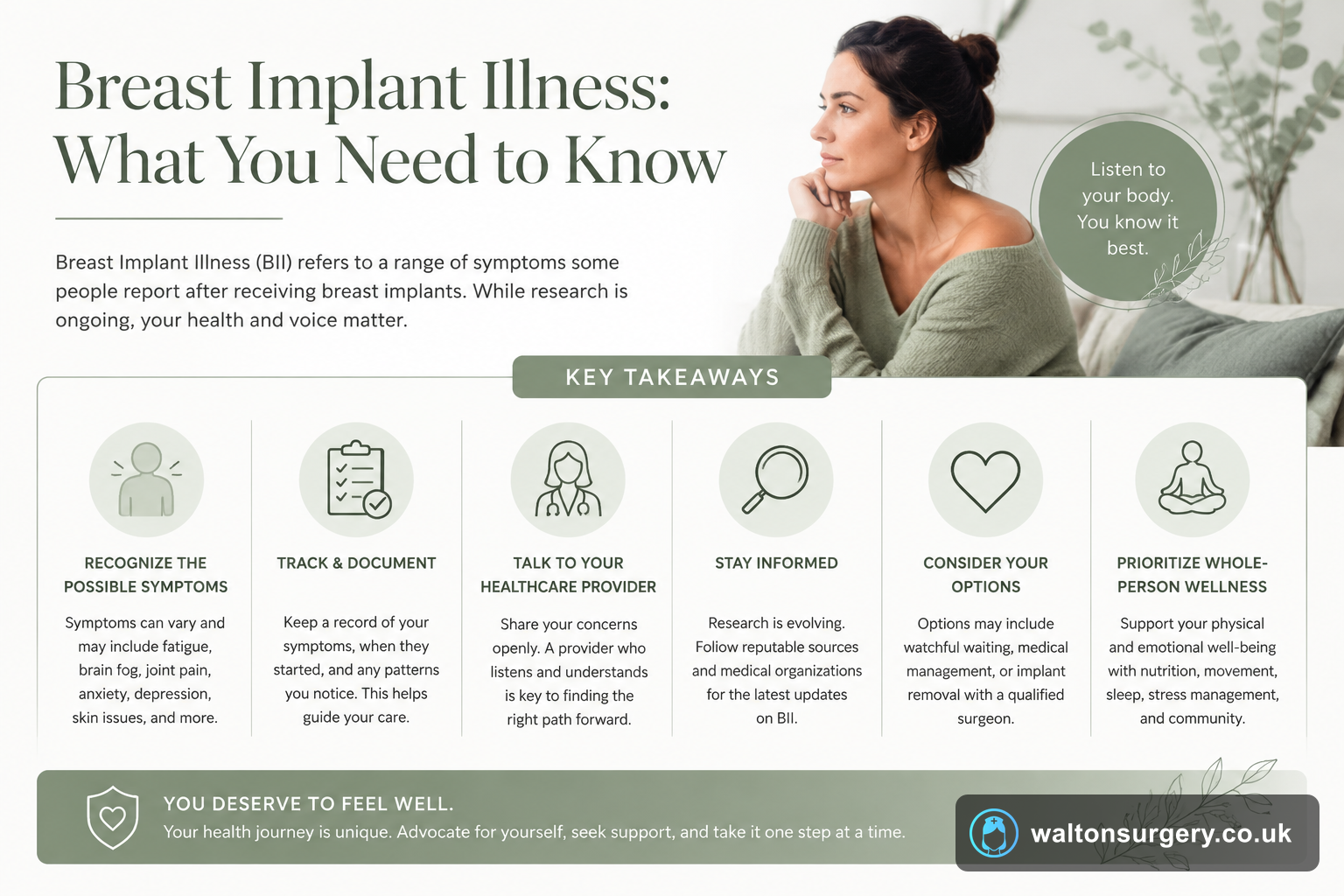
First off, see your GP. This is the most critical move. Don't try to diagnose yourself. Your doctor can do a full health check, run blood tests, and send you to specialists if needed—like a rheumatologist—to look for other treatable conditions. Things like autoimmune disorders, thyroid problems, or simple vitamin deficiencies could be the real issue.
Next, get back in touch with your original surgeon or find a specialist. They can examine you physically to look for implant-specific problems like a rupture or capsular contracture. They might suggest an ultrasound or an MRI to see if the implants are still intact. It's a practical step.
Know your implant details. Find out the manufacturer, whether they're silicone or saline, if the surface is smooth or textured, and when you had the surgery. Having this information to hand is really useful for any doctor assessing you.
Think through your options carefully. If, after all the investigations, you and your medical team think the implants could be contributing, you can talk about removal—that's called explantation. But it's a major operation with its own risks and recovery time. And here’s the honest truth: it doesn’t work for everyone. Some people feel a lot better afterwards, others notice no change, and a few even develop new issues from the surgery itself.
Don't go through it alone. Look for patient support groups. Talking to others who get it can be a huge relief and you'll pick up practical tips. Just remember, what works for one person's story isn't medical proof. Always cross-check advice with your doctor.
The Link to Celebrity News: The Rhian Sugden Example
When someone famous talks about a health issue, everyone pays attention. In July 2026, model Rhian Sugden was in the headlines, and her past openness about her own health battles with implants kept the BII topic alive in public conversation. This kind of media focus is similar to when other public figures discuss their health, such as the recent julia bradbury breast cancer update.
A celebrity sharing their story can do real good. It raises awareness and makes other people feel less isolated in what they're going through. But—and this is important—a personal experience, however compelling, isn't the same as scientific evidence. What it can do, though, is act as a push. It encourages people who've been ignoring or brushing off symptoms to finally book that doctor's appointment. If you're noticing any new symptoms, consulting a breast cancer symptoms nhs guide can be a helpful first step in understanding what to look for.
That renewed public interest matters. It gets patients and doctors talking, and it can push research organisations to put more time and money into actually understanding this condition. For broader context on health equity, it's also worth noting conversations around access to care, such as discussions about breast cancer treatment in prison uk.
Frequently Asked Questions
⭐ The Bottom Line
What this means for you
Breast implant illness is a term that captures the very real worries of many people. The big health authorities—the NHS and the FDA—acknowledge the reports, but their official stance is that science hasn't yet proven a direct causal link. If you have implants and you're feeling unwell, the most important thing you can do is see your GP. Get all possible causes investigated properly. An approach that's informed, centred on your health, and grounded in proper medical consultation—not panic—is the safest way to move forward.
Last updated: 2026-07-24 · Written by the Walton Surgery editorial team · Medical information is for educational purposes only and does not replace advice from a qualified healthcare professional.