Violence Against Paramedics: Impact on Emergency Staff Health
PART C — HTML body: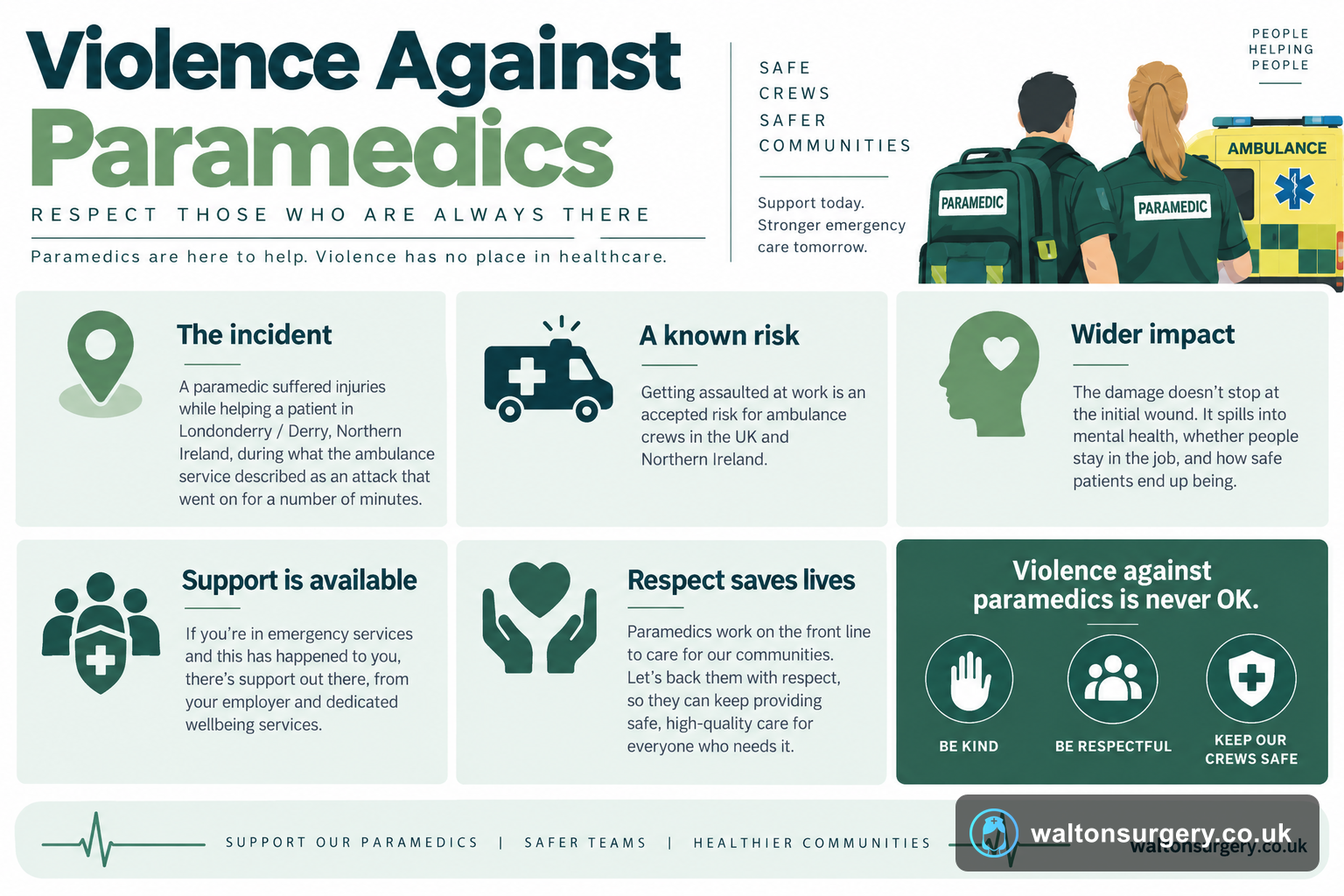
⚡ Quick Answer
A paramedic suffered injuries while helping a patient in Londonderry/Derry, Northern Ireland, during what the ambulance service described as an attack that went on for a number of minutes. Getting assaulted at work is an accepted risk for ambulance crews in the UK and Northern Ireland. The damage doesn't stop at the initial wound either. It spills into mental health, whether people stay in the job, and how safe patients end up being. If you're in emergency services and this has happened to you, there's support out there, from your employer, your GP, and groups like the NHS Staff Support Service.
When someone assaults an ambulance worker mid-treatment, it ought to do more than make the evening bulletins and disappear. In Londonderry/Derry, the paramedic hurt was simply doing the job they'd trained for, helping a person who needed care, and per the ambulance service the whole attack stretched out over a number of minutes. Stories like this keep cropping up across the UK and Northern Ireland, and each incident leaves marks that reach well past the person directly involved.
What follows is a look at what's actually known about assaults on paramedics and ambulance crews, the reasons behind them, and the toll they take on the health of the people in the uniform. This isn't personalised medical advice. If you're struggling after something happened at work, go see your GP or your occupational health team. Those are the sensible places to start.
What exactly happened in Northern Ireland?
According to the BBC, a paramedic sustained injuries while helping a patient in Londonderry/Derry. Words from the ambulance service put it that the "attack lasted a number of minutes", which points to something sustained, not a quick flare-up of frustration. BBC News' Northern Ireland and NI Health sections both carried the story, which itself shows how ordinary reporting about assaults on ambulance staff has become.
Figures beyond what the BBC reported aren't available to us here. Still, the report makes the setting plain: a paramedic got hurt while doing their job, while treating a patient. That particular scenario is what sparks most public worry about ambulance worker safety in the UK.
Why do ambulance workers get attacked?
Crews turn up when people are at rock bottom, in agony, terrified, off their heads, or in the middle of a psychiatric emergency. That's not a justification. It is, though, just how the job works. When an ambulance worker assaulted while treating patient, they are typically dealing with someone whose pain, disorientation, or loss of inhibition has crossed a line into physical aggression.
The Ambulance Service has spoken openly about the pattern the Northern Ireland incident belongs to. Kicking, spitting, biting, cuffing, and outright verbal hostility are all documented as hazards of the work across the UK. Alcohol, drugs, and mental illness come up again and again in the incident accounts ambulance trusts put out. The thing readers ought to take from this: the crew is there to help, and the person lashing out frequently isn't thinking straight.
What does an assault do to a paramedic's body?
You see the bruising first. The paramedic injured in Londonderry/Derry, as reported, was hurt while assisting a patient, and the ambulance service noted the attack carried on for a number of minutes, which is long enough to cause genuine injury and not just a knock.
Assaults on ambulance crews commonly result in soft tissue damage, sprains, broken bones, dental injuries, and head trauma. Spitting and biting bring the added worry of infection passing on, and that normally triggers post-exposure follow-up from occupational health. A slip or fall during the struggle can pile on extra problems. Anyone hurt at work this way should log it through their trust's incident system and get seen by occupational health. Persistent pain, swelling, or stiffness afterwards — that's when you go to your GP. Long-term recovery and wellbeing can also benefit from wider support networks, including cancer patient wellbeing support resources that show how structured support improves outcomes after serious illness or injury.
The hidden toll on mental health — this is the section that matters most
Cuts and bruises tend to fade first. The psychological fallout of being an ambulance worker assaulted while treating patient can hang around far longer, and it's the bit that has been hardest to push onto the public agenda.
What emergency workers describe after an assault sounds remarkably similar across accounts: not feeling safe going back to the same addresses, dreading night shifts, flinching at sudden movements, the incident replaying itself without your permission. Sleep goes to pieces for a lot of people. Confidence takes a knock too. There's a sense that the training didn't keep you safe and might not do next time either. Irritability at home, emotional flatness, pulling away from colleagues — those get reported as well. These are recognisable signs of acute stress response, and if they stick around, they can turn into post-traumatic stress disorder (PTSD), anxiety, or depression.
🔬 Key Facts
The mental health picture after an assault
- → Acute stress symptoms — intrusive replay of the incident, flinching, dreading night shifts
- → Sleep disturbance and loss of confidence reported widely after assaults
- → Untreated, these can become PTSD, anxiety or depression
- → Trauma-focused CBT and EMDR are the recommended PTSD treatments in the UK
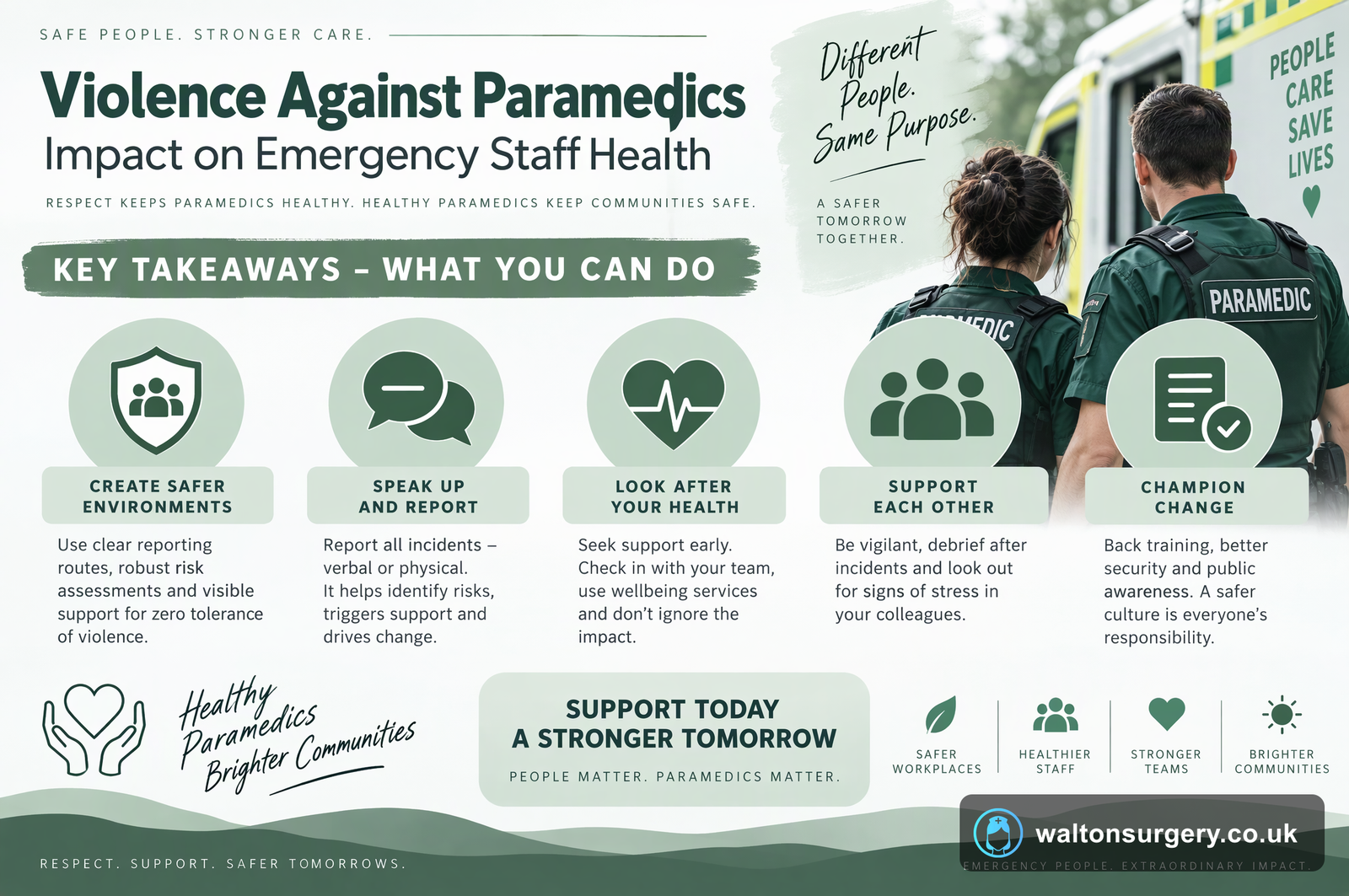
Northern Ireland's Ambulance Service, alongside its UK counterparts, offers staff support routes post-incident, often routed through occupational health, employee assistance programmes, or peer support networks. The NHS Staff Support Service operates UK-wide for health and care workers. Even so, actually asking for help remains a hurdle for plenty of people. Ambulance culture has long valued stoicism, and there's real fear among staff that owning up to a psychological injury will be read as weakness or will feed into fitness-to-practise judgements. That fear is one of the genuine prices the sector pays for the violence.
If you're an emergency worker and you're seeing yourself in any of the above, please go and speak to your GP. Acute stress symptoms respond to treatment and early help genuinely matters. Trauma-focused CBT and EMDR are the recommended PTSD treatments in the UK, usually reached through NHS Talking Therapies services or an occupational health referral. Nothing here replaces a proper clinical assessment.
How do assaults affect patient care?
An assault on an ambulance worker sends ripples out to every patient still waiting for help. Crews get stood down after an incident so they can be checked over and rest, which puts a dent in the capacity on the road. Colleagues attending the same addresses later move with extra caution, and that can slow things down. Retention suffers as well. Skilled paramedics walking away from the profession means fewer experienced hands for everybody.
Trusts across the UK and Northern Ireland spell out this loop plainly: more violence leads to more staff absence, which piles pressure onto the crews still working, which drives up stress levels further. It's not a clean causal chain. But the link between worker safety and the quality of service is widely accepted inside the NHS and among the trade unions that represent ambulance staff. It also matters that sensitive incident records are handled with care, which is where robust NHS data security and patient records standards come in for staff and patients alike.
What protections exist for ambulance staff?
In England and Wales, assaulting an emergency worker counts as a specific offence under the Assaults on Emergency Workers (Offences) Act 2018, and sentencing takes the victim's role into account. Northern Ireland runs on its own legal framework, and the BBC report on the Londonderry/Derry incident falls within that jurisdiction. Trusts also put body-worn cameras, de-escalation training, and after-incident reporting systems into play.
Is any of that enough? Fair question. The fact that a paramedic was hurt while assisting a patient, and the ambulance service said the attack ran to a number of minutes, points to a gap that's still sitting between written policy and what happens on the frontline. On the reader's side, the ask is straightforward: if you see a crew being abused, report it, and back the prosecutions that come out of it. And if you need to get registered with a practice after moving area, our guide to the nhs gp online registration uk 2026 how to register new patient walks you through the process step by step.
Frequently Asked Questions
⭐ The Bottom Line
What this means for you
A paramedic left injured while helping a patient in Londonderry/Derry, in an attack that ran for a number of minutes, is a plain reminder of how much risk ambulance work carries. Violence against emergency workers hurts staff in body and mind, wears down care for everybody waiting, and pushes experienced people out the door. If it's happened to you, talk to your GP or occupational health team. The support is there, and getting onto it early makes a real difference.
Last updated: 2026-11-10 · Written by the Walton Surgery editorial team · Medical information is for educational purposes only and does not replace advice from a qualified healthcare professional.